Rereading MSNBC’s article on the first annual International Conference on Men’s Issues, I have to marvel that so firmly has feminism taken hold that even reporters (whose watchword is objectivity) may respond with Pavlovian menace to an act of civil disobedience—which challenging feminism is.
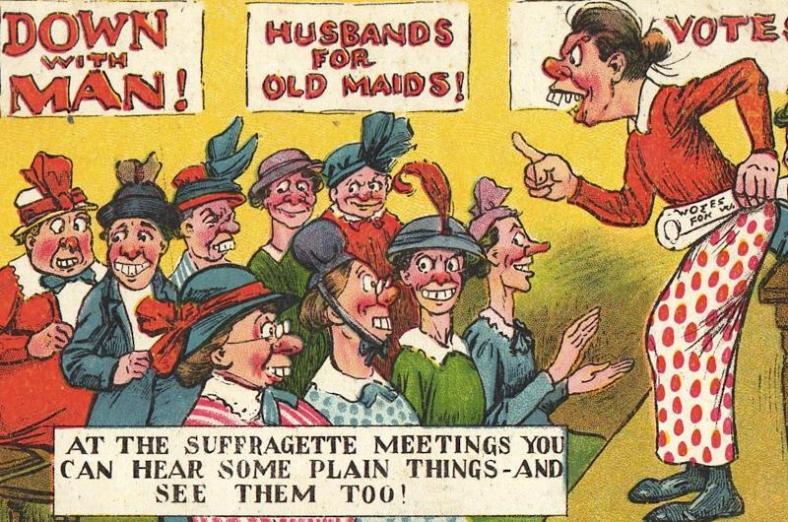
Consider that feminism originates with the 19th-century suffrage movement, that is, with some ragtag groups of women banding together to oppose second-class citizenship and demand the right to vote. Consider, too, that reactions to their early rallies to assert their rights presaged those of the MSNBC reporter who wrote about last month’s men’s conference.
His rhetorical strategies (which, like an apt pupil—or myrmidon—he lifts straight from the feminist playbook) were these:
Underrepresent the opposition. The MSNBC piece is surmounted by a photograph (snapped and cropped by the writer) showing a sparsely populated conference room. Some 16 people are visible if you count the odd pair of hands or feet poking into the frame. Though in a passing nod to journalistic accuracy the writer later reports attendees numbered “more than 100,” the first impression the reader is clearly meant to draw is “handful of nutters.”
Distort and caricature. Quotations featured in the piece were plainly culled for sensationalist impact. Commentary—for example on the phrase equity feminists, coined by a female feminist philosopher whose acumen is redoubtable—was confidently careless and pandering.
Distract. “The conference comes amid increased focus on women’s rights,” the writer observes saliently. Later he quotes a feminist post-grad as saying, “[D]ue to concerns for physical safety, we have decided the best way to oppose the conference that is now going on…is to keep our distance.” The source of fear was unspecified.
Ridicule. Pick a paragraph, any paragraph.
Attacks on the efforts of the early suffragists to have their grievances answered were…right, exactly the same.
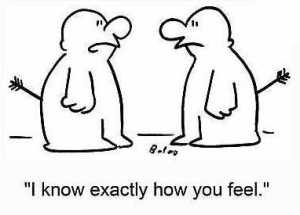
A theme that emerges upon consideration of restraining order abuse is lack of empathy—from impulsive or false accusers and from those who abet them. Plaintiffs who act either spitefully or viciously seldom appreciate the ramifications of their actions. They may possess what we call a normal conscience but either don’t think or, in the heat of the moment, don’t care.
The horror is that this same indifference extends not only to authorities and officers of the court but to feminist advocates for restraining orders and the public at large, who are persuaded that the gravity of violence against women trivializes all other considerations. Their indifference may in fact be unconsciousness, but when people’s livelihoods and lives are at stake, unconsciousness is no more pardonable.
It’s ironic that the focus of those who should be most sensitized to injustice is so narrow. Ironic, moreover, is that “emotional abuse” is frequently a component of state definitions of domestic violence. The state recognizes the harm of emotional violence done in the home but conveniently regards the same conduct as harmless when it uses the state as its instrument.
Emotional abuse is used to control, degrade, humiliate, and punish a spouse. While emotional abuse differs from physical abuse, the end result is the same….
Note the writer’s conclusion that emotional abuse is equivalent to violence in its effects.
Her orientation, of course, is toward victims of domestic violence, but her judgment is just as applicable to false allegations, whose intent is to “control, degrade, humiliate, and punish.”
Plainly the motive of most reasonable feminist arguments and appeals, at least as that motive is understood by those making them, is to induce empathic understanding. They want people to care.
Here’s yet another irony. Too often the perspectives of those who decry injustices are partisan. Feminists themselves are liable to see only one side.
“But my side’s more important” isn’t a rebuttal but a confirmation of chauvinism.
In the explication quoted above, the writer compares the conduct of emotional abusers to that of prison guards toward prisoners of war, who use psychological torment to achieve compliance from their wards. Consider that victims of false allegations may literally be imprisoned.
Consider further some of the tactics that Ms. Meyer identifies as emotionally abusive:
Isolating a spouse from friends and family.
Discourag[ing] any independent activities such as work; taking classes or activities with friends.
If the spouse does not give into the control, they are threatened, harassed, punished, and intimidated by the abuser.
Us[ing] the children to gain control by undermining the other parent’s authority or threatening to leave and take the children.
Control[ling] all the financial decisions, refus[ing] to listen to their partner’s opinion, withhold[ing] important financial information and mak[ing] their spouse live on limited resources.
Mak[ing] all major decisions such as where to live, how to furnish the home, and what type of automobile to drive.
Now consider the motives of false allegations and their certain and potential effects: isolation, termination of employment and impediment to or negation of employability, inaccessibility to children (who are used as leverage), and being forced to live on limited means (while possibly being required under threat of punishment to provide spousal and child support) and perhaps being left with no home to furnish or automobile to drive at all.
The correspondence is obvious…if you’re looking for it. Opponents of emotional abuse need to recognize it in all of its manifestations, because the expectation of empathy is only justified if it’s reciprocated.
The biggest challenge to sensitizing people to abusive restraining order policies that are readily and pervasively exploited by malicious litigants can be summed up in a single word: sex.
Women, who are often victims of abuse of court process, don’t want to implicate women in their injuries; they want to blame their false accusers, who are frequently men. Appreciate that this urge to blame men is the reason why restraining orders as processes of law exist in the first place.
Appreciate also that men aren’t the force behind the perpetuation of the status quo, and pointing fingers in their direction isn’t going to change that fact.
In the last month, I’ve sifted the Internet to discover what types of restraining order are available where and how to undo their misapplication. The most thorough source of information on restraining orders offered by the various states that I’ve found—and one I’ve repeatedly returned to—is WomensLaw.org.
It’ll tell you everything you ever wanted to know about restraining orders in your neck of the woods. Its domain name will also remind you why restraining orders exist and what they signify (there is no MensLaw.org).
After decades of rampant abuse’s being tolerated and with restraining orders’ having become a familiar institution, men have hopped onto the abuse industry bandwagon, and their malicious exploitation of restraining orders will probably continue to escalate with the passage of time.
The authorship of restraining orders, however, is by women, for women. Anyone with an interest in social justice or in reforming a handily abused process that fractures families and derails lives every day must acknowledge this fact and resist the reflex to divert blame from where it’s due.
The women who advocate for restraining orders don’t necessarily understand that they’re abused, why they’re abused, how they’re abused, or what the consequences of their abuse are. And they’re not going to take men’s word for it.
“I wasn’t thinking when I wrote my domestic abuse statement in Virginia against my boyfriend.”
“Can I get a permanent protection order against my spouse’s lover?”
“How [do you] bait someone into violating a restraining order?”
—A few recent search terms leading to this blog
I stumbled upon a video presentation the other day by a self-styled anti-feminist activist Karen Straughan, who’s blogged for a couple years under the moniker “girlwriteswhat.” I thought her talk, “Feminism: Socialism in Panties,” was evenhandedly confrontational, nervy, and smart.
Responses from feminist quarters that I hastily gleaned yesterday suggest that this activist’s denunciations have raised some hackles. I noted, though, that more than one woman respectfully remarked that she’s “articulate,” if “biased.” She’s in fact very articulate. And something I don’t think her female critics are able to appreciate is that her “bias” is a counter-bias and that she isn’t employing rhetorical strategies that are any more tendentious or inflammatory than those used by the people she draws a bead on.
For feminists to argue that turnabout is foul play is silly, and it’s interesting to observe that when dogma’s challenged using its own tactics, it pitches a fit.
The same impulsive emotional reasoning exemplified by this foot-stamping is what’s suggested by the search terms that introduce this post (to which I could have appended thousands more of a similar nature).
The large-scale injustices perpetrated by the restraining order process (on both men and women) are the product of impulsive emotional reasoning, as is the process itself. What may have started out as a sober guard dog 30 years ago has transformed into a manic dragon that arbitrarily spits fire when fingers are snapped, particularly nail-polished fingers. It doesn’t warn its targets to back down; it torches them.
There’s an ancient philosophic principle called the golden mean that advocates avoidance of extremes (“moderation in all things”). According to this principle, if something gets too far off-kilter in one direction, you have to counteract the imbalance by excessively striving in the contrary direction. If the above-referenced activist strikes some as overstating her case, they might consider that she’s endeavoring to knock things back toward equilibrium.
Reading through online comments about her, I was familiarized with the acronyms MRM and MRA, which apparently stand for “men’s rights movement” and “men’s rights activist,” respectfully. One thread about her I found was titled, “What do Feminists think about YouTube blogger ‘Girl Writes What,’ a Female MRA?”
You see from this question how far abroad feminism has strayed and why equity feminists are appalled by what they call the “feminist establishment” (a.k.a. “The Sorority”). The motive of the feminist movement that was underway when I was a kid was to dissolve distinctions and dichotomies between the sexes. Yet as conversational prompts like this one show, today’s so-called feminism promotes division: Us versus Them. Its compulsion is to split everyone into camps. The original idea was to have everybody recognized as the same, irrespective of whether they had an innie or an outie between their legs.
The thrust of today’s mainstream ideological feminism is to blame, subjugate, and punish, not unify. Feminism has betrayed itself.
It has also betrayed women. Something that’s long been a source of curiosity to me is that while the feminist establishment is often criticized as misandronist (man-hating), it’s rarely criticized as misogynist (woman-hating).
Yet inducing women to self-identify as victims can hardly be called “empowering.” If the source of power isn’t you, the power isn’t yours. What inducing women to self-identify as victims is, rather, is denigrating to feminine self-respect. The feminist establishment doesn’t encourage women to cultivate or rely on personal agency; it infantilizes them and urges them to apply for paternal protection (and the abuse and domestic dispute industries have been glad to profit by the ensuing strife).
Contemporary feminism has conditioned women to identify themselves respective to men, namely, as their victims. It’s thoroughly preoccupied with men—to the point of fixation. (The online conversational threads I’ve just looked at either concerned bitching about men or bitching about women who don’t bitch about men.)
The original feminist platform argued that women should identify themselves as independent people. Feminism, however, has become entirely male-centric. There is no feminist identification independent of men.
Prejudicial laws and court processes criticized in this blog and elsewhere are a societal response to women’s conceding that they lack personal agency. Consider that the reason why infants cry for help is because they’re incapable of meeting their own needs (incapable, literally, of standing on their own two feet). Women are much more capable than they’ve been led to believe.
Restraining orders are by and large sought impulsively—in the millions every year. Both motives and the engine that generates them are virtually automatic.
Interesting to me, finally, is that men have adapted to the new status quo (“If you can’t beat ‘em, join ‘em”). Most of the complainants of court abuses who’ve responded to this blog are women, some of whose lives have been shattered by lies and fraud. Men have hopped onto the abuse industry bandwagon, too, and the time may come that the equality that feminism is supposed to be advocating for is realized in the form of both sexes’ exploiting state protections to bash each other into a uniform goo.
“During the early 1970s, feminists began to engage in consciousness-raising efforts to educate the public about the reality of rape. Until then, rape was rarely discussed or acknowledged: ‘Until the 1970s, most Americans assumed that rape, incest, and wife-beating rarely happened.’ The idea of rape culture was one result of these efforts.”
I think I’d heard the phrase rape culture before reading this Wikipedia entry, but I’d never really contemplated its offensiveness. According to this entry, “rape culture is a concept that links rape and sexual violence to the culture of a society…in which prevalent attitudes and practices normalize, excuse, tolerate, and even condone rape.” While I can accept that, prior to the ’70s, people discounted the incidence rates of “rape, incest, and wife-beating,” I find the allegation that Americans as a social collective “excuse, tolerate, and even condone rape” or ever have to be facile and extremist.
I hear weekly if not daily from victims of second-wave feminist rhetoric and the influence it’s exercised over the past 30 years on social perceptions that translate to public policy. Today most Americans assume that the instrument born of 60s and 70s consciousness-raising efforts by equity feminists, the civil restraining order, is rarely abused. This falsehood is promulgated through the unconsciousness-raising efforts of radical feminist usurpers who’ve left proto-feminists like philosopher Christina Hoff Sommers asking, Who Stole Feminism?
Injustice, in the wake of the radical feminist movement, has merely performed an about-face.
Not un-ironically, more than one female respondent to this blog whose life has been trashed by false allegations legitimated through the medium of the restraining order has characterized her treatment by the state as “rape.”
Since it’s been projected that as many as 80% of the two to three million restraining orders issued each year by our courts, instruments that can completely dismantle their targets’ lives and are easily got by fraud, are based on frivolous or false allegations, users of the phrase rape culture—who have unquestionably contributed to the genesis of the “abuse industry”—should assess their own culpability in the manufacture of social injustice.
The Wikipedia entry I’ve cited explains rape culture includes behaviors like “victim-blaming” and “trivializing rape.” Considering that a significant proportion of restraining order abuses may be instances of victim-blaming, that is, of abusers’ (including violent abusers’) inducing the state to harass, humiliate, and drop the hammer on their victims; and considering that this abuse (characterized by some as “rape”) is arguably trivialized by its being categorically ignored or denied, a case arises for the reverse application of the phrase rape culture.
Acknowledging that restraining orders may be motivated by malice and do malice doesn’t somehow trivialize violence against women. I had occasion to talk with a victim of multiple rapes not long ago whose assailants were never held to account for their crimes. I certainly don’t discount either rape’s immediate trauma or the proximal trauma that results when its perpetrator gets off scot-free. Nor do I discount the claim by rape victims that perpetrators too often do walk even when victims are intrepid enough to report them, which may be only a small percentage of the time. Social justice, however, isn’t a zero-sum game played between men and women. Wrong is wrong, whoever its source or target. That’s what equity and equality denote. Since victims of restraining order abuse may be female, moreover, acknowledging the harms done by restraining orders does the opposite of trivializing violence against women. It’s denying that restraining orders are abused and abusive, rather, that trivializes violence against women.
It trivializes people and the value of their lives.
“Few lives, if any, have been saved, but much harm, and possibly loss of lives, has come from the issuance of restraining orders.”
—Justice Milton Raphaelson (upon his retirement)
There’s no denying that the restraining order is a forceful instrument and a nasty one to be on the receiving end of, especially when the behaviors alleged against you are trumped up. The question is, what good are restraining orders when they’re used legitimately?
Dr. Charles Corry, president of the Equal Justice Foundation, has compiled a horror-show list of examples in support of his thesis that court orders that purport to protect women only exacerbate the male rage they promise to defuse or avert.
In The Gift of Fear, Gavin de Becker cites two government investigations that support Corry’s conclusions: “In a study of 179 stalking cases sponsored by the San Diego District Attorney’s Office, about half of the victims who had sought restraining orders felt their cases were worsened by them. In a study done for the U.S. Department of Justice, researchers concluded that restraining orders were ‘ineffective in stopping physical violence.’” De Becker, whose book was published 16 years ago, offers this perspective: “Lawyers, police, TV newspeople, counselors, psychologists, and even some victims’ advocates recommend restraining orders wholesale. They are a growth industry in this country. We should, perhaps, consider putting them on the New York Stock Exchange, but we should stop telling people that a piece of paper will automatically protect them, because…it may do the opposite.”
How many women who trusted in the protection of restraining orders, I wonder, have been maimed, lamed, scarred, or killed since de Becker’s book was printed?
The restraining order’s advent arose in response to feminist outcry for legislative redress of domestic violence. It has since become a judicial quick fix for any complaint involving an allegation of harassment or even vague apprehension. Its original purpose, one for which it has never adequately served, has been obscured; and the ends to which it’s often wielded today are starkly less sympathetic.
Feminist scholars Camille Paglia, Christina Hoff Sommers, and Daphne Patai have publicly criticized the feminist influence that squelches a reasoned consideration of these issues; and conservative commentator Phyllis Schlafly has published columns openly deriding the value and validity of restraining orders and the judicial processes from which they originate.
(I was unsurprised to find a page on Wikipedia entitled, “Restraining order abuse,” that had been deleted. The explanation for its removal reads, “No indication that this article…covers a notable and/or neutral topic.” A related article, “Restraining order,” did acknowledge that abuse of restraining orders “is claimed to be widespread.” That verbiage has been redacted. When I began this blog in 2011, it included these stats, also, which have since been edited out: “A 1995 study conducted by the Massachusetts Trial Court that reviewed domestic restraining orders issued in the state found that less than half of the orders involved even an allegation of violence [note that over 15 years have gone by since then]. Similarly a West Virginia study found eight out of 10 orders were unnecessary or false.” Once you could find an eHow article explaining, “How to Avoid Becoming a Victim of Restraining Order Abuse.” Its URL now redirects to “How to Get a Harassment Restraining Order in Chicago.”)
My own contempt for restraining order laws and how they’re applied couldn’t be keener. But I’m also angry for women legitimately at risk. Not only are restraining orders prone to casual abuse—making them a mockery—they don’t answer the problem for which they were enacted.
The dominant political influence in the perpetuation of the status quo in all matters related to restraining order legislation is that exerted by dogmatic feminists (a.k.a. “gender feminists”). And money talks. Feminism’s representatives have received billions in federal funding under the Violence Against Women Act (VAWA). A cynic might propose that the interests of the cause are being protected over the welfare of the victims of restraining orders, male and female.
If vengeance for past injustices and leverage over men are feminists’ intent, then defense of current restraining order policies certainly has a lot to recommend it (just ask any attorney who practices family law). Here’s where honest self-examination of motives by feminists, specifically those of the academic stripe (a.k.a. “The Sorority”), is due.
Feminists should realize, being in the main acutely intelligent women, that sexual discrimination and role reversals—however spitefully gratifying they may be—don’t signify an advance toward gender equality but rather a resignation to its unattainability that parades as social progress. Encouraging women to crouch behind the legs of parental policies, policies both biased and in some cases dangerously or even fatally ineffectual, isn’t encouraging them to stand on their own two feet. Feminist used to mean brassy and independent.
Let’s be clear here: assault is already a crime. The answer to it is a barred cage.
Let’s be honest, too. The common function of restraining orders is tactical terrorism. They don’t empower women; they just diminish men (and feminist and judicial credibility). They’re exploited as expedients—and often for ends ulterior to the ones their petitioners profess.
Turnabout may be fair play, but it’s still just gamesmanship that we’re talking about, not equity. If feminists are sincere when they say they want to be taken seriously, their aim should be nobler than dominance of the sandbox by baseball bat.
You know something’s gone very wrong when the question becomes, who’s battering whom?
Some reject the notion that moderate feminists exist, a misapprehension that arises from labeling. I know many, though they don’t readily identify themselves as feminists. Their agenda isn’t the subjugation of men. “Equity feminists” is what philosopher and feminist scholar Christina Hoff Sommers calls them, a term she applies to women who promote (and justly expect) equal rights, representation, and recognition to distinguish them from “gender feminists,” her term for embittered female chauvinists. Ms. Sommers makes the distinction, because she believes feminism has since the eighties been coopted by influential extremists. And she’s right.
This post isn’t directed at them.
Its subject is the reform of restraining order legislation, and it’s a subject that should be of concern to the liberal feminist majority. Rampant abuse of restraining orders has now been allowed to persist for decades. The number of restraining orders issued is estimated at two to three million a year in the United States alone, and as many as 80% of these are said to be frivolous at best and at worst utterly fraudulent. Consider then the proportion of the voting constituency who have been abused and alienated by a process originally conceived by the state to appease feminist activists.
Take a second to do the math.
This number swells by two citizens a minute. One of these guys (or gals) may be a sociopathic creep. But at least one will be a normal, law-abiding Joe who will have had his faith in government permanently compromised and may feel very jaded toward any measure advocating social change on behalf of women, no matter how worthy.
Add to this the friends and family members of victims of restraining order abuse who’ve been lastingly affected, and the number may double, treble, or quadruple.
That restraining orders are routinely abused isn’t a secret. With tens of millions of them having been issued in the last 30 years, chances are you encounter people every day who’ve received one or who know someone who has. Two women I’ve corresponded with recently—one of them an anonymous critic of this blog—have brothers whose lives have been ruined by false allegations of violence made by women. And this fact was completely coincidental to the reason for their contacting me.
Moderate feminists take note: the crimped convictions of the influential minority that preserves this persecutory status quo are actively eroding the sympathy you rely on (and should be able to rely on). The solution is reform. The same activist zeal you apply to advancing worthy feminist aims must be brought to bear on ensuring that down the road there’s still going to be someone listening to you.
 A theme that emerges upon consideration of
  It’s ironic that the focus of those who should be most sensitized to injustice is so narrow. Ironic, moreover, is that “emotional abuse” is frequently a component of state definitions of domestic violence. The state recognizes the harm of emotional violence done in the home but conveniently regards the same conduct as harmless when it uses the state as its instrument.
 Here’s yet another irony. Too often the perspectives of those who decry injustices are partisan. Feminists themselves are liable to see only one side.
 Now consider the motives of false allegations and their certain and potential effects: isolation, termination of employment and impediment to or negation of employability, inaccessibility to children (who are used as leverage), and being forced to live on limited means (while possibly being required under threat of punishment to provide spousal and child support) and perhaps being left with no home to furnish or automobile to drive at all.
 The biggest challenge to sensitizing people to abusive restraining order policies that are readily and pervasively exploited by malicious litigants can be summed up in a single word: sex.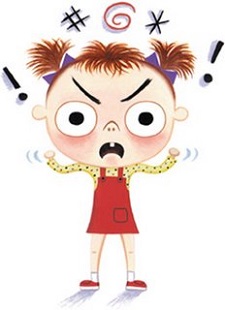
 The same impulsive emotional reasoning exemplified by this foot-stamping is what’s suggested by the search terms that introduce this post (to which I could have appended thousands more of a similar nature).
 The thrust of today’s mainstream ideological feminism is to blame, subjugate, and punish, not unify. Feminism has betrayed itself.
 Restraining orders are by and large sought impulsively—in the millions every year. Both motives and the engine that generates them are virtually automatic.
 I hear weekly if not daily from victims of second-wave feminist rhetoric and the influence it’s exercised over the past 30 years on social perceptions that translate to public policy. Today most Americans assume that the instrument born of 60s and 70s consciousness-raising efforts by equity feminists, the civil restraining order, is rarely abused. This falsehood is promulgated through the unconsciousness-raising efforts of radical feminist usurpers who’ve left proto-feminists like philosopher Christina Hoff Sommers asking,
  The Wikipedia entry I’ve cited explains rape culture includes behaviors like “victim-blaming” and “trivializing rape.” Considering that a significant proportion of restraining order abuses may be instances of victim-blaming, that is, of abusers’ (including violent abusers’) inducing the state to harass, humiliate, and drop the hammer on their victims; and considering that this abuse (characterized by some as “rape”) is arguably trivialized by its being categorically ignored or denied, a case arises for the reverse application of the phrase rape culture.
 Dr. Charles Corry, president of the
  TALKING BACK to restraining orders