The subject of this excursion is “domestic violence,” which phrase is placed in quotation marks because it’s a suspect term that’s become so broadly inclusive as to mean virtually anything a user wants it to.
This is how domestic violence is defined by the American Psychiatric Association—and by many states’ statutes, as well:
Domestic violence is control by one partner over another in a dating, marital, or live-in relationship. The means of control include physical, sexual, emotional, and economic abuse, threats, and isolation.
Emphatically noteworthy at the outset of this discussion is that false allegations of domestic violence have the same motive identified by the APA that domestic violence has: “control”; have the same consequences: “psychological and economic entrapment [and] physical isolation”; use the same methods to abuse: “fear of social judgment, threats, and intimidation”; have the same mental health effects on victims: “depression, anxiety, panic attacks, substance abuse, and post-traumatic stress disorder”; and can also “trigger suicide attempts [and] homelessness.”
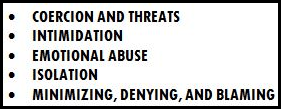
A domestic violence factsheet published by the National Coalition Against Domestic Violence features a “Power and Control” pie chart. These segments of it are ALSO among the motives and effects of false allegations.
Accordingly, then, making false allegations of domestic violence is domestic violence.
When I was a kid, domestic violence meant something very distinct. It meant serial violence, specifically the habitual bullying or wanton battery by a man of his wife. The phrase represented a chronic behavior, one that gave rise to terms like battered-wife syndrome and to domestic violence and restraining order statutes.
These days, however, domestic violence, which is the predominant grounds for the issuance of civil protection orders, can be a single act, an act whose qualification as “violence” may be highly dubious, and an act not only of a man but of a woman (that can be alleged on a restraining order application merely by ticking a box).
As journalist Cathy Young observed more than 15 years ago, the War on Domestic Violence, which was “[b]orn partly in response to an earlier tendency to treat wife-beating as nothing more than a marital sport,” has caused the suspension of rational standards of discernment and introduced martial law into our courtrooms. “[T]his campaign treats all relationship conflict as a crime. The zero-tolerance mentality of current domestic violence policy means that no offense is too trivial, not only for arrest but for prosecution.” Reduced standards of judicial discrimination inspired by this absolutist mentality further mean that even falsely alleged minor offenses are both credited and treated as urgent and damnable.
Consider this recent account posted to the e-petition Stop False Allegations of Domestic Violence:
My boyfriend accused me of DV after an argument about separating and my 18-month-old…. The officer arrested me in front of my daughter, and when I asked why, he said he had a scratch on his arm.
A scratch.
The woman goes on to report that she spent two days in jail, had to post a $5,000 bond to get out, and that she was subsequently “displaced” from her former life.
Here’s another:
My ex-husband told the police that I pushed him, even though a witness had called the police on him for pushing me. He was completely drunk…but I got arrested instead. Right in front of my stunned family.
And another:
I was accused of domestic violence because I pinched my ex-husband when he pinned me and my son between two trucks. He ruined my life.
 A scratch, a push, a pinch—which may not even have been real but whose allegation had real enough consequences.
I’ve also heard from and written about a man who caught his wife texting her lover and tried to take her phone. The two rowed for an hour, wrestling for it. The upshot was that the man was arrested and tried for domestic violence and ended up having to forfeit the home they shared to his wife, into which she had already moved her boyfriend.
(This week, I was contacted by a man trying to vacate an old restraining order whose story is identical: “[T]he only incident was in 2008 when I caught her cheating and tried to grab her phone.”)
False allegations to shift blame for misconduct are common, as are stories like these—stories of lives turned upside down by acts of “violence” that are daily tolerated by little kids—and they’re the motive of my politically incorrect two cents.
I read a feminist bulletin about domestic violence not long ago that featured for its graphic a woman who had very conspicuously been punched in the eye. Her injury was certainly more serious than a scratch or a pinch, but it, too, may have represented a single occurrence and was an injury that would heal within a month or two at the outside.
The gravity with which a single act of assault like this is regarded by the justice system can’t be overstated. The perpetrator is liable to have the book thrown at him.
By contrast, false allegations of domestic violence—or any number of other disreputable offenses—aren’t regarded by the courts or the public with any gravity at all, and their injuries don’t go away.
I work outside with my hands most days—which I wouldn’t be doing if I hadn’t had my own aspirations curtailed by the courts years ago (not based on allegations of domestic violence but on ones sufficiently crippling). I bang, stab, and gash myself routinely. From stress, besides, I’m prone to the occasional ruptured capillary in one of my eyes. I wouldn’t tolerate someone’s hurting a woman—or anyone else—in my presence, but at the same time, if I were offered the chance to recover my name, my peace of mind, and the years I’ve lost by taking a punch in the eye, I’d take the punch. In fact, I’d take many more than one.
I think other targets of false allegations who’ve had their lives wrung dry by them would say the same.
In my 20s, I was run down in the road when I left my vehicle to go to the help of a maimed animal. A 35-year-old guy, driving on a lit street under a full moon, smashed into me hard enough to lift me out of my shoes. The consequences of my injuries are ones I still live with, but a few surgeries and a year later, I was walking without a noticeable limp. I haven’t given the driver another thought since and couldn’t tell you his last name today. I think it started with an M.
Not only do I dispute the idea that physical injuries are worse than injuries done by fraudulent abuse of legal process; I don’t believe most physical injuries even compare.
And I think victims of domestic terrorism, whose torments are ridiculed by false accusers, would acknowledge that the lasting damage of that terrorism is psychic, which further corroborates my point.
Such violation promotes insecurity, distrust, and a state of constant anxiety—exactly as false allegations to authorities and the courts do, which may besides strip from a victim everything s/he has, everything s/he is, and possibly everything that s/he hoped to have and be.
There are no support groups for victims like this—nor shelters, nor relief, nor sympathy. Victims of lies aren’t even recognized as victims.
 I’ve written recently about the abuse of restraining orders by fraudulent litigants to punish. What needs observation is that the laws themselves, that is, restraining order and domestic violence statutes, are corrupted by the same motive: to punish. Their motive is not simply to protect (a fact that’s borne out by the prosecution of alleged pinchers).
Reforms meant to apply perspective to these statutes and reduce miscarriages of justice from their exploitation have been proposed; they’ve just been vehemently resisted by the feminist establishment.
Laws that were conceived decades ago to redress a serious societal problem have not only been let out at the seams but are easily contorted into tools of domestic violence. This hasn’t been accomplished by fraudulent manipulators of legal process, who merely take advantage of a readily available weapon; it’s rather the product of a dogmatic will to punish exerted by advocates who wouldn’t concede that even real scratches, pushes, or pinches are hardly just grounds for having people forcibly detained, tried, and exiled.
Copyright © 2014 RestrainingOrderAbuse.com
 A theme that emerges upon consideration of restraining order abuse is lack of empathy—from impulsive or false accusers and from those who abet them. Plaintiffs who act either spitefully or viciously seldom appreciate the ramifications of their actions. They may possess what we call a normal conscience but either don’t think or, in the heat of the moment, don’t care.
 It’s ironic that the focus of those who should be most sensitized to injustice is so narrow. Ironic, moreover, is that “emotional abuse” is frequently a component of state definitions of domestic violence. The state recognizes the harm of emotional violence done in the home but conveniently regards the same conduct as harmless when it uses the state as its instrument.
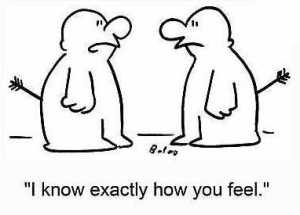 Here’s yet another irony. Too often the perspectives of those who decry injustices are partisan. Feminists themselves are liable to see only one side.
 Now consider the motives of false allegations and their certain and potential effects: isolation, termination of employment and impediment to or negation of employability, inaccessibility to children (who are used as leverage), and being forced to live on limited means (while possibly being required under threat of punishment to provide spousal and child support) and perhaps being left with no home to furnish or automobile to drive at all.
 TALKING BACK to restraining orders