“Testilying is a portmanteau of testify and lying. Defendants who embellish their own testimony, particularly when no evidence contradicts them, can…be said to be testilying.”
I’ve highlighted this coinage because it’s a clever and colorful one. What it’s drawn my attention to is that while Wikipedia, the universal go-to source for information or corroboration, has entries on “Perjury,” “Abuse of process,” “Malicious prosecution,” “False accusation,” “False allegation of child sexual abuse,” “False accusation of rape,” “False evidence,” “Scapegoating,” “Miscarriage of justice,” “Legal abuse,” and “Restraining order,” an entry on restraining order abuse or false allegations on restraining orders is conspicuously absent.
And bump-bump-bum there used to be one.
I’ve resisted joining the conspiracy crowd, because I haven’t frankly detected any intelligence in the administration of restraining orders that would suggest the existence of some sinister, overarching plot. Glad-handing, cronyism, money motives, power mania, and rote automation, yes. Evil ingenuity, no (except in the trenches).
When you perceive a conspicuous absence like this, though, you have to wonder just how nonpartisan and free-ranging Wikipedia really is.
The page that used to be up was discounted as lacking a meritorious basis and not representing a topic of broad social interest (“No indication that this article…covers a notable and/or neutral topic”). It was brief, to be sure, but certainly could have been developed, and my understanding of how Wikipedia works is that pages are fleshed out and refined by the cooperative efforts of various contributors. Since e-How recognizes that restraining order allegations are falsified and offers tutorials on how to combat false restraining orders, move for their vacation and expungement, etc., Wikipedia’s recusancy is curious.
Certainly there are any number of Wikipedia pages devoted to topics of interest to a highly select few. I’m sure I could learn all about the author of some obscure cookbook if I wished. Or a B-movie actress, manga villain, or obsolete gadget.
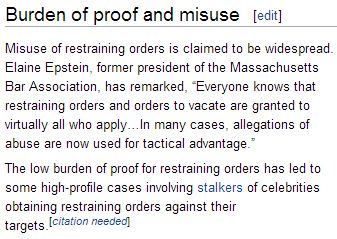
 No topic defies neutral qualification, and since Wikipedia’s own “Restraining order” page recognizes that restraining orders are widely claimed to be misused, and since restraining orders are furthermore issued against millions of people every year across the globe, restraining order abuse can hardly be dismissed as a trivial topic or one unworthy of attention and elucidation. That’s its being disregarded owes to avoidance of a sensitive subject is a more credible explanation.
If Wikipedia has a page on cannibalism—and I’m sure it does—a page devoted to restraining order abuse is palpably overdue.
Copyright © 2014 RestrainingOrderAbuse.com
 TALKING BACK to restraining orders