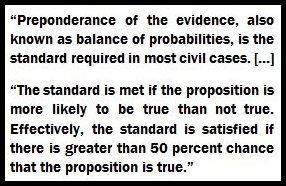
“Preponderance of the evidence, also known as balance of probabilities, is the standard required in most civil cases. […]
“The standard is met if the proposition is more likely to be true than not true. Effectively, the standard is satisfied if there is greater than 50 percent chance that the proposition is true.”
—Wikipedia, “Legal burden of proof”
As the previous two posts have discussed, “preponderance of the evidence” is the standard according to which restraining order allegations are “tried.”
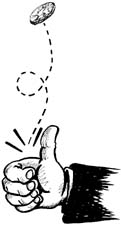
 Note that the odds of its being accurate, assuming all conditions are equal, may be only slightly better than a coin flip’s.
Accusations on restraining orders that are adjudicated by this standard may include any of the following (along with any other allegation conceivable): simple or aggravated assault, simple or aggravated battery, stalking, cyberstalking, sexual abuse, false/unlawful/forced imprisonment, peeping, criminal coercion, reckless endangerment, child abuse/molestation, “menacing,” “terroristic threatening,” theft, arson, criminal mischief, extortion, burglary, criminal trespass, sexual harassment, incest, offensive touching/“lewd fondling,” kidnapping/abduction, malicious property damage, injury or killing of animals/pets, larceny, rape or statutory rape, or other felonies, including (in New Jersey and Alaska) homicide.
See for yourself: “Standards of Proof for Domestic Violence Civil Protection Orders (CPOs) by State.” And appreciate that accusations like these need not be made against domestic partners or other members of a shared household. They can be made against friends, lovers, work associates, neighbors, exes, exes’ new spouses or boy- or girlfriends, rivals of any other sort, nondomestic family members, former family members, strangers—you name it.
Accusations on restraining orders may alternatively amount to no more than “annoyance.” The same standard is applied to the allegation of rape as is applied to allegations of nuisance, and irrespective of a plaintiff’s actual claims, the implications of a restraining order, which is a publicly accessible record and one preserved in the databases of state and federal police, are threat, stalking, and/or violence.
 Restraining orders are understood to be issued to “sickos.” Nobody hears “restraining order” and thinks “Little Rascal.”
Consider that the initial determination of the truth or falsity of a restraining order plaintiff’s allegations is grounded on a brief interview between the plaintiff and a judge. Consider further that the judge will likely have never met the plaintiff before; that the judge may therefore have no basis whatever for forming an opinion of the plaintiff’s honesty, soberness, or sanity; and that the defendant upon whom judgment is rendered is just a name on a form.
If the “legal burden of proof” defined in the epigraph didn’t already sound sketchy enough, observe that unless a defendant has a prior record of misconduct, no empirical grounds exist even for a judge to decide that there’s a 51% probability that the plaintiff’s telling the truth—other than, perhaps, whatever physical corroboration the plaintiff may provide, which may be none, may be forged, or may be misrepresented.
Restraining order allegations are essentially established (and essential establishment is all that’s required) on the forcefulness of a plaintiff’s claims. The truth or falsity of individual allegations is literally irrelevant (except, of course, to the defendant who has to live with them for the rest or his or her life). A judge isn’t a fact-finder in these cases; s/he’s a bookmaker.
It’s all about the probability that a plaintiff’s claims are more true than false, and the fixer of the odds is a single judge—or at most two.
In other words, the standard “preponderance of the evidence” is hokum. It’s basically an authorization for a judge to act according to his or her discretion, which is a lofty way of saying that it authorizes a judge to decide however s/he wants. Allegations, including of felony crimes, don’t have to be true, just “truthy.”
If, prior to forming a decision on a restraining order petition, a judge were required to at least meet the defendant; and if it weren’t the case that the judge had likely had it impressed upon him or her that s/he should prejudicially regard the plaintiff’s allegations as true; and if it weren’t the case that societally conditioned expectations urged the same prejudice…then there might be a reasonable hope that a judge could perform the computation required by “preponderance of the evidence” with some degree of accuracy, allowing that a “degree of accuracy” should be acceptably conclusive.
As the procedure exists today, there can be no such reasonable hope.
Copyright © 2014 RestrainingOrderAbuse.com

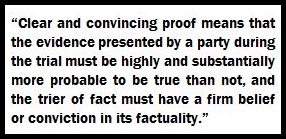


 A scratch, a push, a pinch—which may not even have been real but whose allegation had real enough consequences.
 I’ve written recently about the abuse of restraining orders by fraudulent litigants to punish. What needs observation is that the laws themselves, that is, restraining order and domestic violence statutes, are corrupted by the same motive: to punish. Their motive is not simply to protect (a fact that’s borne out by the prosecution of alleged pinchers).
 Noteworthy finally is Ms. Malloy’s acknowledgment that false allegations of violence, which are devastating in the emotional oppression, humiliation, and social and professional havoc they wreak on the falsely accused, are used strategically to gain leverage in divorce proceedings.
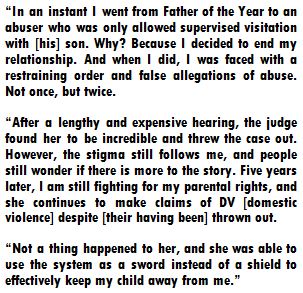
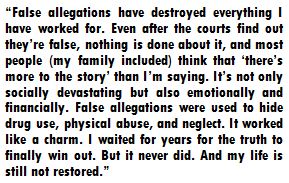
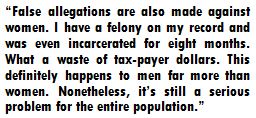
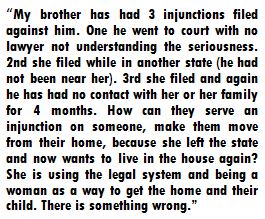
 Rape and domestic violence happen. There’s no question about it. There’s likewise no question that their effects may be damaging beyond either qualification or quantification.
 A significant number, if not the majority, of respondents to this blog who report being the victims of false allegations on restraining orders—particularly the ones who detail their stories at length—are women. This doesn’t mean that women, who represent less than 20% of restraining order defendants, are more commonly the victims of false allegations. It’s indicative, rather, of women’s disposition to socially connect and express their pain, indignity, and outrage. (Women, furthermore, aren’t perceived as dangerous and deviant, so they feel less insecure about publicly declaiming their innocence; they have the greater expectation of being believed and receiving sympathy.)
 The idea that even one perpetrator of violence should escape justice is horrible, but the idea that anyone who’s alleged to have committed a violent offense or act of deviancy should be assumed guilty is far worse.
 “If we did prosecute perjurers, there’d be no resources left for putting dangerous people behind bars…so we’ll prosecute the people perjurers falsely accuse of being dangerous”—as analysis of most of the arguments made in defense of domestic violence and restraining order policies reveals, the reasoning is circular and smells foul. It’s in fact unreasoned “reasoning” that’s really just something to say to distract attention from unflattering truths that don’t win elections, federal grants, popular esteem, or political favor. So entrenched are these policies and so megalithic (and lucrative) that rhetoric like this actually passes for satisfactory when it’s used by someone in a crisp suit with a crisper title.
 Consider whether you don’t think this kind of scenario is more likely to exert a detrimental influence on a child’s development (and whether Jesus wouldn’t have thought so):
 Restraining orders are unparalleled tools for discrediting, intimidating, and silencing those they’ve been petitioned against. It’s presumed that those people (their defendants) are menaces of one sort or another. Why else would they be accused?
 Memorable stories of restraining orders’ being used to conceal (or indulge) indiscretions or infidelities that have been shared with me since I began this blog over two years ago include a woman’s being accused of domestic violence by a former boyfriend she briefly renewed a (Platonic) friendship with who had a viciously jealous wife who put him up to it; a man’s being charged with domestic violence after catching his wife texting her lover and wrestling with her for possession of the phone for an hour (he was forced to abandon his house so his rival could move in); and a young , female attorney’s being seduced by an older, married colleague who never told her he was married and subsequently petitioned an emergency restraining order against her, both to shut her up and to minimize her opportunity to prepare a defense. I’ve even been apprised of people’s (women’s) having restraining orders petitioned against them by spouses (women) who resented being informed of their mates’ sleeping around.
 What this blog and

 I was recently emailed by a 50-year-old woman who desperately wants to see her mother before her mother dies. This woman, whom I’ll call Natasha, has been restrained by court injunction from entering, calling, or nearing her childhood home.
 TALKING BACK to restraining orders