Reporting Restraining Order Abuse to Elected Officials

“I am suffering from the effects of a fraudulent protection order in Colorado, which was filed by my female roommate and had me and my young daughter kicked out of our home.

“There appears to be no recourse for me, but I did contact 10 state representatives and senators, and I heard back from three of them. If more people report this abuse to their elected officials, maybe something will actually be done about this awful system.”

—Respondent to this blog

Writing to district and state representatives can be a lot like trying to communicate with judges. Expecting a human response isn’t unreasonable, but it’s often disappointed.

There’s nevertheless value in bringing systemic injustices to the attention of legislators (senators and congressmen and -women), because (1) they make, reform, and repeal laws, and (2) if they hear the same complaints over and over—and especially if they know other people of influence are hearing the same complaints and looking to them for action—there’s a chance some of them might step up.

The voices of women who’ve been abused by court process, particularly, need to be heard, because the procedures that are most often and easily abused are ones it’s presumed are protecting them.

Consult this site for the names and addresses/websites of elected officials with whom to register a complaint (state legislators should be first in order of importance):

Find Your Representatives

See also these tutorials:

Writing to Your Legislator

“How to Write a Letter to Your United States Senator

How to Write Letters to Congress

A petition that automatically forwards stories of abuses of domestic violence laws and restraining orders to legislators/administrators is here.

Copyright © 2014 RestrainingOrderAbuse.com

*See also: What to Do if You’ve Been Abused by a Judge

Restraining Orders Based on Fraud Falsely Imprison Defendants Whether They’re Incarcerated or Not

“Forensic psychiatrists and other mental health professionals must remember that although allegations are often genuine, there is an almost equal number of cases…in which they are not. Complete and objective assessment is always required, and especially so when accusations emerge in contexts such as the following:

  • Certain kinds of mental illness and character traits (particularly in allegations against clinicians). One should note poor doctor-patient relationships, whether real or perceived, patients with psychotic or delusional symptoms, certain hysterical and factitious disorders, some fragmenting or dissociative disorders, and those with substantial borderline, inadequate, and/or passive personality traits
  • Divorce proceedings
  • Child custody proceedings
  • Situations with the potential for substantial financial reward
  • Situations in which the accuser has an emotional or characterological reason to avoid discovery, prosecution, or confrontation with legal (or parental) authority (e.g., those with antisocial personality traits, some substance abusers)
  • A history of repeated past allegations, particularly if they have not been fully investigated
  • Unusual timing of the accusation or alleged event (e.g., alleged ‘date rape’ within an otherwise close and stable relationship, or accusations made only when some sort of secondary purpose or reward is evident).”

—“False Allegations: The Role of the Forensic Psychiatrist

The previous post called attention to an excerpt from a story featured in The Times of Malta this month that concluded that incidences of false allegations weren’t “one-offs,” meaning they’re not singular occurrences but more common than the public imagines.

The lawyers quoted by reporter, what’s more, refer to criminal cases in which sexual abuse is alleged and, consequently, in which the accused are afforded attorney representation.

By contrast, civil restraining order hearings are mere minutes long, defendants aren’t afforded counsel, and fraud is typically ignored by the court even if it’s perceived. There is, therefore, no accurately determining the pervasiveness or degree of lying in such adjudications.

Many authoritative sources conclude it’s rampant, and anecdotal reports concur.

The application process for restraining orders is typically free, it’s concluded in an afternoon if not within minutes, and there are no consequences for lying. Why, then, shouldn’t the process be broadly and routinely abused?

To believe that such a process wouldn’t be abused would depend on an unshakably naïve conviction in the inherent goodness of people, and such a belief would determine the process unnecessary. Anyone who believes people are capable of beastly behavior and that restraining orders are necessary—take, for example, feminists—must believe people are capable of lying hurtfully to get them.

Exposing the flaws in the belief that anyone who points a finger must necessarily be telling the truth doesn’t take a professor of philosophy.

Consider, then, that allegations made in civil court may be identical to those introduced against defendants in criminal court—and can include rape, child molestation, or even murder. The only difference between civil and criminal rulings is legal consequence.

This is the source of the cognitive disconnect exemplified by judges and, largely, everyone else. Because civil restraining orders only threaten incarceration rather than mandate it, they’re considered “no biggie.”

The conceit is that though falsely accused restraining order defendants may be denied access to their homes, money, property, and children—besides facing other privations—they aren’t denied their freedom; it’s only curtailed somewhat (“Here are your shoes—you’re free to leave”).
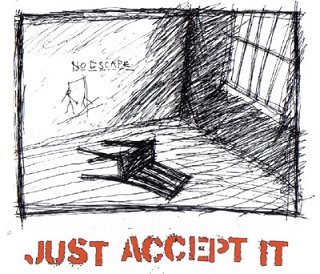
Faith in the conceit that restraining orders are minor impingements on defendants’ lives depends on accepting that being falsely, publically, and permanently labeled a stalker or batterer, for example, shouldn’t interfere with a person’s comfort, equanimity, or ability to realize his or her dreams. Such faith is founded, in other words, on the fantastical belief that wrongful vilification won’t exercise a detrimental influence on a person’s mental state, won’t affect his or her familial and social relationships, won’t negatively impact his or her employment and employability, etc.

Clearly such faith is beyond unreasonable; it’s inane. Being forced to live with false allegations can be crippling—for painfully obvious reasons. Whether a person is forced to agonize in a cell or is permitted to agonize in his or her place of choice is of scant significance to the psycho-emotional well-being of the sufferer. Prison isn’t just an environment, and arresting someone doesn’t require handcuffs.

Copyright © 2014 RestrainingOrderAbuse.com
Eight Years of Hell: On the Toll of False Allegations of Abuse

“Bitter separation battles and unrequited love are among the reasons why people falsely accuse others of sexual abuse, according to legal professionals.

“Lawyers contacted by The Sunday Times of Malta came across several examples of cases when people, often women, made false claims that they or their children had been abused.

“Lawyer Roberto Montalto gave the example of one situation where a woman claimed her children were abused by her husband’s colleague.

“The case dragged on for eight years and the man was acquitted after the court found that the woman lied….”

—“False Abuse Accusations Not One-Offs, Say Lawyers

To read the rest of this story, published just a couple of weeks ago, you have to subscribe to The Times of Malta. I can guess the remainder’s content, as I know many men and women who’ve visited this site can.

This excerpt is highlighted, because even today most people are under the impression that instances of false allegations’ being made repeatedly in protracted legal assaults are rare and isolated occurrences.

As attorneys and others attest, they’re not. Only hearing about them is.

Among the reasons why restraining orders are criticized on this site and elsewhere is that they’re superlative and intoxicating gateway fixes for spiteful accusers bent on gratifying malicious impulses. They can be obtained in a few hours—even a few minutes—based on allegations that require no substantiation and that are subjected to a minimum of scrutiny, if any at all.

They’re easily exploited to establish claims that can then be parlayed into interminable attacks.

False criminal allegations suggestive of sexual or violent deviancy—e.g., stalking, sexual harassment or molestation, and domestic abuse—can be just as effective and for the same reasons. The hysteria promoted by the abuse industry and the political influence it has bent to its “cause” have conditioned police, municipal prosecutors, and judges to credit allegations of abuse automatically (especially ones from women).

Eight years—that’s the term in hell the man in the epigraph had to endure before it was apparently demonstrated that the whole ordeal was based on lies: eight years lost for nothing. Nothing. More horrible yet is that the only thing that makes this story exceptional is that the fraudulent accuser was eventually exposed and acknowledged as such.

Eight years is a Ph.D. Eight years is a career. Eight years is a son or daughter’s childhood.

Copyright © 2014 RestrainingOrderAbuse.com

“Are You Serious?”: One Commenter’s Experience of Restraining Order Corruption

A commenter on this blog’s Q&A page recently submitted an update on his own ordeal that illumines the contradictions, corruption, and chaos that mar the restraining order process. His story, which I’ve edited for clarity, is worthy of the attention of legislators and should be of interest to anyone who has a stake in these matters or is curious to know how the restraining order process has been debauched since its advent decades ago.

As I mentioned before, I made an attempt to file an order of protection against the scorned sociopathic woman who put one on me. I was told I could not, yet nobody was able to tell me what statute prohibits this or what the law says except, “You cannot put an order of protection on anyone who has one on you.” I did, however, file a motion to dismiss/vacate.

One day last week I was going to visit my mother for lunch—her house is one of the few places I will go. She lives downtown. While on the way to visit her, I decided to make another attempt to file this order of protection. The court building is very close to where my mother lives. I went to the main courthouse and was ultimately told by a clerk (as well as lawyer who had overheard me) that to file a restraining order, I had to go to another building specifically for this. This new courthouse is about three years old. I took a taxi to the new building, made it into the area to file, gave my info, signed in, and waited. Ninety percent of the people there were women, most of whom looked like trouble. There were no secretaries. Questions and answers were audible to everyone. There were some very legitimate people, though I could see a lot of these people were simply looking for trouble. Not one was turned away.

They should get a revolving door put in soon.

There were about 20 forms to fill out. I was handed examples of how to fill them out with arrows, underlines, and check marks to indicate where everything went. I had already filled mine out in advance, using an online PDF. I handed the paperwork in, and it was gone over with me before the helper entered it into the computer. A short while later, a woman called my name. She asked me if had a case with this woman. I said yes. She said she sees I’m in the computer for filing a motion to vacate. She asked, “Vacate what?” I said, “Restraining order.” She told me, “You cannot put an order of protection on a person who has one on you.” I said, “I have not been out of my house in a year. I am the one who needs this. This woman is a scorned sociopath, and she is looking to get me in trouble.” She said a judge usually won’t hear a case like this. I said, “The constitution says we have equal protection under the law.” She said, “Let me see what I can do.” A short while later another woman called me and said the judge will see you at 2. I sat around and phoned my mother to say lunch was off. Two o’clock rolled around. I headed to the courtroom and saw the youngest female judge I have ever encountered (my fourth female judge). I thought to myself, she looks like a nice woman; I think she will be unbiased.

I honestly think people become possessed by demons when they put that black robe on. Most of them, anyway.

While I waited to be called, I did witness a couple of cases that were legit. I also saw some are-you-serious? cases. One woman just wanted her ex-boyfriend to stop calling and bugging her. I thought, no way is she getting one. The judge asked her, “Are you afraid he will hurt you?” She answered, “No.” The judge said, “I cannot issue one if you have no fear of him.” She said, “I don’t think he will hurt me…I don’t want him to bug me,” and fumbled for what else to say. The judge again leaned in, stuck her head forward and said, “I am going to ask you one more time: Do you fear him?” She said, “Yes.” Bingo! You just won a restraining order. Congrats!

Now I was called.

The judge had thought my order was up in a couple weeks, though that was the motion to dismiss. She said, “I cannot give an order of protection to anyone who has one on them from the other party.” I said, “What about the U.S. Constitution and the Illinois Constitution that state citizens have equal protection under the law?” She was cocky and said, “Oh, really. Where exactly does it say that?” I went into my carrier, which has a stack of paperwork for this case, and I pulled out the full constitution and said, “Article1, Section 2: ‘nor be denied the equal protection of the laws.’” I heard gasps at the back of the courtroom. She said, “Well, it is law I cannot give you one.” (By the way, this was the fastest talker I had ever encountered in my life—Adderall added, I’m guessing.) I grabbed my pen and said, “I have looked all over for such laws and cannot find any. Can you give me that statute?” She grabbed a book and said it was in the Illinois restraining order law book (I missed the page number), statute 750:60/215. I tried to find this book or that statute and had no luck. I must have written it down wrong, or she made it up, because she found it as fast as I could put pen to paper.

The good news is she made the restraining order “pending,” and it will be heard the same day as the motion. Her final words were, “You’ve made all the proper steps so far.” Like a game, eh? If that book does exists (I’m sure it does), I’d love to buy a copy!

The statute the judge quoted to him does exist (750 ILCS 60/215):

Mutual orders of protection; correlative separate orders. Mutual orders of protection are prohibited. Correlative separate orders of protection undermine the purposes of this Act and are prohibited unless both parties have properly filed written pleadings, proved past abuse by the other party, given prior written notice to the other party unless excused under Section 217, satisfied all prerequisites for the type of order and each remedy granted, and otherwise complied with this Act. In these cases, the court shall hear relevant evidence, make findings, and issue separate orders in accordance with Sections 214 and 221. The fact that correlative separate orders are issued shall not be a sufficient basis to deny any remedy to petitioner or to prove that the parties are equally at fault or equally endangered.

This statute is over 25 years old and derives from the Illinois Domestic Violence Act of 1986. The commenter above was not a batterer, nor, it’s very likely, were most of the men (and possibly women) who were slated to be issued restraining orders as a consequence of allegations made against them on the afternoon the commenter visited the courthouse (allegations, it’s worthy to note, that may have been coerced by the presiding judge: judicial subornation of perjury). The language of the statute (“protection,” “abuse,” “endangered”) along with the title of the act that instituted it into law plainly suggest that a much narrower application of it was intended by lawmakers than obtains in the administration of restraining orders today.

I find this commenter’s account very credible, as I hope any legislators who may read it will. “Are you serious?” is right.

Copyright © 2013 RestrainingOrderAbuse.com