An Anagram of RationalWiki Is “A Liar—I Know It”: Talking Back to Little Sisters Who Play Big Brother

They have a network of informants. They target dissenters, lump them, and apply a label. They maintain lists. They coerce lockstep conformity with their perspectives by ridicule and censure….

No, I don’t mean the former East German secret police; I mean those liberal/feminist pretenders to enlightenment and humanism whose robotic pronouncements are so clotted with jargon they actually read like computer code: YEC, ID, MRAs, MGTOWs, PUAs, Nice Guys/Incels/AFCs, TERFs, radfems, Randroids, etc.

RationalWiki’s logo, fittingly, is a disembodied brain.

Don’t underestimate the potency of nerds, though. They have Twitter accounts…and they’re not afraid to use them.

I learned the other day that this blog had been put on one of their blacklists. If my motive for writing about reprehensible acts like fraud, corruption, perjury, betrayal, parental alienation, discrimination, legal abuse, judicial dereliction, and bullying people to suicidal despair were self-promotion instead of firsthand knowledge of the ruin they cause, I might be flattered that my desultory musings had achieved the notice of (dotdotdotDAAAAAA)…

RationalWiki.org. (Enter Chihuahua, stage left, in a tutu,)

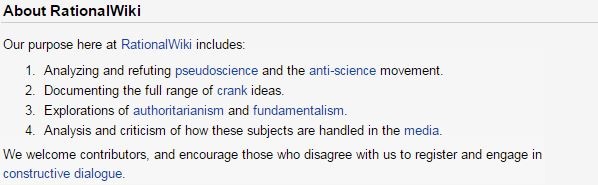
No, I didn’t know there was a RationalWiki.org, either—and after visiting the site, I’m still not sure there is. If “rational” is meant to imply “having reason and understanding,” then this is to report the domain name lacks qualification. The word rational can also mean “involving division,” however. Maybe that’s what the editors meant.

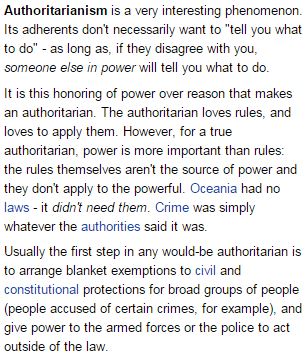
RationalWiki, “Authoritarianism”

The rhetoric of sites like this isn’t without its amusements. For example, RationalWiki invites its audience to “Check Our Entitlement.” In other words, it doesn’t want to exclude the less advantaged, or seem to talk down to them.

Considering there’s nothing on RationalWiki that doesn’t smack of pop-culture-poxed, pseudo-intellectual, East Coast establishment condescension, and that the educationally impoverished victims of racism and classism that RationalWiki purports to defend probably couldn’t track a fraction of what’s published there, the invitation to “Check Our Entitlement” deserves to be met with chorus of raspberries or a barrage of moldy tomatoes.

The page on RationalWiki that pans the blog you’re reading is charmingly titled, “Webshites.” The word is a pun that will only be understood by fans of the BBC or the novels, say, of Graham Swift—and there’s nothing elitist or alienating about that. (Shite is Anglo-Irish for shit.)

RationalWiki accuses this site of being “sexist.” Since RationalWiki is plainly a stalking-horse for feminist and otherwise PC propagandists, this site proposes it’s projecting. Since RationalWiki is blind to the wealth of pain its derelict dogma produces, this site further proposes it’s vicious.

Finally, this site’s editor dismisses RationalWiki’s editors as a collective of dorks.

Copyright © 2015 RestrainingOrderAbuse.com

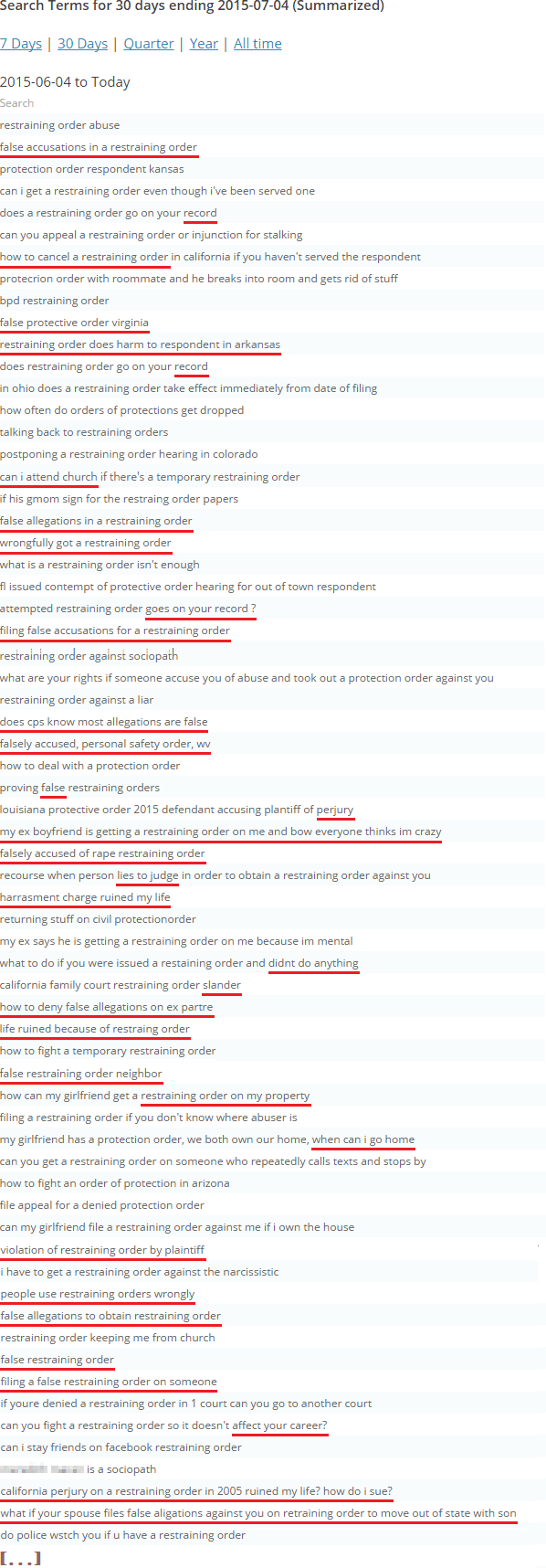
*Propaganda is “the spreading of ideas, information, or rumor for the purpose of helping or injuring an institution, a cause, or a person” (Merriam-Webster’s Collegiate Dictionary). This is how information control is disguised:

This is reality:

More on False Accusation Culture: A Memoir That Exemplifies how False Accusations Are Motivated by “Mass Panic”

Meredith Maran, in writing about falsely accusing her father of molesting her, has been lauded for her bravery, compassion, and honesty by no lesser literary lights than Anne Lamott, Elizabeth Loftus, and Michael Chabon. One must wonder, however, whether a memoir by her father about the torment of being falsely accused and alienated from his grandchildren, particularly if Ms. Maran had maintained her story of abuse, would have received the same sympathetic interest, never mind the same critical acclaim.

Thanks to how Google News is prioritizing its returns for the search term “false accusations,” I came across a Salon.com interview the other day (published in 2010) that speaks significantly to how false claims of abuse, even “false memories” of abuse, can be socially coerced. What it relates exemplifies why how we talk about violence is a very big deal.

More than 20 years ago, Meredith Maran falsely accused her father of molestation. That she came to believe such a thing was possible reveals what can happen when personal turmoil meets a powerful social movement. In her book My Lie: A True Story of False Memory (the introduction of which is excerpted on Salon), Maran recounts the 1980s feminist-inspired campaign to expose molestation, which hit feverish levels in 1988 with the book The Courage to Heal. As an early reporter on the story, Maran observed family therapy sessions, interviewed molesters, and steeped herself in cases where abuse clearly took place. Meanwhile, she divorced her husband and fell in love with a woman who was also an incest survivor. Maran began having nightmares about her own molestation and soon what had been a contentious relationship with her father turned into accusations of unspeakable crimes. Eventually, she came to realize the truth. She was the person who had done wrong.

Toward the end of her memoir, her father asks her, “What I really want to know is how the hell you could have thought that of me.”

Ms. Maran tells Salon reporter Michael Humphrey that she was a thrall of “mass hysteria” (of “mind control” or “brainwashing”).

I was working as a feminist journalist, writing exposés of child sexual abuse, trying to convince the world that incest was more than a one-in-a-million occurrence. In the process, I convinced myself that my father had molested me. After five years of incest nightmares and incest workshops and incest therapy, I accused my father, estranging myself and my sons from him for the next eight years.

In the early 1990s the culture flipped, and so did I. Across the country, falsely accused fathers were suing their daughters’ incest therapists. Falsely accused molesters were being freed from jail—and I realized that my accusation was false. I was one of the lucky ones. My father was still alive, and he forgave me.

The early ’90s, coincidentally, was when restraining orders entered full swing, and the Violence Against Women Act emerged—and allegations of “epidemic violence,” largely from feminist quarters, have never broken stride since.

Ms. Maran’s memoir presents a case study in the coercive effects of rhetoric, especially when it’s backed by widely embraced “social science.”

In 2007, I was out for a walk with someone I wasn’t even that close to. She asked me if I’d ever done anything I was ashamed of and had never forgiven myself for. And without hesitation I said, yeah, when I was in my 30s I accused my father of molesting me, and then I realized it wasn’t true. She stopped walking and stood still, just staring at me and she said, “The same exact thing happened to me.” When I came home from that hike I started calling people I had known back then and speaking to some of the therapists I had seen during that period. With the exception of my ex-lover, every other person I talked to who had accused her father in the ’80s and early ’90s now believed she had been wrong.

[…]

It really shocked me, I must say, to see how much influence the external had on the internal. That the most intimate emotions and relationships can be so affected by the dominant paradigm.

Today’s “dominant paradigm” (a.k.a. dogma) is that accusers who allege abuse are telling it straight, especially if the accusers are female and they’re alleging violence. Conscientious voices continue to meet with vehement hostility, even for making the mild (and very reasonable) suggestion that allegations shouldn’t be treated as facts.

[T]he statement of accusation is all it takes to put the wheels in motion. Either legally or in your family. One thing I’ve learned is the relevance of the phrase “the perfect storm.” Not only for me, but for a lot of women I know who made these false accusations, it was very much a social phenomenon. Metaphorically, everything we were saying was true. But there was a confusion between a metaphor and a fact. And it was a highly relevant difference.

Put plainly, the difference Ms. Maran remarks is between real and fictional—a “highly relevant difference” indeed. So much of the rhetoric that continues to exert a governing influence on social perspectives mirrors what we “want to think” or what we’ve been motivated or conditioned to think (what it’s “right” or politically correct to think). There’s a broad and vocal contingent of “true believers” who are deeply invested in the notion that “violence is epidemic” and that “victim’s” needs should preempt all other concerns, including justice and the false implication of the innocent.

Mr. Humphrey’s interview with Ms. Maran ends on a chilling statement that’s worthy of reflection, coming as it does from a woman who’s written a book acknowledging that people may be led to falsely accuse and that she herself was “brainwashed” into doing so.

In the middle of the book, while you are still deeply in the mind-set of being molested, there’s a notion you agree with that if one innocent man goes to prison, but it stops a hundred molesters, it’s worth it. Do you still agree with that notion?

I’m fairly close to a man still in prison, and really believe he is innocent. I know how he’s suffered. I know he’s 80 years old and in ill health. He’s spent 20 years in prison, for no reason. If every elementary school child is now taught how to protect themselves from sexual abuse—and even more to the point, some father or preschool teacher who feels the urge to molest a child will be inhibited from doing so because they think there are guys still in jail for doing that—but innocent people are in prison, do I have to make that choice? It is a Sophie’s choice kind of thing. Would I allow an innocent man to sit in prison if it meant keeping children safe?

So would you make that choice?

I think so.

In closing, appreciate these facts: (1) A false accuser isn’t pilloried but praised for “bravely” admitting the truth years later, years during which someone else—may we also say “bravely”?—lived with the isolating stigma of her accusations; and (2) the same false accuser who “saw the light” nevertheless opines that other people’s lives are arbitrarily expendable for a virtuous cause.

If these compound horrors weren’t bad enough, the view the memoirist expresses is generally shared and, for all intents and purposes, held by our own “justice system” (consequently).

The question the interviewer poses isn’t a “Sophie’s choice.” The character in William Styron’s novel is forced by a Nazi soldier to choose which of her children should be allowed to live. The choice wasn’t a moral one. Opting to punish people for crimes they haven’t committed to make “object lessons” of them against their will decidedly is.

Whether it’s “worth it” to expediently destroy some other person’s life for the betterment of society isn’t a decision anyone gets to make but the owner of that life—and how dare anyone presume otherwise.

Copyright © 2015 RestrainingOrderAbuse.com

*The definition of expedient in my dictionary (World Book) includes this model sentence: “No honest judge would make a decision that was expedient rather than fair and just.”

Even when They’re Right, They’re Wrong: A Female Author Agrees Domestic Violence Laws Are Exploited to “Set Up” Partners but Puts the Blame Squarely on Men

Since the publication of this post, the website it quotes has been deleted.


“Victims of these increasingly common set-ups face criminal charges alongside their emotionally depleting divorce and custody cases, which are, of course, by now stacked against them.”

—Former crime reporter Janie McQueen

The quotation above comes from the author of the book, Hanging on by My Fingernails: Surviving the New Divorce Gamesmanship, and How a Scratch Can Land You in Jail.

Perhaps you’re thinking: I can so identify with that—and perhaps you can identify with it. If you’re not a woman, though, you’re not supposed to. So stop it.

Yep, a female author (and journalist) acknowledges that lying to the court to gain the upper hand in divorce and custody cases occurs. In fact, she says it’s “increasingly common.” According to her, though, the culprits are violent men.

Ms. McQueen apparently aspires to upset the dogma while still keeping the faith: The system is abused, she emphasizes, but women are the victims, and men are the victimizers.

Evident without benefit of having read her book is that because Ms. McQueen alleges she was framed (and probably quotes other women who allege they were framed), “set-ups” of this sort are asserted to be “increasingly common.” They probably are—they’re reported here routinely—but never mind, apparently, that Ms. McQueen’s contention is exactly what men have been saying for, um, decades. Whether frame-ups are “increasingly” common or not, they are common, and they have been for a long time (and thanks to rhetoric that insists women are incapable of lying maliciously, the likelihood of their becoming increasingly “increasingly common” is strong).

Since I haven’t read Ms. McQueen’s book, fairness requires that I acknowledge her position may not be as chauvinistic as it sounds. Also, the book has apparently been in print for three years, and I just heard about it Monday, so I’d venture to guess that it hasn’t exerted a great deal of populist influence. For an audience sympathetic to feminism to concede that false allegations from men are rampant would be to invite speculation on how rampant false allegations from women are.

That, as they say, ain’t gonna happen.

I learned of Ms. McQueen’s book in an online column in Forbes by Jeff Landers, a “certified divorce financial analyst” and the founder of Bedrock Divorce Advisors, LLC, a “divorce financial advisory firm that works exclusively with women.” Mr. Landers is also the author of multiple books directed to a strictly female audience.

His representation of Ms. McQueen’s book, then, may be skewed to his marketing demographic. I can’t say. This, however, is a passage from Ms. McQueen’s book quoted in Mr. Landers’s column “How Some Men Are Upending Domestic Violence Laws to Scam an Advantage in Divorce” (the passage is from the book’s forward, which is penned by Chicago criminal defense attorney Tamara N. Holder):

Unfortunately, many abusive men have learned to reshape domestic violence laws into another weapon of abuse. They are turning police and court protections upside down: The abusers themselves call 9-1-1; they have the women arrested for domestic violence; and then they do everything they can to try to have the women prosecuted and sentenced. In this way, the true victim is painted as the abuser.

There is a deeper motivation in using this ploy; to show a pattern of “violent conduct” on the woman’s part so that the abuser can use it as evidence against her in a divorce or child custody battle. And this form of abuse is permanent. A bruise heals after a few days, but a conviction for a violent crime mars her record forever.

The set-up: A couple has a fight. Either the wife calls 9-1-1 in a desperate plea for police intervention, or the husband makes the call first in a preemptive attack. When the police arrive, the woman is visibly upset. The man, on the other hand, is extremely calm as he switches off his anger. The husband tells the police that his wife is delusional, crazy, and violent. Depending on how convincing the man’s story is to the police officer, and the state’s law on domestic violence, either both people are arrested or the woman is arrested.

In the case of a dual arrest, which some states discourage, the woman often tells prosecutors she doesn’t want to testify against her husband, so the case is dismissed. Meanwhile, the husband is determined that she be prosecuted. Instead of the prosecutors looking into the history of the relationship before proceeding with the criminal case, they move full speed ahead. The wife is usually cut off from her husband’s financial support so she cannot pay for defense against him. As a result, she is forced to take a plea to the charges because she cannot afford to defend herself. She fears taking the case to trial, losing, and going to jail.

Conclusory remarks will be brief. First, bravo to Ms. Holder (and Ms. McQueen) for a detailed articulation of a serious problem, one that founders lives. What’s described above certainly happens; don’t doubt it for a moment. Second, though, what impassioned subdual of the imagination is required for an intelligent person to believe this only happens to women? C’mon. (Not only does the same thing happen to men, but the presence of children in the relationship isn’t a necessary motivation.) Finally, mark this statement well: “And this form of abuse is permanent. A bruise heals after a few days, but a conviction for a violent crime mars [a] record forever.”

Copyright © 2015 RestrainingOrderAbuse.com

Restraining Order Fraud Needs to Be Recognized for What It Is: CRIME

“Emotional distress as the result of crime is a recurring theme for all victims of crime. The most common problem[s], affecting three quarters of victims, [include] fear, anxiety, nervousness, self-blame, anger, shame, and difficulty sleeping. These problems often result in the development of chronic post-traumatic stress disorder (PTSD).”

—Wikipedia, “Victimology

Restraining orders are governmentally advertised and popularly perceived as deterrents to crime, particularly stalking/harassment and domestic violence. In other words, they’re supposed to do good.

It’s no wonder, then, that the idea that restraining orders may be used to commit crime and do grievous harm is regarded with indifference if not hostility.

The very real if inconvenient truth remains that victims of false allegations made to authorities and the courts present with the same symptoms highlighted in the epigraph: “fear, anxiety, nervousness, self-blame, anger, shame, and difficulty sleeping”—among a host of others. And that’s just the ones who aren’t robbed of everything that made their lives meaningful, including home, property, and family. In the latter case, post-traumatic stress disorder may be the least of their torments. They may be left homeless, penniless, childless, and emotionally scarred.
It’s time for a much overdue reality check: victims are victims, and it doesn’t matter one iota whether a victim is injured by a recognized crime or one that society prefers to pretend doesn’t occur because it’s complicit in its commission. Treating victims like fiends, in fact, compounds victimization manifold, as any zealous bandier of the phrase victim-blaming should eagerly corroborate.

The quoted Wikipedia entry observes that we (among other countries) have a National Crime Victimization Survey (“a tool to measure the existence of actual, rather than reported, crimes”) to determine our country’s victimization rate. “This survey enables the government to estimate the likelihood of victimization by rape, sexual assault, robbery, assault, theft, household burglary, and motor vehicle theft for the population as a whole as well as for segments of the population such as women….”

False allegations, predictably, aren’t recognized as criminal, which of course both false reporting to the police (a statutory misdemeanor) and perjury (a statutory felony) most certainly are. Moreover, and significantly, all of the crimes enumerated in the quotation immediately above may be abetted or excused by the state’s endorsement of restraining order fraud—and at the same time. Victims of restraining order abuse may not only be victims of assault (or even conceivably rape) by their false accusers; by virtue of the state’s validating false accusers’ allegations, the accused may literally be stripped (robbed) of their belongings (i.e., property, vehicles, and money), and ousted from their homes, besides, and forced to forfeit entitlement to them (along with access to their own children): grand theft everything.

E-v-e-r-y-t-h-i-n-g. We’re talking not only about trivializing suffering or “blaming the victim” but of punishing the victim to a cruel and unusual extreme—and congratulating ourselves for doing it. (Feminist) rights advocates make much ado about society’s discounting or trivializing the suffering of victims, ignoring that the state may, for example, yank victims of domestic violence from their homes and kick them sobbing to the curb if their abusers finger them on restraining orders first.

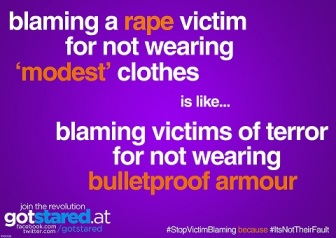
Blaming victims of false allegations made on restraining orders IS “blaming victims of terror for not wearing bulletproof armour,” and why false allegations on restraining orders are so effective (and devastating) is because of the basic message of posters like this: When victimhood is asserted, it’s not to be questioned.

The perceptual blind that preserves these crimes from being exposed and redressed is the “unspoken, politically correct rule that the role of the victim…is NOT to be explored” acknowledged by Dr. Ofer Zur in “Rethinking ‘Don’t Blame the Victim’: The Psychology of Victimhood.” The presiding prejudice that procurers of restraining orders are victims not only enables false accusers to commit theft and abuse on a grand scale (in cases effacing the lives of their male and female victims entirely); it enables them to do so with authorization and impunity, and on top of it all to be rewarded with sympathy. This is victim-blaming with a megaphone.

Victims—victims—may be incarcerated (locked in cages) and serially persecuted (in cases, for years) after having been tossed in the street and having had everything they owned and cared about taken from them. A survey of the accounts on the e-petition “Stop False Allegations of Domestic Violence” will make the horror plain to any reader with a soul (or even just an ounce of honesty).

Denial of this horror by agents of the abuse industry underscores that rights advocacy has become corrupted by dogma, politics, and cash. If it was ever truly about justice, any claim that its mainstream manifestations still are is beyond disingenuous. It’s criminal.

Copyright © 2014 RestrainingOrderAbuse.com