“Fuck the Court”: A Brief Lesson on American Civil Liberties for Those Who’ve Been Given Every Reason to Believe They’re a Mirage

“I am ashamed to think how easily we capitulate to badges and names, to large societies and dead institutions. […] I ought to go upright and vital, and speak the rude truth in all ways.”

—Emerson

I thought about using, “F*ck the Court,” in the title to this post to spare the sensibilities of the prudish. But that would have defeated the point.

“Fuck the court” is a sentiment untold multitudes feel. You’ll nevertheless find few returns for the phrase on Google—and no wonder: Citizens who have experience with the court know it’s pretty good at fucking with them.

So, “can” you say, “Fuck the court”? Sure. The freedom to express any opinion or conviction you have, especially a political one, is guaranteed by the First Amendment, no matter how objectionable that opinion or conviction may be to others, including representatives of our public institutions (whose kids’ college tuitions we subsidize). As long as you’re not exciting violence—namely by advocating or threatening it—you enjoy the freedom to say your piece. Expressions of disgust are not only constitutionally protected; they’re more than warranted in this case.

(Consider that anarchists advocate for the complete abolishment of government. Are they “allowed” to do that? Of course.)

Context alone matters. What you say to the world at large, in a blog like this one, for example, is protected speech. If someone doesn’t want to hear it, s/he doesn’t have to listen.

Important distinctions: If you, as a party to a proceeding, wore a t-shirt emblazoned with “Fuck the Court!” to court, the judge might (would) order you turn it inside out. Or if you were just a looker-on, the bailiff could (would) ask you to leave and only come back when/if you were “respectfully” attired. If you pronounced, “Fuck the court!” aloud in court, you could be held in contempt for causing a disruption.

Got it? Good. And fuck the court. You have every right to register your disapproval.

Copyright © 2018 RestrainingOrderAbuse.com

*If you’re wondering whether this means you can criticize the conduct of judges and attorneys (by name), the conduct of plaintiffs (by name), and how a case or cases you’ve been involved in were conducted, the answer is YES. Just qualify your opinions as such, restrict their expression to the world at large, that is, never direct them to the object of your scorn, and represent facts accurately.

The Use of Restraining Orders to Bully Women: Jenny’s Story

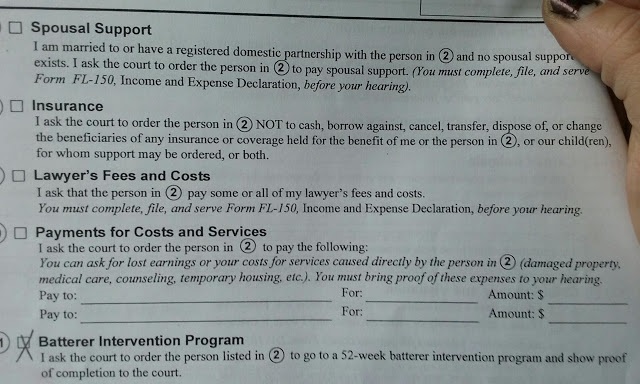
The painted fingernail in this image isn’t that of the person who filed the domestic violence restraining order; it’s the fingernail of the person against whom the order was issued (wrongly).

A woman named Jenny brought her blog to my attention yesterday. Jenny reports she was falsely accused of domestic violence for no better motive than to hurt her, and she prevailed in court.

I broke down during my turn to defend myself, but I couldn’t help it. My heart hurt so badly. I was in so much pain. The judge took no time at all to throw the case out. He pretty much laughed Mr. Wrong out of the courtroom for his petty allegations and…what he was trying to use as proof of domestic violence….

As Jenny puts it, she was “slapped with a restraining order.” She should have said “SLAPPed.” Her accuser, whom she calls “Mr. Wrong,” implied the worst about her that the boilerplate bureaucratic form allowed—to shut her up: She’d published a warning about her ex-boyfriend online and invited his friends to read it. That’s protected speech (besides nonviolent), and the judge was right to vacate the order.

Don’t break out the champagne yet, though.

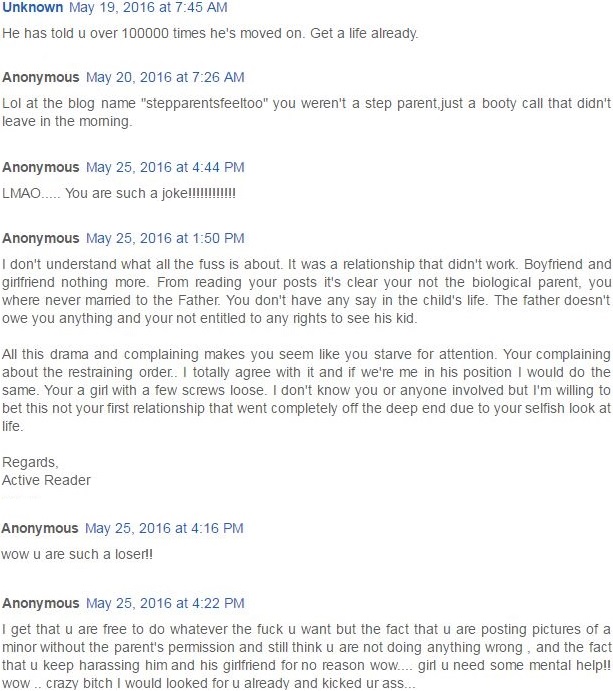
Jenny, who has been served with two falsely petitioned restraining orders alleging “domestic violence” (this month) besides heckled on her blog as a “crazy bitch,” a “joke,” a “loser,” and “just a booty call that didn’t leave in the morning”

In her latest post, Jenny reports she was yesterday served with a second domestic violence protection order. Yeah. The motive is the same: to shut her up and hurt her. Jenny had left a note asking if she could see her accuser’s son, a boy she had parented and whom she cared about and missed.

This time around, Mr. Wrong ticked a box on the form mandating that Jenny attend a 52-weekBatterer Intervention Program” (funded by the tax-paying public).

He also ticked a box indicating Jenny owned a gun, which she says she never has. That doesn’t matter, of course, nor does it matter that the same guy petitioned the same order a few weeks before and was ultimately denied. Restraining order proceedings are conducted ex parte, which means orders are issued blindly, and the priority is to “protect” plaintiffs. There’s no cap on how many times vexatious plaintiffs can play this game. Defendants aren’t consulted or considered. They’re just handed orders that say the court has reason to suspect they’re batterers (or stalkers or child abusers or rapists, etc.).

Jenny has besides been serially ridiculed and taunted by “anonymous” commenters on her blog (who could “they” be?). She’s been called a “crazy bitch,” a “joke,” a “loser,” and “just a booty call that didn’t leave in the morning”:

According to the National Coalition Against Domestic Violence (NCADV), domestic abuse includes “coercion and threats”; “intimidation”; “emotional abuse”; “isolation”; “minimizing, denying, and blaming”; and “using children.”

The NCADV and other “women’s advocacy groups” defend restraining orders as deterrents of abuse…and thereby make the abuse of people like Jenny not just possible but easy.

Copyright © 2016 RestrainingOrderAbuse.com

*Contrast this story with how complainants of false accusations of domestic violence are represented by feminist advocates like UC Davis Prof. Kelly Behre.