Courtroom Fraud and Smear Campaigns: The Full Machiavelli

Cheryl Lyn Walker PhD, Dr. Cheryl Lyn Walker, Dr. Cheryl L. Walker PhD, M.D. Anderson Cancer Center, Michael Honeycutt PhD, Michael Honeycutt TCEQ

“False Accusations, Distortion Campaigns, and Smear Campaigns can all be used with or without a grain of truth, and have the potential to cause enormous emotional hurt to the victim or even impact [his or her] professional or personal reputation and character.”

—“False Accusations and Distortion Campaigns

There are several fine explications on the Internet about the smear campaigns of false accusers. Some sketch method and motive generally; some catalog specific damages that ensue when lies are fed to the police and courts.
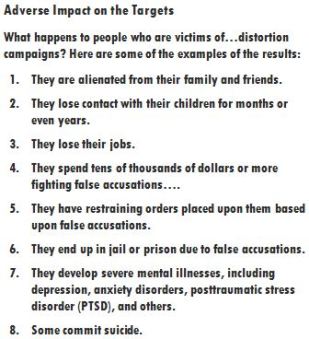
This survey of “adverse impacts” is credited to lies told by people with borderline personality disorder. Conducting “distortion campaigns” isn’t exclusive to BPDs, however, and the “adverse impacts” are the same, irrespective of campaigners’ particular cognitive kinks.

The valuable role of the police and courts in the prosecution of campaigns to slander, libel, and otherwise bully and defame can’t be overstated. They’re instrumental to a well-orchestrated character assassination.

Lies can be told to anyone, of course, and lies told to anyone can have toxic effects. The right lie told in a workplace, for example, can cost someone a job and impair or imperil a career.

Lies told to police and judges—especially judges—they’re the real wrecking balls, though. False allegations of threat or abuse are handily put over in restraining order or domestic violence procedures, and they endure indefinitely (and embolden accusers to tell further lies, which are that much more persuasive).

Among the motives of false accusation are blame-shifting (cover-up), attention, profit, and revenge (all corroborated by the FBI). Lying, however, may become its own motive, particularly when the target of lies resists. The appetite for malice, once rewarded, may persist long after an initial (possibly impulsive) goal is realized. Smear campaigns that employ legal abuse may go on for years, or indefinitely (usually depending on the stamina of the falsely accused to fight back).

Legitimation of lies by the court both encourages lying and reinforces lies told to others. Consider the implications of this pronouncement: “I had to take out a restraining order on her.” Who’s going to question whether the grounds were real or the testimony was true? Moreover, who’s going to question anything said about the accused once that claim has been made? It’s open season.

In the accuser’s circle, at least—which may be broad and influential—no one may even entertain a doubt, and the falsely accused can’t know who’s been told what and often can’t safely inquire.

Judgments enable smear and distortion campaigners to slander, libel, and otherwise bully with impunity, because their targets have been discredited and left defenseless (judges may even punish them for lawfully exercising their First Amendment rights and effectively gag them). The courts, besides, may rule that specific lies are “true,” target_of_blamethereby making the slanders and libels impervious to legal relief. Statements that are “true” aren’t defamatory. The man or woman, for instance, who’s wrongly found guilty of domestic violence (and entered into a police database) may be called a domestic abuser completely on the up and up (to friends, family, or neighbors, for example, or to staff at a child’s school).

Lies become facts that may be shared with anybody and publicly (court rulings are public records). Smear campaigners don’t limit themselves to court-validated lies, either, but it seldom comes back to bite them once a solid foundation has been laid.

Some so-called high-conflict people, the sorts described in the epigraph, conduct their smear or distortion campaigns brazenly and confrontationally. Some poison insidiously, spreading rumors behind closed doors, in conversation and private correspondence. As Dr. Tara Palmatier has remarked, social media also present them with attractive and potent platforms (and many respondents to this blog report being tarred on Facebook or even mobbed, i.e., bullied by multiple parties, including strangers).
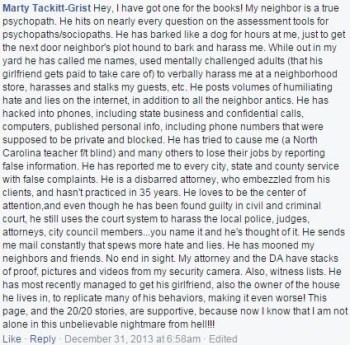
Even when false accusers’ claims are outlandish and over the top, like these posted on Facebook by North Carolinian Marty Tackitt-Grist, they’re rarely viewed with suspicion—and almost never if a court ruling (or rulings) in the accusers’ favor can be asserted. The man accused in this comment to ABC’s 20/20 is a retiree with three toy poodles and a passion for aviation who couldn’t “hack” firewood without pain, because his spine is deformed. He is a retired lawyer, but he wasn’t “disbarred” and hasn’t “embezzled” (or, for that matter, “mooned” anyone). He has, however, been jailed consequent to insistent and serial falsehoods from his patently disturbed neighbor…who’s a schoolteacher.

For Crazy, social media websites are an endless source of attention, self-promotion, self-aggrandizement, and a sophisticated weapon. Many narcissists, histrionics, borderlines, and other self-obsessed, abusive personality types use Facebook, Twitter, and the like to run smear campaigns, to make false allegations, to perpetrate parental alienation, and to stalk and harass their targets while simultaneously portraying themselves as the much maligned victim, superwoman, and/or mother of the year.

(A respondent to this blog who’s been relentlessly harried by lies for two years, who’s consequently homeless and penniless, and who’s taken flight to another state, recently reported that a woman who’d offered her aid suddenly and inexplicably defriended her on Facebook and shut her out without a word. Her “friend” had evidently been gotten to.)

(An advocate for legal reform who was falsely accused in court last year by her husband and succeeded in having the allegations against her dismissed reports that he afterwards circulated it around town that she tried to kill him.)

I was falsely accused in 2006 by a woman who had nightly hung around outside of my house for a season. She was married and concealed the fact. Then she lied to conceal the concealment and the behavior that motivated the concealment. She has sustained her fictions (and honed them) for nearly 10 years. People like this build tissues of lies, aptly and commonly called webs.

Their infrastructures are visible, but many strands may not be…and the spinners never stop spinning.
The personality types associated with chronic lying are often represented as serpentine, arachnoid, or vampiric. This ironically feeds into some false accusers’ delusions of potency. Instead of shaming them, it turns them on.

I know from corresponding with many others who’ve endured the same traumas I have that they’ve been induced to do the same thing I did: write to others to defend the truth and hope to gain an advocate to help them unsnarl a skein of falsehoods that propelled them face-first into a slough of despond. (Why people write, if clarification is needed, is because there is no other way to articulate what are often layered and “bizarre” frauds.)

I know with heart-wrenching certainty, also, that these others’ honest and plaintive missives have probably been received with exactly the same suspicion, contempt, and apprehension that mine were. It’s a hideous irony that attempts to dispel false accusations are typically perceived as confirmations of them, including by the court. To complain of being called a stalker, for example, is interpreted as an act of stalking. There’s a kind of awful beauty to the synergy of procedural abuse and lies. (Judges pat bullies on the head and send them home with smiles on their faces.)

Smear campaigns wrap up false accusations authorized by the court with a ribbon and a bow.

Copyright © 2015 RestrainingOrderAbuse.com

*The name Machiavelli, referenced in the title of this post, is associated with the use of any means necessary to obtain political dominion (i.e., power and control). Psychologists have adapted the name to characterize one aspect of a syzygy of virulent character traits called “The Dark Triad.”
Learning to Talk the Talk: Resources for Victims of “Disturbed” People Who’ve Also Been Victimized by the Courts

“[Narcissism] is, in my opinion, the single most damaging and maladaptive tendency seen in sociopaths. When taken to extremes, it can lead to seriously abusive patterns of behavior that are repulsive and idiotic, both from any sort of ethical perspective and from the perspective of sheer self-interest. It is also fundamentally misunderstood. The word ‘narcissist’ connotes, to most people, merely personal vanity taken to an extreme. This is not what the word narcissism means in the context of sociopathic psychology. Narcissism…means the inability to understand that other people exist as distinct entities from oneself—with their own wants, emotions, and personal space—combined with a grandiose and exaggerated perception of self. The ‘narcissistic personality disorder’ described in the DSM is in my opinion simply the identification of sociopathic individuals who allow their own narcissistic tendencies to become so severe that [they begin] to ruin their lives and the lives of those around them.”

—Clinically diagnosed sociopath and blogger

I encountered this exceptional writer in an online forum recently and quoted much of what he had to say about the motives of the sociopathic mind, as well as his “insider” conclusions about what makes narcissists tick. He corroborated some of my own lay suspicions and corroborates as well the belief of psychologist Tara Palmatier, who has written volubly about abuses of legal procedure, that the personality disorders most damaging to others stem from sociopathy.

This writer, who very plausibly calls himself a “high-functioning sociopath” but who doesn’t otherwise identify himself, perceives people with these personality disorders (specifically, narcissistic personality disorder and borderline personality disorder) as “low-functioning sociopaths” who are prone to indulge hedonistic (that is, pleasure-seeking) impulses, both to their own detriment and that of those who run afoul of them. Put plainly, they hurt other people to gratify the urges of their haywire brains. This writer’s ideas are carefully and lengthily qualified, and with convincing earnestness and intelligence, and I urge anyone who’s interested in a nuanced understanding of disordered brains and their eccentricities to visit this writer’s blog, as well as that of the aforementioned psychologist, Dr. Tara Palmatier, for personal and clinical perspectives on disordered personalities and how to deal with them.

The reasons the personality-disordered are often brought up in this blog are two: (1) because these people have limitless capacity to destroy the lives of others and no scruples or inhibitions about lying to disown accountability for their actions, and (2) because their victims, who are also often victims of legal clashes people like this instigate to distance themselves from their crimes, don’t have the words or concepts to qualify what in the hell just happened to them.

Those who’ve been pursued by or had relationships with disordered personalities, particularly narcissists, whose peculiarities aren’t prominent and easily distinguished as aberrant, may be inclined to doubt or question their own perceptions (which narcissists are masters at manipulating) and may be no more able to characterize the conduct and chronic lying of such people than as “hurtful” or “disturbed” or “psycho.” The motives of the personality-disordered aren’t easily explicable, because they don’t make any sense. Until you’ve been initiated and made an earnest effort to comprehend such bewilderingly anomalous minds, you don’t have the tools to even articulate what you’ve been subjected to. It’s no wonder, for example, that blogs about victimization by narcissists have titles like An Upturned Soul and Out of the Fog—or that using the search term “narcissist” on Amazon.com yields 1,028 returns (including the titles, How Many Lies Are Too Many?: How to Spot Liars, Con Artists, Narcissists, and Psychopaths before It’s Too Late and Web of Lies: My Life with a Narcissist).

Fascinatingly, reading the blog of the “high-functioning sociopath” I’ve commended, and considering that sociopaths are popularly said to be emotional vacuums, there’s no avoiding the impression that he is very empathic, though his isn’t an “I feel you” empathy so much as a reasoned, analytic (“I feel me”) one, which actually makes for very lucid explication unmuddied by touchy-feely distractions that are hardly soothing, anyway, to people who’ve had their lives derailed and are looking for answers rather than palliatives.

Copyright © 2014 RestrainingOrderAbuse.com

*The original blog cited and recommended in this post, QuestioningSociopathy.com, has since been deleted by its author.

Differentiating the Frauds of Sociopaths and Narcissists: A First-Person Perspective

“I became suspicious of my own traits after extended contact with another sociopath, with whom I clicked instantly.”

—Clinically diagnosed sociopath

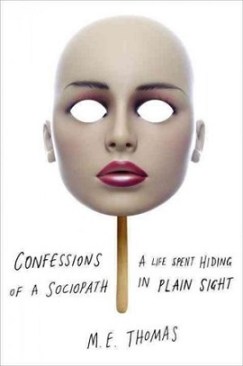
The above remark in an online forum caught my eye, because it validated a suspicion I’ve nursed that sociopathic people identify with and gravitate toward one another. It’s predictable, really, that people with common perspectives should be mutually attracted, as well as drawn to particular fields, for a couple of examples, institutional research and law. Italics that appear in the quoted paragraphs below, which are by the same male speaker, are added. This speaker, whose comments will be illuminating to students of anomalous brains, is not the author of the book whose cover is used as illustration.

“Generally our impulsive and charismatic personalities mean we become friends easily. For example, both of my flatmates are sociopathic, although probably to a lesser degree than myself. I’m able to freely talk with them about manipulative behavior, and we occasionally teach each other tricks based on our own areas of social expertise. Working as a group, we can very easily mask one another and cooperate to more effectively manipulate others. We also mutually operate on the same rationally motivated, prosocial basis, and as a result we find it very easy to trust one another as our motivations are all identical, and we’re aware of that.

“An awful lot of my sociopathic friends are aware, because I had the conversation with them and ‘woke them up.’ I tend to deliberately gather other socios around me and then make them self-aware, which has created a very interesting little social circle around me. We talk about it quite regularly, because it often comes up when we’re venting to each other or discussing our emotional responses.

“Academia is full of narcissists and sociopaths. So is the legal profession. Virtually any ‘prestigious’ career that offers a lot of potential cash will contain socios, but at the same time there will be some of us almost anywhere as many socios choose the easiest lifestyle possible, which isn’t compatible with those sorts of high-level careers. All fringe subcultures have a higher than average representation of socios, and the drug subculture is absolutely infested with them.”

Reading this person’s analysis of the differences between sociopaths and narcissists, which is very self-aware and forthcoming, was equally interesting, and those who’ve been traumatized by personalities of these types, may also find it significant.

“It’s the difference between ‘I am better than those around me’ and ‘I am fundamentally different [from] those around me, because I have a bizarre and somewhat broken brain.’ Narcissists believe they excel because they’re amazing at everything; sociopaths accept that we’re cheating.

“I very rapidly psychoanalyze others and then use their self-image and insecurities against them. For example, say I spot a woman who’s very insecure and in need of male validation. I can compliment her in exactly the way she wants and needs, and as a result foster emotional dependence, which can give me what I want. Or if you’re badly educated and insecure about your intelligence, I’ll show interest in you as an intelligent and well educated man, and tell you how smart I think you are and how much potential you secretly have, and as a result you’ll end [up] feeling ‘special’ and get the feelings of excellence you crave. Which can give me what I want. Etc., etc. It would take a very long time to explain every possible outcome, but generally it relies on telling people what they want to hear. This is my style, though, and some other socios can be VERY different. Female sociopaths tend to use self-victimization and foster ‘white knight’ behavior in men above all else, for example.

“I can be very passionate about some things, and that’s genuine. I care about my closer friends (because they’re mine) and the women I’m sleeping with (because they’re mine). I avoid negatively affecting those people at all and can actually be very, very protective of them—which in practice ends up being a mutually beneficial relationship.”

This person also validated my conviction that narcissists possess a far greater potential to damage others.

“I f*cking hate narcissists. They’re even worse than us, and they manage to delude themselves into believing that they’re the nicest people on earth. I hate the effect they have on other people, because it’s completely, needlessly damaging, and my own ethics are utilitarian, so the sort of wastefully cruel behavior they participate in just strikes me as stupid and childish.”

He corroborates the most basic defining attributes of the sociopath—and the character traits and tendencies he limns are ones familiar to me as a daily reader of people’s ordeals with sociopathic partners or former partners.

“I don’t feel any guilt. I have no idea what guilt even feels like. I have very few emotions at all. Most of my social interactions with non-socios are pure acting. I also have the full-on stereotypical predatory stare unless I remind myself to ‘act’ as if I’m making normal eye contact, which is a dead giveaway. I feel like most people are just zombies rather than real human beings at all.

“I don’t have a conscience. I use the word hate all the time, but I’m not sure I know what it truly means, to be honest.

“Most of my emotions are what is described as ‘shallow’—that is, they are short-lived, theatrical, and don’t affect my thought processes to the same degree as a normal person. Anger is heightened, and I have a capacity for truly blind rage. I have fallen in what I perceived as ‘love’ with another sociopath in the past, but whether that was mutual obsession or what a neurotypical person would describe as ‘love’ is a mystery to me, although I did care about her deeply.

“We’re almost invariably very smart and possessed of higher than average verbal and social intelligence. Acting is just…easy, for us, for some reason. It’s something we all seem to learn naturally. It is absolutely just acting, and if you can watch a professional actor bring tears on command then you understand how we do it.

“I think all sociopaths get off on power. We tend to view ourselves as distinct from other people (in a way that very easily slips into narcissism) and as ‘natural leaders’ (which we sort of are, in all fairness), and we enjoy being in those positions. I enjoy success, and I enjoy demonstrating that I’m more able than others. Sexually, I tend towards being extremely dominant and aggressive; however, I’d rather find submissives who enjoy that experience than shoot myself in the foot by needlessly harming other people. I think this need to demonstrate dominance over others is inherent, but you can deal with it in different ways; I’d rather be heavily involved in BDSM and a careerist assh*le than satisfy my need for dominance by needlessly murdering other human beings, but I do suspect that that need is why the most maladjusted and broken sociopathic individuals sometimes deliberately harm others for kicks, or even kill.

“Fringe sexual preferences [are] virtually ubiquitous. They don’t bother me at all, because they’re really fun—and drug use allows me to experience some of the emotional extremes that I would otherwise be denied.”

He also contradicts the psychopath stereotype.

“Animals love me for some reason. Cats especially will always pick me to sit on if there [are] multiple people in the room. Dogs respond to my eye contact and mannerisms by being very submissive.

“I like cats and dogs, and I enjoy having them around, so I don’t see any reason to hurt them. The idea of hurting an animal does not make me feel guilty at all, but I do see it as unpleasant.”

His derision of narcissists betrays resentment that sociopaths should be popularly or psychologically associated with these undisciplined and self-delusory slaves to their compulsions. Below is his response to the inquiry, “In your [opinion], do narcissists a) know fully that they’re lying when they’re gaslighting you? b) truly believe the twisted version of reality they present you with, or c) talk themselves into believing their own lies gradually because it suits them? This question is something that causes me a lot of pain and confusion when being gaslighted. Some part of me still wants to believe they are good people without malice….”

”This depends on exactly how self-deluding any given narcissist is, and from an external perspective it’s very hard to tell. I avoid gaslighting [see footnote]…but if I [were] to do it, I’d be fully aware that I was lying. On the other hand, narcissists are extremely unlikely to ever admit it to themselves, because their entire self-perception is completely distorted. It’s likely to be a combination of B + C in practice; A would be behavior more characteristic of a true sociopath. Keep in mind that narcissism is a sliding scale of self-delusion in practice; the worst examples will be B, but the majority are likely to be C. A narcissist is just a sociopath who believes [his or her] own bullshit, really. I wouldn’t say they’re ‘good people’ but they’re not fully conscious of what they’re doing.

“Assume everything they say is bullshit until you see at least some evidence. You don’t have to tell them this, but be absolutely cynical.

“Any extreme displays of emotion are not real.

“Do NOT do anything to give them any more power over you than they have—lending or borrowing money, making minor concessions, etc. They will use it against you.

“Narcissists have incredibly unstable self-esteem. Keep this in mind, and you may be able to motivate them into doing what you want to some degree.

“I think sociopaths are born, and narcissists are made from some of those sociopaths. I don’t think every person has the potential to be a true narcissist based on nurture. People who are naturally ‘sociopathic’ aren’t evil, because we can be incredibly socially symbiotic if we’re aware of the value of prosocial behavior.”

It’s fascinating to me to contrast my impression of this highly intelligent man, who’s a self-acknowledged sociopath with a reasoned code of ethics, with what I know of the narcissist, who’s a parasitic sponge and chronic and impulsive liar. The narcissist is infantile; designing, perfidious, and fraudulent to the core; and wantonly vengeful and destructive. This man, who’s clearly very singular in his self-awareness, lucidness, and honesty may be a sociopath, but after observing how willfully “neurotypical” people lie and treacherously betray others, I’d much sooner trust his motives and integrity than theirs.

Copyright © 2014 RestrainingOrderAbuse.com

Wikipedia: “Gaslighting is a form of mental abuse in which false information is presented with the intent of making a victim doubt his or her own memory, perception, and sanity. Instances may range simply from the denial by an abuser that previous abusive incidents ever occurred up to the staging of bizarre events by the abuser with the intention of disorienting the victim.”