What Massachusetts Law Firm Dane Shulman Associates Says about Restraining Order Abuse and Divorce

Below is Massachusetts law firm Dane Shulman Associates writing about the game of false accusation. Lawyers know this happens. They know it very well.

Various feminist advocates doggedly assert that restraining order abuse, particularly to gain leverage in family court, is insignificant—or worse, that claims of it are merely men’s rights propaganda—and such assertions are made even by professors of law. Practitioners of law (the lawyers in the trenches, not the ivory tower) report otherwise.

Restraining Order Abuse in Divorce Cases” (emphases added):

Unfortunately, some people are abusing Massachusetts’ restraining order laws and using them as a divorce tactic. An individual involved in divorce proceedings may file a temporary restraining order against [his or her] spouse, alleging abuse of him or [her] or of the couple’s children. This would prevent the alleged abuser from having contact with his or her children during the 10-day temporary order, and if the allegations stick, the restraining order would last up to a year after the accusations were made. Often, such allegations are false, and only a way to put a wrench in the divorce proceedings and for the accusing spouse to gain custody of the children involved.

To prevent the restraining order from being extended, it is imperative that the alleged abuser present evidence [in] the second hearing that the allegations made against him or her are false. This is the first and only time an alleged abuser can present his or her case. If he or she fails to appear, chances are that the restraining order will be extended, and the accusing spouse will gain custody of the children.

A restraining order can have disastrous effects on the alleged abuser. The order is put on his or her criminal record, and any violation of the order results in criminal charges. The alleged abuser is also listed in the statewide Domestic Violence Registry, a record that never goes away. All of these actions greatly impact an alleged abuser’s ability to secure new employment, especially jobs for the government or jobs that involve working with children.

Massachusetts’ courts issue restraining orders to protect victims, not so the orders can be used as frivolous tactics to gain the upper hand in a divorce or a child custody matter. Restraining orders have serious consequences for the alleged abuser, and also for the relationship between the alleged abuser and his or her children, since the order could put strain on the parent-child relationship. A restraining order is something no one should consider obtaining without a serious, truthful cause.

Copyright © 2018 RestrainingOrderAbuse.com

*One of the most outspoken critics of restraining orders, attorney Gregory Hession, also practices in Massachusetts.


“Shame and Stigma” and the “Mean-Spirited Cultural Response” That Efforts to Cast Them Off Provoke: Procedural Abuse and Parental Alienation

“Parental alienation is the ‘programming’ of a child by one parent to denigrate the other (targeted) parent, in an effort to undermine and interfere with the child’s relationship with that parent, and most often occurs within the context of a child custody conflict. This includes the ‘legal abuse’ of parents who have been disenfranchised from their children’s lives subsequent to sole custody and primary residence judgments. Within an adversarial legal process, non-custodial parents are often subjected to shame and stigma, lack of access to their children, and devaluation of their role as parents. And those who speak about the pain and woundedness in their lives are subjected to a mean-spirited cultural response, where their talk of woundedness is mocked.”

Edward Kruk, Ph.D.

Here’s child and family social worker Edward Kruk corroborating that parents may be the targets of “legal abuse”; that they’re subjected to shame and stigma, and to alienation from their children; and that they’re ridiculed and regarded with contempt for complaining about it: “The Impact of Parental Alienation on Parents: Post-traumatic Stress in the Rupture of Parent-Child Relationships” (2013). There are mothers who endure this, make no mistake, but as Dr. Kruk observes, “Most alienated parents are non-custodial fathers.”

Members of both genders (parents and non-parents alike) have reported on this blog that they’ve experienced (or are in the throes of) PTSD consequent to abusive legal contests, and it’s not the intent of this post to discount the plaints of mothers who face this torment. It must be emphasized, however, that the “mean-spirited cultural response” Dr. Kruk notes is predominately, if not exclusively, directed at men, and it’s because fathers’/men’s plaints are so roundly and effectively denounced and dismissed that mothers’/women’s plaints also lack a sympathetic audience.

(Feminists would prefer that female victims of legal abuse quietly recede into obscurity and accept the role of martyr for “the cause.”)

The “mean-spirited cultural response” is broad but includes highly influential voices, including law professors and esteemed advocacy groups like the Southern Poverty Law Center, which has equated men’s and fathers’ rights representatives with hate groups, asserting that they’re on a par with the Ku Klux Klan.

No kidding.

To vehemently complain about being treated prejudicially by the courts and alienated from your kids is to be caricatured as a racist wearing a bedsheet and brandishing a torch. (Few in the mainstream press, moreover, scoff at this rhetoric.) For moms (and women in general) who’ve been victimized by legal abuse to be heeded, the demonization of men’s and fathers’ advocates as mere “misogynists” must first be controverted.

Last year, a post on this blog reported the award of a $500,000 grant to a female law professor to “debunk” the claim that court procedures are abused to alienate parents from their children, and it’s this sort of (government-funded) social science research that marginalizes voices like Dr. Kruk’s.

It provides fodder to bloggers and other commentators, and it’s used to “train” judges how to rule.

The selective orientation of feminist social science ignores competing (and compelling) findings like these Dr. Kruk cites:

Suicide rates are reported to be of epidemic proportions among parents, fathers in particular, who are struggling to maintain a parenting relationship with their children (Kposowa, 2000; Kposowa, 2003); and legal abuse has been noted as a key factor in these cases.

A recent post on this blog referenced the suicide of a father who’d undergone years of legal hell and couldn’t face any more. He bled out—emotionally, morally, and financially. Feminist advocates stress the consequences and “rampancy” of domestic violence—focusing narrowly on female victims—while denying that the effects of legal abuses are grave. They trivialize those effects and often deny legal abuses occur to any extent worthy of attention or redress.

The devaluation of family and the curtailment of lives aren’t trivial.

Copyright © 2015 RestrainingOrderAbuse.com

Who or What Can’t Be Published on CafeMom?: On Ad Hominem Attacks, Feminist Hatemongering, and the Victimization of Moms by Both

I was concerned to see that someone was brought to this site recently by the search term “Tara Palmatier [X].” I’ve omitted the final word of the phrase not because it’s vulgar but because I don’t want an anomalous Google query to put an idea into the head of some crank with too much time on her hands.

Dr. Tara J. Palmatier is a psychotherapist whose writing I’ve come to admire and respect, and which I’ve consequently quoted many times. She has what distinguishes the brilliant from the intelligent: bold candor. I did a hasty Google search of my own to see what would have prompted someone to use the keywords cryptically quoted above and nothing correspondent appeared except a page that appeared to be a spoof.

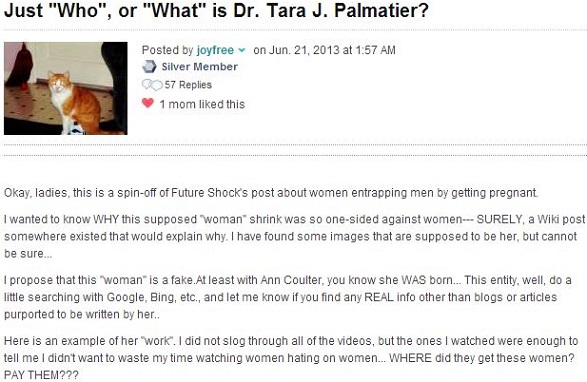
I did, however, notice this post, published eight months ago, on CafeMom: “Just ‘Who’ or ‘What’ is Dr. Tara J. Palmatier?” (which was deleted subsequent to the publication of this post).

In several pieces I’ve published over the last couple of months, I’ve given critical scrutiny to feminist rhetoric, because I believe the gross civil injustices this blog concerns owe their ontological debt and perpetuation to such rhetoric.

Consider the rhetorical strategies of this writer, who identifies herself with a picture of a kitty cat and the alias “joyfree” (prompting this writer to wonder whether she’d be less catty if she were more joy-ful).

Note first that the question that titles the post disdains to recognize Dr. Palmatier as human. Why? Apparently because she wrote about women’s entrapping men by getting pregnant. Assuming she did, how this observation could be “one-sided against women” is baffling, not for the least of reasons because it’s impossible for men to entrap women by getting pregnant. The actual source of the beef, of course, isn’t its writer’s perception of Dr. Palmatier as unfair; it’s kneejerk resentment of a woman’s criticizing women. That’s why instead of offering a reasoned critical response, the writer simply denounces a (“supposed”) woman with a doctorate in clinical psychology as a “fake.” (William Buckley called this “rebuttal by epithet.”)

There’s little point in my spending an hour parsing (and thereby dignifying) the facile hatemongering of an anonymous writer who probably invested half that time cobbling her post together. What I would bring to the attention of this blog’s audience (particularly its female readers) is that this vitriol was published on a site called CafeMom. This isn’t a forum of radical feminist academicians; these are your everyday householders. And the question I would hope scrutiny of public statements like this arouses is when did it become okay to attack someone’s sexuality and qualification as a human being, because she voiced an eminently informed, professional opinion that wasn’t favorable to female exaltation?

If Dr. Palmatier were black, would it still be okay to suggest she wasn’t human? Not so much, right? Observe, though, that this writer’s rhetorical strategies (like those of any number of like-minded writers) pretty much mirror those of racial bigots of centuries past.

And it slides under the radar.

What shouldn’t slide under the radar of this blog’s readers is that the acceptability of these kinds of views is an indicator of the breadth of feminist influence, and it’s this coercive influence by women that allows this to continue (quoted from the e-petition “Stop False Allegations of Domestic Violence”):

“My ex has used the law and the justice system, and destroyed my life and those of my minor children! He lied and said he had a witness to testify to his false accusations and bullied me into a deal with the devil eight months ago, and has filed five emergency ex parte motions to remove my kids…. He has put me in debt. I lost my job. I have no money, no friends. Therapists will not help my children as they are afraid he will ruin their lives, too…. Lawyers drop the case because of the constant verbal abuse he does to me and eventually to them, too. I have no friends left. Everyone has left me, and my family is far away, and their hands are tied. He has told teachers and principals and camp counselors these horrible accusations and caused me to have to move to a different town. My five-year-old told me his mind is telling him to die because his mommy is never happy. So what about the [woman] who [doesn’t] cry wolf and [leaves] an unhealthy marriage to save [her] kids and [has] a scorned, mentally ill, narcissistic ex-husband who is torturing every single day and using the law to harass [her]? He is a doctor and has deep pockets, and I am now in debt with no income. Had they been ethical the day of the hearing and admitted that they had no witness anymore, this would never have happened. So what about the tortured women?”

Over to you, CafeMom.

Copyright © 2014 RestrainingOrderAbuse.com