What Massachusetts Law Firm Dane Shulman Associates Says about Restraining Order Abuse and Divorce

Below is Massachusetts law firm Dane Shulman Associates writing about the game of false accusation. Lawyers know this happens. They know it very well.

Various feminist advocates doggedly assert that restraining order abuse, particularly to gain leverage in family court, is insignificant—or worse, that claims of it are merely men’s rights propaganda—and such assertions are made even by professors of law. Practitioners of law (the lawyers in the trenches, not the ivory tower) report otherwise.

Restraining Order Abuse in Divorce Cases” (emphases added):

Unfortunately, some people are abusing Massachusetts’ restraining order laws and using them as a divorce tactic. An individual involved in divorce proceedings may file a temporary restraining order against [his or her] spouse, alleging abuse of him or [her] or of the couple’s children. This would prevent the alleged abuser from having contact with his or her children during the 10-day temporary order, and if the allegations stick, the restraining order would last up to a year after the accusations were made. Often, such allegations are false, and only a way to put a wrench in the divorce proceedings and for the accusing spouse to gain custody of the children involved.

To prevent the restraining order from being extended, it is imperative that the alleged abuser present evidence [in] the second hearing that the allegations made against him or her are false. This is the first and only time an alleged abuser can present his or her case. If he or she fails to appear, chances are that the restraining order will be extended, and the accusing spouse will gain custody of the children.

A restraining order can have disastrous effects on the alleged abuser. The order is put on his or her criminal record, and any violation of the order results in criminal charges. The alleged abuser is also listed in the statewide Domestic Violence Registry, a record that never goes away. All of these actions greatly impact an alleged abuser’s ability to secure new employment, especially jobs for the government or jobs that involve working with children.

Massachusetts’ courts issue restraining orders to protect victims, not so the orders can be used as frivolous tactics to gain the upper hand in a divorce or a child custody matter. Restraining orders have serious consequences for the alleged abuser, and also for the relationship between the alleged abuser and his or her children, since the order could put strain on the parent-child relationship. A restraining order is something no one should consider obtaining without a serious, truthful cause.

Copyright © 2018 RestrainingOrderAbuse.com

*One of the most outspoken critics of restraining orders, attorney Gregory Hession, also practices in Massachusetts.

Women Are Bigmouths: Why This Has Been Bad for People Who’ve Been Abused by the Court…but COULD Be Good

I grudgingly constructed a page this week on Facebook, which confirmed to me two things I already knew: (1) I really hate Facebook, and (2) women are more socially networked than men.

Calling women “bigmouths” isn’t strictly right, and people affronted by the assertion will insist women and men talk about the same amount, or that men talk more than women do.

Uh-huh.

Not impolite to observe is that women “collaborate” more than men do, that is, they sooner work in tandem, which is what statistics I gleaned from Facebook corroborate.

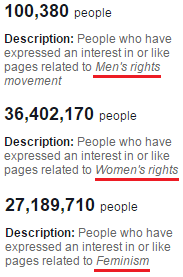
“Tell us about the people you’d most like to connect with,” Facebook urges when you piece together a page on its site. My entries under “Interests” brought up terms like Men’s rights movement, Feminism, and Women’s rights. Accompanying these topics were figures about how many others had expressed an interest in connecting with people who shared those interests.

See for yourself.

Notice that 200 to 400 times greater interest in bonding with people concerned with women’s rights has been shown than interest in bonding with people concerned with men’s rights. That’s a lot…A LOT a lot.

I don’t think there’s anyone who would deny that the fruits of feminism owe to social networking. Some of these fruits have been great; some really horrible. This blog concerns the rotten ones: a culture of victimhood and false accusation combined with the legislation of accelerated and derelict legal procedures presided over by judges bigoted by politics, bad practices (including engineered social science), and money.

Men have been the majority of victims, and they’ve been the only source of concentrated complaint, concentrated complaint that’s been mocked and muted. If we can assume the 200 to 400 times greater interest shown in women’s rights translates more or less proportionally to the number of people disinterested in or opposed to men’s beefs, then no wonder. Female influence, which is significantly feminist influence, is vastly predominant. The sympathy market has been cornered.

Men aren’t the only victims of procedural abuse, however.

Many if not most of the victims who comment on this blog are women, and they’re often desolate. Some live like hermits, some like refugees. They feel exiled and isolated.

The irony is this is exactly how women felt before the rise of feminism, and there’s a lesson to be taken from that.

Men’s struggles for a market share of sympathy face a phalanx of resistance and the priority of conditioned sentiment (prejudice); they’re also troubled by men’s lesser inclination to work collaboratively (the maverick mentality is a losing one). Women, however, can work from behind the lines. They can tap into the women’s rights network and harness its power.

And they should.

Copyright © 2015 RestrainingOrderAbuse.com

“Asia’s Law”: A Bereaved Father’s Proposal to End Parental Alienation

“Parental Alienation is an act of child abuse, and an attempt by one parent to sever [a] child’s ties with the other parent.”

Steven Foxworth, DaddysHeart.com

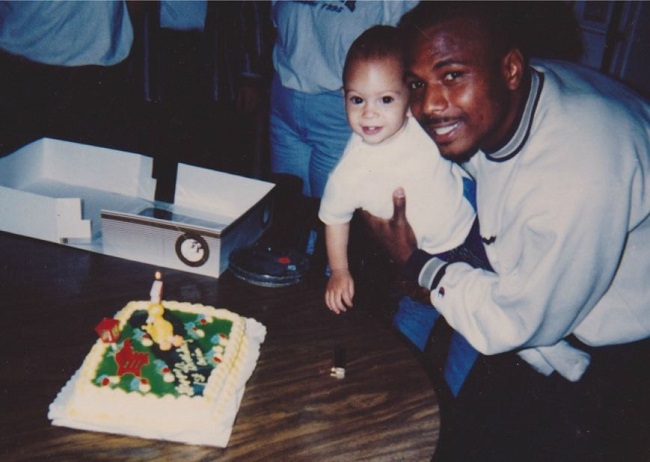
Steven Foxworth had a beautiful daughter, a beautiful daughter whose life he had been excluded from for 12 years, and a beautiful daughter he will never see again.

Nor will anyone else.

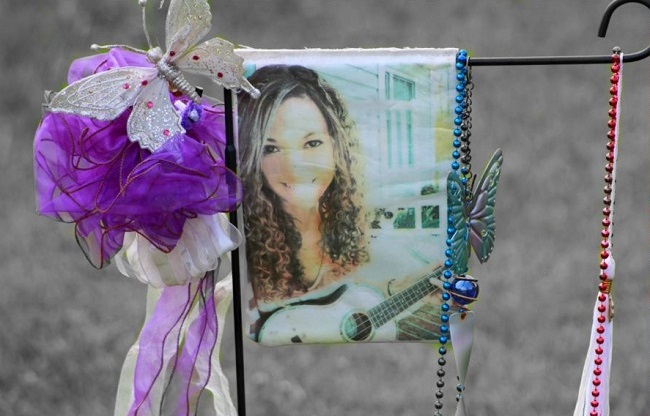
Asia Danielle was killed in a car accident in 2011 at the age of 16, and Mr. Foxworth didn’t learn of his daughter’s death until eight months later. Even if he had chanced to see the headline of his daughter’s obituary, published in another state, he may not have recognized it as hers, because his daughter’s name had been changed, which is why his attempts to find her over the years proved fruitless.

Asia Danielle Foxworth a.k.a. Danielle Westbrook was tragically killed in a car accident in 2011. Her father, Steven Foxworth, was informed of his daughter’s death by a mailed notice asserting that he had no entitlement to her estate. Mr. Foxworth was unlawfully denied any contact with his daughter for 12 years and wasn’t told her name had been changed.

For most of her brief life, the girl Mr. Foxworth had known as Asia Danielle Foxworth was Danielle (“Danni”) Westbrook.

After Mr. Foxworth separated from Asia’s mother in 1998, he was “threatened to stay away from his own child’s daycare that he enrolled her in.” Mr. Foxworth petitioned the court and succeeded in having his parental rights acknowledged “concerning phone/standard physical visitation, and full access to all pertinent info, i.e., school and medical records,” but Asia’s mother, Rusty Dawn Skipper, was granted full custody, and she moved to North Carolina and, according to Mr. Foxworth, declined to observe the court’s order that Asia be brought to Georgia for visitation with her father. She furthermore provided Mr. Foxworth no contact information and in 2000 changed Asia’s surname to Westbrook, that of her then fiancé, without Mr. Foxworth’s consent.

Though he paid child support, never knowing if it reached its intended recipient, the only communication Mr. Foxworth received from Asia’s mother concerning his daughter in 12 years was a legal notice, sent after his daughter’s death, apprising him that he had no claim to her estate.

That’s how the mother of his daughter informed Mr. Foxworth that his daughter was gone.

Mr. Foxworth reports that even seven months after Asia was killed, her maternal grandparents represented her as living when he contacted them, which he had faithfully done for years, even annually singing “Happy Birthday” on their answering machine, hoping the song would be shared with his estranged daughter.

Mr. Foxworth’s is a poignant story of a father’s alienation from his child that includes collusion by family members and the state. A more detailed version can be found on Mr. Foxworth’s tribute to Asia, DaddysHeart.com, under the tab “Asia’s Law.”

“Asia’s Law” is Mr. Foxworth’s proposal to stop parental alienation.

“Asia’s Law” will stand on the principle that no one parent has the right to infringe upon the legal parental rights of another parent.

“Asia’s Law” will promote the enforcement of standard child visitation for noncustodial parents as rigorously as child support is enforced for custodial parents. There will be a governmental arm that works with Child Support Enforcement Services that regards court-ordered visitation as seriously as child support arrearage. In the current construct, the message is sent that the value of money to take care of a child is more important than the value of a child’s having the love, affection, and guidance of his or her other parent.

“Asia’s Law” will also make it illegal for a custodial parent to change the name of a minor without the other natural parent’s consent—in any state.

Additionally, “Asia’s Law” will mandate that a non-custodial parent give blood (except in cases of religious exemption) so that if a child needs blood for any medical reason, it will be there for him or her.

“Asia’s Law” will save lives—emotionally and physically. We need this law passed to protect families.

My daughter, Asia Danielle Foxworth (“Danielle Westbrook”), is no longer here, but if there had been a law like this in place while she was living, she could not have been kept from me—under the radar for 12 years. Further, her “name change”—save legal adoption (which I would not have consented to)—could never have been permitted. Lastly, if my daughter would have survived her fatal car accident and needed blood, she could have had mine, providing it was stored for her. There are also children who have natural ailments; blood donation from a natural parent could save their lives, even if that other parent lived in another state. Too many are suffering. We need “Asia’s Law” passed. I have my story, but there are countless others. Parental Alienation is an age-old phenomenon and stereotypes typecast parents, especially fathers. The bottom line is no child should be kept from a loving parent—illegally and/or out of spite. If through “Asia’s Law” families are reunited, the rights of noncustodial parents respected, and lives saved, my daughter’s transition will not have been in vain.

~Steven Foxworth

Copyright © 2015 RestrainingOrderAbuse.com

*Compare Mr. Foxworth’s story of parental alienation to that of estranged father Neil Shelton: “The ‘Nightmare’ Neil Shelton Has Lived for Three Years and Is Still Living: A Father’s Story of Restraining Order Abuse.” Attention to Steven Foxworth’s story was brought to the author of this blog by the Georgia-based Kayden Jayce Foundation, a nonprofit devoted to remedying parental alienation and legal abuse.

The “Nightmare” Neil Shelton Has Lived for Three Years and Is Still Living: A Father’s Story of Restraining Order Abuse

The following account is reported by North Carolinian Neil Shelton, a father denied access to his son and daughter for “three years now and counting.”

In his account, Mr. Shelton alleges that his sister, in collusion with his ex-wife, lied to have him involuntarily committed, and that one or more partners in the law firm of his ex-wife’s attorney fabricated evidence to have him incarcerated. He alleges, in short, some very dirty divorce tactics.

Mr. Shelton’s allegations are abhorrent yet all too believable. Significantly, none of the criminal allegations introduced against him have held up in court.

Because, however, its author has no means of corroborating Mr. Shelton’s allegations of fraud, it is not the position of this blog that Mr. Shelton’s sister lied to the court or that either the attorney in question or his associates engaged in forgery. The blog author’s investigative wherewithal is limited, and he has no way of determining the allegations’ accuracy. Rebuttal responses from the accused are accordingly welcomed.

Neil’s story, then, as he tells it:

I am the victim of false allegations and restraining order abuse resulting from my divorce.

I’ve been wrongfully incarcerated for almost a year and falsely arrested numerous times for nothing I’ve done. To get a better idea, look at my page on Facebook, Growing UP Mayberry, and that will give you most of the full story. For this website, I want to share the restraining order abuse, as well as the ex parte abuse, and several things resulting from the restraining order and false allegations.

On May 29, 2012, which was shortly after I was kicked out of my house by my now ex-wife, I was arrested three times in one day.

This was the start of a campaign by my ex-wife’s divorce attorney, who is also my state representative, Sarah Stevens of Surry County and Mayberry (Mt. Airy), North Carolina. Yes, Mayberry, home of Andy Griffith and the inspiration for The Andy Griffith Show. My only reason for pointing that out is that no matter where you live, you are not immune to this unnecessary attack and, ultimately, bullying.

My ex-wife had my sister, Joan Shelton Phillips, a family nurse practitioner and my primary care physician, lie on two Involuntary Commitment forms saying I was bipolar, refused medication, and was riding around in a limousine threatening myself and others. At the top of the commitment papers, it says clearly: “wife wants husband committed.” The interviewing physicians were able to get my medical records, which showed I had never been seen or medicated for bipolar disorder. After some questioning, I was released from the first commitment attempt.

The Surry County Sheriff’s Dept. had arrested me at 10 a.m. the first time. I was released at 2:30 p.m. and rearrested by the MAPD at 3 p.m. for the second commitment attempt. When I arrived back at the hospital, the head physician asked, “What the hell are you doing back? I just released you!” Again, after a shorter session with the doctors, my ex-wife was made aware they were going to release me. On the commitment forms, the doctor even wrote that the one needing commitment was my soon-to-be ex-wife, not me.

When my now ex-wife was made aware of my impending release, she took her sister-in-law, who was the director of Surry’s Stop Child Abuse Now (SCAN), and they went to the Surry County Sheriff’s Dept. and had me charged with criminal trespassing.

I went straight from the hospital into police custody. Even though I was charged with criminal trespassing, my now ex-wife would later admit that I’d never been physically violent toward her. Using the criminal trespassing charge, of which I would later be found not guilty, my soon-to-be ex-wife was able to get a restraining order against me. Because I was never physically violent toward her, her divorce lawyer got creative. I had called my ex-wife a bitch and said, “You are not going to keep me from my kids.” This was used as the reason for the restraining order. Three years later, I’m still subject to the same restraining order.

The first day I met the divorce lawyer, Sarah Stevens, she asked to talk with me out in the hallway before the trial, saying maybe we could reach an agreement before being heard. I turned on my audio recorder and placed it in my shirt pocket, and proceeded to go speak with her. Once in the hallway, she said: “Now two things can happen today. One, you can be found guilty, which I promise you will be, and leave here with a restraining order against you from not only your ex-wife but your kids. Two, you can take a $5,000 settlement with no child support and agree to supervised visitation with your children, and the restraining order will disappear.”

I told her my children were not mentioned on the restraining order, and all I did was call my wife a bitch and tell her she wasn’t going to keep my kids from me, and that’s not domestic violence. She said yes your kids are mentioned in it, at which point I said then if you believe that, you need to go back to law school, because I haven’t been and know better than that.

“I’m dangerous broke, as y’all have shut down all my businesses, but I’m not dangerous with $5,000 and no restraining order against me?” With that, I told her I was finished. She said, “Yes, you are,” and we proceeded into the courtroom. I called her a few choice words, and her reply was, “Boy, am I gonna have fun playing with you.”

This is the nightmare I’ve lived for three years and am still living. I was arrested every time I turned down a settlement offer for an alleged restraining order violation. I began trashing Sarah Stevens on Facebook by posting what she was doing to me in court. I got warned to shut up and stop, but I didn’t and, again, everything I was doing was legal.

A total of five restraining order violations were alleged, leading up to a sixth, before they got tired of my winning in court without representation and got tired, also, of my political Facebook posts, and did something borderline genius, instead…only they executed it wrong.

They sat down with Zach Brintle, Stevens’s law partner, and penned a letter posing as me. In it, “I” threatened to kill all the lawyers, including him and his law partner/aunt, Sarah Stevens. It also threatened that all the district attorneys, the police, my entire family, and others would be killed, and ended, “Boston is nothing compared to what I’m planning.” This letter was purportedly mailed to my now ex-wife, and I was arrested for making terroristic threats.

During my almost yearlong incarceration, I was found not guilty on all counts of violating the restraining order, but I lost everything in my divorce. That’s because I was only allowed to work on my criminal trial while in jail, and my incarceration just happened to end two days after the deadline to appeal my divorce decree passed, and the decree gave my now ex-wife everything. The incarceration continued, because the district attorney claimed the FBI was doing an analysis of the letter. But after I was released, the FBI told me it had never received this letter for analysis. When I took the letter to my own handwriting expert, he concluded it was 98% likely that Brintle, not I, wrote it.

Upon my release, I showed the judge the two failed commitment attempts, the six not-guilty verdicts for allegedly violating the restraining order, the dismissal of the letter charges, the phone number of the FBI agent who told me the FBI had never been involved and had never investigated the letter—which supposed investigation the other side had used to hold me in jail—and the handwriting analysis proving the lawyer, Zach Brintle, wrote the letter. But the judge still extended the restraining order for yet another year.

I met Michael Volpe, the author of the upcoming book Bullied to Death: The Chris Mackney Story, who told me that these tactics are quite common in family court. I also met Raquel Okyay, who knows a lot and has helped raise my awareness that there are others going through this, too. She has also helped me tremendously in getting my story out.

My story is bizarre and extreme, but there are a many with stories like mine out there. I have not been allowed to see or speak with my children for three years now and counting. I’m sure I’ve left some things out, but there’s not enough room to tell my tale in this forum.

Since you’re reading this, chances are you’ve either experienced the same or are experiencing it, as most people don’t care until it happens to them. Honestly, I didn’t either, but that has changed. When reading this and all articles like it, remember you are not alone.

GOD BLESS.

Copyright © 2015 RestrainingOrderAbuse.com
Even when They’re Right, They’re Wrong: A Female Author Agrees Domestic Violence Laws Are Exploited to “Set Up” Partners but Puts the Blame Squarely on Men

Since the publication of this post, the website it quotes has been deleted.


“Victims of these increasingly common set-ups face criminal charges alongside their emotionally depleting divorce and custody cases, which are, of course, by now stacked against them.”

—Former crime reporter Janie McQueen

The quotation above comes from the author of the book, Hanging on by My Fingernails: Surviving the New Divorce Gamesmanship, and How a Scratch Can Land You in Jail.

Perhaps you’re thinking: I can so identify with that—and perhaps you can identify with it. If you’re not a woman, though, you’re not supposed to. So stop it.

Yep, a female author (and journalist) acknowledges that lying to the court to gain the upper hand in divorce and custody cases occurs. In fact, she says it’s “increasingly common.” According to her, though, the culprits are violent men.

Ms. McQueen apparently aspires to upset the dogma while still keeping the faith: The system is abused, she emphasizes, but women are the victims, and men are the victimizers.

Evident without benefit of having read her book is that because Ms. McQueen alleges she was framed (and probably quotes other women who allege they were framed), “set-ups” of this sort are asserted to be “increasingly common.” They probably are—they’re reported here routinely—but never mind, apparently, that Ms. McQueen’s contention is exactly what men have been saying for, um, decades. Whether frame-ups are “increasingly” common or not, they are common, and they have been for a long time (and thanks to rhetoric that insists women are incapable of lying maliciously, the likelihood of their becoming increasingly “increasingly common” is strong).

Since I haven’t read Ms. McQueen’s book, fairness requires that I acknowledge her position may not be as chauvinistic as it sounds. Also, the book has apparently been in print for three years, and I just heard about it Monday, so I’d venture to guess that it hasn’t exerted a great deal of populist influence. For an audience sympathetic to feminism to concede that false allegations from men are rampant would be to invite speculation on how rampant false allegations from women are.

That, as they say, ain’t gonna happen.

I learned of Ms. McQueen’s book in an online column in Forbes by Jeff Landers, a “certified divorce financial analyst” and the founder of Bedrock Divorce Advisors, LLC, a “divorce financial advisory firm that works exclusively with women.” Mr. Landers is also the author of multiple books directed to a strictly female audience.

His representation of Ms. McQueen’s book, then, may be skewed to his marketing demographic. I can’t say. This, however, is a passage from Ms. McQueen’s book quoted in Mr. Landers’s column “How Some Men Are Upending Domestic Violence Laws to Scam an Advantage in Divorce” (the passage is from the book’s forward, which is penned by Chicago criminal defense attorney Tamara N. Holder):

Unfortunately, many abusive men have learned to reshape domestic violence laws into another weapon of abuse. They are turning police and court protections upside down: The abusers themselves call 9-1-1; they have the women arrested for domestic violence; and then they do everything they can to try to have the women prosecuted and sentenced. In this way, the true victim is painted as the abuser.

There is a deeper motivation in using this ploy; to show a pattern of “violent conduct” on the woman’s part so that the abuser can use it as evidence against her in a divorce or child custody battle. And this form of abuse is permanent. A bruise heals after a few days, but a conviction for a violent crime mars her record forever.

The set-up: A couple has a fight. Either the wife calls 9-1-1 in a desperate plea for police intervention, or the husband makes the call first in a preemptive attack. When the police arrive, the woman is visibly upset. The man, on the other hand, is extremely calm as he switches off his anger. The husband tells the police that his wife is delusional, crazy, and violent. Depending on how convincing the man’s story is to the police officer, and the state’s law on domestic violence, either both people are arrested or the woman is arrested.

In the case of a dual arrest, which some states discourage, the woman often tells prosecutors she doesn’t want to testify against her husband, so the case is dismissed. Meanwhile, the husband is determined that she be prosecuted. Instead of the prosecutors looking into the history of the relationship before proceeding with the criminal case, they move full speed ahead. The wife is usually cut off from her husband’s financial support so she cannot pay for defense against him. As a result, she is forced to take a plea to the charges because she cannot afford to defend herself. She fears taking the case to trial, losing, and going to jail.

Conclusory remarks will be brief. First, bravo to Ms. Holder (and Ms. McQueen) for a detailed articulation of a serious problem, one that founders lives. What’s described above certainly happens; don’t doubt it for a moment. Second, though, what impassioned subdual of the imagination is required for an intelligent person to believe this only happens to women? C’mon. (Not only does the same thing happen to men, but the presence of children in the relationship isn’t a necessary motivation.) Finally, mark this statement well: “And this form of abuse is permanent. A bruise heals after a few days, but a conviction for a violent crime mars [a] record forever.”

Copyright © 2015 RestrainingOrderAbuse.com

Feminist Response Invited: Mom Gives up after Spending $25,000 to Fight a False Restraining Order and Regain Custody of Her Son Only to Have Her Ex-Husband Start the Whole Thing over Again

Feminists who identify with the “battered women’s movement” (the domestic violence lobby) insist fathers’ claims that women lie about abuse are false or overblown. This writer wonders whether they feel the same about mothers’ claims that men lie about abuse.

Here’s one mom’s account (submitted yesterday):

My ex-husband’s family just filed their second bogus restraining order against me to overturn custody of our 13-year-old. The first one, three years ago, I spent three months and $25,000 to fight, and got my son back. This one? I promised myself not to fight if they tried again, and I didn’t and lost today in court. They upheld the emergency order of protection and extended a restraining order against me for no contact with my own son for nothing I did at all—for two years. My son wants to be with them, so I’m not fighting. I just don’t want him to grow up thinking I did anything wrong and that’s why they took him from me. I don’t need to lose any more money and get fired from any more jobs trying to fight…. I’m done.

Restraining orders suck when used for ulterior motives. Unfortunately, they’re used to legally kidnap children, and I wish anyone who’s going through what I’m going through strength and health.

For those who don’t know how an “emergency order of protection” works, it’s this simple: the petitioner goes to court and files some allegations (“under oath”) that the defendant has to respond to a few days later. Typically the window to respond is far too narrow to make it possible for a defendant to retain legal counsel even if she weren’t resigned to defeat, as the mom whose story appears above was (after running up $25,000 in costs fighting a previous prosecution, losing jobs, and possibly being emotionally harried to the brink of insanity).

Feminists are encouraged to respond to this mom’s story, whether with sympathy or criticism. The court process she’s a victim of isn’t one this writer condones. Let’s hear from some people who do condone it.


This writer is tired and has no words of solace. The mother whose story this post concerns is prohibited contact with her son for two years, which may mean she’ll never have a normal, healthy relationship with him again.

Feminists out there—and I know you’re out there—are invited to remind her why this is as it should be.

Perhaps you could tell her how the courts never swallow lies, so she must be lying. Perhaps you could tell her how a process comprising two hearings mere days apart, a process that’s initiated and concluded in minutes, is fair and just. Perhaps you could reassure her that her sacrifice is ensuring the protection of abused women she’ll never meet. Don’t, however, let me put words in your mouths.

Ladies?

Copyright © 2014 RestrainingOrderAbuse.com

Learning to Talk the Talk: Resources for Victims of “Disturbed” People Who’ve Also Been Victimized by the Courts

“[Narcissism] is, in my opinion, the single most damaging and maladaptive tendency seen in sociopaths. When taken to extremes, it can lead to seriously abusive patterns of behavior that are repulsive and idiotic, both from any sort of ethical perspective and from the perspective of sheer self-interest. It is also fundamentally misunderstood. The word ‘narcissist’ connotes, to most people, merely personal vanity taken to an extreme. This is not what the word narcissism means in the context of sociopathic psychology. Narcissism…means the inability to understand that other people exist as distinct entities from oneself—with their own wants, emotions, and personal space—combined with a grandiose and exaggerated perception of self. The ‘narcissistic personality disorder’ described in the DSM is in my opinion simply the identification of sociopathic individuals who allow their own narcissistic tendencies to become so severe that [they begin] to ruin their lives and the lives of those around them.”

—Clinically diagnosed sociopath and blogger

I encountered this exceptional writer in an online forum recently and quoted much of what he had to say about the motives of the sociopathic mind, as well as his “insider” conclusions about what makes narcissists tick. He corroborated some of my own lay suspicions and corroborates as well the belief of psychologist Tara Palmatier, who has written volubly about abuses of legal procedure, that the personality disorders most damaging to others stem from sociopathy.

This writer, who very plausibly calls himself a “high-functioning sociopath” but who doesn’t otherwise identify himself, perceives people with these personality disorders (specifically, narcissistic personality disorder and borderline personality disorder) as “low-functioning sociopaths” who are prone to indulge hedonistic (that is, pleasure-seeking) impulses, both to their own detriment and that of those who run afoul of them. Put plainly, they hurt other people to gratify the urges of their haywire brains. This writer’s ideas are carefully and lengthily qualified, and with convincing earnestness and intelligence, and I urge anyone who’s interested in a nuanced understanding of disordered brains and their eccentricities to visit this writer’s blog, as well as that of the aforementioned psychologist, Dr. Tara Palmatier, for personal and clinical perspectives on disordered personalities and how to deal with them.

The reasons the personality-disordered are often brought up in this blog are two: (1) because these people have limitless capacity to destroy the lives of others and no scruples or inhibitions about lying to disown accountability for their actions, and (2) because their victims, who are also often victims of legal clashes people like this instigate to distance themselves from their crimes, don’t have the words or concepts to qualify what in the hell just happened to them.

Those who’ve been pursued by or had relationships with disordered personalities, particularly narcissists, whose peculiarities aren’t prominent and easily distinguished as aberrant, may be inclined to doubt or question their own perceptions (which narcissists are masters at manipulating) and may be no more able to characterize the conduct and chronic lying of such people than as “hurtful” or “disturbed” or “psycho.” The motives of the personality-disordered aren’t easily explicable, because they don’t make any sense. Until you’ve been initiated and made an earnest effort to comprehend such bewilderingly anomalous minds, you don’t have the tools to even articulate what you’ve been subjected to. It’s no wonder, for example, that blogs about victimization by narcissists have titles like An Upturned Soul and Out of the Fog—or that using the search term “narcissist” on Amazon.com yields 1,028 returns (including the titles, How Many Lies Are Too Many?: How to Spot Liars, Con Artists, Narcissists, and Psychopaths before It’s Too Late and Web of Lies: My Life with a Narcissist).

Fascinatingly, reading the blog of the “high-functioning sociopath” I’ve commended, and considering that sociopaths are popularly said to be emotional vacuums, there’s no avoiding the impression that he is very empathic, though his isn’t an “I feel you” empathy so much as a reasoned, analytic (“I feel me”) one, which actually makes for very lucid explication unmuddied by touchy-feely distractions that are hardly soothing, anyway, to people who’ve had their lives derailed and are looking for answers rather than palliatives.

Copyright © 2014 RestrainingOrderAbuse.com

*The original blog cited and recommended in this post, QuestioningSociopathy.com, has since been deleted by its author.

“Why Fix It If It Ain’t Broke?”: On Restraining Order Injustice and the Authority of Usage

“The greatest absurdities in the world become correct, as soon as they have got Usage fully on their side, just as the worst usurper becomes legitimate, as soon as he is completely established on the throne.”

—Esaias Tegner (1874)

The author of the epigraph, a Swede who popularized linguistic research, was talking about language, but his denunciation is broadly applicable. He deplored that standards of reason and rectitude are easily corrupted when “anything goes” becomes the norm.

He despairingly observed, in other words, that when absurdity becomes customary, it’s accepted without question.

The inanities inherent in the administration of civil restraining orders persist, because the process has enjoyed a 30-year reign virtually uncontested. Those most qualified to protest its inequities and inadequacies are seldom its victims, so their protests (few and far between) have accomplished little toward motivating reform, and those victimized by the process are seldom sufficiently educated in the law or spiritually equipped to defy their lot.

Popularity and rootedness have replaced decency and propriety as the gauges of worthiness, and the authorities who should most be outraged by this misrule have mostly kept mum.

Estimable jurists (legal experts) shouldn’t be contented with the dismissal, “Why fix it if it ain’t broke?” The restraining order process is broke, in more ways than one. It’s not only broken; it’s morally bankrupt, besides.

Elaine Epstein, former president of the Massachusetts Bar Association, acknowledged two decades ago that restraining orders are “granted to virtually all who apply.” Echoes of her critical candor from peers in the legal community have been markedly few, however, during the years since. Disdainful remarks by respected attorneys about how restraining orders are abused, such as those by Terri Weiss in her blog From Bedroom to Courtroom, may appear as asides in treatments of other topics, but seldom are restraining orders categorically denounced at length.

Eminent legal scholars are more likely to parse and weigh in on legal niceties of interest to the highest courts in the land, because such opinions are excellent fodder for curricula vitae (academic résumés). Meanwhile gross abuses of everyday processes that victimize citizens on an epidemic scale go disregarded. Too mundane, wot, wot. In reality, bucking the status quo by observing the obvious isn’t impressive or likely to enhance one’s popular (and thus professional) regard and credibility.

It would, however, promise to do a lot more social good.

Copyright © 2014 RestrainingOrderAbuse.com

Diving into the Shallow End: What It Takes to Disprove and Recover Damages for a Restraining Order Based on Fraud

Many restraining order recipients are brought to this site wondering how to recover damages for false allegations and the torments and losses that result from them. Not only is perjury (lying to the court) never prosecuted; it’s never explicitly acknowledged. The question arises whether false accusers ever get their just deserts.
It turns out it does happen sometimes. Or has at least once. Kinda.

A news story I came across the other day exemplifies how extreme false allegations must be, how vigorously they must be confuted, and how prominently their victim must stand out from the crowd for a judge to sit up and take notice.

The story concerned a woman’s being ordered to pay her former boyfriend over $55,000 after she “falsely accused him of raping and brutalizing her…during a child-custody dispute.” She had applied for a permanent restraining order against him alleging that he “perpetrated a horrific physical attack.” Her specific allegations to the police and court were that he “knocked her unconscious,” “dragged her in the house,” “sexually assaulted her,” and “burned her with matches and committed other violence.”

The boyfriend was arrested and held without bail for three months before a judge dismissed the charges. To regain his liberty, the man had to hire (besides an attorney, of course) a private investigator, who turned up “10 witnesses who were ready to testify that they saw [him] in other locations at the time of the alleged attack.”

According to his lawyer, he would otherwise have “faced the possibility of five life sentences in prison as a result of [his girlfriend’s] criminal complaint.” The money he was awarded was for legal and travel expenses. Although the lawyer informed the district attorney’s office that she had evidence the girlfriend had committed perjury, the woman wasn’t prosecuted. She had accused her boyfriend of breaking her shoulder during his alleged assault, but, the lawyer said, “her medical records reveal that she broke her shoulder diving into the shallow end of a swimming pool.”

The news story goes on to report that the boyfriend was pursuing a malicious prosecution lawsuit against his accuser, with whom he shares a son, alleging false imprisonment, abuse of process, and infliction of emotional distress.

While the recognition this man received for his suffering may surprise readers who’ve also been victimized by false allegations only to be subjected to further ridicule and disparagement from the court for resisting a bum rap, the fact that this rare recipient of quasi-justice is the senior vice president of a bank won’t be surprising at all.

Copyright © 2014 RestrainingOrderAbuse.com

Egotists, Narcissists, and Other Self-Seeking Con Artists: On (Restraining Order) Fraud and Its Motives

I came upon a monograph recently that articulates various motives for the commission of fraud, including to bolster an offender’s ego or sense of personal agency, to dominate and/or humiliate his or her victim, to contain a threat to his or her continued goal attainment, or to otherwise exert control over a situation.

These motives will be familiar to anyone who’s been the victim of a fraudulent abuse of legal process and correspond with those of attention- and revenge-seeking restraining order plaintiffs, plaintiffs keen to avoid exposure of extramarital entanglements or otherwise compromising indiscretions or misconduct (such as stalking), and plaintiffs intent upon wresting possession of children and/or property from a partner (and, in one fell swoop, rubbing him or her out).

Excerpted from “The Psychology of Fraud” by Grace Duffield and Peter Grabosky (published by the Australian Institute of Criminology in its Trends and Issues in Crime and Criminal Justice):

“[An] aspect of motivation that may apply to some or all types of fraud is ego/power. This can relate to power over people as well as power over situations. In terms of the former, the sensation of power over another individual or individuals seems to be a strong motivating force for some fraud offenders to the point that it becomes an end in itself. As one confidence man put it:

“‘For myself, I love to make people do what I want them to, I love command. I love to rule people. That’s why I’m a con artist’ (quoted in Blum 1972, p. 46).

“In manipulating and making fools of their victims, some fraud perpetrators seem to take a contemptuous delight in the act itself rather than simply the outcome. As Stotland (1977) points out:

“‘[S]ometimes individuals’ motivation for crime may have originally been relative deprivation, greed, threat to continued goal attainment, and so forth. However, as they found themselves successful at this crime, they began to gain some secondary delight in the knowledge that they are fooling the world, that they are showing their superiority to others’ (pp. 186–7).

“Similar to the sense of superiority over others is the gratification obtained from mastery of a situation.”

Predictably the monograph also touches on narcissistic personality disorder (NPD), one of several personality disorders that lead people to commit frauds on the court, and sketches the dimensions of this cognitive aberration.

“Persons who harbour unrealistic impressions of their own capability, when reinforced by sycophants, lack a reality check and may be more likely to engage in risky behaviour than more grounded or ‘normal’ [types] (Janis 1982).

“This risk-taking would be exacerbated by the indifference to conventional rules of conduct that apply to narcissistic personalities. According to the Diagnostic and Statistical Manual of Mental Disorders, narcissistic personality disorder is a pervasive pattern of grandiosity, a need for admiration and a lack of empathy for others. Individuals with this disorder believe that they are superior, unique, and ‘chosen,’ and they are likely to have inflated views of their own accomplishments and abilities. They focus on how well they are doing in comparison with others, and this can take the form of an excessive need for attention and admiration. A sense of entitlement is evident, and they expect to be given whatever they want regardless of the imposition it places on others. In the workplace, these people tend to overwork others. They demand unquestioning loyalty and are incredulous or infuriated when it is not forthcoming. They are likely to respond angrily to criticism (DSM-IV Task Force 1994, pp. 658–9). Perhaps most relevant to fraud offences is the tendency of the narcissistic personality to usurp special privileges and extra resources that they feel they have an entitlement to, over and above ordinary people. This attitude is captured in the words of Leona Helmsley, a wealthy American subsequently convicted of tax evasion, when she said ‘only the little people pay taxes.’ Due to their ambition, confidence, and ruthlessness in dealing with others, the narcissistic personality may be a high achiever in their chosen field of endeavour.”

This definition bears obvious correspondences with that of the sociopath, another familiar abuser of legal process. Narcissists and sociopaths are statistically rare: 1/100 and 1/25, respectively. If you consider, however, that within a population the size of the United States’ that translates to over 3,000,000 narcissists and over 12,000,000 sociopaths, widespread complaints of fraudulent abuses by these human anomalies are easily credible. They become more credible yet if you further consider that such people, being devoid of moral inhibition, may be far more likely than others to engage in fraud for spiteful or self-serving ends.

Restraining order fraud, which often entails criminal acts like the commission of false reporting and perjury, is commonplace and commonly winked at by the courts. Possibly judges don’t appreciate how attractive and accommodating restraining orders are to frauds. Possibly they don’t appreciate how damaging the consequences of restraining order fraud are to the psyches and fortunes of defendants (among others, for example, defendants’ children). Possibly they don’t recognize how epidemic the problem is. Or possibly…they don’t care.

But should.

Copyright © 2013 RestrainingOrderAbuse.com

[Referenced works in the quoted excerpts above are Deceivers and Deceived by R. H. Blum, “White Collar Criminals” by E. Stotland (published in the Journal of Social Issues), and Groupthink: Psychological Studies of Policy Decisions and Fiascos by I. Janis.]

What’s Wrong with This Nativity Scene?: Abusing Restraining Orders to Destroy Young Mothers and Take Their Babies

I hadn’t intended to write anything more before the holiday than my little stab at humor. I’ve had my outrage doubly piqued recently, though, by two corresponding sources. One of these sources is the whatever-you-call-ems who want the Christ put back in Christmas, most of which zealots are Protestants—do they want the mass put back in Christmas, too? And the other is two people’s writing to tell me about naïve, young girls who’ve been exploited, impregnated, rejected, taunted, and manipulated only to then be fingered as unstable in restraining order cases so the fathers and those fathers’ parents could gain custody of the babies. One of the dads in these cases is the son of an evangelical Protestant minister.

On NPR the other day, I listened to a woman voice how fretted she was by a nativity scene on display (in Washington D.C., I think) that was made out of beer cans. (As I understood the story to report, it wasn’t even on public display; it was viewable by admission only.) The concern—the expressed one, anyhow—was that seeing beer cans could inspire kids to want beer. According to this logic, seeing a house of cards might inspire kids to gamble, and seeing a matchstick fort might lead them to become arsonists.

Consider whether you don’t think this kind of scenario is more likely to exert a detrimental influence on a child’s development (and whether Jesus wouldn’t have thought so):

“My 23-year-old daughter’s life has been ruined by a restraining order [that] was put on her by her abusive [boyfriend] after she had their baby. My daughter is African American, and the baby’s dad is Caucasian. He decided to just stop communicating with my daughter after she had the baby [except] to taunt her into calling and emailing him out of frustration. The baby came looking close enough to Caucasian…. [H]e and his parents…put a restraining order on her and ceased any communication with her. She didn’t get how serious the restraining order was and ended up in jail three times. The irony is that he was beating my daughter up before she had the child, and she protected him rather than put a restraining order on him.”

The boyfriend and his folks used the restraining order, which was petitioned on the grounds that it was harassing of this woman’s daughter to call and email the father of her child to talk about their baby, to leverage custody of the child.

An identical situation was shared with me a month or so ago. In that case, the boyfriend/father was the son of a Southern Baptist pastor. Naïve girl was sexually exploited, led on, baited, and framed, and now must fight off maliciously false allegations and fight for custody of her child. (Merry Xmas, Reverend.)

The people who imagine that restraining orders are golden shields that protect women from abuses are the same pop dogmatists who perceive pernicious influence in a beer-can crèche. Ideas, ladies (and gentlemen), ideas need to be vetted for correspondence with reality. Let’s stop finding menace in abstractions and start recognizing it in real life.

Copyright © 2013 RestrainingOrderAbuse.com

“Why Would Someone Get a False Restraining Order?”

This question pops up a lot.

Simply rephrasing it can dispel some of the wonderment: “What would someone have to gain by falsely accusing someone else of conduct society condemns?”

Satisfaction of a spiteful impulse might come to mind.

I remember looking at a book once by a guy named Hayduke. It was chock full of ingenious vengeance schemes—pretty much all of them criminal or bordering on it. Lying on a restraining order to sate a hurtful yen, while technically criminal, is never treated as such and may well succeed in criminalizing the target of that yen.

Common allegations on restraining orders are harassment, stalking, danger, and violence. Any of these—and especially the last—can doom a person’s employment or professional aspirations, tear relationships apart, and gnaw at and vex the innocently accused indefinitely (to his or her physical and psychological erosion). Allegations like this from a domestic partner can deprive the same victim of assets and access to loved ones. The use of fraudulent restraining orders to gain the upper hand in child custody battles is pretty much cliché.

And restraining orders don’t just vanish from public record when the expire. In some regions, there are even restraining order registries to make finding out who’s had a restraining order sworn out against him or her conveniently (and alluringly) accessible by the public. The political push is toward making such registries universal.

It’s possible that the question, “Why would someone get a false restraining order?” is prompted by a disbelief that a person could be so unethical. Such a disbelief betrays the questioner’s naivety.

People frame people for crimes or commit crimes to hurt others every day. Abusing restraining orders is just more fail-safe. Perjury (lying in court or on a sworn statement) is never prosecuted, and restraining orders are generally free for the asking. You get the state to exercise your malice for you, it costs you nothing, and everyone extends you their sympathies.

The worst that happens when someone lies to obtain a restraining order is that it’s overturned on appeal. And even if it’s quashed, the recipient of the fraudulent restraining order will have been put through hell (and possibly cost several thousands of dollars in attorney fees). In fact succeeding in having a restraining order vacated (canceled) doesn’t necessarily mean it disappears from public record. Even if a fraud loses, s/he wins.

Clearly then the answer to the question, “Why would someone get a false restraining order?” is “Why not?”

Copyright © 2013 RestrainingOrderAbuse.com