A Legislated License to Lie: Nothing CAN’T Be Falsely Alleged on a Restraining Order

OK

Battery, rape, child molestation—any heinous allegation imaginable can be made in a petition for a restraining order, and it can be made falsely without consequence to the accuser.

Victims of false allegations often ask incredulously, “Can somebody say that?”

There’s nothing that can’t be alleged to the courts (or, for that matter, to the police). There’s no such thing as “can’t allege.” A judge might view allegations of genocide or conspiracy with aliens to achieve global domination as suspect—or s/he might not. Certainly there’s nothing to stop a restraining order applicant from making these allegations, and there’s nothing to stop a judge from crediting them. Neither accusers nor judges are answerable to a literal burden of proof.

As the infamous David Letterman case shows, even the most outlandish allegations easily duck judicial radar. For anyone unfamiliar with the case, here’s Massachusetts attorney Gregory Hession’s synopsis and commentary (quoted from “Restraining Orders Out of Control”):

One day in December of 2005, Colleen Nestler came to Santa Fe County District Court in New Mexico with a bizarre seven-page typed statement and requested a domestic-abuse restraining order against late-night TV host David Letterman.

She stated, under oath, that Letterman seriously abused her by causing her bankruptcy, mental cruelty, and sleep deprivation since 1994. Nestler also alleged that he sent her secret signals “in code words” through his television program for many years and that he “responded to my thoughts of love” by expressing that he wanted to marry her.

Judge Daniel Sanchez issued a restraining order against Letterman based on those allegations. By doing so, it put Letterman on a national list of domestic abusers, gave him a criminal record, took away several of his constitutionally protected rights, and subjected him to criminal prosecution if he contacted Nestler directly or indirectly, or possessed a firearm.

Letterman had never met Colleen Nestler, and this all happened without his knowledge. Nonetheless, she requested that the order include an injunction requiring him not to “think of me, and release me from his mental harassment and hammering.” Asked to explain why he had issued a restraining order on the basis of such an unusual complaint, Judge Sanchez answered that Nestler had filled out the restraining-order request form correctly. After much national ridicule, the judge finally dismissed the order against Letterman. Those who don’t have a TV program and deep pockets are rarely so fortunate.

If allegations like these don’t trip any alarms, consider how much easier putting across plausible allegations is, plausible allegations that may be egregiously false and may include battery, rape, child molestation, or the commission of any other felony crimes.

What recent posts to this blog have endeavored to expose is that false allegations on restraining orders are very effective, because the “standard of evidence” applied to restraining order allegations both tolerates and rewards lying. The only thing that keeps false allegations reasonably in check is the fear that malicious litigants may have of their lies’ being detected. Normal people at least understand that lying is “bad” and that you don’t want to get caught doing it.

To some degree at least, this understanding restricts all but the mentally ill, who may be delusional, and high-conflict litigants, who may have personality disorders and have no conscience, or whose thinking, like that of personality-disordered people’s, is overruled by intense emotions, self-identification as victims, and an urgent will to blame. Normal people may lie cunningly or viciously; high-conflict people may lie cunningly, viciously, compulsively, outrageously, and constantly.

The fear of getting caught in a lie is in fact baseless, because perjury (lying to the court) is prosecuted so rarely as to qualify as never. Most false litigants, however, don’t know that, so their lies are seldom as extravagant as they could be.

Often, though, their lies are extravagant enough to unhinge or trash the lives of those they’ve accused.

Appreciate that false allegations on restraining orders of battery, rape, child molestation, or their like don’t have to be proved. Restraining orders aren’t criminal prosecutions. Allegations just have to persuade a judge that the defendant is a sick puppy who should be kenneled. An allegation of battery, rape, or child molestation is just a contributing influence—except to the people who have to bear its stigma.

More typical than utterly heinous lies are devious misrepresentations. Accusations of stalking and untoward contact or conduct, which may simply be implied, are a common variety. The alleged use merely of cruel language may be very effective by itself. Consider how prejudicial a female plaintiff’s accusing someone (male or female) of forever calling her a “worthless bitch” could be. Substantiation isn’t necessary. Restraining order judges are already vigilantly poised to whiff danger and foul misconduct everywhere. In processes that are concluded in minutes, false or malicious accusers just have to toss judges a few red herrings.

Irrespective of the severity of allegations, the consequences to the fraudulently accused are the same: impediment to or loss of employment and employability, humiliation, distrust, gnawing outrage, depression, and despondency, along with possibly being menacingly barred access to home, children, property, and financial resource. This is all besides being forced to live under the ever-looming threat of further state interference, including arrest and incarceration, should additional false allegations be brought forth.

Even if no further allegations are made, restraining orders, which are public records accessible by anyone, are recorded in the databases of state and federal police…indefinitely.
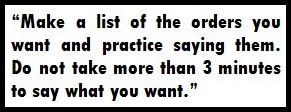
This “advice,” which urges restraining order applicants to rehearse, comes from the California court system and is offered on a page titled, “Ask for a Restraining Order.” The page’s title is not only invitational but can be read as an order itself: Do it. Note, also, that finalization of a restraining order may be based on less than “3 minutes” of testimony and that the court prefers it to be.

Recourses available to the falsely accused are few, and even lawsuits that allege abuse of process may face hurdles like claim preclusion (res judicata), which prohibits previously adjudicated facts from being reexamined. Never mind that the prior rulings may have been formulated in mere minutes based on fantasy and/or cooked allegations. Victims of defamation, fraud on the police and courts, and intentional infliction of emotional distress may moreover face stony indifference from judges, even if their lives have been entirely dismantled. And it should be stressed that attempting to rectify and purge their records of fraudulent allegations, which are established in minutes, can consume years of falsely accused defendants’ lives.

Recognizing that there are no bounds placed upon what false accusers may claim and that there are no consequences to false accusers for lying, the wonder is that more victims of lies aren’t alleged to be “batterers,” “rapists,” and “child molesters.”

Copyright © 2014 RestrainingOrderAbuse.com

No Proof Necessary: Why Restraining Orders Are Abused and Why Restraining Orders Exist

Advocates of restraining orders consider this standard too demanding.

The previous post addressed American standards of evidence and observed that with a single exception, the standard that’s applied to restraining order adjudications, “preponderance of the evidence,” is the least demanding.

Both the award of restraining orders and their being made “permanent” are at a judge’s discretion. (One of the meanings of discretion is “freedom to choose.”)

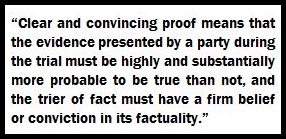
Even in Maryland, the exception to the rule, where final decisions to approve restraining orders must meet the intermediate standard of “clear and convincing evidence,” issuance of restraining orders is discretionary.

In other words, it’s pretty much up to whether judges feel plaintiffs’ allegations are more probably true than not. (Some states call this “good cause” or “reasonable grounds.”)

As previously remarked, this means the legitimacy of restraining order claims is always iffy. This is beside the fact that issuance of restraining orders proceeds from brief, one-sided interviews between plaintiffs and judges, and hearings to finalize them, which may be held mere days later, may themselves be nearly as cursory. Prejudice in favor of complainants, furthermore, has been conditioned if not explicitly mandated, and is all but universal.

What must be emphasized is that in a significant number of cases, despite their bearing criminal imputations or implications, the word evidence isn’t actually applicable.

This is the standard according to which restraining order allegations are “vetted.”

The phrase standard of evidence is misleading, because we’re accustomed to equating the word evidence with proof.

A restraining order may be approved on no more ascertainable a basis than an accuser’s alleged emotional state, that is, the claim of fear may be sufficient. Even when “evidence” is adduced, it may of course be misrepresented—and easily. Doctoral candidates’ oral exams are far more rigorous than restraining order hearings.

Worthy of note is that their tolerance of an absence of proof is both the reason why restraining orders are criticized and the reason why restraining orders are defended.

The only “justification” for restraining orders is the absence of proof.

This isn’t as counterintuitive as it sounds. Crimes alleged on restraining orders are prohibited by criminal statute. Assault, for example, may of course be tried in criminal court.

In that case, however, satisfaction of the standard “proof beyond a reasonable doubt” is necessary.

Restraining orders are stopgaps. What do you do if someone’s threatening you or knocking you around, but you can’t prove it? You apply for a restraining order. It takes an hour—or at most an afternoon—and gratification is immediate. The provision of instant relief was one of the germinal motives of restraining order laws.

All well and good, and there’s no question that people are abused all the time in ways they could never prove in criminal court. But what if an accuser is neurotic, mentally ill, or maliciously lying to gratify an ulterior motive?

There’s no failsafe built into the system. Recognize this, and the limitless potential restraining orders have for abuse becomes obvious.

What restraining orders do is make it easy for the system to dispense with a great number of complaints in short order that would otherwise gum up the works. They also keep a number of special interests happy and a lot of people busy and flush.

This wouldn’t be a big deal if their consequences were minor and restraining orders left no traces once their terms expired. This, however, isn’t the case. Restraining orders, which are prejudicially presumed by the public to be issued to stalkers and batterers, are public records that are not only preserved in the databases of the courts that issued them but in those of state and federal police.

Maryland

This assertion, which originates from the Maryland governor’s office and which presumes only genuine victims apply for restraining orders, argues that allegations ranging from “serious bodily harm” to “rape or sexual offense” should be adjudicated according to the same standard as contract or insurance disputes (as they are in every other state).

Direct consequences to their recipients, besides harassment and public humiliation, may include eviction from their homes and denial of access to kids, money, and property; and proximal consequences may include loss of employment and employability—along with all of the psychological effects that ensue from such losses, among which may be loss of enjoyment of life. Victims of delusional or malicious accusers may moreover be subject to arrest and incarceration if additional allegations are filed.

Pretty big deals, all of them, especially when the precipitating allegations are trumped up. Lives are undone by less.

Few suggest that restraining orders should be abolished, because no one wants to be accused of indifference to victims of domestic violence. The justification for restraining orders, finally, is coercive (and maybe always was).

Restraining orders should be abolished—or radically reconceived.

It’s true that restraining orders help victims out of abusive situations, and this is huge; but in a nation founded on the principle that all people are equal, no group’s interests excuse injury to other people. Aid to those in abusive situations, including children, must not come at the expense of others whose entitlement under the law is the same.

This doesn’t mean those in abusive situations should be written off; it means the present “solution” needs to be revised, because it’s unconscionable.

Coercive influences on law related to violence against women have generated wild imbalances in how allegations of stalking and domestic violence are treated, and have besides promoted unreasonable expansions of statutory definitions (“domestic violence,” for example, can mean a single act, which may not even qualify as violent). Our laws have become rattletraps.

Adjudication of restraining orders, catchalls that bear the stigma of stalking and violence and which may include these allegations among an assortment of others, is particularly problematic, because criminal allegations as severe as rape may escape being answerable either to a jury or to the standard to which they should properly be subject.

That standard is “proof beyond a reasonable doubt.”

Copyright © 2014 RestrainingOrderAbuse.com
“American Law is Irresponsible”: The American Civil Standard of Evidence and Abuse of Restraining Orders

“On the European continent, for the court to hold against the defendant, the judge must be convinced that the facts brought forward by the plaintiff in support of the claim are indeed true. In principle, continental law does not make a difference between civil law and criminal law […]. By contrast, U.S. law has three different standards of proof […]. In criminal law, the charge must be established ‘beyond a reasonable doubt.’ In civil law, normally the plaintiff wins if only ‘the preponderance of the evidence’ is in [his or] her favour. Only in a limited number of civil law matters, of particular gravity for the defendant, the intermediate standard of ‘clear and convincing evidence’ must be met.”

—Dr. Cristoph Engel

The monograph from which this quotation is excerpted, which is by a professor of experimental law and economics, begins by candidly remarking that “American law is irresponsible.”

No argument here.

At the root of restraining order injustice is the lax evidentiary standard applied to plaintiffs’ allegations. Not only may allegations on restraining orders be false; a judge doesn’t have to be convinced that they’re not false to find in favor of their plaintiff.

Excepting in Maryland, which adjudicates the merits of civil restraining order allegations based on the intermediate standard of “clear and convincing evidence,” the standard applied to restraining orders is “preponderance of the evidence.”

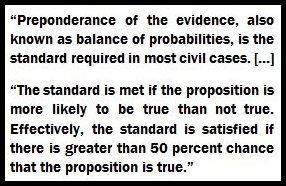
If claims seem more likely true than false, “preponderance of the evidence” is satisfied.

In other words, the law is contented if a single judge (not a jury of independent thinkers) reckons the allegations against a defendant are “probably true” (or “maybe true” or “true enough”). To be effective, all allegations have to be is compelling.

Making allegations compelling isn’t a tall task for people in the throes of bitter animosity, as restraining order plaintiffs typically are, and it’s a cakewalk for unscrupulous liars, who are hardly rare among restraining order plaintiffs.

Officers of our courts have furthermore had it impressed upon them that they shouldn’t question allegations made pursuant to the procurement of restraining orders, which are presumed to be sought by those in need of protection.

The legal standard familiar from TV and the movies, “proof beyond a reasonable doubt,” is reserved for criminal prosecutions. For a judge to find in favor of a civil restraining order plaintiff, no proof of his or her allegations is necessary.

Why this is a big deal is that being publically accused is agonizing. Cops and constables serve restraining orders on people at their homes, and just the documents themselves terrorize and shame (as they’re meant to). Allegations on restraining orders, what’s more, are never harmless. Even alleged minor offenses like harassment are inevitably tinged with overtones of danger and/or sexual deviancy. Plaintiffs are inclined to make their allegations as sensational as possible to justify their applications to the courts, and the courts are inclined to find threat or perversion even where none may exist to justify their intrusions into defendants’ lives.

Defendants are met with damning fingers from all directions—and enduringly, because restraining orders (and the allegations on them) are public records, accessible by anyone, that never disappear.

What makes this an even bigger deal, especially when evidence is fraudulently represented or allegations are false, is that restraining order defendants further face loss of employment and employability, as well as loss of access to kids, home, and property in a majority of cases.

Revisiting a phrase used by the author of the epigraph, such losses easily qualify as “particularly grave” and should therefore require the application of a more conclusive standard of evidence by our courts than “close enough.”

Exacerbating the injustice of this tenuous standard is that restraining orders are issued based solely on the word of their plaintiffs (ex parte). Decisions that may result in the losses enumerated above proceed from testimony given in interviews rarely lasting longer than 10 minutes.

Such hearings are far more perfunctory than probative. Basically a judge is just looking for a few cue words to run with and may literally be satisfied by a plaintiff’s saying, “I’m afraid.” (Talk show host David Letterman was notoriously issued a restraining order based on the petition of a woman who accused him of mentally oppressing her through her TV.)

What you have, then, on top of the presupposition of guilt, is a wishy-washy protocol yoked to a wishy-washy evidentiary standard.

It’s true that defendants are afforded the opportunity to challenge allegations leveled against them and actually address the court, but these follow-up hearings, also mere minutes long, are necessarily biased by the court’s prior findings.

The issuance of a restraining order (based on a few-minute chitchat) already represents a ruling, and the court’s disposition isn’t to contradict itself. This bias, authorized by a low evidentiary bar, too often translates to follow-up hearings’ being little more than theater—and an opportunity to subject defendants to additional humiliation and scorn.

Judges coyly criticize their partiality as “paternal.” Considering, however, the steep toll that that partiality may exact from innocent defendants, this self-excuse is nothing shy of obscene (and underscores the cognitive disconnect to which judges are prone between their performances in the courtroom and the effects of those performances on people’s lives).

Clearly the motive for applying a diminished standard of evidence to any courtroom procedure is not to decrease the likelihood of error. The lower the standard of evidence is, that much greater is the probability that miscarriages of justice will occur. When such miscarriages equate to innocent defendants’ being subjected to public humiliation and defamation, loss of employment, and effacement from their former lives, besides their having to tolerate the ever-looming possibility of incarceration following further false allegations’ being made against them, nothing less than the highest standard of evidence is conscionable.

The criticism of the writer of this post’s epigraph that “American law is irresponsible” doesn’t even begin to say it.

Copyright © 2014 RestrainingOrderAbuse.com