Play Misty for Me: Feminine Psychodrama and Restraining Orders

“The first time ‘Misty’ broke into the backyard to pound and scream at the bedroom window, the police handcuffed her and said—her face pressed to the hood of the idling black-and-white—that she was not to return. I figured we would never see her again after that early morning in 2012. But the next night, around 1 a.m., I was in bed with my new boyfriend, ‘Scott,’ and we heard the bedroom door slowly crack open. Scott jumped up. ‘No! You can’t be here!’ he shouted, all high-pitched.”

—“This Restraining Order Expires on Tuesday

Here’s a fascinating look at the female drama behind restraining orders. Its author is a gifted writer, and it’s an engaging read.

The subject of the piece, who’s called “Misty,” actually responds to it in the comments section—repeatedly—and calls some of its details into question, including ones that suggest speculation by the author (which, while imaginative, is nevertheless scrupulous and plausible). The writer, Natasha, was Misty’s rival in a love triangle. She apparently replaced Misty before Misty was prepared to relinquish her man.

That first night, [Scott and I] stayed at my house, and after having an intimate conversation in bed, we noticed his phone had 41 missed calls from Misty.

Then came the texts. She was at his house.

12:03 AM: Where are you? I’m staying here

12:05 AM: Please come back. I’m not going to lose you. I’m not going to give up. Please come back I want to see you. I love you

12:06 AM: I’m too drunk to drive home, can I please stay?

12:10 AM: Ok I’m staying.

Scott turned off the phone. The next morning when we checked again there were 16 more:

6:41 AM: By the way the pup tore the shit out of the house, but don’t worry I cleaned it up. If you can’t take care of him then you need to put him up for adoption.

To judge from Misty’s not contradicting the meat of the story (see the comments that follow it), its more titillating details are substantially accurate—and include serial calls and text messages to a nonresponsive ex, camping out in his yard, and even entering his house uninvited.
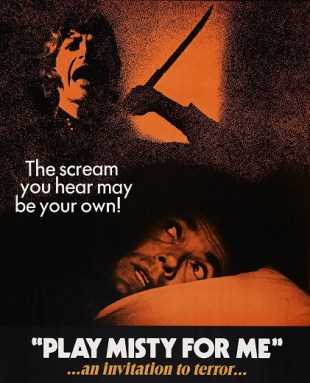
Hollywood representations like this one are seldom mirrored in real life. True “fatal attractions” are rare. High-conflict people, though, aren’t as rare as most imagine, which would be better known were their spiteful urges literally murderous (or even significantly violent). Attacks are typically insidious in their effects rather than bloody.

I tried to relax in Scott’s bed and just as I did, Misty appeared in the doorway.

“No! You can’t be here!” Scott cried, as he scrambled out of the sheets.

“I just came to see about the dog!” Misty shouted, rushing towards Scott.

Scott managed to wrangle Misty backwards away from the bed but she broke through and, before I could get fully to my feet, her arm swung back and I felt a fleshy thud against the side of my head.

She looked me in the eye, her nose ring glinting in the lamplight. “That’s what you get, you fat c[—],” she said.

She swooshed around, threw open the door (she had broken in through the window), and ran away into the night.

There was another series of confrontations with Misty but most of them took place in a courtroom, or through the unregulated space of fake Facebook profiles and anonymous emails. In the days after our first six-month order expired in 2013, Scott’s phone buzzed at 1 a.m.

It was a text message from Misty that just read: “Hi.”

Misty’s claim that her rival engaged in some passive-aggressive payback after a restraining order was procured also sounds credible:

Did you tell the people reading this article that you sent me a blank text from your boyfriend’s new phone during the restraining order period? I responded asking “who is this?” Natasha then proceeded to call the cops and told them I had violated the order. The judge laughed at it.

I’m no more a psychologist than Natasha, who chronicles the escapade, and I don’t know that her diagnosis of borderline personality disorder (BPD) would be confirmed by a clinician, but I think there’s more than a hint of personality-disordered aggression in Misty’s conduct (that reported and that on display in the comments section beneath the story). Of the various personality disorders that typify high-conflict people, what’s more, BPD seems the best fit.

The individual with BPD demonstrates a wide range of impulsive behaviors, particularly those that are self destructive. BPD is characterized by wide mood swings, intense anger even at benign events, and idealization followed by devaluation. The BPD individual’s emotional life is a rollercoaster and his/her interpersonal relationships are particularly unstable. Typically, the individual with BPD has serious problems with boundaries. They become quickly involved in relationships with people, and then quickly become disappointed with them. They make great demands on other people, and easily become frightened of being abandoned by them.

Most suggestive of a disordered personality is the lack of shame or remorse in Misty’s responses. Her impulse is to blame, derogate, and punish:

One day I will laugh at her and said moron’s obese, ugly children and thank the lord they are not mine. I will defend myself to the end! A gigantic f[—] you to all is well deserved. I really can’t help the fact that she’s ugly. Jealousy is a horribly disease. I can’t really think of any other reason why she’d carry this drama on so long, they clearly talk about me. I’m flattered.

A high-conflict person may act impulsively—i.e., in hot blood—but having a personality disorder doesn’t mean someone is insane or psychotic. After an outburst of pique, rage may cool to mute hostility—which may nevertheless endure and continue to flare for years. (It’s perhaps telling, though, that wrathful women are often portrayed brandishing knives. It’s our go-to image for invoking vengeful malice.)

There’s a temptation to wonder whether all of this couldn’t have been resolved by talking things through. The reactions of the couple, like the behavior of Misty’s that motivated it, might be considered hysterical. On the other hand, had the man in the middle shown empathy and tried to assuage Misty’s feelings, he might have been the one who ended up on the receiving end of a restraining order.

This happens.

People like Misty are on both sides of restraining order and related prosecutions. Dare to imagine what Misty would be like as an accuser—the absence of conscience and the vengeful vehemence—and you’ll have an idea of what those who are falsely fingered as abusers are subject to. They’re menaced not by repeated home intrusions but by repeated abuses of process (false allegations to the police and court), which are at least as invasive and far more lasting and pernicious in their effects and consequences.

Something the story significantly highlights is feminine volatility. Feminism (itself often markedly hostile) would have us believe women are categorically passive, nurturing, and vulnerable. It’s men who are possessive, domineering, and dangerous.

The active agents in this story are the women; the guy (the “bone of contention”) is strictly peripheral.

Copyright © 2018 RestrainingOrderAbuse.com

*The author of RestrainingOrderBlog.com (now apparently defunct) alleged his accuser was a borderline personality.

The Difficulty of Deciphering NUTS: Why False Allegations by People with Character Disorders Elude Recognition

knows nuts

The postscript to a recent post observed that one of the most devastating lessons of being the target of false allegations of abuse is how eagerly even people who should least react to them from the gut…do.

Trial judges often fail the victims of false allegations leveled by the disturbed. Subsequently, wronged defendants may follow the natural inclination to reach out to others for understanding and help…only to be disappointed all over again.

Those others might include members of their own social circles and families. Formal accusation is very divisive. Pastors and Ph.D.’s alike—contrary to their training and the ethics of their professions—will “reason by reflex” (ironically, exactly like someone who’s mentally disturbed).

On the one hand, shame on them. On the other hand, preconditioned prejudices mute the objections of better judgment—and they’re only reinforced when the people who bring fraudulent charges are convinced they’re telling the truth (really, their truth).

People with disordered personalities believe they’re victims. They may know otherwise, but what they know is overruled by what they feel. Their “truth” is precognitive. In a legal context, such people are called “high-conflict,” and they’re often serial abusers of process, because they’re drawn to it; it appeals to (and rewards) their compulsion to blame.

Some may think sociopaths, for example, have no feelings. That’s wrong. They may lack empathy—an appreciation for others’ feelings—but they’re acutely sensitive to their own emotions (albeit that those emotions may span a shorter spectrum than is typical). Their sensitivity to insult or anything that offends their sense of justice is particularly keen (as are their sense of entitlement and instinct for self-preservation). This is also true of “lower-functioning sociopaths,” like people with borderline or narcissistic personality disorder. If they feel insulted, they will go into blame overdrive like it’s life-or-death.

People with character disorders (who fixedly occupy the center of their universes) will lie to exact “vengeance” and perceive no moral conflict—and they’ll defend their lies with their final breaths. Their conviction is passionate and absolute (so, too, their need to dominate).

This makes them very persuasive and capable of any extremity of expression, even sobbing and hysteria (which may be as sincere as any brat’s is).

Law depends on visible, material contradictions to reach a determination of fraud. So do just folks.

Even victims of legal abuses who have significant evidence of lying—like letters, for example, or emails—find themselves tearing at their hair when they try to elucidate that evidence, because a personality-disordered person will lie to someone who knows s/he’s lying (this is called gaslighting). A letter to a victim from his or her accuser, for instance, will likely include some self-exculpatory narrative that the victim knows is false but that sounds totally plausible to a third party…and makes a firm impression. The contradictions in what mentally aberrant but socially conscious people say may be small, nested here and there in numerous statements, and finding a discerning audience among others who suspect the worst of him or her is nearly impossible for the accused to do.

Borderline personalities may be very domineering—notwithstanding that what they say may be totally off the wall (no one dares contradict them)—and narcissists may be excellent social engineers.

Process, furthermore, favors economy, and standards of evidence that accusers are required to meet may be very low—or even, practically speaking, nonexistent. Accusations leveled in civil court, for example pursuant to procuring a restraining order—a highly accelerated procedure—may only have to satisfy a judge’s “emotional read.”

Possibly most fiendish is that people with personality disorders aren’t necessarily great tacticians, but their impulsive lies perfectly accord with the expectations of normal people. Their programmed behaviors and responses, which after a while victims can readily anticipate, exactly synch with the (equally mindless) programmed behaviors and responses of their auditors. They hit the right chords.

They don’t have to be plotting; they just have to do what comes naturally.

Copyright © 2016 RestrainingOrderAbuse.com

*It doesn’t help that the prevailing status quo that obtains in the “justice system” is predisposed to afford victim status to anyone who points a finger. Nor does it help that judges may ignore even clinical diagnoses (nominating them “privileged,” “private,” or “irrelevant”) or that psychologists depend on voluntary admissions by the disturbed to make formal diagnoses in the first place.

Borderline Personality Disorder, Procedural Abuse, and Feminism: A Victim’s Reckoning of Their Tolls

YY_mural

“I hate this world and almost everybody in it. People use each other. I find most of you disgusting. My brothers are disgusting. The people I used to work with are disgusting. You’re shallow, you’re two-faced and hypocritical, you’re judgmental, you cause me more pain than you could ever possibly know. You don’t want me around? Guess what? I don’t want to be around you ugly motherf[—]ers, either. You cause all of your own problems, heap them onto other people, and then blame those people for your problems. You bitch about the amount of pain you’re in, then tell other people to get over their pain.

“I am done with all of you. I am done with your lies and your shitty society, and most of all, I am done kissing your ass.”

—Mrs. Nathan Larson (May 9, 2014)

Virginian Nathan Larson has had a tumultuous year.

He married a woman he met online (April 23, 2014); then she moved out (June 21, 2014) and accused him, among other things, of rape (August 2014 through January 2015); then they divorced; then he learned he was a father when the news reached him that his ex-wife had committed suicide.

The quotation above is from an online post of his former wife’s published between their marriage and their separation. Below is an excerpt from a digital diary entry of hers written when she was a teen (which included a “hit list”):

I hate the students at […]. They are arrogant and foolish. My one dream, my passion is to achieve a machine gun or something and shoot every f[—]er in the school. I want to pump them full of metal, their blood splattered on the tiles. I want to make a massacre that becomes the worst in American history. There are only a few people who I would spare. Everyone else…I would love to see them writhing on the ground in pain, blood oozing out of a million holes in their body.

Nathan’s wife, who was an arguably troubled woman, abruptly terminated their relationship of “75 days total” and then informed him she had miscarried their child. In August 2014, she accused him of rape to the police, but he declined to talk with them and was never charged. In November 2014, she began to accuse him to the courts.

This wasn’t a trial run, either. The accusations brought against Nathan by his wife mirrored charges she had made against a previous partner, also to damning effect.

She petitioned three ex parte (temporary) restraining orders before successfully obtaining a permanent order against Nathan in January of this year (by default). Its alleged bases were “domestic abuse, stalking, sexual assault, and physical assault.” The order was petitioned in Colorado, and Nathan would have had to travel a significant distance to be heard in his defense. “Not wanting to invest money and emotional energy in fighting it, and knowing it would be hard for me to successfully contest it, I didn’t show up to the hearing,” he says. He elected to “move on.”

The two were divorced in April 2015, and that seemed to be an end on it.

Two months later, Nathan was told his (then) wife had given birth to a child in February, presumably the one she had told him she had miscarried. This information reached him along with the news that his former wife had killed herself following her commitment for “suicidal depression” and allegedly hearing voices compelling her “to hurt or kill the Child.”

Nathan must now contest a “dependency and neglect petition” in Colorado asserting he’s an unfit parent.

What follows are his reflections on his marriage to a woman who he alleges had untreated borderline personality disorder, on feminism, and on “abuse culture” and its damages.

Nathan Larson (with his new fiancée’s infant cousin)

Having the benefit of distance from the situation and more calmness about it (especially now that she’s dead), I would say that we both made a lot of mistakes during and after the relationship. There are some people who say that it’s a mistake to enter into a relationship with someone with untreated borderline personality, because it simply won’t work, no matter what you do. Unfortunately, once you get into a relationship like that, your sense of reality can get distorted because you’re so in love, and they’re so convincing, and they get so many other people to agree with them, that you too start to believe it if you don’t have enough of an understanding of BPD to realize what’s happening and why.

For example, suppose you used to argue with your BPD partner, and occasionally lost your temper and had to apologize for saying something unkind. Because they’re so sensitive to minor betrayals, they might claim that you horribly emotionally abused and bullied them to get your way, and then tried to be sweet to them and make up, just like in the classic model we’ve been taught of the cycle of abuse. If you’re still thinking this person is the most wonderful person in the world, then logically you might think that you really did emotionally abuse them, because why would such a wonderful person say it if it weren’t true? Plus, they are clearly very upset over how you treated them, and they broke up the relationship over it, and now they’ve told everyone in your circle of friends and family about it, and many of them are telling you they agree that the breakup was your fault because of your emotional abuse.

These are people you respect and trust, and therefore this could not possibly be happening unless you really were abusive!

You start to blame yourself and even tell people, “She left me because I was emotionally abusive” (which of course attracts more criticism, because who would admit that if it weren’t true?). Eventually, you run into someone who hears your account of what was actually said and done, and challenges your interpretation, saying you’re being too hard on yourself, and that this chick is not as great as you seem to think she is. (To which, of course, you may think, “He just doesn’t know and understand her and our deep and beautiful relationship! We were soulmates! What are the chances I will ever find another woman like that? I searched my whole life, and she was the only one like that I’ve ever met who loved and appreciated me so much.”)

If you have good friends, they’ll awaken you to the fact that someone who truly loved you that much would be willing to forgive and come back to you, or at least treat you decently, rather than holding a grudge and trying to make you suffer.

Also, there’s the fact to consider that people with borderline personality disorder idealize and devalue, and they view people as either completely good or completely bad. This means that once they’re faced with the inescapable reality that you’re not perfect, they have to view you as completely evil. They also have to deny any blame at all for the end of the relationship, lest they have to conclude that they too are flawed, which would cause them to view themselves as completely evil. They can’t handle any feelings of guilt; they have to deflect all blame, including the blame for their own emotionality.

Feminists, of course, are not thinking about all this psychology going on behind the scenes.
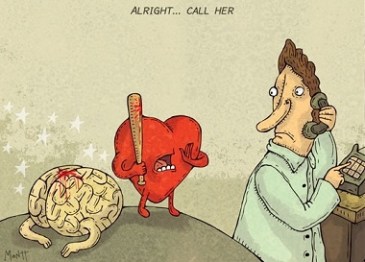
They’re busy calculating whether being skeptical of the claims of someone like that will make the public more likely to be skeptical of the claims of someone with legitimate, serious complaints, and make those victims more reluctant to come forward. So the innocent who was accused gets sacrificed for the greater good.

Some women with borderline personality disorder are attracted to the feminist movement and voraciously read all of their materials about abuse, patriarchy, rape culture, etc. because it helps them view themselves as a helpless victim of powerful sociopaths, and thus deflect blame.

They can find a community of people who will give them the benefit of the doubt by believing their stories, and confirm their interpretation of what happened. Borderlines also sometimes struggle to find a sense of identity, and the feminist movement can provide that as well. Their victimhood actually makes them useful to someone, since it’s a story they can tell and retell to those who need to be persuaded that political change is necessary to stop these abuses. (Feminists, like advocates for most other political movements, would bristle at any suggestion that their ideology attracts mentally ill people, since that would tend to discredit them.)

Yet what the feminist movement can never satisfactorily explain to them is why, despite all this training in recognizing red flags of abusers, and despite all the tools the system has provided for punishing abusers (e.g., restraining orders, prison sentences, etc.), they keep getting “abused” by partner after partner, while many other women seem to have successful, happy relationships.

The only possible answer is that it’s a combination of sociopaths’ finding them particularly attractive for some reason (maybe they sense they’ve been abused and think it’ll be easy to re-victimize them) combined with the fact that the patriarchy is still strong, abused women are still not being believed, and therefore we need to punish abusers more harshly and give the accusers even more benefit of the doubt.

Then, finally, when we have a world where all you need to do to get a man locked away for life is cry rape without any supporting evidence, rational men will finally stop raping. Except, even if such a system were put in place, these insecure women would still feel victimized by their partners, and they would attribute the “abuse” to these guys’ acting impulsively without regard to the certain punishment.

Copyright © 2015 RestrainingOrderAbuse.com

*An excellent explication of procedural abuse by “high-conflict” people (who are associated with personality disorders like BPD) and why court procedure is attractive to them is here.

J’s Story: Restraining Order Abuse and the “Dreaded Crazy”

J, a single dad who lives in Texas with his two kids, submitted his story as a comment to the blog in September, prefacing it: “I am writing this to share [it] with the rest of my fellow male victims [who] fall in with the dreaded Crazy.”

The “dreaded Crazy” in J’s case manifested as an Arkansas woman J began a romance with online, a high-conflict person whom a clinician might diagnose with borderline personality disorder (BPD).

(For an elucidation of BPD, see psychologist Tara Palmatier’s “In His Own Words: Dangerous Crazy Bitch Ahead,” which chronicles a case similar to J’s. See also any of Dr. Palmatier’s detailed explications of personality disorders.)

Here’s J’s story in his own words (lightly edited):

I met a beautiful, sexy, well-educated woman online. We met in person, and I was smitten. We shared our life stories with each other and began to see each other more. Although she lived over 500 miles away with her two children, I visited her every chance I could.

Her past was fraught will evil men who had taken advantage of her. She told me she was a young widow and that her first husband died suddenly of heart failure at a very early age, leaving her and her first child all alone. She said she remarried shortly after and had her second child. Unfortunately the second husband turned out to be a quite the carouser and left suddenly for Europe to be with another woman.

I felt so bad for her. I had two children of my own as a single father, so I was able to connect with how hard it was. She told me how she loved children and had always wanted a big family. She lamented feeling that her own family had deserted her, shunning her because she wasn’t a devout Christian.

There were so many twists and turns to her story. How could all this happen to such a wonderful and beautiful woman? She was such a nice and giving person….

Because it was all complete bullsh*t.

I won’t go into the details of my awakening. Let’s just say dates didn’t match up. Her kids’ (Fruit Loops’) stories didn’t match up. As a matter of fact, just about everything she told me didn’t match up. But I was smitten. So this went on for a long time until one day I just flatly called her on it. Suddenly my little scoop of heaven turned into a raging, clawing, screaming harpy. She accused me of being like every other son of a bitch in her life. Then she was swinging at me and screaming at me to get out.

I was already sprinting backwards, car keys in hand, toward my car. I got inside and sped off as she was chasing me. I was outta there, heading back to Texas never to return.

I did not see, speak, or talk to that woman again for over six months. Then one day a constable walks into my office and says, “Are you so-and-so?” I said yes. “Well, I have a restraining order for you from Arkansas.” Confused, I took it and read it. The constable then said as he was leaving, “I normally don’t read those. But looks like one crazy bitch to me. Better stay away. Ha-ha. Have a nice day.”

I was blown away.

The order claimed that I had snuck inside her house the weekend prior and forced her to call some other guy to tell this other guy (whom I don’t know, never met or heard of) that she was madly in love with me. Then her statement said I “roughed [her] up” then vanished into the night. Damn I was stunned. I did not know what to do. The order stated that I had 14 days to show up in Arkansas! I wasn’t even there. I lived in another state! I had not seen or heard from this woman in six months!

So I called an attorney friend of mine. He jokingly asked, “Did you do it”? I replied, “Hell no!” He then asked me to fax over the order. After he reviewed it, he called back and said, “Yep, it’s a restraining order, and you have 14 days. In the meantime, you have to stay away from her and her children.”

I replied, “This is bullsh*t! What if I just ignore it?” He said, “Well, if you ignore it and don’t show up in court on that day, you will automatically be found guilty. The charge will stay on your record, and you may not be able to buy a firearm.” “What the f—!” I yelled. “Can’t you just send a letter to the court explaining I wasn’t there and live 500 miles away?” He said no. “If you want to fight the charge, you have to show up.” He said he would have gone for me but wasn’t licensed in Arkansas.

He gave me the number of an attorney friend who worked in Little Rock. Next thing I knew, I’m having to fax or email every record I kept that shows my whereabouts on that day: gas receipts, store receipts, etc. I had to get a list of movies that I watched from the video download company we use. Cell phone calls. Text messages. (By the way, they really do monitor those. They can pinpoint your exact location, but you have to send a written request.) All of this to prove I was not there. Once I gave that attorney everything, he told me he would go to court that day and ask for an extension of 60 days. And I would still have to show up in Arkansas. Sh*t!

I cannot express the worry I endured during this time. Here I was falsely accused of something I did not do and was guilty until I proved otherwise in another state!

Prior to my court date, the attorney hired a private detective to run police reports on this woman’s current and former addresses. All you really have to do is call the local police department, and for a small copy fee it will give you all of the police reports related to a specific address for a specified time period. It’s really quite easy to do.

I was shocked when I saw them.

This woman, over a period of five years, had called the police over 20 times between two different addresses claiming either an assault or attempted break-in. All the police reports were noted as unfounded. One was a claim of rape. On that claim, she took some poor guy all the way to a grand jury, which promptly dismissed it. (Grand jury decisions are sealed, but the defendant’s name and attorney were listed. My attorney called that guy’s attorney and got a few details.)

The file on her sordid past was pretty thick. I thought that this was going to be over. Nope! I couldn’t use this information in court. It didn’t pertain to this incident. It was still her word against mine.

The day of the court hearing came. I drove out of state to be there. She actually showed in up in court that day. I suspect she didn’t expect I would show. The judge called out our docket. She sat on one side of the courtroom. My attorney and I sat on the other.

Seconds before the hearing, my attorney asked to briefly speak just to the prosecutor. They met in front of the bench, and my attorney handed him the file with prior police reports and my receipts and information as to my whereabouts on the day in question. The prosecutor then asked the judge if he could take a few minutes with the plaintiff. The prosecutor walked over to her with the file and whispered in her ear as he let her review the contents of the file. You could see the blood drain from her face. She whispered something to him. The prosecutor then stood up and said, “Your Honor, the plaintiff requests to withdraw her charge.” The judge just laughed and said, “Case dismissed.” That was it. It was over, no questions asked: $3,800 bucks and a long drive back home.

I did return to the local sheriff’s office and file an amended police report to state I was falsely accused and the case was dismissed on this date. You can have the dismissal form put in the police record.

I also had a cease-and-desist letter drafted by my attorney stating basically, “Don’t ever do this again, or I will sue you for liability.” You can put that in the police record, as well.

I had a copy of that letter sent to her by certified mail. I also had a copy personally delivered to her place of work by the same investigator who ran the background check. He went to her office and told the receptionist that he had a “special delivery” letter for her and that he needed to deliver it in person.

The receptionist called her to the front office. When she did, the investigator introduced himself and informed her that he had a letter to present. He pulled the letter out and proceeded to read the cease-and-desist letter out loud to her in the crowded waiting room. Then he handed it to her and left. He reported back that she appeared to have been in shock.

That’s it. Haven’t heard from her to date.

Copyright © 2014 RestrainingOrderAbuse.com

Rethinking “Stalking”: When Sociopathic Stalkers Apply for Restraining Orders

“Stalking acts are engaged in by a perpetrator for different reasons: to initiate a relationship (i.e., Some call it stalking; [he or] she calls it courtship); to persuade/coerce a former partner to reconcile; to punish, frighten, or control the victim; to feel a sense of personal power; to feel a ‘connection’ to the victim; or some combination of all of the above. Stalking is a form of abuse, and most abusers ultimately want control over their victims. Therefore, stalking is about controlling a love object, a hate object, or a love/hate object. Both love and hate can inspire obsession.

“Abusive personalities and stalkers often lack or have selective empathy for their victims. In fact, a characteristic of stalking is that the stalker objectifies [his or] her victim. If you don’t see your victim as another human being with feelings, needs, and rights, it becomes very easy to perpetrate any number of cruel, crazy, malicious, spiteful, and sick behaviors upon him or her. What about stalkers who believe they’re in love with their victims? Again, this is about possession and control; not love. They want to possess and control you regardless of what you want.”

Dr. Tara J. Palmatier, Psy.D.

Laws tend to define stalking as the exhibition of unwanted behaviors that alarm people.

What a broader yet nuanced definition of stalking like Dr. Palmatier’s reveals is that what makes someone a stalker isn’t how his or her target perceives him or her; it’s how s/he perceives his or her target: as an object (what stalking literally means is the stealthy pursuit of prey—that is, food).

Who perceives others as objects? The sociopath. Mention sociopath and restraining order in the same context, and the assumption will be that the victim of a coldblooded abuser will have sought the court’s protection from him or her.

The opposite, however, may as easily be the case.

Appreciate that stalking is about coercion, punishment, domination, and control of a target who’s viewed as an object, and it’s easy to see why the stalker in a relationship might be the petitioner of a restraining order, an instrument of coercion, punishment, domination, and control.

(“[T]o feel a sense of personal power,” furthermore, is a recognized reward motive for the commission of fraud. Pulling one over on other people, particularly those in authority, feels gooood.)

Appreciate, also, that a stalker’s motives for “courtship” (i.e., what s/he stands to gain from a relationship) may not be recognized by his or her target as abnormal at all. Nor, of course, will they be understood as abnormal by the stalker. What this means is, stalking isn’t always recognized as stalking (predator behavior), and correspondingly isn’t always repelled.

The Psychology of Stalking: Clinical and Forensic Perspectives notes that the majority of stalkers manifest Cluster B personality disorders, which I’ve talked about in the previous two posts, citing various authorities. People like this—borderlines, antisocials, narcissists, and histrionics—often pass as normal (“neurotypical”). They’re around us all the time…and invisible. Dr. Palmatier, a psychologist from whose writings the epigraph is drawn, has posited that Cluster B personality disorders “form a continuum” and “stem from sociopathy,” a trait of which is viewing others as objects, not subjects. Not only may others be unconscious of personality-disordered people’s motives; such people may be unconscious of their motives themselves.

(Out of respect for the author of the epigraph, I should note that my application of the word stalker in the context of this post departs from hers. The position of this post is that the person who pursues an objectified target and then displaces blame for aberrant behavior onto that target to “punish, frighten, or control” him or her is no less a stalker than the person who relentlessly seeks to possess his or her target. The topic of Dr. Palmatier’s exposition is attachment pathology of the latter sort.)

Contrary to the popular conception that stalkers are wallflower weirdos who obsessively trail dream lovers from a distance with the aid of telescopic lenses, stalkers may be socially aggressive and alluring—or at least sympathetic—and may exhibit no saliently weird qualities whatever.

Returning to Dr. Palmatier’s definition of stalking, what makes someone a stalker isn’t how s/he acts, per se, it’s why she acts the way s/he does. What makes an act an act of stalking is the motive of that act (the impulse behind it), which isn’t necessarily evident to a stalker’s quarry.

Placed in proper perspective, then, not all acts of stalkers are rejected or alarming, because their targets don’t perceive their motives as deviant or predatory. The overtures of stalkers, interpreted as normal courtship behaviors, may be invited or even welcomed by the unsuspecting.

The author of the blog Dating a Sociopath astutely limns the course of a relationship with a stalker (someone who views the other as a means, not an end with “feelings, needs, and rights”).

The sociopath wears a mask. But [s/he] will only wear that mask for as long as it is getting him [or her] what [s/he] wants. The sociopath is not emotionally connected, to you or anybody else. Whilst the sociopath might show connection, this would only be a disguise, to serve his [or her] own needs.

When the sociopath realises that [s/he] can have better supply elsewhere, or if [s/he] feels that supply with you is coming to an end, [s/he] will leave you without warning. The sociopath would have sourced a new victim for supply, but this would have been done behind your back and without your knowledge.

To do so, it is likely that the sociopath needed to play victim to the new source. Often [s/he] would have made complaints about you to gain sympathy and win support. Again, this will be something that you have absolutely no knowledge of, until later.

Consider her conclusion that a sociopath may “play victim” to acquire new narcissistic supply, and you’ll perceive how perfectly lies to the police and/or the courts (donning a new mask) may assist him or her in realizing his or her pathological wishes.

The blog post from which this quoted material is drawn concerns being abruptly discarded by a sociopath, which the writer notes may leave the sociopath’s quarry feeling:

  • Confused
  • Bewildered
  • Lost
  • Desperate for answers
  • A longing and neediness to understand
  • Wanting back the honeymoon stage
  • Unsure if the relationship is actually over or not?
  • Self-blame
  • Manipulated, conned, and deceived

Expressions of these feelings, whose motives are not those of stalkers but of normal people prompted by a need to understand the inexplicable, may take the form of telephone calls, emails, or attempts at direct confrontation—all of which lend themselves exquisitely to misrepresentation by stalkers as the behaviors of stalkers.

The personality-disordered answer primal urges, and among those urges is the will to blame others when their bizarre expectations aren’t satisfied—and they inevitably aren’t—or when others express natural expectations of their own that defy disordered personalities’ fantasized versions of how things are supposed to go.

The author of this blog, a formerly private man who had a restraining order petitioned against him characterizing him as a stalker (and who has been back to court three times since to respond to the same allegation, the least of several), has been monitored for eight years by a stranger he naïvely responded to whom he found standing outside of his house one day as he went to climb into his car.

I was a practicing writer for kids.

The first correspondent I had when I began this blog three years ago was a woman who’d been pursued and discarded by a pathological narcissist, who subsequently obtained a restraining order against her (by fraud), representing her as a stalker (cf. Dr. Palmatier’s “Presto, Change-o, DARVO: Deny, Attack, and Reverse Victim and Offender”).

She taught music to kids.

Last fall, I exchanged numerous emails with a woman who’d fallen for a man with borderline personality disorder, who abused her, including violently, then did the same thing after she sought a restraining order against him, which was denied.

She was a nurse who had three kids.

You’ll note that those labeled “stalkers” by the state in these cases—and they’re hardly exceptions—confound the popular stalker profile that’s promoted by restraining order advocates.

An irony of this already twisted business is that injuries done to people by their being misrepresented to the authorities and the courts by disordered personalities as stalkers ignite in them the need to clear their names, on which their livelihoods may depend (never mind their sanity); and their determination, which for obvious reasons may be obsessive, seemingly corroborates stalkers’ false allegations of stalking.
This in turn further feeds into the imperative of personality-disordered stalkers to divert blame from themselves and exert it on their targets. People like this fatten on drama and conflict, and legal abuses gratify their appetites like no other source, both because the residue of legal abuses never evaporates and because those abuses can be refreshed or repeated, setting off further chain reactions ad infinitum.

The agents of processes that were conceived to arrest social parasitism and check the conduct of stalkers are no less susceptible to believing the false faces and frauds of predatory people than their victims are.

Copyright © 2014 RestrainingOrderAbuse.com

Blame, No Shame: Restraining Order Abuse by High-Conflict, Personality-Disordered Plaintiffs

“Court is perfectly suited to the fantasies of someone with a personality disorder: There is an all-powerful person (the judge) who will punish or control the other [person]. The focus of the court process is perceived as fixing blame—and many with personality disorders are experts at blame. There is a professional ally who will champion their cause (their attorney—or if no attorney, the judge) […]. Generally, those with personality disorders are highly skilled at—and invested in—the adversarial process.

“Those with personality disorders often have an intensity that convinces inexperienced professionals—counselors and attorneys—that what they say is true. Their charm, desperation, and drive can reach a high level in this very emotional bonding process with the professional. Yet this intensity is a characteristic of a personality disorder, and is completely independent from the accuracy of their claims.”

—William (Bill) Eddy (1999)

Contemplating these statements by therapist, attorney, and mediator Bill Eddy should make it clear how perfectly the disordered personality and the restraining order click. Realization of the high-conflict person’s fantasies of punishment and control is accomplished as easily as making some false or histrionically hyped allegations in a few-minute interview with a judge.

Contemplating these statements should also make clear the all-but-impossible task that counteracting the fraudulent allegations of high-conflict people can pose, both because disordered personalities lie without compunction and because they’re intensely invested in domination, blaming, and punishment.

Lying may be justified in their eyes—possibly to bring a reconciliation. (This can be quite convoluted, like the former wife who alleged child sexual abuse so that her ex-husband’s new wife would divorce him and he would return to her—or so she seemed to believe.) Or lying may be justified as a punishment in their eyes.

As Mr. Eddy explains in a related article (2008):

Courts rely heavily on “he said, she said” declarations, signed “under penalty of perjury.” However, a computer search of family law cases published by the appellate courts shows only one appellate case in California involving a penalty for perjury: People v. Berry (1991) 230 Cal. App. 3d 1449. The penalty? Probation.

Perjury is a criminal offense, punishable by fine or jail time, but it must be prosecuted by the District Attorney, who does not have the time. [J]udges have the ability to sanction (fine) parties but no time to truly determine that one party is lying. Instead, they may assume both parties are lying or just weigh their credibility. With no specific consequence, the risks of lying are low.

High-conflict fraudsters, in other words, get away with murder—or at least character assassination (victims of which eat themselves alive). Lying is a compulsion of personality disorders and is typical of high-conflict disordered personalities: borderlines, antisocials, narcissists, and histrionics.

When my own life was derailed eight years ago, I’d never heard the phrase personality disorder. Five years later, when I started this blog, I still hadn’t. My interest wasn’t in comprehension; it was to recover my sanity and cheer so I could return to doing what was dear to me. I’m sure most victims are led to do the same and never begin to comprehend the motives of high-conflict abusers.

slanderI’ve read Freud, Lacan, and some other abstruse psychology texts, because I was trained as a literary analyst, and psychological theories are sometimes used by textual critics as interpretive prisms. None of these equipped me, though, to understand the kind of person who would wantonly lie to police officers and judges, enlist others in smear campaigns, and/or otherwise engage in dedicatedly vicious misconduct.
What my collegiate training did provide me with, though, is a faculty for discerning patterns and themes, and it has detected patterns and themes that have been the topics of much of the grudging writing I’ve done in this blog.

Absorbing the explications of psychologists and dispute mediators after having absorbed the stories of many victims of abuse of court process, I’ve repeatedly noticed that the two sources mutually corroborate each other.

Not long ago, I approached the topic of what I called “group-bullying,” because it’s something I’ve been subject to and because many others had reported to me (and continue to report) being subject to the same: sniping by multiple parties, conspiratorial harassment, derision on social media, false reports to employers and rumor-milling, fantastical protestations of fear and apprehension, etc.

The other day, I encountered the word mobbing applied by a psychologist to the same behavior, a word that says the same thing much more crisply.

Quoting Dr. Tara Palmatier (see also the embedded hyperlinks, which I’ve left in):

If you’re reading this, perhaps you’ve been or currently are the Target of Blame of a high-conflict spouse, girlfriend, boyfriend, ex, colleague, boss, or stranger(s). Perhaps you’ve been on the receiving end of mobbing (bullying by a group instigated by one or two ringleaders) and/or a smear campaign or distortion campaign of a high-conflict person who has decided you’re to blame for her or his unhappiness. It’s a horrible position to be in, particularly because high-conflict individuals don’t seem to ever stop their blaming and malicious behaviors.

A perfect correspondence. And what more aptly describes the victim of restraining order abuse than “Target of Blame”?

This phrase in turn is found foremost on the website of the High Conflict Institute, founded by Bill Eddy, whom I opened this post by quoting:

high_conflict_yellow

Restraining orders are seldom singled out or fully appreciated for the torture devices they are by those who haven’t been intensively made aware of their unique potential to upturn or trash lives, but the victims who comment on this and other blogs, petitions, and online forums are saying the same things the psychologists and mediators are, and they’re talking about the same perpetrators.

Judges understand blaming. That’s their bailiwick and raison d’être. They may even understand false blaming much better than they let on. What they don’t understand, however, is false blaming as a pathological motive.

Quoting “Strategies and Methods in Mediation and Communication with High Conflict People” by Duncan McLean, which I highlighted in the last post:

Emotionally healthy people base their feelings on facts, whereas people with high conflict personalities tend to bend the facts to fit what they are feeling. This is known as “emotional reasoning.” The facts are not actually true, but they feel true to the individual. The consequence of this is that they exhibit an enduring pattern of blaming others and a need to control and/or manipulate.

There are no more convenient expedients for realizing the compulsions of disordered personalities’ emotional reasoning and will to divert blame from themselves and exert it on others than restraining orders, which assign blame before the targets of that blame even know what hit them.

Returning to the concept of “mobbing” (and citing Dr. Palmatier), consider:

The group victimization of a single target has several goals, including demeaning, discrediting, alienating, excluding, humiliating, scapegoating, isolating and, ultimately, eliminating the targeted individual.

Group victimization can be the product of a frenzied horde. But it can also be accomplished by one pathologically manipulative individual…and a judge.

Copyright © 2014 RestrainingOrderAbuse.com

The Restraining Order Plaintiff from Hell: Malicious Prosecution and the “High-Conflict Person”

“The term ‘high conflict person’ has been popularised relatively recently in legal texts and general discourse to describe those people with certain behavioural clusters who are often observed in legal disputes. This is not meant to suggest that it is a new phenomenon. On the contrary, vexatious individuals and difficult clients are not new to agencies of accountability, lawyers, or mediators, especially those working in highly emotive legal dispute areas such as family law.”

Duncan McLean

Since I’m neither a psychologist nor an attorney, I’m free to say politically incorrect things. Layman’s license authorizes me to clarify, for instance, that the high-conflict people referred to in the epigraph can be monstrous. A clinician might hesitate to call the conduct of high-conflict people sick, and a mediator would reject such labeling as counterproductive to compromise. Nevertheless, that conduct can be extremely sick and far exceed the bounds of words like contrary, vexatious, and difficult.

If you’ve been attacked serially by someone you trusted who’s abused legal process to hurt you, spread false rumors about you, made false allegations against you, and otherwise manipulated others to join in bullying you (possibly over a period spanning years and despite your reasonable attempts to settle the situation), your persecutor is an example of the high-conflict person to whom the epigraph refers, and understanding his or her motives may be of value to your self-protection.
What the author of the monograph from which the quotation above is excerpted means by “behavioral clusters” (switching to the American spelling) is a set of traits and patterns of habitual conduct. High-conflict people, people with personality disorders (or who at least manifest some of their maladaptive traits), are defined by clusters of observable characteristics that guide them to instigate and sustain conflict, including conflict through abuse of legal process. Borderline, antisocial, narcissistic, and histrionic personality disorder (collectively, the “Cluster B disorders”) are defined by such characterological clusters.

Personality disorders are grouped into clusters based on their predominant features, and it is the Cluster B disorders which typically present with high expression of emotions, neuroticism, dramatization, and hostility.

Cluster B disorders are categorised into the following four sub-types:

  1. Borderline Personality – marked by instability of mood and intense anger, self-destructiveness, a poor sense of self, fears of abandonment, and manipulative behaviour.
  2. Antisocial Personality – a disregard for, and violation of, the rights of others and the rules of society; a lack of empathy and remorse; exploitative, reckless, and irresponsible behaviour.
  3. Narcissistic Personality – a pattern of grandiosity, self-love, and a need for admiration; a sense of entitlement and haughty, arrogant attitudes; preoccupation with success, power, brilliance.
  4. Histrionic Personality – pervasive and excessive emotionality and attention-seeking behaviour; shallow or insincere emotions; inappropriately seductive or provocative behaviour; impressionistic and flamboyant speech.

Note that a single individual may possess traits of more than one personality disorder (or may have more than one personality disorder) and that these definitions are not impervious to overlap. “The people diagnosed with these four disorders are known for their frequent and dramatic interpersonal conflicts and crises. Their personality characteristics often bring them into disputes which involve many others to resolve—including the courts” (Cheryl Cohen, Jack Mahler, and Gwen Jones, “Managing High Conflict Personalities in Mediation”).

If a reader of this post takes nothing else away from the epigraph, s/he should at least note Mr. McLean’s remark that high-conflict, personality-disordered people are “often observed in legal disputes,” a remark echoed by the quotation immediately above, which comes from a different source. Although high-conflict personalities are a minority respective to the population as a whole, they’re disproportionately commonplace among complainants to the courts and other “agencies of accountability” (like child protective services and the police, to offer but a couple of examples).

[P]eople with Cluster B personality disorders are more likely to escalate their disputes to satisfy their underlying need for dominance, blame, denial of responsibility and, sometimes, revenge.

High-conflict people, plainly, are your false accusers and vexatious litigants from hell. They’re driven to divert blame from themselves and exert it on others (who may be their victims).

Restraining orders, due to their low evidentiary threshold and ease of procurement, are ideal media for abuse by those with no scruples about lying or manipulating others and a keen interest in exciting drama and mayhem.

Mediators are circumspect in their judgments, because their role is to pacify strife and facilitate bridge-building between disputants. Effectively doing their work depends on possessing an empathic understanding of the motives of high-conflict people, which may also be worthwhile to those who’ve been victimized by them.

Cognitive distortions, thoughts that are based on a false premise, are a significant feature of high conflict personalities’ thinking style. Often as a consequence of disrupted attachment or a dysfunctional or abusive upbringing, sufferers will develop cognitive distortions and defence mechanisms in an attempt to make sense of the world and to make their experiences fit their own emotions.

Emotionally healthy people base their feelings on facts, whereas people with high conflict personalities tend to bend the facts to fit what they are feeling. This is known as “emotional reasoning.” The facts are not actually true, but they feel true to the individual. The consequence of this is that they exhibit an enduring pattern of blaming others and a need to control and/or manipulate.

The mediator’s position is that high-conflict people are in a sense “unconscious” of their lies and manipulations. More accurate might be that such people aren’t self-critical; they rationalize their conduct, which may be much more impulsive than premeditated but is always relentless and nonetheless destructive. Certainly many psychologists are less generous in their estimations of how unaware the personality-disordered are of their deceits and manipulations—as their victims are bound to be.

That notwithstanding, the appearance of monographs like the one I’ve highlighted in this post is a big deal, because our courts and other “agencies of accountability” are pretty much clueless about personalities like the ones on which it focuses attention (as in fact are most victims of such people).

That’s not to say Mr. McLean’s observations are new. His paper, which was published last year, shadows the professional writing of therapist, attorney, and mediator William (Bill) Eddy, who’s been elucidating the challenges posed by people with personality disorders in the court system (particularly family court) for decades. The monograph, moreover, cites Mr. Eddy’s work more than once. More recently, psychologist Tara Palmatier, whose online explications of the behaviors of the personality-disordered also draw on the pioneering observations of Mr. Eddy, has written volubly, accessibly, and explicitly about abuses, including legal abuses, committed by high-conflict people (as have a number of other psychologists who zero in on the narcissist personality). Many, if not most, of Dr. Palmatier’s patients have been the victims of such abuses and/or abusers, and some of their personal accounts (“In His Own Words”) appear on her blog.

Returning to Mr. McLean’s paper (which, again, echoes summations of both Mr. Eddy and Dr. Palmatier):

High conflict behavior…can be broadly described as behaviour which escalates rather than minimises conflict. The individual tends to escalate because they receive some kind of secondary gain from the dispute, but contrarily, they are inclined to blame others whilst perceiving themselves as the victim. The displayed emotion is often disproportionate to the dispute in question, and often there is the presence of poorly regulated emotions in the form of anger, impulsivity, and criticism of others, whilst it is not uncommon to observe controlling and manipulative behaviours.

High-conflict personalities are worse than liars; they’re liars who delude themselves that their lies are justified. They don’t reconsider or back down, and they’re capable of fomenting and sustaining conflict for years, including (especially in the case of narcissists) by gross fraud, smear tactics, and the enlistment of third parties to abet their frauds or participate in bullying their victims.

Because high conflict people tend to distort facts to suit their emotions, they often put a lot of energy into blaming other people for their cognitive distortions. The need to release internal distress results in reality-distorting defence mechanisms, such as projection and denial, which results in [their] failing to recognise their part in conflict. These cognitive distortions (also known as emotional facts) are frequently transferred to other people, which in turn often enables and exacerbates the behaviour.

In his paper, which I urge readers to consult, Mr. McLean includes actual transcript excerpts from cases heard in court that are both enlightening and impressive, and should encourage anyone in a legal clash with a high-conflict person who’s capable of obtaining the aid and representation of a mediator to consider it.

It’s deplorably the case that “rapport-building” is never an option in the drive-thru arena that is the restraining order process.

Examination of Mr. McLean’s professional insights into the specific personality disorders underscores how vexed resolving legal conflicts in this arena may be. He notes, for instance, that exposing a narcissist’s misconduct by confronting him or her with that misconduct or making him or her “look bad” will only fan the flames. He’s no doubt right, but in hearings that last mere minutes, painstaking assuagement of a narcissist’s ego isn’t practicable. Similarly he observes that among histrionics, “[e]xaggerated emotions and phoniness may be common initially.”

In a court process that’s concluded almost as soon as it’s begun, like a restraining order hearing, exaggerations and phoniness can’t be exposed through methodical cross-examination. The severity of a plaintiff’s allegations of apprehension may in fact excuse him or her from attending a hearing, altogether scotching the opportunity to expose his or her falsehoods by questioning.

Emphatically noteworthy, then, is the virtual absence from any but very lengthy and deliberate trials that are influenced by expertise like Mr. McLean’s of any chance to prosecute a capable defense against the frauds of high-conflict people.

Copyright © 2014 RestrainingOrderAbuse.com

Learning to Talk the Talk: Resources for Victims of “Disturbed” People Who’ve Also Been Victimized by the Courts

“[Narcissism] is, in my opinion, the single most damaging and maladaptive tendency seen in sociopaths. When taken to extremes, it can lead to seriously abusive patterns of behavior that are repulsive and idiotic, both from any sort of ethical perspective and from the perspective of sheer self-interest. It is also fundamentally misunderstood. The word ‘narcissist’ connotes, to most people, merely personal vanity taken to an extreme. This is not what the word narcissism means in the context of sociopathic psychology. Narcissism…means the inability to understand that other people exist as distinct entities from oneself—with their own wants, emotions, and personal space—combined with a grandiose and exaggerated perception of self. The ‘narcissistic personality disorder’ described in the DSM is in my opinion simply the identification of sociopathic individuals who allow their own narcissistic tendencies to become so severe that [they begin] to ruin their lives and the lives of those around them.”

—Clinically diagnosed sociopath and blogger

I encountered this exceptional writer in an online forum recently and quoted much of what he had to say about the motives of the sociopathic mind, as well as his “insider” conclusions about what makes narcissists tick. He corroborated some of my own lay suspicions and corroborates as well the belief of psychologist Tara Palmatier, who has written volubly about abuses of legal procedure, that the personality disorders most damaging to others stem from sociopathy.

This writer, who very plausibly calls himself a “high-functioning sociopath” but who doesn’t otherwise identify himself, perceives people with these personality disorders (specifically, narcissistic personality disorder and borderline personality disorder) as “low-functioning sociopaths” who are prone to indulge hedonistic (that is, pleasure-seeking) impulses, both to their own detriment and that of those who run afoul of them. Put plainly, they hurt other people to gratify the urges of their haywire brains. This writer’s ideas are carefully and lengthily qualified, and with convincing earnestness and intelligence, and I urge anyone who’s interested in a nuanced understanding of disordered brains and their eccentricities to visit this writer’s blog, as well as that of the aforementioned psychologist, Dr. Tara Palmatier, for personal and clinical perspectives on disordered personalities and how to deal with them.

The reasons the personality-disordered are often brought up in this blog are two: (1) because these people have limitless capacity to destroy the lives of others and no scruples or inhibitions about lying to disown accountability for their actions, and (2) because their victims, who are also often victims of legal clashes people like this instigate to distance themselves from their crimes, don’t have the words or concepts to qualify what in the hell just happened to them.

Those who’ve been pursued by or had relationships with disordered personalities, particularly narcissists, whose peculiarities aren’t prominent and easily distinguished as aberrant, may be inclined to doubt or question their own perceptions (which narcissists are masters at manipulating) and may be no more able to characterize the conduct and chronic lying of such people than as “hurtful” or “disturbed” or “psycho.” The motives of the personality-disordered aren’t easily explicable, because they don’t make any sense. Until you’ve been initiated and made an earnest effort to comprehend such bewilderingly anomalous minds, you don’t have the tools to even articulate what you’ve been subjected to. It’s no wonder, for example, that blogs about victimization by narcissists have titles like An Upturned Soul and Out of the Fog—or that using the search term “narcissist” on Amazon.com yields 1,028 returns (including the titles, How Many Lies Are Too Many?: How to Spot Liars, Con Artists, Narcissists, and Psychopaths before It’s Too Late and Web of Lies: My Life with a Narcissist).

Fascinatingly, reading the blog of the “high-functioning sociopath” I’ve commended, and considering that sociopaths are popularly said to be emotional vacuums, there’s no avoiding the impression that he is very empathic, though his isn’t an “I feel you” empathy so much as a reasoned, analytic (“I feel me”) one, which actually makes for very lucid explication unmuddied by touchy-feely distractions that are hardly soothing, anyway, to people who’ve had their lives derailed and are looking for answers rather than palliatives.

Copyright © 2014 RestrainingOrderAbuse.com

*The original blog cited and recommended in this post, QuestioningSociopathy.com, has since been deleted by its author.

Victim-Playing and Restraining Order Fraud

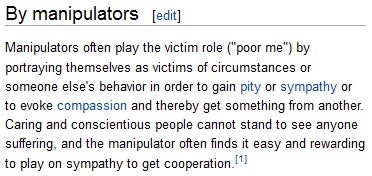
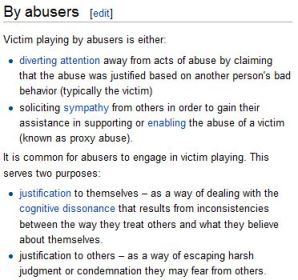
“Victim playing (also known as playing the victim or self-victimization) is the fabrication of victimhood for a variety of reasons such as to justify abuse of others, to manipulate others, a coping strategy, or attention seeking.”

—Wikipedia, “Victim playing

Once again I’m prompted to note that Wikipedia is all over motives for restraining order abuse but squeamishly avoids confronting the subject directly.

Restraining orders cater to and reward victim-playing like nothing else, because hyped or fabricated allegations made to judges aren’t subject to scrutiny or contradiction by anyone who knows the plaintiff (accuser) or defendant (accused). Procurement of a restraining order authorizes a victim-player (whether a bully, manipulator, or attention-seeker) to concoct any story s/he wants for third parties, including colleagues/coworkers, friends, and family. To the fraudster, it’s a golden ticket.

Allegations made on restraining orders are answerable to no standard of proof, are ruled on in the absence of any controverting evidence or testimony from the accused, and are made at no risk to a victim-player and at no cost beyond a few minutes of his or her time. Because lying to obtain a restraining order is child’s play for an unscrupulous accuser, and because this fact is known only to those who are lied about, a victim-player’s audience is easily convinced of his or her falsehoods, which may be extravagant. Gulled employers, for instance, may be induced to institute special security protocols to “protect” a victim-player from his or her victim. S/he doesn’t even have to be a particularly good actor. A restraining order sells itself.

In “Rethinking ‘Don’t Blame the Victim’: The Psychology of Victimhood,” psychologist Ofer Zur observes, “The victim stance is a powerful one. The victim is always morally right, neither responsible nor accountable, and forever entitled to sympathy.” The appeal, whether to a bully or attention-seeker (or attention-seeking bully), is transparent.

Excellent explications of victim-playing to “justify abuse of others” are presented by psychologist Tara Palmatier in her “Presto, Change-o, DARVO: Deny, Attack, and Reverse Victim and Offender” and “To the Victim Go the Spoils: False Allegations, Men as Default Scapegoats, and Why Some Women Get Away with Murder.”

Vis-à-vis victim-playing as a means of manipulation or as a coping strategy, this diagnosis by Dr. Palmatier is revealing: “People who abuse others maintain their power by keeping the truth of what they do secret. When you speak the truth, they begin to lose power and control. That’s what abusive personality types are after—power and control over you.” Restraining orders are unparalleled as tools for reengineering truth and dominating and silencing resistant victims. In fact, they may be the most effective instruments of coercion and revenge we’ve come up with yet. “Emotional abuse and bullying behaviors,” Dr. Palmatier elucidates, “are typical of those who have Borderline, Narcissistic, and/or Antisocial personality traits,” and victims of restraining order fraud by victim-players are urged to investigate the traits of the personality-disordered for correspondence with their own abusers and clues to their psychological motives.

The ambition of this post isn’t to say anything new but to connect a(nother) recognized human behavior to an unrecognized and commonly exploited method of abuse: restraining order fraud. As Dr. Zur observes, there’s an “unspoken, politically correct rule [in our culture] that the role of the victim…is NOT to be explored.” In other words—following the unexamined mantra, “Don’t blame the victim”—we’re not supposed to question “victimhood”; we’re supposed to sympathize and direct opprobrium toward the “offender.” The irony, of course, is that when victimhood is shammed, the actual victim is the mislabeled “offender.” And the unwillingness of society to acknowledge the sham is the agent of the victimization. Lies don’t victimize so much as our eagerness to credit them does. Victims of false allegations are victims of the state, not victims of liars. When restraining orders are abused, victims of that abuse may be stripped of home, children, property, career/livelihood, and (consequently) identity. And the beneficiaries of these losses, which are ones that may never be recovered from, are the victim-players. The “unspoken, politically correct rule” that Dr. Zur remarks not only rewards fraud and rapine; it ensures fraudsters are treated as objects of pity.

Copyright © 2014 RestrainingOrderAbuse.com

Shifting Blame: DARVO, Personality Disorders, and Restraining Order Abuse

“DARVO refers to a reaction that perpetrators of wrongdoing…display in response to being held accountable for their behavior. The perpetrator or offender may Deny the behavior, Attack the individual doing the confronting, and Reverse the roles of Victim and Offender such that the perpetrator assumes the victim role and turns the true victim into an alleged offender. This occurs, for instance, when an actually guilty perpetrator assumes the role of ‘falsely accused’ and attacks the accuser’s credibility or even blames the accuser of being the perpetrator of a false accusation.”

—Jennifer J. Freyd, Ph.D.

I discovered this quotation and the acronym it unpacks in Dr. Tara Palmatier’s “Presto, Change-o, DARVO: Deny, Attack, and Reverse Victim and Offender,” one of the most validating explications of the motives of false accusers I’ve read. There’s nothing in it that I can’t identify with personally, and I’ve heard from many others who I know would respond similarly.

DARVO seems to be a combination of projection, denial, lying, blame-shifting, and gaslighting…. It also seems to be common behavior in most predators, bullies, high-conflict individuals, and/or abusive personality-disordered individuals.

Goaded by some instances of blame-shifting that screamed at me from the e-petition “Stop False Allegations of Domestic Violence,” I recently wrote about “Role Reversal: Using Restraining Orders to Conceal Misconduct and Displace Blame.” I even referred to Dr. Palmatier’s work in the post, not yet having come across the above-mentioned entry in her own blog, which incisively exposes the origins of false motives.

Dr. Palmatier is a psychologist who specializes in treating male victims of domestic violence and abuse, but the behaviors she elucidates aren’t gender-specific, and both male and female victims of blame-shifting will be edified by her revelations, among them “why many Narcissists, Borderlines, Histrionics, and Antisocials effectively employ smear-campaign and mobbing tactics when they target someone” (“By blaming others for everything that’s wrong in their lives, they keep the focus off the real problem: themselves”).

At least a few visitors are brought here daily by an evident interest in understanding the motives of personality-disordered individuals—usually their spouses, lovers, or exes—who’ve obtained restraining orders against them by fraud or otherwise abused them through the courts. If you’re such a reader, consider whether this sounds familiar:

The offender takes advantage of the confusion we have in our culture over the relationship between public provability and reality (and a legal system that has a certain history in this regard) in redefining reality. Future research may test the hypothesis that the offender may well come to believe in [his or her] innocence via this logic: if no one can be sure [s/he] is guilty then logically [s/he] is not guilty no matter what really occurred. The reality is thus defined by public proof, not by personal lived experience [quoting Dr. Freyd].

So thorough and laser-sighted is Dr. Palmatier’s topical treatment of “[a]busive, persuasive blamers [who] rely on the force of their emotions to sell their lies, half-truths, and distortions” that there’s little point in my repeatedly quoting it and adding my two cents, but I eagerly bring it to the attention of those who’ve been attacked through the courts by abusers who used them as scapegoats to mask their own misconduct.

Dr. Palmatier remarks, “This behavior is crazy-making if you are the target of it.” If you respond, Amen—and especially if you respond, F*ckin’ A!men—read this.

Copyright © 2014 RestrainingOrderAbuse.com

Crying Wolf: On Attention-Seeking Personality Disorders and Restraining Order Abuse

I this week came across an online monograph with the unwieldy (and very British) title, “Drama Queens, Saviours, Rescuers, Feigners, and Attention-Seekers: Attention-Seeking Personality Disorders, Victim Syndrome, Insecurity, and Centre of Attention Behavior,” which pointedly speaks to a number of behaviors identified by victims of restraining orders who have written in to this blog or alternatively contacted its author concerning the plaintiffs in their cases.

What caught my eye, especially, is that this monograph appears on a site titled, BullyOnline.org (now defunct).

The popular perception of restraining orders is that they’re sought by plaintiffs to remedy bullying. The monograph I’ve referenced doesn’t speak to restraining orders, per se, but its revelations about attention-seeking personality disorders are very applicable to abuses of restraining orders and are interesting because they turn the popular perception of restraining order plaintiffs’ motives on its head.

Victims of false restraining orders are urged to consult this monograph for language that may be of assistance both in defining the motives of fraudulent plaintiffs and in cementing an understanding of the psychological exigencies that underlie those motives. Of particular relevance to the subject of this blog are the following personality types sketched by the monograph’s author:

The manipulator: she may exploit family relationships, manipulating others with guilt and distorting perceptions; although she may not harm people physically, she causes everyone to suffer emotional injury. Vulnerable family members are favourite targets. A common attention-seeking ploy is to claim she is being persecuted, victimised, excluded, isolated, or ignored by another family member or group, perhaps insisting she is the target of a campaign of exclusion or harassment.

The mind-poisoner: adept at poisoning people’s minds by manipulating their perceptions of others, especially against the current target.

The drama queen: every incident or opportunity, no matter how insignificant, is exploited, exaggerated, and if necessary distorted to become an event of dramatic proportions. Everything is elevated to crisis proportions. Histrionics may be present where the person feels she is not the centre of attention but should be. Inappropriate flirtatious behaviour may also be present.

The feigner: when called to account and outwitted, the person instinctively uses the denial-counterattack-feigning victimhood strategy to manipulate everyone present, especially bystanders and those in authority. The most effective method of feigning victimhood is to burst into tears, for most people’s instinct is to feel sorry for them, to put their arm round them or offer them a tissue. There’s little more plausible than real tears, although as actresses know, it’s possible to turn these on at will. Feigners are adept at using crocodile tears. From years of practice, attention-seekers often give an Oscar-winning performance in this respect. Feigning victimhood is a favourite tactic of bullies and harassers to evade accountability and sanction. When accused of bullying and harassment, the person immediately turns on the waterworks and claims they are the one being bullied and harassed—even though there’s been no prior mention of being bullied or harassed. It’s the fact that this claim appears after and in response to having been called to account that is revealing. Mature adults do not burst into tears when held accountable for their actions.

The abused: a person claims they are the victim of abuse, sexual abuse, rape, etc. as a way of gaining attention for themselves. Crimes like abuse and rape are difficult to prove at the best of times, and their incidence is so common that it is easy to make a plausible claim as a way of gaining attention.

The victim: she may intentionally create acts of harassment against herself, e.g., send herself hate mail or damage her own possessions in an attempt to incriminate a fellow employee, a family member, neighbour, etc. Scheming, cunning, devious, deceptive, and manipulative, she will identify her “harasser” and produce circumstantial evidence in support of her claim. She will revel in the attention she gains and use her glib charm to plausibly dismiss any suggestion that she herself may be responsible. However, a background check may reveal that this is not the first time she has had this happen to her.

Many respondents to this blog—victims of lovers, spouses or ex-spouses, friends, coworkers, neighbors, or family members—have reported serial behaviors of the aforementioned sorts, and some have discovered that plaintiffs who have sought restraining orders against them are not first-time applicants. One or more of these personality types (or a merger of them) is likely recognizable to most victims of restraining order abuse.

Separate profiles on the “serial bully,” the “attention-seeker,” “narcissistic personality disorder,” and “bullies in the family” appear on the referenced site, and its author estimates that 1/30 people fit its profiles.

Hold this statistic up beside the one propounded by psychologist Martha Stout in her book, The Sociopath Next Door, that an estimated 1/25 people fit the clinical definition of “sociopath”—someone, that is, who’s devoid of moral compunction/empathic identification altogether—and it’s a reasonable proposition that an abundance of allegations made to officers of our courts derive from calculated hokum and that a goodly percentage of restraining orders, far from being sought out of a need for remedial relief, are in fact exploited as instruments of abuse or employed to gratify their plaintiffs’ need to have all eyes focused on them.

Copyright © 2013 RestrainingOrderAbuse.com

“perjury and sociopaths”: On the Challenges of Contesting Restraining Orders Sought by the Mentally Aberrant, Deranged, or Ill

A recent respondent to this blog detailed his restraining order ordeal at the hands of a woman who he persuasively alleges is a sociopath. He says this label is generally scoffed at by people he explains the matter to and wonders how he could convince a judge of its accuracy.

Since this blog was published nearly two years ago, hundreds have been led to it by search terms that include words and phrases like “sociopath,” “mental illness,” “narcissist,” and “personality disorder” or “borderline personality disorder” (“bpd”).

This should hardly be a source of surprise.

Restraining order applicants aren’t screened based on their psychiatric histories. Sociopaths and narcissists, who are seldom clinically diagnosed in the first place, are moreover cunning liars and manipulators. Obtaining restraining orders—which are issued solely on the basis of brief interviews between petitioners and judges—is not only a simple matter for them but rewards their pathological drives for dominance and revenge.

Characterized generously, the restraining order process is fast-food justice. The ability and opportunity of most defendants to qualify allegations of sociopathy or insanity against their accusers—assuming these defendants even recognize these conditions—is effectively none at all. And unless a restraining order applicant is completely off the wall, his or her allegations won’t even cause a judge to arch an eyebrow. Applicants are in and out of restraining order interviews in a matter of minutes. Sociopaths are the smoothest liars you’ll ever meet, and the insane may be more convincing yet if they wholeheartedly believe their allegations in spite of those allegations’ possibly having no relationship to reality at all.

The imperceptibility of mental disorders is what makes them so difficult to expose (on this subject, see also these related posts).

I could go on about how easily the restraining order process is abused by sociopaths or the otherwise mentally aberrant. And I could describe to you the devastating effects their false allegations have on the lives of those they abuse. Instead I’ll close with some of the relevant search terms that have brought readers here since this blog’s inception. Identical search terms have been eliminated (“beating a narcissistic sociopath,” for example, rolls in regularly).

  • “beating a narcissistic sociopath”
  • “emotional crimes” “sociopathy”
  • #beating a narcissistic sociopath
  • a crazy person filed a restraining order on me
  • a mentally ill sister files false charges in virginia
  • a narcissist filing pfa
  • a narcissist that plays the victim role
  • abuse by a nsrcisistic sociopath restraining order
  • abusice narcissist ruined my life erased
  • antisocial personality disorder and self-victimizing statements
  • antisocial personality mom filed abuse charges against
  • are narcissists con artists?” for order of protection
  • attention seeker false abuse
  • attorneys lawyer in san jose for emotionally abused men by bpd wife
  • attribute mental illness false allegations
  • bdp, false charges,revenge
  • beating a narcissistic sociopath in court false accusations
  • beating a narcissistic sociopath restraining order
  • bi polar ex gets restraining order
  • bipolar and getting a protection order against me
  • borderline ex got ppo
  • borderline ex ruining my reputation
  • borderline false restraining orders
  • borderline mother making false accusations
  • borderline personality and false restraining order
  • borderline personality and restraining order
  • borderline personality boyfriend call the cops with false alligations
  • borderline personality disorder and denied restraining orders
  • borderline personality disorder and false accusations and restraining orders
  • borderline personality disorder and restrainig orders
  • borderline personality disorder and restraining order police
  • borderline personality disorder false accusations
  • borderline personality disorder false allegations restraining order
  • borderline personality disorder false harrassment claims
  • borderline personality disorder false pfa
  • borderline personality disorder getting a restraining order against me
  • borderline personality disorder restraining order
  • borderline personality false domestic violence
  • borderline personality perjury custody
  • borderline personality restraining order
  • borderline personality wife how to stop her ruining my reputation?
  • borderline restraining order
  • borderline teen making false accusations
  • borderline trying to ruin reputation
  • borderline woman and restraining order
  • borderline woman out to ruin my reputation
  • borderline women false accusations of violence
  • borderlines and protection orders
  • borderlines and restrainging orders
  • bpd “false accusations” police
  • bpd and false accusations
  • bpd and restraining order
  • bpd and restraining orders
  • bpd and slander
  • bpd destroying other peoples false allegations, police, court, arrested, crazy
  • bpd ex boyfriend wanting revenge
  • bpd ex filed restraining order
  • bpd ex got ppo
  • bpd ex ruined my reputation
  • bpd false accusations and jealousy
  • bpd false accusations legal process
  • bpd false harassment claims
  • bpd false protective orders
  • bpd false stalking
  • bpd filing protection of abuse order to spouse
  • bpd gf abused me
  • bpd how to deal with false allegations california
  • bpd protective order children
  • bpd restraining order dropped
  • bpd restraining orders
  • bpd restraining orders fraudulent
  • bpd spouse ruined my life
  • bpd threatening to call cops
  • bpd why do they make false accusations
  • bpd wife filing for restraining order based on false accusations
  • bpd wife put restraining order on husband
  • bpd wife ruined my life
  • bpd woman and restraining order
  • california domestic violence false allegations borderline disorder
  • can you secretly videotape a narcissist for proof of perjury
  • civil harassment and narcissistic personality disorder in california
  • crazy ex girlfriend filing fake assault charges on me
  • crazy girlfriend filing fake domestic violence charges
  • crazy girlfriend pfa
  • crazy girlfriend who makes false police reports
  • crazy neighbor got a restraining order on me
  • darvo + bpd
  • darvo and the bpd
  • dealing with sociopaths in court
  • defeating a sociopath
  • defense of false allegations and maryland and personality disorder
  • defense says plaintiff is sociopath
  • destroyed by a narcissis sociopath
  • destroyed by a narcissist sociopath
  • do abusive narcassists like reatraining orders
  • does the bpd woman return after making false allegations
  • ex wife is a bpd and keeps filing bogus restraining orders how to stop this
  • exposing a sociopath narcissist in court
  • false accusations police borderline personality
  • false charges of child sexual abuse and narcissistic personality
  • false police report made in missouri due to mental illness
  • false report by mentallt ill girlfriend az
  • false restraining orders and personality disorders
  • female narcissist revenge
  • female sociopaths family court
  • fighting a sociopath ex husband in court
  • fighting back against false claims made by borderline personality disordered women
  • fighting tro placed on you by a person with bpd
  • fraud narcissist
  • god’s plan for me after bpd wife restraining order
  • harrassment sociopath courts
  • help me, i got punished at work psychopath due incapable work and fraud
  • how can i beat my bpd wife in court
  • how can my narcassist husband that said loved me file and go through with false exparte now all i had is gone
  • how to beat a narcissistic in court
  • how to beat a narcissistic sociopath
  • how to beat a narcissitic sociopath
  • how to beat my sociopath ex gf in court pfa
  • how to beat narcissistic mother in court
  • how to deal with sociopath in court
  • how to deal with mentally ill making false reports against you to the police
  • how to expose a sociopath
  • how to expose a sociopath in court
  • how to fight a psychopath in court protection order
  • how to get rid of a sociopath ex wife + filing false restraining orders
  • how to outsmart a sociolpath in divorce fraud
  • how to protect yourself against false allegations by bpd ex wife
  • how to stop a sociopath from filing false restraining orders + family court
  • how to win against a narcissistic sociopath in court
  • how to win against a sociopath in court
  • husband refusal to submit to bpd false accusations
  • is wise to take back a bipolar daughter that put on me a restraint order but the judge exonerate me?
  • lies and false accusations sociopath ex husband custody
  • malicious sociopathic sister
  • mental and personality disorders
  • mental help dealing with sociopath restraining order
  • mental history restraining order
  • mental illness gets restaining order
  • mental illness protective order
  • mental illness restraining order
  • mental illness took out false ppo against me
  • mental illness, extended family, and restraining order
  • mental+illness+&+no+contact+orders
  • mentally disabled wife files false restraining order
  • mentally ill and restraining order
  • mentally ill daughter filed restraining order
  • mentally ill exwife harassing
  • mentally ill false protective order
  • mentally ill filing false ppo michigan
  • mentally ill keeps makng false allegations
  • mentally ill spouse filed false orders of protection
  • mentally ill stalker filing false police reports
  • michigan ppo put on me by crazy sister
  • my bipolar gf filed a restraining order
  • my bpd ex girlfriend had me served with a tro
  • my mentally unstable daughter mad a false police report what should she do
  • my narcissistic ex put a restraining order on me
  • my wife has mental illness lied on restraing order
  • narcassist and restraining order
  • narcisist court orders
  • narcisist puts restraining order on me , will he come back?
  • narcissism and criminal fraud
  • narcissism and restrainig orders
  • narcissism and restraining order
  • narcissism restraining order
  • narcississ threatens restraining order
  • narcississtic man filing false police reports
  • narcissist above the law
  • narcissist abuse of legal system
  • narcissist an drestraining order
  • narcissist and a civil protection order
  • narcissist and false police reports
  • narcissist and falsifying police reports
  • narcissist and final restraining orders
  • narcissist and lying fabricating lies
  • narcissist and personal protective order
  • narcissist and protective order
  • narcissist and restraining orders
  • narcissist convincing
  • narcissist darvo
  • narcissist ex boyfriend falsely accused me of domestic violence
  • narcissist ex finally got what she want filed restraning order against me
  • narcissist ex girlfriend filed sexual harassment
  • narcissist ex girlfriend puts a restraining violent order on me
  • narcissist exwife put restraining order on me
  • narcissist false allegations
  • narcissist false allegations of stalking
  • narcissist filed a false pfa on me
  • narcissist filed bogus pfa against me
  • narcissist filed bogus pfa against me and it was denied
  • narcissist filed pfa agains me
  • narcissist files for order of protection for revenge
  • narcissist files restraining order
  • narcissist got a restraining order against me
  • narcissist got restraining order against me
  • narcissist has filed restraning order
  • narcissist has restraining order
  • narcissist husband filed fake restrainig order on me
  • narcissist husband filed for divorce and served me a restraining order
  • narcissistic in the civil courts how to beat
  • narcissist lied and got restraining order
  • narcissist lied to police and had me arrested
  • narcissist lies
  • narcissist lying on court affidavit
  • narcissist playing the victim
  • narcissist plays the victim
  • narcissist put restraining order on me
  • narcissist restraining order
  • narcissist restraining order child custody
  • narcissist restraining order on me
  • narcissist restraining order still talking to me
  • narcissist seeking sole custody filed tro
  • narcissist spouse discards
  • narcissist threatened me with a restraining order
  • narcissist wife files assault charge
  • narcissist’s false accusers
  • narcissistic abuse order of protection
  • narcissistic abusive sociopath
  • narcissistic borderline restraining order
  • narcissist domestic abuse
  • narcissistic ex filed restraining order against me for finding out her lies
  • narcissistic mother restraining order
  • narcissistic personality disorder and restraining order
  • narcissistic personality disorder in the family court system
  • narcissistic personality disorder injunction for harassment
  • narcissistic personality disorder restraining order
  • narcissistic revenge
  • narcissistic revenge tactics
  • narcissistic sociopath
  • narcissistic sociopath false accusations
  • narcissistic sociopath in court
  • narcissistic sociopath restraining order
  • narcissistic sociopath women restraining orders
  • narcissistic sociopaths
  • narcissistic spouse accused you of domestic abuse
  • narcissistic threatens restraining order
  • narcissistic woman false domestic violence
  • narcissistic women and false accusations of “stalking”
  • narcissistic women making false statement
  • narcissists accuse me of harsment
  • narcissists and misuse of restraining orders
  • narcissists and restraining orders
  • narcissists are evil
  • narcissists breaking protective orders
  • narcissists make their children lie
  • narcissists restraining order
  • narcissists restraining orders
  • narcissists ruin lives
  • narcissists who try to get protective orders
  • narcissit grudge
  • narcissitic bastard filed a false restraining order on me
  • narcissitic ex husband slandering new husband
  • narcisstic men and restraining orders
  • narcisstic personality disorder and restraining order
  • narcisstists restraining order abuse
  • narrcassist use restraini.comg orders
  • narrcissist and false restraining orders
  • narrsim and not letting go even with a restraining otder
  • neighbor harassment mental illness maryland
  • new petition for change of custody based on false accuasations by exhusband with bpd
  • npd and protection orders
  • npd and restraining order
  • npd disordered people will they threaten to have you arrested on false charges
  • npd restraining order
  • npd sister “restraining order”
  • obssive vindictive narcissist and a restraining order
  • pathological liar and restrainig orders
  • perjury & narcissist
  • perjury and sociopaths
  • personality disorder order protection illinois
  • personality disorders and restraining orders
  • physcopath husband filed false dv
  • protective order mental illness
  • psychopath free restraining order
  • psychopath lied to get restraining order
  • psychopath manipulating a woman to make a false allegations against me
  • psychopath narcissist abuse
  • psychopath put restraining order against me took my house
  • psychopath restraining order pennsylvania
  • psychopath targets roomate for false arrest
  • psychopathic husband had me arrested for dv
  • psychopaths and restraining orders
  • psychopaths entrap their victims
  • psychopaths: what attorneys and judges should know.
  • psyphopath and perjury
  • recourse mental ill ex-spouse slandering
  • restraining order and mental illness
  • restraining order and narcissist
  • restraining order appeal personality disorder
  • restraining order mental illness
  • restraing orders and sociopaths
  • restraining orders borderline personality disorder
  • restraining orders from sociopaths
  • restraining orders in ma for mentally ill
  • restraining orders sociopath and narcissist
  • restrasingn ordre and psycopath
  • revenge of a narcissist after divorce
  • self exaltation and lying by bpd
  • signs of mental illness false accusations against people
  • sociapathic narcissistic ex boyfriend filed restraining order, how do i fight it
  • sociopath & restrainig order
  • sociopath accusing me of harassment
  • sociopath and court orders
  • sociopath and false abuse
  • sociopath and perjury
  • sociopath and restraining order
  • sociopath and restraining orders
  • sociopath as vexatious litigant
  • sociopath behavior perjury
  • sociopath civil perjury
  • sociopath daughter put a restraining order on me
  • sociopath fake police report
  • sociopath false domestic abuse charges
  • sociopath game restraing order
  • sociopath made vile false accusations about me
  • sociopath makes false allegation and forgets
  • sociopath mom files restraining order on her child
  • sociopath narcissist bogus protective order
  • sociopath order protection
  • sociopath perjury
  • sociopath restraining order
  • sociopath restraining order abuse
  • sociopath tricks restraining orders
  • sociopath with a restraining order
  • sociopath narcissist bogus protective order
  • sociopath women restraining orders
  • sociopathic boyfriend threatens with restraining order
  • sociopathic narcissist violence domestic and he had me falsely arrested for self defense
  • sociopaths and orders of protections
  • sociopaths and protective orders
  • sociopaths and restraining orders
  • sociopaths restraining orders
  • socipath protective orders
  • son’s psychopath ex girlfriend keeps harassing him
  • stop narcissist filing motions
  • the narcissist and false accusations of stalking
  • the narcissistic wife and false accusations of abuse
  • the sociopath is making me the victim mentally sick
  • the teenage sociopath and false accusations of abuse
  • type of personality disorder restraining order
  • uk divorce “narcissistic spouse” “false accusations”
  • victims rights and narcissist
  • what do i do about mother of my grandchild having me investigated .she is one with persnality disorder lying to dept of childrens services
  • what to do against falst accusations from a borderline personality disorder
  • what type of person does a sociopathic narcissist target?
  • when a crazy person tries to put a restraining order on you
  • when a narcissist files a restraining order on you
  • when a narcissist files false charges against someone
  • when a narcissist puts a restraining order against you
  • when a wife leaves a husband and then claims false tro bpd
  • who can help with narcissist exhusband knowing everyrhing i do calling filing bogus xharges on me
  • why do bpd women ruin lives
  • why do narcissists play the victim
  • why do sociopaths file restraining orders
  • why has the narcissist put a restrianing order on me
  • win court against narcissist
  • winning an epo hearing against mentally ill wife
  • woman narcissistic sociopath no contact orders abuse
  • women with mental illness that file pfa’s
  • youtube when a narcissist call police with false statment

Copyright © 2013 RestrainingOrderAbuse.com