“Stalking acts are engaged in by a perpetrator for different reasons: to initiate a relationship (i.e., Some call it stalking; [he or] she calls it courtship); to persuade/coerce a former partner to reconcile; to punish, frighten, or control the victim; to feel a sense of personal power; to feel a ‘connection’ to the victim; or some combination of all of the above. Stalking is a form of abuse, and most abusers ultimately want control over their victims. Therefore, stalking is about controlling a love object, a hate object, or a love/hate object. Both love and hate can inspire obsession.
“Abusive personalities and stalkers often lack or have selective empathy for their victims. In fact, a characteristic of stalking is that the stalker objectifies [his or] her victim. If you don’t see your victim as another human being with feelings, needs, and rights, it becomes very easy to perpetrate any number of cruel, crazy, malicious, spiteful, and sick behaviors upon him or her. What about stalkers who believe they’re in love with their victims? Again, this is about possession and control; not love. They want to possess and control you regardless of what you want.”
—Dr. Tara J. Palmatier, Psy.D.
Laws tend to define stalking as the exhibition of unwanted behaviors that alarm people.
 What a broader yet nuanced definition of stalking like Dr. Palmatier’s reveals is that what makes someone a stalker isn’t how his or her target perceives him or her; it’s how s/he perceives his or her target: as an object (what stalking literally means is the stealthy pursuit of prey—that is, food).
Who perceives others as objects? The sociopath. Mention sociopath and restraining order in the same context, and the assumption will be that the victim of a coldblooded abuser will have sought the court’s protection from him or her.
The opposite, however, may as easily be the case.
Appreciate that stalking is about coercion, punishment, domination, and control of a target who’s viewed as an object, and it’s easy to see why the stalker in a relationship might be the petitioner of a restraining order, an instrument of coercion, punishment, domination, and control.
(“[T]o feel a sense of personal power,” furthermore, is a recognized reward motive for the commission of fraud. Pulling one over on other people, particularly those in authority, feels gooood.)
Appreciate, also, that a stalker’s motives for “courtship” (i.e., what s/he stands to gain from a relationship) may not be recognized by his or her target as abnormal at all. Nor, of course, will they be understood as abnormal by the stalker. What this means is, stalking isn’t always recognized as stalking (predator behavior), and correspondingly isn’t always repelled.
The Psychology of Stalking: Clinical and Forensic Perspectives notes that the majority of stalkers manifest Cluster B personality disorders, which I’ve talked about in the previous two posts, citing various authorities. People like this—borderlines, antisocials, narcissists, and histrionics—often pass as normal (“neurotypical”). They’re around us all the time…and invisible. Dr. Palmatier, a psychologist from whose writings the epigraph is drawn, has posited that Cluster B personality disorders “form a continuum” and “stem from sociopathy,” a trait of which is viewing others as objects, not subjects. Not only may others be unconscious of personality-disordered people’s motives; such people may be unconscious of their motives themselves.
(Out of respect for the author of the epigraph, I should note that my application of the word stalker in the context of this post departs from hers. The position of this post is that the person who pursues an objectified target and then displaces blame for aberrant behavior onto that target to “punish, frighten, or control” him or her is no less a stalker than the person who relentlessly seeks to possess his or her target. The topic of Dr. Palmatier’s exposition is attachment pathology of the latter sort.)
Contrary to the popular conception that stalkers are wallflower weirdos who obsessively trail dream lovers from a distance with the aid of telescopic lenses, stalkers may be socially aggressive and alluring—or at least sympathetic—and may exhibit no saliently weird qualities whatever.
Returning to Dr. Palmatier’s definition of stalking, what makes someone a stalker isn’t how s/he acts, per se, it’s why she acts the way s/he does. What makes an act an act of stalking is the motive of that act (the impulse behind it), which isn’t necessarily evident to a stalker’s quarry.
 Placed in proper perspective, then, not all acts of stalkers are rejected or alarming, because their targets don’t perceive their motives as deviant or predatory. The overtures of stalkers, interpreted as normal courtship behaviors, may be invited or even welcomed by the unsuspecting.
The author of the blog Dating a Sociopath astutely limns the course of a relationship with a stalker (someone who views the other as a means, not an end with “feelings, needs, and rights”).
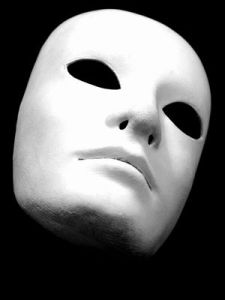
The sociopath wears a mask. But [s/he] will only wear that mask for as long as it is getting him [or her] what [s/he] wants. The sociopath is not emotionally connected, to you or anybody else. Whilst the sociopath might show connection, this would only be a disguise, to serve his [or her] own needs.
When the sociopath realises that [s/he] can have better supply elsewhere, or if [s/he] feels that supply with you is coming to an end, [s/he] will leave you without warning. The sociopath would have sourced a new victim for supply, but this would have been done behind your back and without your knowledge.
To do so, it is likely that the sociopath needed to play victim to the new source. Often [s/he] would have made complaints about you to gain sympathy and win support. Again, this will be something that you have absolutely no knowledge of, until later.
Consider her conclusion that a sociopath may “play victim” to acquire new narcissistic supply, and you’ll perceive how perfectly lies to the police and/or the courts (donning a new mask) may assist him or her in realizing his or her pathological wishes.
The blog post from which this quoted material is drawn concerns being abruptly discarded by a sociopath, which the writer notes may leave the sociopath’s quarry feeling:
- Confused
- Bewildered
- Lost
- Desperate for answers
- A longing and neediness to understand
- Wanting back the honeymoon stage
- Unsure if the relationship is actually over or not?
- Self-blame
- Manipulated, conned, and deceived
Expressions of these feelings, whose motives are not those of stalkers but of normal people prompted by a need to understand the inexplicable, may take the form of telephone calls, emails, or attempts at direct confrontation—all of which lend themselves exquisitely to misrepresentation by stalkers as the behaviors of stalkers.
The personality-disordered answer primal urges, and among those urges is the will to blame others when their bizarre expectations aren’t satisfied—and they inevitably aren’t—or when others express natural expectations of their own that defy disordered personalities’ fantasized versions of how things are supposed to go.
The author of this blog, a formerly private man who had a restraining order petitioned against him characterizing him as a stalker (and who has been back to court three times since to respond to the same allegation, the least of several), has been monitored for eight years by a stranger he naïvely responded to whom he found standing outside of his house one day as he went to climb into his car.
I was a practicing writer for kids.
The first correspondent I had when I began this blog three years ago was a woman who’d been pursued and discarded by a pathological narcissist, who subsequently obtained a restraining order against her (by fraud), representing her as a stalker (cf. Dr. Palmatier’s “Presto, Change-o, DARVO: Deny, Attack, and Reverse Victim and Offender”).
She taught music to kids.
Last fall, I exchanged numerous emails with a woman who’d fallen for a man with borderline personality disorder, who abused her, including violently, then did the same thing after she sought a restraining order against him, which was denied.
She was a nurse who had three kids.
You’ll note that those labeled “stalkers” by the state in these cases—and they’re hardly exceptions—confound the popular stalker profile that’s promoted by restraining order advocates.
An irony of this already twisted business is that injuries done to people by their being misrepresented to the authorities and the  courts by disordered personalities as stalkers ignite in them the need to clear their names, on which their livelihoods may depend (never mind their sanity); and their determination, which for obvious reasons may be obsessive, seemingly corroborates stalkers’ false allegations of stalking.
This in turn further feeds into the imperative of personality-disordered stalkers to divert blame from themselves and exert it on their targets. People like this fatten on drama and conflict, and legal abuses gratify their appetites like no other source, both because the residue of legal abuses never evaporates and because those abuses can be refreshed or repeated, setting off further chain reactions ad infinitum.
The agents of processes that were conceived to arrest social parasitism and check the conduct of stalkers are no less susceptible to believing the false faces and frauds of predatory people than their victims are.
Copyright © 2014 RestrainingOrderAbuse.com
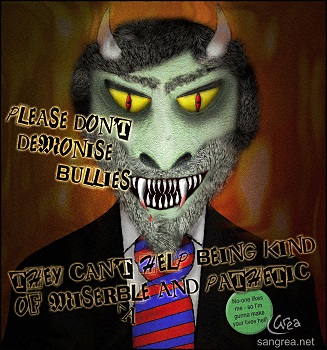
 Contemplating these statements should also make clear the all-but-impossible task that counteracting the fraudulent allegations of high-conflict people can pose, both because disordered personalities lie without compunction and because they’re intensely invested in domination, blaming, and punishment.
 I’ve read Freud, Lacan, and some other abstruse psychology texts, because I was trained as a literary analyst, and psychological theories are sometimes used by textual critics as interpretive prisms. None of these equipped me, though, to understand the kind of person who would wantonly lie to police officers and judges, enlist others in smear campaigns, and/or otherwise engage in dedicatedly vicious misconduct.

 TALKING BACK to restraining orders