Fighting the Arizona Injunction Against Harassment

“Let’s face it, sometimes you get wrongfully accused of harassing someone. Perhaps it is a vendetta, a figment of the accuser’s imagination, or something else. […] The mere accusation, even if unfounded, can be devastating to your reputation and may imperil your chances of employment, could lead to the loss of your right to possess a firearm, [restrict] where and when you can go places, etc. (Note: These matters become public records that can be easily searched and identified.) For example, we often find that neighbors who become ‘unneighborly’ will seek an order restricting how close you can come to their home, and whether you are to stay away from certain ‘areas,’ etc. Additionally, if left unchallenged, then often the mere allegation that you violated the injunction against harassment may land you in custody.”

—Attorney Joseph A. Velez

The “Injunction Against Harassment” is one of three types of restraining (or “protective”) order issued in Arizona. The title of the instrument is deceptive. Allegations by petitioners aren’t limited to harassment and may be of anything, including violent threat or assault, or even sexual violation.

An “Order of Protection” is what a complainant files against someone who shares a residence with him or her; an “Injunction Against Harassment” is what a complainant files if his or her relationship with the defendant is other than domestic (e.g., against a friend, neighbor, or stranger). Conduct alleged on either order may be identical.

It may also be false. Orders aren’t hard to obtain, including on the basis of exaggerations or outright fraud.

Here are some facts of which the recipient of an Arizona Injunction Against Harassment should be aware:

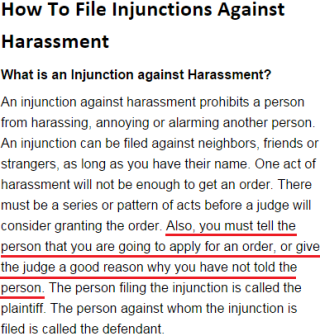
  1. Highlighted in this explanation from the Tucson City Court, which applies everywhere in the state of Arizona, is a statutory requirement that the judge who issued you an Injunction Against Harassment may have carelessly overlooked.

    The injunction may be appealed, and an appeals hearing may be requested at any time during the order’s term of effect (one year). It need not be requested immediately. A.R.S § 12-1809(H). You must apply to be granted a hearing, and you must apply in writing. (Instructions appear at the top of the document’s first page.)

  2. Postponing the appellate procedure allows you more time to gather evidence and witness testimony, and save money to procure the services of a lawyer. Being issued an order of the court can be intimidating and bewildering, and a defendant’s impulse may be to drop everything and respond immediately. There’s much, however, to recommend deferment.
  3. Satisfaction of A.R.S § 12-1809(E) requires that the petitioner of the order must have presented to the judge “specific facts attesting to [his or her] efforts to give notice to the defendant or reasons supporting the plaintiff’s claim that notice should not be given.” This means if the petitioner of the order did not notify you prior to applying for an ex parte order from the court, and no good reasons were provided to the judge why you weren’t notified, then judicial approval of the order was against the law.
  4. Judicial derelictions are grounds for an order’s dismissal.

Restraining order defense may be a specialization of some criminal attorneys, and the defendant seeking legal counsel would do well to search for a specialist in his or her city online and/or call around.

Copyright © 2018 RestrainingOrderAbuse.com

*The author of this post successfully had an injunction against harassment dismissed last summer.

Facts and Fairness: Using Arizona’s Policies to Expose Restraining Order Iniquity

I live in Arizona where I was issued a restraining order in 2006 petitioned by a woman I nightly encountered hanging around outside of my house. The restraining order said I was a danger to her husband and shouldn’t be permitted to approach or talk to him.

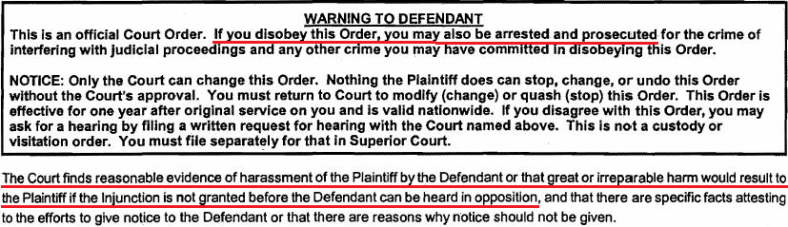
If you receive a restraining order in my home state, here’s the first thing that greets your eye:

On the basis of the form this warning captions—which looks like it was drafted by someone using a pizza crust as a straightedge—citizens are recorded in state and national police databases as stalkers and violent abusers.

Consider that the immediate impression this warning is meant to give is beware. It naturally excites fear—and if you’ve been falsely accused, a host of other emotions, besides, none of which conduces to calm and lucid thinking.

Something you wouldn’t guess from this “Warning to Defendant” is that if a defendant “disagrees” with an order issued in Arizona, s/he has the statutory right to apply for an appeals hearing at any time during the order’s effectiveness. For example, if the duration of the order is one calendar year, the defendant can take 11 months to assemble his or her appeal and save up, if necessary, to have an attorney represent that appeal.

Here’s the law:

At any time during the period during which the injunction is in effect, the defendant is entitled to one hearing on written request. No fee may be charged for requesting a hearing. A hearing that is requested by a defendant shall be held within ten days from the date requested unless the court finds compelling reasons to continue the hearing. The hearing shall be held at the earliest possible time. An ex parte injunction that is issued under this section shall state on its face that the defendant is entitled to a hearing on written request and shall include the name and address of the judicial office where the request may be filed. After the hearing, the court may modify, quash or continue the injunction.

The statute says the court’s order must inform the defendant that s/he’s entitled to a hearing, but it doesn’t require that the order inform the defendant that s/he has a year (or possibly years) in which to prep and apply for that hearing, that the hearing is free, or that the defendant may be represented by an attorney.

Restraining orders are rhetorical psych-outs. Their language is overtly menacing, and neither the law nor the issuing courthouse gives any consideration to apprising defendants of their rights.

The stress is on apprising defendants, who are presumed to suck (sight unseen), of what rights they’re no longer deemed worthy of.

Appreciate that the court’s basis for issuing the document capped with the “Warning” pictured above is nothing more than some allegations from the order’s plaintiff, allegations scrawled on a form and typically made orally to a judge in four or five minutes.


In the courthouse where the order issued against me was obtained, restraining order petitioners file into a room like a small bus station terminal, submit their applications, wait for an audience with a judge, chat with him or her for a few minutes, and leave.

That’s it.

Consequences of receiving an order of the court whose merits are determined on this basis include registration in state and national law enforcement databases, and may also include loss of entitlement to home, children, and possessions, and loss of employment.

In contravention of due process, orders are issued against defendants that may deny them liberties and property without the court’s hearing from them at all.

Ever.

In Arizona, unless a defendant requests a hearing before a judge, that’s an end on the process. No judge will even have learned what s/he looks like, and the truth of the plaintiff’s claims will never have been controverted—claims, to reiterate, that were made in a few minutes and could include anything from annoyance to physical or sexual violence.

Such claims often amount to nothing more certain than finger-pointing.

(Docket time afforded by the court to the testimony of defendants who go to the trouble of appealing rulings based on such claims, incidentally, is about 15 minutes. The cost of attorney representation at an appeals hearing may be $2,000 to $5,000.)

The only provision the law or the court makes for discouraging false testimony (some motives for which are here) is this one, which predictably appears at the very end of the application form:

The plaintiff signs below.

Applicants aren’t of course told what “perjury” is, and they’re certainly not told it’s a felony crime that carries a prison term (as it is and does in Arizona and many other states). Lying to the court is never sanctioned or prosecuted, anyway.

Recent posts on this blog were answers to dismissal by a doctor of laws of criticisms that the restraining order process is unfair. The process would have to be far more deliberative than it is, in fact, to be merely “unfair.”

The process is automated.

Copyright © 2014 RestrainingOrderAbuse.com

“Do I Need a Lawyer?”: On Combating Restraining Orders

nutcracker
“Do I need a lawyer?” is a question that commonly brings restraining order defendants to this blog and other sites like it.

No one wants to shell out thousands for an attorney to bat away allegations made on a restraining order that may have been concocted in a fit of pique by an embittered friend, a jealous ex, or a crazy neighbor. Too, it’s often the case that allegations leveled by restraining order plaintiffs are of a kind no one wants to advertise to strangers, let alone friends and family. Just the implications of the phrase restraining order are enough to make most people recoil.

I know someone who applied to the mayor for a character reference after she was falsely accused of domestic violence—on a restraining order—by a married friend she’d briefly renewed an association with. Sounds insane, right? The judge ultimately tossed the case after observing that the allegation wasn’t even applicable, because the plaintiff and the defendant weren’t in a domestic relationship. But that didn’t cause a judge any hesitation in approving the restraining order in the first place, and imagine what it cost this woman emotionally to have to explain the matter and ask for help. Imagine further if she had been a he, and you can appreciate the horror of fighting these kinds of allegations, which are validated by judges on a modicum of evidence, if any, and which neither cost nor risk their plaintiffs anything to make. Restraining orders are cheap or free to get, and no one is ever actually jailed for lying to get them.

I did a quick scan today of top Google returns for the term “lying to the court.” Most commenters weighed in that lying = perjury, which is a crime, so beware. It’s true that lying about a material fact in court (a fact, that is, that’s likely to influence a judge’s opinion) is a statutory crime. A felony, no less. Equally true, though, and much more pertinent is that lying isn’t prosecuted. So there’s nothing really for a fraudulent plaintiff to have to be wary of except maybe a little embarrassment if actually caught in a lie (and most plaintiffs, of course, aren’t aware that lying to a judge is a crime, so it’s not even on their minds).

Someone who’s morally bankrupt enough to lie to a judge in the first place isn’t going to hesitate because of the risk of shame if s/he’s caught. Shame is an emotion to which s/he’s obviously immune, anyway.

In the administration of restraining orders, the ideal of justice isn’t given priority. Restraining orders are issued ex parte, which means they’re approved without the judge’s having the faintest idea who s/he’s issuing a restraining order against. The only person the judge hears from is the plaintiff, and hearings to obtain restraining orders are typically 10-minute affairs.

Talk show host David Letterman was famously issued a restraining order petitioned by a stranger who lived in another part of the country. The judge didn’t think twice about rubber-stamping the thing and moving on to the next applicant.

Defendants don’t need attorneys; it’s perfectly lawful for them to defend themselves in an appeals hearing. Whether defendants need attorneys to better their chances of a favorable verdict is a different question entirely. David Letterman, it should go without saying, had a team of them. And it should come as no surprise that they shredded the restraining order to confetti.

A cynical answer to the question of whether defendants need attorneys to improve their odds of beating a bum rap is that defendants who can afford attorneys are perceived as deserving greater consideration than ones who can’t (or who don’t know enough to seek counsel—or who are hoping they can just quietly make the whole thing go away on their own). This answer doesn’t jibe with the judicial canon that everyone should be treated the same, but that doesn’t mean it isn’t true. Because restraining orders are issued ex parte, the idea that fairness obtains at any stage of the process is clearly dubious.

Truth and falsehood in judicial proceedings are, besides, very relative things. For truth to even exercise its power to dispel lies depends on how effectively a defendant can make it plain to the judge. As straightforward as a naïve defendant might believe this to be, it’s not as simple as stating facts that contradict fraudulent testimony or producing some evidence that’s expected to be conclusive. The judge might decide that that evidence is irrelevant or that the lie it exposes is immaterial to the case. Or s/he might decide s/he doesn’t like the defendant period. Can you lose a case because the judge doesn’t like you or likes the plaintiff better? Sure. Does that have anything to do with the truth of the plaintiff’s allegations against you? No.

Representation by an attorney isn’t a guarantee of success. The mere presence of one, though, will give you a degree of credibility you wouldn’t otherwise have. An attorney with courtroom experience, furthermore, has presentational skills that you lack. Restraining order appeals hearings are very brief, judges tend to be skeptical of defendants (particularly men), and even a self-styled Perry Mason may find him- or herself stammering and squirming once s/he’s in the hot seat under the glare of the judge.

There’s the possibility, too, that the plaintiff will have an attorney, and attorneys aren’t known either for playing fair or for showing mercy to their opponents. Some attorneys—gasp—are even professional liars. Several respondents to this blog, in fact, have had false restraining orders petitioned against them by attorneys who were ex-lovers or -spouses or—in one case—a parent. The restraining order process, more than any other, brings out the worst in human nature.

If you’re the defendant in a restraining order case, especially one grounded on fraud, get an attorney.

Now.

Copyright © 2013 RestrainingOrderAbuse.com

Addressing the Judge: What to Expect at a Restraining Order Appeals Hearing…and What Not To

Judges famously tend to be an inscrutable lot.

Defendants who expect a judge to leap from the bench with indignation upon being shown evidence of lies by the plaintiff are bound to be disappointed.

Far more likely the judge will evince bemused or stoic indifference. You may even wonder if s/he registered what you said at all.

Don’t be nonplussed. This is how s/he’s supposed to act. Keep on trucking until s/he interrupts or redirects your presentation.

What you want to focus on is triage. Triage means presenting the points of your defense in order of importance (triage is a wartime medical term that means privileging patients with the best chance of recovery over those who are sure goners). What will positively doom you in a hearing is rambling, speaking off the point, or carefully qualifying everything to the extent that the judge completely misses what you’re driving at.

Don’t waffle or be mealymouthed.

Bullets. Present your case in brief staccato bursts. Everything should be short and sweet (so to speak). Time is always a limited commodity, and a restraining order hearing may be granted no more than a handful of minutes. People—and judges are people like anyone else—tend to remember best what they hear first and last and/or what’s stated to them emphatically.

Like bullets, everything you say should be pointed and intended to inflict damage. Pare down everything you want to say to its most elemental, and state facts in the light that most favorably represents you.

And absolutely speak to your conduct (or the conduct you’ve been accused of, anyway), because that’s what’s being ruled upon. In other words, don’t try to defend your own actions (or “actions”) by merely speaking to misconduct by the plaintiff like a little kid would: “She started it!” or “She’s a liar!”

It’s often if not usually the case that restraining order plaintiffs and defendants are lovers, spouses or ex-spouses, friends, or family members: people, in other words, who are or have been close. There’s a temptation, therefore, for defendants to explain the context of their statements or even to show sympathy or generosity toward their accusers. There’s also, of course, a tendency to feel betrayed, ashamed at being exposed to public censure, or humiliated by allegations that may be beastly misrepresentations of the truth.

Don’t yield to these impulses and emotions.

What you learn after you’ve been put through this ringer is that your opponent is going to show you no mercy and may very well lie heinously to ensure that you’re “defeated.” Even people you considered friends may turn out to be rats and side with your accuser and lie for him or her.

Combat analogies are very aptly applied to this process: the courtroom is an arena. “Bloodsport” isn’t a bad metaphor.

The judge is there to ensure that no one actually brawls, but his or her role otherwise is less as an arbiter or referee than as a spectator (who, like a Roman emperor at the Colosseum, gives a thumbs up or down when the dust settles).

Your goal isn’t to appeal to his or her sympathies; it’s to make a decisive impression. The judge’s impression will be based on your manner, composure, confidence, directness, and the cogency of your presentation, that is, how well it sticks together and how well it conveys your points (and, of course, how good those points are). The standard in civil cases is a “preponderance of evidence.” You want your evidence and testimony to have more heft and credibility than the plaintiff’s.

If the plaintiff’s allegations are a fraud, start by saying, “The plaintiff’s allegations, Judge, are a fraud.” Triage. Get the big points in—the general—then move to the specifics in short order. Directly address and contradict the allegations you can. The more evidence (“proof”) you can support your points with the better.

What attorneys do is this: they present their clients’ cases in the light most favorable to them (and most damning to their opponents), not balking at distorting the truth or outright lying, and ignore everything material that they can’t spin doctor.

I can’t advocate lying. Otherwise, though, thinking like an attorney isn’t a bad idea.

Translated into practical terms, this means a shove is an “assault,” a shout is “verbal abuse,” a demand is “harassment,” something that happened twice is “serial misconduct,” a touch is a “grope,” etc.: cold, cruel, categorical, and coarse.

Male judges have a chivalrous bent—and most judges are male—which is among the reasons why so many restraining orders sought by women against men are approved even on evidence or testimony that’s tenuous at best. If you’re a man defending yourself against a woman, bear this in mind. A woman can spout the most incendiary evil she can muster, and it’s not going to be held against her, because she’s a “girl.” Whatever a man counter-alleges against a woman needs to be presented reasonably and decently. He should choose his words carefully, avoid vigorous gestures, and keep cool.

If you’re a man defending yourself against a woman, you start with your hands tied and two strikes against you. That’s in the nature of this travesty of justice.

Bat with your head. There’s no surviving this process without some fractures.

Copyright © 2013 RestrainingOrderAbuse.com

*Unrepresented restraining order defendants, incidentally, should pour everything they’ve got into their appeals hearings, because the rules and expectations that obtain in Superior Court—should the case progress up the judicial ladder—are much more exacting and only capably negotiated by veteran attorneys (or shysters, a word that means unethical lawyers and fittingly derives from the German for “defecators,” because much of what comes out of their mouths is feces).