Eight Years of Hell: On the Toll of False Allegations of Abuse

“Bitter separation battles and unrequited love are among the reasons why people falsely accuse others of sexual abuse, according to legal professionals.

“Lawyers contacted by The Sunday Times of Malta came across several examples of cases when people, often women, made false claims that they or their children had been abused.

“Lawyer Roberto Montalto gave the example of one situation where a woman claimed her children were abused by her husband’s colleague.

“The case dragged on for eight years and the man was acquitted after the court found that the woman lied….”

—“False Abuse Accusations Not One-Offs, Say Lawyers

To read the rest of this story, published just a couple of weeks ago, you have to subscribe to The Times of Malta. I can guess the remainder’s content, as I know many men and women who’ve visited this site can.

This excerpt is highlighted, because even today most people are under the impression that instances of false allegations’ being made repeatedly in protracted legal assaults are rare and isolated occurrences.

As attorneys and others attest, they’re not. Only hearing about them is.

Among the reasons why restraining orders are criticized on this site and elsewhere is that they’re superlative and intoxicating gateway fixes for spiteful accusers bent on gratifying malicious impulses. They can be obtained in a few hours—even a few minutes—based on allegations that require no substantiation and that are subjected to a minimum of scrutiny, if any at all.

They’re easily exploited to establish claims that can then be parlayed into interminable attacks.

False criminal allegations suggestive of sexual or violent deviancy—e.g., stalking, sexual harassment or molestation, and domestic abuse—can be just as effective and for the same reasons. The hysteria promoted by the abuse industry and the political influence it has bent to its “cause” have conditioned police, municipal prosecutors, and judges to credit allegations of abuse automatically (especially ones from women).

Eight years—that’s the term in hell the man in the epigraph had to endure before it was apparently demonstrated that the whole ordeal was based on lies: eight years lost for nothing. Nothing. More horrible yet is that the only thing that makes this story exceptional is that the fraudulent accuser was eventually exposed and acknowledged as such.

Eight years is a Ph.D. Eight years is a career. Eight years is a son or daughter’s childhood.

Copyright © 2014 RestrainingOrderAbuse.com

SPITE: Feminism and Restraining Order Rampancy

“I wasn’t thinking when I wrote my domestic abuse statement in Virginia against my boyfriend.”

“Can I get a permanent protection order against my spouse’s lover?”

“How [do you] bait someone into violating a restraining order?”

—A few recent search terms leading to this blog

I stumbled upon a video presentation the other day by a self-styled anti-feminist activist Karen Straughan, who’s blogged for a couple years under the moniker “girlwriteswhat.” I thought her talk, “Feminism: Socialism in Panties,” was evenhandedly confrontational, nervy, and smart.

Responses from feminist quarters that I hastily gleaned yesterday suggest that this activist’s denunciations have raised some hackles. I noted, though, that more than one woman respectfully remarked that she’s “articulate,” if “biased.” She’s in fact very articulate. And something I don’t think her female critics are able to appreciate is that her “bias” is a counter-bias and that she isn’t employing rhetorical strategies that are any more tendentious or inflammatory than those used by the people she draws a bead on.

For feminists to argue that turnabout is foul play is silly, and it’s interesting to observe that when dogma’s challenged using its own tactics, it pitches a fit.

The same impulsive emotional reasoning exemplified by this foot-stamping is what’s suggested by the search terms that introduce this post (to which I could have appended thousands more of a similar nature).

The large-scale injustices perpetrated by the restraining order process (on both men and women) are the product of impulsive emotional reasoning, as is the process itself. What may have started out as a sober guard dog 30 years ago has transformed into a manic dragon that arbitrarily spits fire when fingers are snapped, particularly nail-polished fingers. It doesn’t warn its targets to back down; it torches them.

There’s an ancient philosophic principle called the golden mean that advocates avoidance of extremes (“moderation in all things”). According to this principle, if something gets too far off-kilter in one direction, you have to counteract the imbalance by excessively striving in the contrary direction. If the above-referenced activist strikes some as overstating her case, they might consider that she’s endeavoring to knock things back toward equilibrium.

Reading through online comments about her, I was familiarized with the acronyms MRM and MRA, which apparently stand for “men’s rights movement” and “men’s rights activist,” respectfully. One thread about her I found was titled, “What do Feminists think about YouTube blogger ‘Girl Writes What,’ a Female MRA?”

You see from this question how far abroad feminism has strayed and why equity feminists are appalled by what they call the “feminist establishment” (a.k.a. “The Sorority”). The motive of the feminist movement that was underway when I was a kid was to dissolve distinctions and dichotomies between the sexes. Yet as conversational prompts like this one show, today’s so-called feminism promotes division: Us versus Them. Its compulsion is to split everyone into camps. The original idea was to have everybody recognized as the same, irrespective of whether they had an innie or an outie between their legs.

The thrust of today’s mainstream ideological feminism is to blame, subjugate, and punish, not unify. Feminism has betrayed itself.

It has also betrayed women. Something that’s long been a source of curiosity to me is that while the feminist establishment is often criticized as misandronist (man-hating), it’s rarely criticized as misogynist (woman-hating).

Yet inducing women to self-identify as victims can hardly be called “empowering.” If the source of power isn’t you, the power isn’t yours. What inducing women to self-identify as victims is, rather, is denigrating to feminine self-respect. The feminist establishment doesn’t encourage women to cultivate or rely on personal agency; it infantilizes them and urges them to apply for paternal protection (and the abuse and domestic dispute industries have been glad to profit by the ensuing strife).

Contemporary feminism has conditioned women to identify themselves respective to men, namely, as their victims. It’s thoroughly preoccupied with men—to the point of fixation. (The online conversational threads I’ve just looked at either concerned bitching about men or bitching about women who don’t bitch about men.)

The original feminist platform argued that women should identify themselves as independent people. Feminism, however, has become entirely male-centric. There is no feminist identification independent of men.

Prejudicial laws and court processes criticized in this blog and elsewhere are a societal response to women’s conceding that they lack personal agency. Consider that the reason why infants cry for help is because they’re incapable of meeting their own needs (incapable, literally, of standing on their own two feet). Women are much more capable than they’ve been led to believe.

Restraining orders are by and large sought impulsively—in the millions every year. Both motives and the engine that generates them are virtually automatic.

Interesting to me, finally, is that men have adapted to the new status quo (“If you can’t beat ‘em, join ‘em”). Most of the complainants of court abuses who’ve responded to this blog are women, some of whose lives have been shattered by lies and fraud. Men have hopped onto the abuse industry bandwagon, too, and the time may come that the equality that feminism is supposed to be advocating for is realized in the form of both sexes’ exploiting state protections to bash each other into a uniform goo.

Copyright © 2014 RestrainingOrderAbuse.com

Restraining Order Fraud Needs to Be Recognized for What It Is: CRIME

“Emotional distress as the result of crime is a recurring theme for all victims of crime. The most common problem[s], affecting three quarters of victims, [include] fear, anxiety, nervousness, self-blame, anger, shame, and difficulty sleeping. These problems often result in the development of chronic post-traumatic stress disorder (PTSD).”

—Wikipedia, “Victimology

Restraining orders are governmentally advertised and popularly perceived as deterrents to crime, particularly stalking/harassment and domestic violence. In other words, they’re supposed to do good.

It’s no wonder, then, that the idea that restraining orders may be used to commit crime and do grievous harm is regarded with indifference if not hostility.

The very real if inconvenient truth remains that victims of false allegations made to authorities and the courts present with the same symptoms highlighted in the epigraph: “fear, anxiety, nervousness, self-blame, anger, shame, and difficulty sleeping”—among a host of others. And that’s just the ones who aren’t robbed of everything that made their lives meaningful, including home, property, and family. In the latter case, post-traumatic stress disorder may be the least of their torments. They may be left homeless, penniless, childless, and emotionally scarred.

It’s time for a much overdue reality check: victims are victims, and it doesn’t matter one iota whether a victim is injured by a recognized crime or one that society prefers to pretend doesn’t occur because it’s complicit in its commission. Treating victims like fiends, in fact, compounds victimization manifold, as any zealous bandier of the phrase victim-blaming should eagerly corroborate.

The quoted Wikipedia entry observes that we (among other countries) have a National Crime Victimization Survey (“a tool to measure the existence of actual, rather than reported, crimes”) to determine our country’s victimization rate. “This survey enables the government to estimate the likelihood of victimization by rape, sexual assault, robbery, assault, theft, household burglary, and motor vehicle theft for the population as a whole as well as for segments of the population such as women….”

False allegations, predictably, aren’t recognized as criminal, which of course both false reporting to the police (a statutory misdemeanor) and perjury (a statutory felony) most certainly are. Moreover, and significantly, all of the crimes enumerated in the quotation immediately above may be abetted or excused by the state’s endorsement of restraining order fraud—and at the same time. Victims of restraining order abuse may not only be victims of assault (or even conceivably rape) by their false accusers; by virtue of the state’s validating false accusers’ allegations, the accused may literally be stripped (robbed) of their belongings (i.e., property, vehicles, and money), and ousted from their homes, besides, and forced to forfeit entitlement to them (along with access to their own children): grand theft everything.

E-v-e-r-y-t-h-i-n-g. We’re talking not only about trivializing suffering or “blaming the victim” but of punishing the victim to a cruel and unusual extreme—and congratulating ourselves for doing it. (Feminist) rights advocates make much ado about society’s discounting or trivializing the suffering of victims, ignoring that the state may, for example, yank victims of domestic violence from their homes and kick them sobbing to the curb if their abusers finger them on restraining orders first.

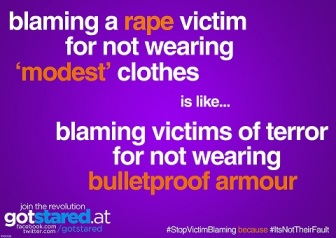
Blaming victims of false allegations made on restraining orders IS “blaming victims of terror for not wearing bulletproof armour,” and why false allegations on restraining orders are so effective (and devastating) is because of the basic message of posters like this: When victimhood is asserted, it’s not to be questioned.

The perceptual blind that preserves these crimes from being exposed and redressed is the “unspoken, politically correct rule that the role of the victim…is NOT to be explored” acknowledged by Dr. Ofer Zur in “Rethinking ‘Don’t Blame the Victim’: The Psychology of Victimhood.” The presiding prejudice that procurers of restraining orders are victims not only enables false accusers to commit theft and abuse on a grand scale (in cases effacing the lives of their male and female victims entirely); it enables them to do so with authorization and impunity, and on top of it all to be rewarded with sympathy. This is victim-blaming with a megaphone.

Victims—victims—may be incarcerated (locked in cages) and serially persecuted (in cases, for years) after having been tossed in the street and having had everything they owned and cared about taken from them. A survey of the accounts on the e-petition “Stop False Allegations of Domestic Violence” will make the horror plain to any reader with a soul (or even just an ounce of honesty).

Denial of this horror by agents of the abuse industry underscores that rights advocacy has become corrupted by dogma, politics, and cash. If it was ever truly about justice, any claim that its mainstream manifestations still are is beyond disingenuous. It’s criminal.

Copyright © 2014 RestrainingOrderAbuse.com

Rhetoric and Restraining Order Rampancy

“Rape culture exists because we don’t believe it does. From tacit acceptance of misogyny in everything from casual conversations with our peers to the media we consume, we accept the degradation of women and posit uncontrollable hyper-sexuality of men as the norm. But rape is endemic to our culture because there’s no widely accepted cultural definition of what it actually is.”

The Nation Magazine (February 4, 2013)

I’m not certain I even know what this means. Rhetorically, though, it’s impressive. In a single sentence, its writers “establish” that we are all of their party and that something exists, because we don’t believe it does.

I won’t pretend to know anything about The Nation, but does a position like this pass for responsible journalism? I’ve surveyed a lot of this kind of writing recently, and it alarms me for more than just the reasons that I (1) don’t believe we do “accept the degradation of women,” (2) don’t believe that rape is “endemic to our culture” any more than it is endemic to the animal kingdom, and (3) do believe the definition of rape is pretty clearly and universally understood.

What the writers mean, I guess, is that rape culture, which they haven’t established exists in the first place, continues to exist, because we unknowingly contribute to its perpetuation by saying and doing things that we are not aware reveal our unconscious hatred of women. You didn’t know you hated women? Well, you do.

We all do, apparently. And shame on us for it.

You see how this rhetoric works. It’s more than just assertive; it’s coercive. A lot of it also betrays patently false reasoning that masks what’s actually propagandist badgering. The source of its outrage is sympathetic; how it expresses that outrage is significantly less so.

Consider this line of argument: “When an instance of sexual assault makes the news and the first questions the media asks [sic]are about the victim’s sobriety, or clothes, or sexuality, we should all be prepared to pivot to ask, instead, what messages the perpetrators received over their lifetime about rape and about ‘being a man.’ Here’s a tip: the right question is not, ‘What was she doing/wearing/saying when she was raped?’ The right question is, ‘What made him think this is acceptable?’”

“During the postwar period of Radical Reconstruction (1867-1877), many white writers argued that without slavery—which supposedly contained their animalistic tendencies—blacks were reverting to criminal savagery. The brute caricature portrayed black men as threatening menaces, fiends, and sociopaths, and as hideous, terrifying predators who targeted helpless victims, especially white women.”

(Note the Freudian slip: “an instance” has “perpetrators,” plural. It’s not for nothing that some have perceived in writing like this the tacit belief that all men are rapists.)

First, how has the postulated “instance of sexual assault” been qualified as such? These writers presume that an incident is an “assault” with a “victim.” The overwhelming likelihood in a case like this is that it is what it appears to be, but it’s not the job of investigators, including journalists, to equate appearances with facts. There are no “right” questions. Some questions may be tactful, some rude or insensitive, some effective at exposing the truth, some less so. The value or “rightness” of a question can only be judged in hindsight, as writers for a news magazine should know.

If all journalists shared these writers’ jaundiced perspective or felt constrained to only ask “appropriate” questions, how many instances of false allegations should we imagine would ever be recognized, let alone sanctioned? I have an interest in false allegations, and the answer to this question disturbs me.

I’ve surveyed studies of the incidence rate of false allegations of rape, and I have no reluctance allowing for argument’s sake that rape is rarely alleged falsely. What I have a problem with is the non-recognition of the harm that’s wrought when rape is alleged falsely—and no one argues that this never happens. The life of an innocent may be destroyed. And we will have destroyed it.

A rape is a fait accompli. Before we know about it, it’s done. Falsely prosecuting someone for rape (or anything else), however, isn’t a case of a bad person doing a bad thing. It’s a case of bringing the full weight and menace of the state to bear on an innocent person. Prosecution is a choice that we are all answerable for.

Although the writers would argue the contrary (and do), society isn’t accountable for the actions of individuals. It is, however, accountable for the actions of its elected officials, agents, and representatives. We are accountable, and we collectively must be guided by a higher moral standard than any one individual. We craft laws and policy, and we have an ethical responsibility to ensure laws and policy are fair and scrupulously applied.

This blog isn’t about rape. But what it is about, restraining order abuse, is a product of the rhetoric exemplified by the article I’ve criticized. Propagandist writing about harassment isn’t what keeps eyes diverted from restraining order injustice, and it isn’t what has spawned the “abuse industry.” Writing about violence against women has.

I could argue that restraining order abuse exists because we don’t believe it does. But it’s more clearly said that it exists because we believe the propaganda—or are too intimidated to scrutinize or take exception to it.

Copyright © 2014 RestrainingOrderAbuse.com