
“Due process of law implies the right of the person affected thereby to be present before the tribunal which pronounces judgment upon the question of life, liberty, or property, in its most comprehensive sense; to be heard, by testimony or otherwise, and to have the right of controverting, by proof, every material fact which bears on the question of right in the matter involved. If any question of fact or liability be conclusively presumed against him, this is not due process of law.”
—Black’s Law Dictionary
The phrase due process (or due process of law) names those most fundamental legal entitlements that ensure an individual is provided the means and opportunity to defend him- or herself and his or her interests in court.
In the previous post, I observed that restraining orders skirt due process entirely—which I’m hardly the first person to remark.
As this post’s epigraph explains, whenever the court presumes that a person is liable for or guilty of some alleged transgression and enters a judgment against that person without first granting that person the opportunity to challenge the allegations against him or her, that person is denied due process.
Not kinda-sorta but flatly.
Since restraining orders (by legislative mandate) are issued ex parte, which means that the only parties judges hear from prior to entering rulings are restraining order applicants, every restraining order recipient is denied due process. Every one of them. Always. Restraining order defendants are just inked names on paper forms; judges have no idea whom they’re entering judgments against, and defendants have no idea judgments have been entered against them until a constable comes knocking.
Restated using legalese from this post’s epigraph, when a defendant’s guilt is “conclusively presumed,” as it is when a judge approves a restraining order, “this is not due process of law.” Restated simply, when rulings are made prior to defendants’ being given a chance to defend themselves, there’s no due process. Restated simplest, restraining orders = no due process = no adherence to the most basic principles of law = dirty pool.
This is an obvious and indisputable fact, and as I stated earlier, I’m hardly the first person to have noted it.
What’s more rarely observed is that denying defendants due process was the purpose of restraining orders’ being enacted. Restraining order legislation, by design, authorizes a plaintiff to communicate his or her allegations directly to a judge, without having to convince any legal authorities of the merits of those allegations, and requires that a judge enter a ruling on those allegations without a plaintiff’s having to face the person s/he’s accused. (Due process is a constitutional guarantee under the Fourteenth Amendment—except when lawmakers say otherwise.)
The motive for this circumvention of due process is now a very dusty one.
Restraining orders were born three decades ago in response to a pressing demand from female advocates for a process that allowed at-risk women, particularly victims of domestic violence, to avoid the pain and humiliation of having to take their claims to the police (who may have discounted those claims or even criticized women for making them) and go straight to a judge, that is, to have the opportunity to quickly and quietly explain their hardships in a situation of security and minimal scrutiny.
In the social climate that predominated in the 1970s, this made sense. Wives were still expected, by and large, to stay home, tend to their kids and kitchens, and mind their husbands. If husbands sometimes got a little free with their hands, that wasn’t something you broadcast to the world.
Restraining orders, which were legal finesses from the outset, were meant to arrest domestic violence and provide abused women with a discreet and minimally agonizing way to communicate abuse to the court and gain immediate relief from it. It certainly wasn’t on the minds of lawmakers at the time (or anyone else) that restraining orders would one day be applied to routine annoyances or that applicants might fabricate allegations or manipulate a free and convenient process for malicious or selfish ends.
Legislators bowed to social pressures for very sympathetic reasons. The problem is they’ve gone right on bowing for 30 years without consideration to how far restraining orders have drifted from their original intent or to whether their denial of due process to defendants is still justifiable.
Today, relative to the millions of restraining orders that are issued every year, it’s only seldom that allegations of violence are made on restraining orders at all.
Which doesn’t at all mean that the presumption of violence (stalking, sex offenses, etc.) isn’t applied to restraining order recipients universally.
Warrant for the continuation of a process whose nuclear cloud has gusted so far from its target demands a retrofit. This isn’t 1979, and there no longer exists any conscionable excuse for denying defendants due process of law. This is 2013, and violating defendants’ civil rights and burdening them thereby with criminal imputations for the rest of their lives is cruel and unusual punishment.
It’s vicious.
The restraining order process either needs to be dusted off and revisited or relegated to the dustbin of history.
Copyright © 2013 RestrainingOrderAbuse.com

 I’ve written before about “due process,” a constitutional privilege that’s universally denied to restraining order defendants. Recently I was contacted by an intelligent 17-year-old girl who wanted to know what her rights were under the law. She didn’t stand accused of anything. Rather her adult boyfriend had been issued a mandatory (criminal) restraining order in California “on her behalf” that she didn’t seek, and she wanted to know what she could do about it.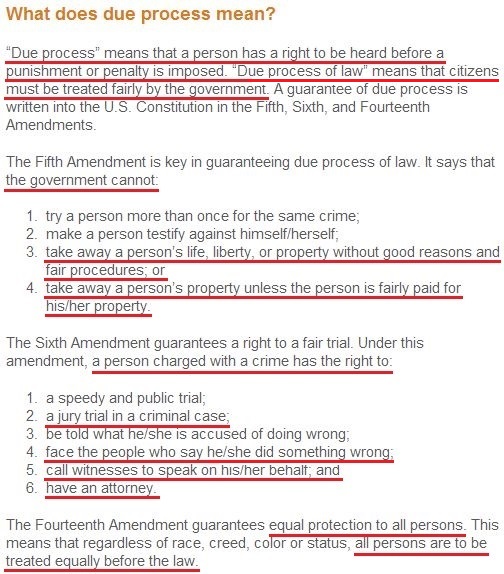
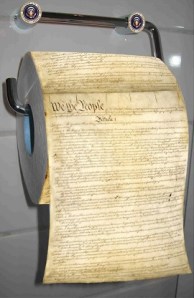 A defendant is deprived of liberty and often property, besides, without compensation and in accordance with manifestly unfair procedures concluded in minutes = Fifth Amendment.

 TALKING BACK to restraining orders