DISCLAIMER: This page, which attempts to answer frequently asked questions (FAQ), is intended as a resource to those bewildered by the restraining order process and offered because attorneys rarely dispense information or counsel freely that they could bill for. The replies below are those of this blog’s author, whose knowledge of restraining orders and restraining order abuses is grudging and unqualified by any formal education in the law. I’m a writer, not an attorney. If in doubt, consult a licensed professional.
If you are the defendant in a restraining order case (that is, if you are the recipient of a restraining order), especially one based on false/fraudulent allegations:
- Read the court’s order front to back so that you understand its restrictions and expectations to the letter. Be able to quote it from memory.
- Immediately apply to the court for an appeals hearing if you haven’t already been assigned one. This will provide you with an opportunity to contest the restraining order applicant’s allegations and have the order quashed (that is, negated, nullified, canceled). You can do this by mail, by phone, or by visiting the courthouse.
- File a motion for continuance with the court to request a postponement of your appeals hearing to provide you with additional time to find and consult with an attorney (if within your means), gather evidence (which may include affidavits from witnesses), and prepare your defense. This is just a matter of going to the courthouse, explaining to the clerk what you’re after, and filling in a few lines on a form. You may even be able to do this by phone. Have your case number handy. The worst that can happen is that your motion is denied.
- Request a copy of the restraining order applicant’s affidavit to the court. This is his or her written narrative explaining why s/he “needs” a restraining order. If you’re assertive, a clerk at the courthouse should provide you with a copy with some information redacted (crossed out), such as the applicant’s address. Knowing what the plaintiff has alleged against you is both your constitutional right and essential to your defense.
- Exploit any and all available resources to obtain the services of a qualified attorney, that is, an attorney both experienced with representing restraining order defendants and one you feel confident will represent your interests without reservation. Call around. Having an attorney speak on your behalf is your best bet of arresting a biased process that stands to exert a very detrimental influence on your future. Some respondents to this blog have reported paying thousands to attorneys who they felt ultimately sided with the restraining order applicant. So choose an attorney you feel certain will have your back. A lawyer is no different from anyone else you employ to do a job for you: get one you have faith in.
*Readers may perform a keyword search of this FAQ page (or any other) by pressing Ctrl + F or ⌘ Cmd + F. A dialogue box will appear.
______________
“A judge contacted my job and is trying to get me fired. [What to do?]”
A judge’s contacting your employer is way out of line. You can report this misbehavior to the police, apply for a restraining order against the judge for harassment, and/or report his or her actions to your state’s judicial oversight commission. If the judge succeeded in costing you your job, you would also have grounds to sue him/her for damages. The system protects its own, so you would have to substantiate (document/prove) your case very thoroughly. Your best avenue of recourse (if it’s financially feasible) would be to hire an attorney.
“A person filed a restraining order, which a judge denied. Now the person is telling everyone they have a gun to use against the other party. [What to do?]”
If the other party feels his or her life is in danger, s/he shouldn’t hesitate to report these threats to the police and/or apply to the court for a restraining order him- or herself (which can require that the person be prohibited from possessing firearms or ammunition). The other party can obtain affidavits (sworn statements) from witnesses to support his or her allegations to a judge. Bear in mind, however, that a restraining order is just a piece of paper. If this person is psychotic, the threatened party should consider a more certain deterrent like relocating.
“A police officer called and informed me of a PPO [protection order]. Is a phone call effective without personal service upon me?”
In some jurisdictions, astonishingly, this is satisfactory, yes.

“Am I a criminal if I have a restraining order?”
Though the court and others may well treat you like a criminal or make you feel like one, no. A restraining order is a civil misdemeanor.
“Am I breaking the law if I posted a comment on Facebook about my ex-girlfriend who got a restraining order against me…?”
Restraining orders are public record, so no. You would only have made yourself liable to police interference if your comment was threatening or to civil litigation if your comment was libelous—in other words, if you lied about your ex-girlfriend in a defamatory way. Truth is an absolute defense against allegations of libel or slander. Fact is fact. Opinion is also protected under the Constitution. Care should be taken, though, if you’re commenting on a restraining order that’s still in effect that you don’t make yourself vulnerable to allegations of harassment. A good rule of thumb is to imagine that everything you write will be read by a judge. A single comment isn’t harassment.
“Are charges filed against me public record?”
Yes. The plaintiff’s affidavit (written narrative to the court) is often concealed—even from the defendant; but the restraining order itself is publicly accessible, along with any allegations that appear on it (whether true or false).
“Are narcissists con artists?”
Yes, they’re consummate manipulators and frauds who don’t scruple about lying to realize their own ends, including to police officers and judges.
“Are no-contact orders public knowledge and if so where do you locate them?”
Records of restraining orders are public, yes. A courthouse website will usually have a database that you can search by name or case number. Note that restraining orders can issue from county or city courthouses. Note also that accessibility of restraining order records by Internet can vary state-to-state. (Here, for example, is the public index for Charleston County, South Carolina.)
“Are restraining orders being issued too freely?”
Yes, in all senses: they’re issued casually, and they cost their applicants little or nothing.
“Are restraining orders constitutional?”
There are certainly grounds for questioning their constitutionality. Provisions of the United States Constitution and state constitutions require that all citizens be given equal recognition under the law and that no group of citizens be shown special consideration, and preferential treatment both of women generally and plaintiffs specifically is not only prevalent but often mandated (for example, courts may be given grant monies in return for consenting to unquestioningly accept allegations of fear or violence from women as true). Restraining orders also deny recipients due process, a constitutional privilege guaranteed by the Fifth, Sixth, and Fourteenth Amendments. They furthermore enable the courts to criminally sanction defendants (imprison them) without first affording them their constitutional entitlement to a trial by a jury of their peers. And almost all if not all restraining orders are issued ex parte, which means defendants are deprived of liberty (and often property) prior to being heard by the court. Some defendants, in fact, are never heard. Restraining orders are issued against them without the court’s ever knowing anything about them but their names.
“Are restraining orders hard to beat?”
Yes, because they can be based on testimony that’s impossible to discredit, for example, an emotional state. An allegation of fear, which may be all a plaintiff needs to persuade a judge to approve a restraining order, can’t be disproved. The only defense is to discredit the plaintiff by convincingly showing there are no objective grounds for fear or that s/he has an ulterior motive for alleging it. As painful as it may be, no matter how strained your finances, securing the representation of an attorney is critical to balancing the scales and insuring you at least get a fair shake in a restraining order appeal. Since restraining orders are obtained ex parte—that is, based solely on the word of the plaintiff—the notion that the scales of justice are balanced to begin with is ridiculous.
“Are you notified if a person you have a restraining order against moves?”
No. Unless the person were for some reason required to inform authorities of a change of address, neither the police nor the court would even know, and a restraining order doesn’t prohibit a person from moving (except, perhaps, within the vicinity of the petitioner).
“Can a CPO be verbal, or does it have to be written?”
To the best of my knowledge, a criminal protection order would necessarily have to be in print so that its recipient were duly apprised of its prohibitions. Mere communication of an order would seem to be insufficient (unless it were directly communicated by a judge). Orders issuing from the court, even if they’re verbally pronounced by judges, are typically “written” and mailed to or served on the parties at whom they’re directed. That notwithstanding, if you believe you’ve been ordered by the court not to approach or contact another person, you should refrain accordingly.
“Can a defendant vacate an order of protection?”
A defendant can contest the preliminary/temporary order prior to its being finalized. Either a date will be scheduled automatically, or one will be assigned subsequent to the defendant’s applying to the court for the opportunity to defend. Protocols vary from state to state. In Arizona, for example, defendants must request hearings. Filing a motion like this one from Maine, “Defendant’s Motion to Dissolve Temporary Order for Protection,” may or may not be necessary. A defendant’s appearance in court to challenge a restraining order is essentially understood as a motion to the court to dismiss/vacate the preliminary judgment, but there’s no harm in a defendant’s filing a motion and/or pronouncing in court, “Defendant moves to have the plaintiff’s order dismissed, because its allegations are false [or “baseless,” “frivolous,” etc.].” Dismissed, vacated, dissolved, terminated, or a similar word will be used, depending on the jurisdiction, to mean canceled, “dropped,” or “tossed.” Grounds for moving to have an order vacated after it has been finalized might be that the defendant was never served with the preliminary order and summons or that the order was otherwise “void.” If this doesn’t apply, and a ruling to finalize a restraining order goes against a defendant, s/he may appeal the ruling to a higher court. These are the only ways to vacate a restraining order without its petitioner’s cooperation. With the petitioner’s cooperation and an attorney’s assistance, an expired restraining order may be vacated even years later by filing a nunc pro tunc motion with the court (nunc pro tunc means “now for then”). Exceptions like this option available in Colorado may exist in other states: “JDF 395 Instructions for Restrained Person to Modify/Dismiss PO R3-12.”
“Can a felon have a restraining order against somebody?”
Yes. See this post for an example case: “Restraining Orders and the First Amendment: A Female Blogger’s Successful Appeal of a Restraining Order That Labeled Her a ‘Cyber-Stalker’.”
“Can a future employer see if you have a restraining order?”
Yes, if s/he endeavors to find out. Restraining orders are public record. In some regions, moreover, restraining order registries have been established like those for sex offenders, making access by the public not only convenient but enticing.
“Can a governor remove a restraining order?”
A governor can pardon (or commute) a crime. To the best of my knowledge, a governor cannot vacate/expunge a restraining order, which represents a civil misdemeanor. If you learn otherwise, please let me know. You have nothing to lose, of course, by writing or calling the governor’s office and asking.
“Can a judge dismiss a cease-and-desist harassment order at a hearing?”
Yes, presuming the purpose of the hearing is to hear the defendant’s arguments for the order’s being quashed/vacated (voided).
“Can a judge give a restraining order keeping my child in the hands of strangers?”
If anecdotal reports to this blog are reliable, yes. One respondent reported that a judge awarded custody of his son to one of his wife’s former boyfriends, who falsely claimed to be the boy’s father. Another respondent, whose son’s baby was placed in the custody of his maternal grandmother, reported that the grandmother refused to return the baby after the restraining order was dismissed, and authorities refused to intervene.
“Can a lover sue on behalf of someone else?”
Possibly. If the other person were incapacitated, for example, or otherwise deemed unfit to represent him- or herself, or if the injury complained of to the court was one the lover also suffered from.
“Can a no-contact order get dropped without consent from the person [who] put it up?”
A defendant/respondent can appeal the order (through multiple tiers of the court system if s/he has the stamina and financial resource). If appeals have been exhausted, though, or the window to file has closed, the answer to the question is probably no. Some respondents to this blog have sued and had restraining orders vacated that way (either the judge rules to “drop” them, or the sued parties consent to cooperate in their vacation in out-of-court settlements). A plaintiff/petitioner (“the person who put it up”) can file a motion to dismiss (vacate, withdraw, dissolve, terminate) a restraining order while it’s in effect, or the plaintiff and defendant can cooperatively file a nunc pro tunc motion with the court through an attorney to vacate it after its expiration.
“Can a person be coerced to file a fraudulent restraining order?”
Definitely. Particularly abominable is when a person (woman) is coerced to file a false restraining order by a police officer or agent of Child Protective Services (CPS) or by a judge.
“Can a person who doesn’t own the house file a restraining order and make the person who owns the house move out?”
Yes. It’s a common motive among restraining order applicants.
“Can a person who lies about a restraining order be charged if they request to drop it?”
Not really, no. It’s remotely conceivable that if you were to confess to lying, you could be sanctioned by the court, but such a confession isn’t necessary to have an order dismissed. You would only have to offer—if you were questioned at all—that you felt you acted rashly and now regret it. The court just needs to be assured that you don’t feel the order is necessary and that you’re not seeking to withdraw it because you were threatened or otherwise feel coerced. You don’t have to implicate yourself as a “liar,” per se, to have an injunction “dropped.” You just need to return to the courthouse and file a “motion to dismiss” or “motion to vacate.” Approval isn’t guaranteed, but if the allegations weren’t extreme and children weren’t involved, there shouldn’t be a problem. If the allegations were extreme and/or children were involved, the court might require that your home situation be investigated before ruling. See also this post.
“Can a PFA [protection from abuse order] keep you from a public place such as a church function?”
If the plaintiff on the order is there, yes; the proscriptions of the order (among them keeping a distance from the plaintiff) apply everywhere. Although an order may not specify a “minimum distance” that the defendant must observe, it will require that the defendant “keep away” from the plaintiff.
“Can a plaintiff drop a temporary protective order lawsuit?”
Yes. Only a judge can modify or vacate (“drop”) an order of the court, but a plaintiff can move a judge to do so. Procedures will vary from state to state, because every state’s laws are different. This document “explains,” for example, how a restraining order is modified or vacated in California: “Do you want to change or cancel a restraining order?” This page by a New Jersey attorney underscores the complexities of undoing the effects of restraining orders alleging domestic violence: “Can a domestic violence restraining order be vacated or dismissed?” Here’s a basic eHow tutorial: “How to Rescind a Protective Order.” The National Center for State Courts provides links to court forms in all 50 states that can be used by self-represented litigants. Plaintiffs seeking to vacate restraining orders in some states (for example, Kentucky) may not find prepared forms and may have to make their own. This would probably best be done by looking at a different motion form from their state, using it as a template/model, and titling it, “Motion to Vacate [X kind of] Order.” See also these state-specific forms/tutorials (and this post):
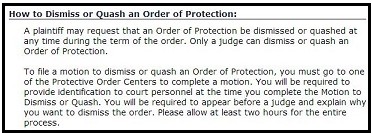
How to dismiss or quash an order of protection in (Maricopa County) Arizona.
“Request to Modify or Dissolve Protective Order” (Alaska)
“Motion to Set Aside/Vacate Judgment” (Arizona)
“Ex Parte Request and Order to Terminate Restraining Order” (California)
“Request to Vacate Restraining Order” (California)
“Protection Order Forms” (Colorado)
“Motion to Modify/Dismiss Temporary/Permanent Protection Order” (Colorado)
“Order Vacating Restraining Order” (Colorado)
“Injunctions and Restraining Orders in Connecticut“
“How to Prepare a Civil Motion” (Delaware)
“Motion to Modify, Extend, or Vacate Order of Protection from Abuse” (or Word file) (Delaware)
“Dismissal of Temporary Restraining Order” (Georgia)
“Court Forms” (Hawaii)
“Motion for Dismissal” (Hawaii: applicable to first district court protection order)
“Motion to Dismiss” (Hawaii: applicable to third district court protection order)
“Motion to and Declaration to Dissolve the Existing Order” (Hawaii: applicable to family court restraining order)
“Procedure to Change or Dismiss an Order of Protection” (Illinois)
“Protection Order Forms” (Indiana)
“Petitioner’s Verified Request for Dismissal” (Indiana)
“Request to Cancel or Change a Chapter 236 Protective Order” (or Word file) (Iowa)
“Protection From Abuse Forms” (Kansas)
“Notice of Dismissal” (Kansas)
“Order of Dismissal” (Kansas)
“Uniform Abuse Prevention Order Forms” (Louisiana)
“Plaintiff’s Pre-Judgment Motion to Dismiss Complaint” (Maine)
“Plaintiff’s Post-Judgment Motion to Modify or Terminate Protection Order” (Maine)
“Petition To Modify/Rescind Peace Order” (Maryland)
“Petition To Modify/Rescind Protective Order” (Maryland)
“Restraining Order & Harassment Forms” (Massachusetts)
“Plaintiff’s Motion to Modify or Terminate Abuse Prevention Order” (Massachusetts)
“Motion and Order to Dismiss Action for Personal Protection Order” (Michigan)
“Motion to Modify, Extend, or Terminate Personal Protection Order” (Michigan)
“Domestic Abuse Forms” (Minnesota)
“Affidavit and Order for Dismissal” (Minnesota)
“Procedure—Setting Aside Final Judgments in Missouri”
“Domestic Violence – Protective Orders: Forms for Printing” (Montana)
“Motion for Modification or Termination of the Protection Order” (Montana)
“Motion to Vacate and Set Aside and to Dismiss” (Nebraska)
“Modifying, Dissolving, or Appealing a Protection Order” (Nevada)
“Failure to Prosecute, Dismissals, and Withdrawals” (New Hampshire)
“Can A Domestic Violence Restraining Order Be Dismissed?” (New Jersey)
“Dissolving a Domestic Violence Restraining Order” (New Jersey)
“Motion to Dismiss Temporary Order of Protection” (New Mexico)
“Procedure to Dismiss an Order of Protection in New York”
“Family Court Forms” (New York)
“Motion to Modify or Terminate Domestic Violence Civil Protection Order” (Ohio)
“Family Abuse Prevention Act (FAPA) Forms” (Oregon)
“Petitioner’s Motion and Affidavit for Dismissal and Order” (Oregon)

Instructions from the First Judicial District of Pennsylvania for vacating a protection-from-abuse order (PFA).
“Domestic Protection Order Forms” (South Dakota)
“Motion to Dismiss Protection Order” (South Dakota)
“Order Dismissing Protection Order” (South Dakota)
“Prosecuting and Defending Protective Orders” (Texas)
“Protective Order Forms” (Utah)
“Order on Request to Dismiss or Vacate Protective Order” (Utah)
“Relief from Abuse Forms” (Vermont)
“Motion to Vacate Relief from Abuse Order” (Vermont)
“Guide to Civil Protection Orders in D.C.” (Washington D.C.) (see p. 27: “Vacating Your CPO”)
“Domestic Violence Forms” (West Virginia)
“Petition to Terminate Protective Order” (West Virginia)
“Order Dismissing/Denying Petition for TRO/Injunction” (Wisconsin)
“Can a plaintiff email the defendant’s husband when [there’s a] harassment order?”
Yes. Since you’ve arguably injured that man’s family, though, unless the intent of your email were conciliatory (that is, unless you were trying to negotiate a peace), you would likely stir up trouble. The restraining order that you were awarded doesn’t, strictly speaking, impose any limitations on your actions, only on the defendant’s.
“[C]an a police officer sue someone for making a false accusation?”
A police officer might have sufficient grounds to sue someone for making a false accusation against him or her, yes, especially if it was done publicly in a way that damaged the officer’s reputation or professional standing. A police officer couldn’t sue, though, for someone’s making false allegations against someone else. False reporting to a police officer is a misdemeanor crime that could only be prosecuted by the county/district attorney’s office.
“Can a police officer work in a town if someone has a restraining order against them?”
That’s probably a question for HQ (police admin). Unless having a restraining order against him or her were grounds for termination of employment from the police department, it would probably just impose some limitations on where the officer was permitted to go. Typically, though, restraining orders prohibit defendants from possessing firearms, which might well mean an officer couldn’t work in any town.
“Can [a] protection order forbid you to go to someone’s home who is not involved?”
Unless the court’s order specifically says so, no. Obviously if the plaintiff resides in that person’s home, it’s off-limits. Though restraining orders are boilerplate instruments, each will specify what addresses you’re forbidden to visit (usually the plaintiff’s residence and place of work or study). The only adult you’re forbidden contact with is the order’s plaintiff, though minor children in the plaintiff’s care may also be included on the injunction. If the plaintiff has requested an area be forbidden to you for no justifiable reason, you can bring this up at your appeals hearing or apply to see a judge to modify the order.
“Can a restrained person communicate through a lawyer?”
Ask one. A lawyer who’s representing you in a legal action against the plaintiff is authorized and legally bound to inform the plaintiff, certainly. Whether an attorney can tender an olive branch to the plaintiff or propose a reconciliation is a question s/he could best answer.
“Can a restraining order be placed with no hearing?”
Yes, in contravention of defendants’ constitutional right to due process, restraining orders are typically issued ex parte, which means based on allegations made by the accuser and articulated in a brief interview with a judge (five to 10 minutes). In some states (Arizona and Michigan are examples), no hearing is required (also in contravention of due process). In order to be heard at all, defendants must apply to the court to be given an audience and an opportunity to defend (which is often limited to around 15 minutes).
“Can a restraining order be taken out against a child under 10 in Maryland?”
Google Maryland + restraining order laws. I know juvenile restraining orders are available in California. See this Huffington Post story: “Father of Bullied Son Files Restraining Order against 9-Year-Old Kid.” See also this letter from the Maryland Office of the Attorney General.
“Can a restraining order become [a] public document without your knowledge?”
A restraining order is a public document.
“Can a restraining order ruin your future?”
No question about it. If you’re asking could it prevent you from getting a job, it would probably depend on the job. Whether knowledge of your having received a restraining order would be the reason an employer would cite for rejecting you is uncertain. Whether that knowledge would influence an employer’s decision is less uncertain. Running for high public office is probably off the table. (One reader found this blog by this search engine query: “old restraining order keeps me from getting jobs.” Other respondents report being denied jobs because of vacated restraining orders, that is, ones that were ultimately dismissed as baseless.)
“Can a stepmother sue an ex-wife for intentional infliction of emotional distress?”
Yes. A husband can’t sue his wife or she him. Otherwise, a litigant’s relationship with the other party in a lawsuit is irrelevant. What would matter in a suit of this sort is the plaintiff’s (the stepmother’s) ability to substantiate her allegations of intentional infliction of emotional distress against the defendant (the ex-wife). Consult your state’s definition of this tort to see whether the grounds of your complaint to the court would qualify. Typically for misconduct to rise to the level of intentional infliction of emotional distress, it has to be pretty heinous. Extreme misconduct is hardly unheard of in cases of abuse of restraining orders or related bureaucratic processes, but lawyers and judges need considerable persuading, because they’re unaccustomed to thinking of restraining orders, for example, as “abusive” (even though they know damn well that they’re abused—and routinely). You would need to firmly impress upon them the severity of your injury, which would likely require third-party corroboration (for example, from a doctor and/or therapist) and documentation, for example, of lost income, etc. Affidavits or testimony from family members or friends regarding your mood and behavior might also support your allegation.
“Can a teenager have a restraining order removed?”
If the teenager were still in the care of the adult guardian who petitioned the order, probably not, though this is a question that could be run past a lawyer with a phone call (no charge). If the petitioner of the restraining order were no longer (or was never) the teenager’s legal guardian, it’s possible the court might determine the restraining order to be void.
“Can [a] third party be arrested when breaking a protection order…?”
The only person who can violate a restraining order is the person against whom it was issued (that is, the defendant). A restraining order only applies to the actions of its defendant.
“Can a wife put a restraining order on someone for someone else?”
Only if that “someone else” is a minor or an adult deemed unfit to represent him- or herself. You can’t apply for a restraining order for someone else if the other person is an adult capable of self-representation.
“Can anyone attend a TPO hearing…?”
Yes. It’s a public proceeding.
“Can charges be filed for filing a false protective order?”
Only by the district prosecutor. Who won’t. So no.
“Can evidence help fight a restraining order?”
Assuredly. Don’t, however, expect evidence you provide to the court to speak for itself. Use it instead to support your interpretation of the restraining order plaintiff’s motive. Judges should ask questions and probe defendants’ allegations, but defendants shouldn’t take judges’ interest in the truth (or justice) for granted. The reason you have a restraining order in the first place is because a judge swallowed whatever story the plaintiff told him or her.
“Can I appeal if I lost a motion to terminate a PPO against me?”
If the ruling in a hearing to appeal a restraining order went against you, you may appeal the case to the next highest court, yes. Inquire at the courthouse that issued the order. In my state, applying for the opportunity to file an appellate memorandum with the Superior Court is free, and defendants have a month to craft their appeals briefs. If you exercise this option, find out what the criteria for judging such an appeal are. In Arizona, where I live, the Superior Court rules on such an appeal based on whether the lower court clearly “abused its discretion” in issuing/upholding a restraining order, that is, the next judge up the food chain doesn’t review a case de novo (from scratch); it determines whether the lower court overstepped its authority.
“Can I be arrested for mailing a certified letter if there [is] a restraining order against me?”
Not if you’re mailing legal documents, but such documents will of course have to have been filed with and approved by the courts beforehand. If, for example, you’ve filed a lawsuit against the plaintiff in a restraining order case against you, you may (and have to) mail the complaint and summons to him/her. If contact by mail is forbidden by the restraining order, though, mailing any other sort of communication to its plaintiff would be a violation of the order (whether by certified letter or other means). Put simply, you can mail court documents pursuant to a legal action; you can’t write to say hi.
“Can I be charged with violating a restraining order I didn’t know about…?”
Technically, no, but it’s not unheard of. If you’ve been accused of violating an order you were never served with, you need to appeal and make that clear to a judge.
“Can I be sued for libel if I write about my ex and don’t post his name?”
Qualifying grounds for suing someone for libel are that s/he lied about you publicly in a defamatory way. The key word here is lied. If what you write about your ex is true, no matter how unflattering it might be, it isn’t libel. Truth is an absolute defense against allegations of libel/slander/defamation. If you are sued for libel, and you didn’t lie about the plaintiff, you may countersue for malicious prosecution/abuse of process and request damages. A caveat to consider, however, is that when someone does sue for libel, the burden falls upon the defendant (you) to prove that what s/he’s reported is accurate. Can someone file a libel suit against you? Sure. Under the circumstances you specify, though, it’s very unlikely you would be sued.
“Can I call my accuser to the stand on stalking charges?”
A restraining order hearing isn’t a trial. It’s conducted more like a hearing for a traffic violation (in my state, anyway). Participants are sworn in but don’t take the stand. You can, though, pose questions to your accuser through the presiding judge, that is, the judge will communicate your question(s) to the plaintiff and require that s/he respond.
“Can I call my ex’s attorney when I have a restraining order on him?”
There’s certainly no legal impediment preventing you, though his attorney has no obligation to take your call. His attorney’s responding would probably depend on the nature of what you had to say or what you were asking of him or her. A lawyer is employed to serve the interests of his or her client.
“Can I contact my husband under an order of protection against him?”
Sure. But if he responds, he may be subject to arrest and incarceration. Better to communicate through a third party.
“Can I drop a PPO order I had taken out?”
Yes. Any time before it expires, you may go to the courthouse and have it vacated with no repercussions—though if allegations of domestic violence were made against a spouse, and there are minor children in the household, it’s possible the court would require that your domestic situation be investigated prior to issuing a ruling. See also this post.
“Can I drop a restraining order before court?”
Yes. You would file a motion with the court to have the temporary order dismissed/vacated.
“Can I fight a restraining order that’s been put on my boyfriend by the DA?”
Yes. See the links in this comment strand for advice.
“Can I file a civil suit against someone who has filed a false order for harassment against me?”
Yes. Survey similar questions on this page for further information.
“Can I file a lawsuit against my ex-wife for taking out an order of protection on me and wrecking my reputation?”
If she lied, absolutely. The standard of proof of libel/defamation requires that you demonstrate she publicly made false statements of fact about you that harmed your name and respectability. The statute of limitation for libel/defamation is usually one year.
“Can I [file a] motion to vacate an order…when I’m not the defendant?”
As the petitioner/plaintiff, you can move the court to vacate/dismiss an order you requested, yes (see above for links to forms and tutorials).
“Can I file a PFA [protection from abuse order] if my wife beats me?”
Certainly, yes. Though they wouldn’t strictly be necessary, photographs of injuries (bruises, etc.) would support your allegations.
“Can I fire my lawyer on a protective order case?”
Sure.
“Can I get a restraining order against my wife?”
If the court determines you have sufficient grounds, sure.
“Can I get a restraining order against someone who attacked me?”
Yes. That’s what restraining order laws were enacted to provide protection against.
“Can I get a restraining order on someone who got one on me? / “Can a respondent file an application for an injunction against the plaintiff?”
Yes. The court usually doesn’t discriminate (and, constitutionally speaking, shouldn’t). In some jurisdictions, however (for example, Illinois), there are laws on the books that prohibit “mutual orders.” See this post. This doesn’t bar applicants from filing separate petitions, though, which would be heard separately and assigned their own case numbers.
“Can I get an order of protection against someone who has one on me?”
Assuming you can persuade the court that you’re in need of protection, yes. And unless you’re asked, you’re not obligated to share that you’re under a court-ordered injunction yourself (which should have no bearing on your allegations, anyway). A restraining order in no way restricts your taking legal action against the plaintiff or reporting his or her misconduct to the police or the courts; it only forbids you from personally contacting or approaching the plaintiff. If you successfully petitioned for a protection order, you would still have to observe the injunction against you or risk arrest. The defendant on the restraining order you got would be identically restricted.
“Can I get in trouble for emailing with a restraining order?”
Yes. Consult the court order you were issued. Sometimes only face-to-face contact is forbidden, but if the plaintiff has indicated no emails, telephone calls, etc., then those forms of communication are also off-limits, and engaging in them could make you subject to arrest.
“Can I get in trouble for not paying the court costs for someone [who] put a restraining order on me?”
If the court has ordered you to pay those costs, yes. If you’re asking whether you’re automatically obligated to pay attorney fees for the plaintiff’s being represented at a hearing, the answer is probably no. It was the plaintiff’s choice to hire counsel. If in doubt, don’t hesitate to go to the courthouse and ask.
“Can I get in trouble for violating my own restraining order years later?”
No. There are no grounds, that is, for your being arrested for communicating with the defendant in spite of a restraining order you obtained that’s now expired—or for your communicating with that person since its expiration. Some basis for the defendant to sue you may still endure, but the probability of this is low.
“Can I get in trouble if I don’t report my husband violated the PPO?”
Not legally. If your reasons for taking out the protection order were legitimate, though—that is, if your husband’s dangerous—then you could be inviting further violations. The only value of a restraining order (a legitimate one) is to check the behavior of someone who has a basic respect for the law. (Restraining orders are band-aids dispensed to reassure the public that the government cares. That’s why they’re most effective when they’re false). If your husband is dangerous and has no respect for the law, a restraining order is all but useless, and you’d do well to consider an alternative solution, like relocating. (This is the pickle the court puts you in: reporting your husband may only inflame a volatile situation.) If, on the other hand, your husband isn’t dangerous and you’ve thought better of the restraining order and that’s why you haven’t reported the violation, you may pacify the situation by going to the courthouse and having it nullified. A lawyer or women’s advocate could tell you if there’s a middle course, like hashing out differences through a mediator.
“Can I get in trouble for talking to someone I filed a protection order against…?”
No. But the other person could. Enforcing no-contact is presumably why you filed for the protection order.
“Can I get into trouble [for] speaking to someone with a restraining order?”
A restraining order’s prohibitions only apply to its defendant (its recipient), that is, a restraining order only prohibits its defendant from communicating with its plaintiff. If you’re asking as the defendant in a restraining order case, the only person (or people) you can get into trouble speaking to are the ones you’ve been told not to speak to. If you’re asking whether you can get into trouble for speaking to someone else who has a restraining order, the answer is no. Though it’s often among the evil effects restraining orders have, they aren’t meant to place defendants in social quarantine.
“Can I go to my husband’s court [hearing] if the district attorney placed a criminal protection order on him?”
Yes. A restraining order against your husband in no way constrains your actions.
“Can I include my girlfriend in a restraining order?”
If you’re asking whether you can include your girlfriend as a co-plaintiff on a restraining order that you apply for against a third party, no. You and your girlfriend would have to file separate restraining orders against him or her.
“Can I keep a sociopath out of my same state with a restraining order?”
No.
“Can I post pics on Facebook of someone who has a restraining order against me?”
Facebook may have its own policies concerning posting pictures of others. You’re technically only constrained from performing activities specified on the court’s order (forbidden activities are usually limited to contacting or approaching the plaintiff). Posting pictures of the plaintiff that s/he might object to is not going to land you in jail. It might, however, provoke the plaintiff to cause you more legal aggravation.
“Can I put a restraining order on my spouse forbidding them to talk to someone else?”
Strictly speaking, no (though this is a common ulterior motive among restraining order applicants, especially ones who’ve cheated on their husbands or wives and don’t want them finding out—or who don’t want their spouses cheating on them).
“Can I request to get the affidavit on [a] restraining order…?”
On a restraining order against you, yes. See a clerk at the courthouse, and assert your right to know what the plaintiff has alleged against you. If you’re insistent, the clerk should provide the affidavit with some information redacted (crossed out), such as the plaintiff’s address. If you’re refused, an attorney can obtain it for you.
“Can I request to have a restraining order vacated if its petitioner harasses me?”
Not per se. You certainly can, though, apply for a restraining order yourself against the plaintiff of the one against you. You can also report this person’s misconduct to the police (who will likely call the person and warn him or her to stop). Having a restraining order against you in no way impedes your instituting legal action against its plaintiff or reporting his or her actions to the police and/or courts.
“Can I send a letter to the court against my protection order?”
It’s perfectly lawful to write to a judge. It’s very unlikely to have any effect in your favor, though. If the judge obviously violated his ethical duties, you can file a complaint against him or her with your state’s Commission on Judicial Conduct. This is unlikely to affect the ruling, either, however. You can appeal the verdict to the Superior Court (no cost), but it bases its ruling on whether the lower court judge clearly abused his discretion, so you’d want to orient your appeal toward proving s/he did (i.e., that s/he went out of bounds). If the window for filing for an appeals hearing has closed, or you’ve already had an appeals hearing and it went against you, you’re stuck with applying directly to the plaintiff (through an attorney) to have him or her cooperate in vacating the restraining order in lieu of litigation (and this may only be a viable option after the order has expired). This answer presumes you’re the defendant. If you’re the plaintiff, you can have your restraining order quashed by dropping by the courthouse—or, if it has expired, by having an attorney file a nunc pro tunc motion.
“Can I Skype if the order of protection says ‘phone’?”
Generally speaking, you’re not forbidden from using Skype. If you’re asking whether you can contact the plaintiff via Skype, that would probably be okay if the order allows phone contact. The plaintiff would have the option of responding to your call if s/he wanted or ignoring it if s/he didn’t. If the order forbids phone contact with the plaintiff, though, Skyping him or her would also be forbidden, obviously.
“Can I still send my kids things even though the girl has a restraining order?”
Consult the specific constraints on the restraining order you were issued. Sometimes only face-to-face contact with the plaintiff is forbidden, but oftentimes all contact is forbidden. The children may even be listed on the court’s order as additional parties you’re forbidden from contacting. Be very sure you’re authorized contact with your children before sending them anything, because even mailing something as innocuous as a birthday card could land you in jail (and you wouldn’t be the first to be arrested for something so harmless and understandable).
“Can I submit a letter to the courts in defense of my boyfriend, who was charged with domestic violence against me?”
Yes. This is unlikely to have any effect, though. You’d do better to provide testimony in his defense at a hearing or to provide him or his attorney with an affidavit, which is a written statement that you would have notarized to make it the equivalent of sworn testimony. See also this comment thread on vacating a criminal restraining order (a.k.a “mandatory order” or MRO).
“Can I sue a stalker who has filed a restraining order against me falsely to only then beat me up and say it was self-defense since they have a restraining order against me in place?”
PLEASE DO.
“Can I sue my soon-to-be ex-husband for filing a bogus order of protection?”
Yes, but you’d probably have to postpone filing your complaint with the court until the divorce was final.
“Can I sue someone for filing a wrongful restraining order that cost me my job?”
Yes. See similar questions for a more detailed answer.
“Can I sue if a police officer lied about serving a restraining order?”
You can sue anyone for anything (including officers of the law and court—yep, you can sue a judge just like anyone else whose negligent conduct injures you). To show standing to prosecute a complaint (lawsuit), you need to demonstrate that you were injured and have a vested stake in the court’s redressing that injury. If you were served with a restraining order, the police officer should be able to produce a receipt with your signature on it.
“Can I sue someone for mental anguish from attempting to get a restraining order?”
Yes. To make a compelling case, though, you’d have to see a counselor and doctor so the court had some third-party substantiation of your suffering. If it was merely an attempt and the duration of your suffering was brief, the sympathy you could expect would probably be scant. If you could show a pattern of conduct, you’d stand a better chance of prevailing in a lawsuit. If this pattern rose to a sufficient level of egregiousness, you could sue for intentional infliction of emotional distress.
“Can I sue someone who wrongfully filed a civil harassment suit?”
Yes. See also above. Torts for suits alleging malicious prosecution or abuse of process involving a restraining order are likely to be among these: malicious prosecution/abuse of process, defamation, false light, intentional infliction of emotional distress, and fraud (on you and/or the police and courts). Other torts may apply, such as those entailing invasion of privacy. See your local law library for a book of jury instructions (which will show you not only what torts may be alleged in your state but how those torts are defined and what you would need to prove to establish liability).
“Can I talk to the police about emotional abuse?”
Certainly, yes. Whether an officer could assist you with resolving the abuse would depend on the circumstances.
“Can I travel to Bangladesh and reenter the U.S. with a restraining order?”
Unless you’re under unique restrictions, there’s no evident reason for concern. Though it may feel otherwise, you’re not being monitored. A civil restraining order prescribes limitations on your interaction with another party. That’s all. Violation of a restraining order (e.g., contacting the plaintiff) can result in the deportation of a non-citizen, but travel is not a violation. A restraining order is meant to keep you away from someone, not keep you close. To be certain your restrictions aren’t peculiar, review the court’s order, and don’t hesitate to inquire with the court (i.e., a judge, not a clerk) if you’re still anxious.
“Can multiple persons be named in a restraining order?”
Unless the laws in your state are exceptional, only one adult can be named as “plaintiff” on a restraining order, though children in that adult’s care may additionally be listed. Multiple adults seeking a restraining order against a single defendant would have to apply separately.
“Can my attorney speak to the person I have a restraining order against?”
Of course. Anybody can. Injunctions (excepting mutual no-contact orders) are one-way: the only person restrained by a restraining order is the defendant (who could freely respond to your attorney if s/he wished).
“Can my employer stop me from talking to someone else?”
While you’re on the clock, yes. An employer can’t impose limitations on how you spend your personal time, though. See the question, “Can your employer make you file a restraining order on someone?” for how to respond to workplace/employer coercion. If the job is one you couldn’t live without, consider asking the other person not to visit or call you at work and reassure your employer that your relationship with the other person isn’t one s/he need be concerned about.
“Can my ex come back to the house to get her stuff if I have an order of protection?”
No, the order of protection prohibits her from nearing you or your place of residence (on pain of police arrest). You could, though, have her belongings delivered to her or let someone pick them up for her.
“Can my fiancé ask the DA to terminate the criminal protective order that he has with me?”
He can ask, yes.
“Can my girlfriend get arrested for lying on a protective order?”
In theory, yes. In practice, no. Perjury, though a felony, is a crime in name only. The statute is seldom enforced and never in commonplace matters. The district prosecutor, if asked why, would shrug and say that if he prosecuted everyone who lied, there’d be no one outside of prison to caddy for him.
“Can my husband have the court date changed?”
Sure, provided the court finds his request for a postponement to be worthy.
“Can my spouse file a protective order after I filed one already?” / “Can someone file a restraining order against me if I have one against them?”
Yes. In a democracy, what’s deemed fair for you to do is deemed fair for all to do. In some jurisdictions, entitlement to file cross-claims is restricted, but it’s usually possible for defendants to apply for injunctions against plaintiffs provided they’re insistent and meet certain qualifications.
“Can restraining orders be served via postal mail?”
Possibly. I’ve heard of a restraining order being served by video on Facebook. Service requires confirmation that the defendant has been provided with a copy of the court’s order or had that order read out to him verbatim. If a restraining order were mailed, it would probably require a signature from the defendant confirming receipt to properly qualify as served.
“Can someone file a restraining order on the other person who already has one on them?”
Sure.
“Can someone file multiple protection orders?”
Yes, even against a single person.
“Can someone get a restraining order against me for posting a blog?”
It would probably depend on how a judge perceived its intent. The courts generally consider blogs to be the equivalent of online diaries. If you haven’t contacted the person in question and repeatedly been told not to, you’re not vulnerable to an allegation of harassment. If you haven’t lied about the defendant, you’re also immune to allegations of libel or defamation. Unless you’re leaking state secrets, posting information or opinion is protected under the Constitution. Where a judge might take exception to your blog is if its intent is patently malicious or invades the privacy of the other person (or, in the case of warring parents, if it stands to injure the kids). If the gist of your blog is, “X did this” or “X did this to me, and I think s/he’s a dirtbag,” saying so is your First Amendment prerogative. In other words, it’s defensible. That said, restraining orders lacking any meritorious basis are awarded to petitioners routinely. “S/he posted a blog about me, and I feel threatened!” may strike some judge or other as sufficient grounds (particularly an older judge who thinks the Internet is a playground for perverts). A goodly percentage of restraining orders are obtained on the force of dramatic persuasion alone. Should someone be able to get a restraining order against you for posting a blog? Excluding the exceptional cases I’ve mentioned, no. See also this post.
“Can someone get a restraining order against me without my knowledge?”
Restraining orders are issued ex parte, meaning based on interviews between judges and plaintiffs. Defendants are only informed after the fact. So yes, someone can obtain a restraining order without your knowledge. Service of the restraining order is required, however, for it to take effect. If you haven’t been served with a court order and informed of its restrictions on your freedom, you can’t be expected to observe it.
“Can someone park their vehicle in front of your house if you have a TRO against them?”
If the court has ordered this person not to come within a certain distance of you and/or your residence, then his/her parking in front of your house is a willful violation of the restraining order and grounds for arrest.
“Can someone place a restraining order after one contact in five years?”
Restraining orders are meant to restrain chronic behaviors. That said, a judge may sign off on a restraining order in the absence of any qualifying evidence. If you’re issued a restraining order based on a single isolated meeting, you would have strong grounds to appeal.
“Can someone put a restraining order on me for calling her a bitch?”
Calling someone a name is not sufficient grounds for a restraining order. This is the land of the free (supposedly, at least): you’re entitled to call a Supreme Court Justice a bitch. This person, though, especially if she is a bitch, could allege that you’ve repeatedly harassed her despite her asking you to leave her alone or make any number of similar claims to a judge (they don’t have to be true). Steer clear of her, and tell her to leave you alone.
“Can someone put a restraining order on me from another state?”
Yes.
“Can someone sue you for filing a restraining order against them?” / “Can someone sue me for filing a false restraining order that was dismissed?” / “Can I be sued for a dismissed domestic abuse restraining order?” / “Can I sue if [the] plaintiff dismissed [the] charges?” / “Can I sue…if an order of protection was taken [out] against me, and the accusations were proven to be false?” / “Can I sue the plaintiff if a protection order is quashed for legal fees, etc.?” / “Can I sue a neighbor for filing false charges against me that could affect my job?”
Yes.
“Can someone take out a restraining order for someone else?”
No, not unless the other person is a minor or an adult found to be incapable of representing him- or herself. Hawaii’s family court, for example, has a specific application for this (“Petition for an Order for Protection on Behalf of a Family or Household Member“).
“Can someone who has a restraining order on me tell my boss?”
Yes, s/he can tell anyone. Restraining orders are public documents. This doesn’t mean, however, that the restraining order plaintiff could lie to your boss with impunity. If s/he made false claims about you that imperiled your employment, you could sue him or her for damages or seek an injunction against the plaintiff of your own, alleging harassment.
“Can someone write on Facebook about you if you have a restraining order against them?”
A restraining order doesn’t mean someone can’t talk or write about you. It just means s/he can’t talk or write to you. If what the defendant has written is patently harassing or taunting, you may have grounds for having the restraining order modified to forbid this kind of public expression. If, however, the defendant is reporting facts about the case, that’s his or her constitutional right (as is his or her expressing an opinion about those facts). Restraining orders are matters of public record. If the defendant (or anyone else) lies about you publicly in a damaging way, you may sue him or her for defamation.
“Can the state pick up a case after you drop a restraining order?”
If a restraining order that was electively petitioned in civil court were vacated upon the request of the petitioner, there wouldn’t seem to be any grounds for further state interest. If the order had been violated, that is, if the plaintiff and defendant had been communicating or seeing each other in spite of the order’s prohibitions and this were reported, it might constitute grounds for a renewal of scrutiny. Otherwise, I can’t conceive of a reason why terminating the restraining order wouldn’t be a legal end on the matter.
“Can women get away with false protective orders?”
Sure. Men, too (though not as easily).
“Can you be prosecuted for lying to get a restraining order?”
Yes. If you lie about a material fact in a restraining order case (that is, one likely to influence a judge), you’re vulnerable to prosecution by the county/district attorney for felony perjury. You may also be prosecuted in civil court (sued) by the person you lie about (for defamation, false light, fraud, etc.).
“Can you be violated for a restraining order after it expires?”
Expired means no longer valid/effective. A possible exception would be if you violated the restraining order before it expired, and this was easily proved.
“Can you beat a PFA…if you have prior mental issues?”
Possibly. You would probably need a counselor (therapist, psychologist) or doctor/psychiatrist to testify on your behalf at an appeals hearing, whether in person or by affidavit. Ideally, you should have an attorney represent you, besides. Because you’re not being charged with a crime, guilt is less a factor than whether the plaintiff has a legitimate reason to be concerned for his or her safety, privacy, or peace of mind. If the allegations against you are nonviolent—if you were merely accused of harassing conduct, for example—you might be able to base a defense on a mental condition like manic depression, schizophrenia, or Tourette syndrome—a condition, that is, that causes you to involuntarily engage in activity that someone would find unsettling or distressing.
“Can you file a restraining order based on hearsay…?”
You can file a restraining order based on fantasy or outright lies.
“Can you get a fake restraining order?”
Daily if you’re determined enough.
“Can you get a protective order because of a threatening phone call?”
Possibly, though a threat communicated by phone is impossible to substantiate (prove) unless the call was recorded.
“Can you get a restraining order for comments made on Facebook?”
If you’ve been libeled (that is, if someone has made false, public statements that traduced your name and respectability) or if you’ve libeled someone yourself, redress through the courts would probably be by lawsuit. Grounds for a restraining order would be your repeatedly making comments to someone or that person’s repeatedly directing unwanted comments to you despite being told not to. In other words, if you keep posting to someone’s wall or emailing him or her in spite of that person’s telling you to buzz off, s/he could allege harassment and be granted a restraining order. If you post comments about someone to someone else, and those comments can be defended as either truthful or simply your opinion, the person you wrote about would not have grounds for filing for a restraining order against you (which, unfortunately, doesn’t mean a great deal: a judge can approve a restraining order on a whim). Play it safe. If you’ve got someone threatening to petition for a restraining order against you, keep your communications about that person private.
“Can you get a restraining order if you don’t want someone to view your finances at their place of employment?”
Probably not, per se. If the person were to use that information inappropriately in a way that injured you or that demonstrably invaded your privacy, you might have grounds to allege harassment (besides report that person for professional misconduct).
“Can you get a restraining order to stop someone from posting messages on Facebook and [sending] text messages?”
Yes. Before taking this extreme step, though, why not tell the person to stop and inform the person of your intention if s/he doesn’t? That may suffice to resolve the nuisance and would save you and him/her a good deal of grief (and the taxpaying public about $2,000).
“Can you get an order of protection against you for only stating your opinion about someone?”
Strictly speaking, no. There might be exceptions, for example, if you publicly stated the opinion that the other person would look better in a noose or in concrete shoes at the bottom of the ocean. Opinion is protected under the Constitution. Unless your opinion could be persuasively interpreted as threatening, there isn’t a substantive basis for a protection order.
“Can you get fair representation yourself against a lawyer in court?”
In theory, yes. In practice, no. Courts show partiality toward attorneys and those represented by them. Restraining order defendants are an exceptional case. For restraining order defendants, having a lawyer definitely improves the odds of their prevailing in a hearing but doesn’t guarantee success, because courts also show partiality toward restraining order plaintiffs (applicants, that is, especially female ones). If you’re a restraining order defendant and the plaintiff is represented by counsel, you’re going to have a very tough time of it on your own. Retain a lawyer yourself if at all feasible.
“Can you legally explain your side of a temporary restraining order on Facebook?”
A restraining order doesn’t deny you your freedom of speech. If you’re forbidden all contact with the plaintiff, though, you can’t message him or her on Facebook. Also, take care when writing that what you say is defensible (that is, true and factual) and that you don’t provide the plaintiff with grounds to allege harassment. If you’re writing about a restraining order that’s still in effect, you’d be wise to imagine that everything you say will be read by a judge. A blog is typically viewed by the courts as an online diary, so a blog might provide you with more latitude to express yourself than you’d have writing on Facebook. A blog requires that others choose to read what you post there; things you post on Facebook are automatically forwarded to those in your circle, making it an aggressive medium rather than a passive one (a judge may discern a difference, that is, between your explaining your side and your advertising it). See also this post.
“Can you post a restraining order on Facebook?”
A restraining order is a public document.
“Can you press charges for harassment with a PPO in effect?”
You can certainly try. An injunction doesn’t forbid your filing a police report or taking other legal action against the plaintiff (for example, suing him or her). Just make sure any documents you send or have served on the plaintiff are mailed or delivered through proper channels (i.e., do not contact or confront the plaintiff in person). Such documents must, of course, have been processed by the court ahead of time. If you’re male and you’re being harassed by a female plaintiff with a protection order against you, your allegations are likely to be discounted by the police. An attorney could best advise you on available recourses, which will probably be through the courts. Initial consultations are usually free.
“Can you re-serve a restraining order?”
If you’re asking whether you can apply for another restraining order to replace one that has expired, yes, if the conduct complained of in the first injunction resumes.
“Can you report that your girlfriend will file a fake restraining order?”
No. The court only rules on actual misconduct. It won’t act on your prediction. If there’s no restraining order in effect at present, though, you’re perfectly free to tell your girlfriend that you intend to sue her penniless if she follows through on the threat—which you would have every right to do in such a case.
“Can you send a greeting card to someone who has a restraining order against you?”
Consult the order you were served. If it prohibits all contact with the plaintiff, including by phone, email, and post, then sending a card would be a violation. Take the court’s order very seriously, because defendants have been arrested for acts as innocuous as this.
“Can you settle a restraining order out of court?”
Possibly. Bear in mind that if you’re the defendant and the restraining order is in effect, your contacting the plaintiff is probably forbidden and grounds for arrest. Consult the court’s order to see whether all contact is off-limits. Sometimes communication by phone, letter, or email is allowed. If it isn’t, then you’d either have to speak via a third party (which may also be forbidden) or through an attorney to avoid risk of arrest. If the restraining order was fraudulent, you can of course sue for damages and possibly settle the matter out of court that way. If you’re the plaintiff in the case, you can return to the court and request that it be vacated.
“Can you still be pressed with charges if you talked during a restraining order, but the restraining order is over?”
The window for reporting a violation is probably closed now that the injunction has expired. This is a question you could likely run past a criminal attorney for no charge, though, if you’re really concerned. Make a call and frame the question this way: “I’m wondering if I need to retain legal counsel. My situation is….”
“Can you still sue someone if you have a restraining order against you?”
Yes. A restraining order isn’t an impediment to instituting a civil action against the plaintiff. Once you’ve filed your complaint and summons with the court (usually your local Superior Court), you may send the court-approved documents to the defendant by certified mail or have them served on the defendant by a local law officer or process server. (You want a confirmation that the defendant received them, which you need to provide to the court to proceed.) Keep everything on the up and up. Your only communication with the defendant will be through legal briefs submitted through the court (copies of which you’ll mail to the defendant or the defendant’s attorney).
“Can you stop a restraining order before it is served?”
If you’re the plaintiff, possibly. You’d have to return to the courthouse and move to have it vacated. If you’re the defendant, no. You’d have to request an appeals hearing.
“Can you sue a counselor if she doesn’t keep her word?”
You may have grounds for suing her and/or having her license revoked if she breached confidentiality (that is, if she talked about your private sessions with a third party or parties without your consent).
“Can you sue for legal fees on a dropped restraining order?”
Yes. If you’re only out a few thousand or less, filing in small claims would be simplest—and you could represent yourself if having a lawyer represent you would cause your damage claim to exceed that court’s award limit.
“Can you sue for repetitive false restraining orders?”
You can sue anyone for anything, certainly, and it only costs a couple hundred or so to file a lawsuit with the Superior Court. Getting a judge to recognize the pain, suffering, and stress that the kind of sniping you’re talking about causes is challenging, though, because the court obviously doesn’t want to cop to its role in this abuse. If you could qualify and substantiate your losses adequately, and you filed your complaint within the statutes of limitation for whatever torts you were alleging, you could probably recover on your suffering and simultaneously bring this conduct to a permanent halt. Consider, also, if you’re seeking to recover damages, requesting a jury trial (instead of a “bench trial”). There’s an extra cost for a jury, but I’d sooner rely on Joe and Jane Doe to recognize how torturous what you’re complaining of is than a judge.
“Can you sue someone if you have a restraining order?”
Yes. A restraining order isn’t an impediment to your taking legal action against your accuser. Injunction against contacting him or her doesn’t apply to mailing legal documents (a court summons and lawsuit, for example) or to having legal documents delivered by a process server or local law officer. Nor, incidentally, does it apply to your talking to anyone else you might wish to, whether an attorney, friends on Facebook, or people who know both you and the plaintiff whom you want to explain the situation to and/or obtain testimony from. If you choose to meet with a mutual acquaintance, of course, make sure the plaintiff won’t be present.
“Can you violate a restraining order if a temporary order was created the same day you supposedly violated it?”
Technically a restraining order isn’t valid until it’s been served on the defendant. You can’t, that is, be expected to observe an order of the court until you’ve been provided with a copy of it or have otherwise been informed of its specifications (by having it read out to you by a law officer, for example).
“Can your employer make you file a restraining order on someone?”
No. S/he couldn’t compel you to prosecute someone by threatening to fire you, that is. If your employer objects to someone’s conduct, s/he should apply to the courts him- or herself. If you are threatened by your employer for not doing something that clearly falls outside of your job duties, file a complaint with the Equal Employment Opportunity Commission (EEOC). Employers are not permitted to retaliate against you for filing such a complaint. There are also statutes (laws) against workplace coercion/retaliation, such as those defined here.
“Do courts send out text messages about restraining orders?”
I’ve never heard of this, no.
“Do I have to go back to court to quash a restraining order?”
An attorney could prepare the paperwork for you, but it’s possible the court will require a followup hearing that you would have to attend.
“Do I need an attorney to fight a restraining order…?”
Maybe not. If “maybe not” isn’t what you want to bank your future well-being on, get an attorney. Hock your car if you have to.
“[Do] I, the plaintiff, have every right to drop my protective order anytime before my court date?”
You have the right to apply (move) for the order’s vacation. It’s possible that a judge, at his or her discretion, could deny your motion.
“Do judges hold people in contempt for violating a restraining order…?”
Yes.
“Do judges like attorneys at restraining order hearings?”
No, because it complicates things and makes them accountable for their rulings. Bring one. Bring two.
“Do narcissistic men trick courts into giving them restraining orders?”
With ease, yes, and a good deal of relish, besides. Narcissistic women, too. Glib lying comes naturally to narcissistic sociopaths, and lying successfully (bending others to their will) gratifies their egos, which know no bounds. Narcissists have a pathological lust for vengeance, and restraining orders not only cater to their talents—social manipulation and dominance—but are very effective at wreaking havoc on the lives of those whom they target for revenge.
“Do police call if someone takes out an injunction or restraining order on you?”
If the plaintiff first filed a complaint with the police, possibly. If the plaintiff went straight to the courthouse, you may not be informed you’ve been issued a restraining order until you’re served with it (though a phone call from a cop may constitute “service” in some locales).
“Do police inform neighbors of no-contact orders?”
Typically, no.
“Do restraining orders prevent people from making phone calls to employers?”
A restraining order may forbid a defendant from making phone calls to the employer of the plaintiff, yes, if the employer and the plaintiff share the same workplace. Typically restraining orders will list those locations that are off-limits to a defendant. Calling an employer may be a gray area. The purpose of a restraining order is to restrict a defendant from contacting its plaintiff.
“Do the police track your phone with restraining orders?”
Unless the circumstances were extraordinary ones, no. To the best of my knowledge, the police would have to apply to the court for permission to tap a telephone line or monitor its records, which authorization would only be granted in the case of probable criminal activity. There might be exceptions under the Patriot Act, but it isn’t standard protocol, no. Millions of restraining orders are issued each year, and there aren’t resources enough for the police to monitor that many phones. You would likely have grounds for filing a lawsuit, besides, if your privacy were invaded in this way without justification.
“Do women with borderline personality disorder make false rape allegations?”
False allegations of a sexual nature are common, yes. One female respondent to this blog, the long-term girlfriend of a man who’s likely a borderline, reported being accused of rape (coerced sex). Another woman, whose borderline personality-disordered boyfriend had physically abused her, was accused of sexual kinks in court, which worked to explain away her allegations of violence. From “BPD Distortion Campaigns”: “What lies do BPs [borderline personalities] tell? Often they revolve around false claims of partner abuse, child abuse, perverse sexual behaviors, drug and substance abuse, mental illness, and criminal conduct.”
“Do you get served a new restraining order when it’s modified…?”
Restraining order laws and procedures vary from state to state, but probably you would simply be mailed a copy of the modified terms.
“Do you have to notify your job [that] you have a PPO against someone?”
No, but it wouldn’t be a bad idea if this person legitimately poses a danger to you or others.
“Do you have to out that you have an order of protection on a job application?”
To the best of my knowledge, you’re under no ethical obligation to report that you’re the recipient of a civil restraining order to a prospective employer unless asked. Note that restraining orders are civil instruments and do not mean that you’ve been convicted of a crime. A restraining order equates (in legal significance, anyway) to a civil misdemeanor and doesn’t represent a criminal anything.
“Does a denied temporary restraining order stay on my record?”
Possibly. Some respondents to this blog report that they’ve been denied jobs because of vacated restraining orders (ones, that is, that were dismissed/quashed). You should endeavor to find out what kind of residue remains on public record and see that it’s expunged. Since you’re arguably a victim of abuse of process/malicious prosecution, don’t hesitate to go to the courthouse and request an interview with a judge to see that your record is cleared, particularly if the order was approved and quashed on appeal. If the court approved the ex parte order in the first place, it’s the court’s responsibility to see that you’re not punished for a judicial error.
“Does a restraining order include my new girlfriend, too?”
Not per se, no. A restraining order only applies to its defendant/respondent. It may, however, expressly prohibit “third-party contact” with the plaintiff/petitioner, which means that if your new girlfriend were to contact the plaintiff and that contact could be construed as being instigated by you, you could be charged with violating the order. Your girlfriend’s actions, in other words, aren’t restricted, but if she were to act injudiciously toward the plaintiff, you could end up paying for it.
“Does a restraining order stay on your record?”
Yes, indefinitely.
“Does calling an elementary school saying I am abusive to children count for slander?”
Yes, provided the allegation has no factual basis, that is, you may sue for defamation if someone lies about you publicly in a way that injures your name and respectability.
“Does having a protection order against you prevent travel to the U.S.A.?”
I don’t see why it would (unless there’s only one departing flight, and the plaintiff is the pilot). If you’re worried, don’t hesitate to call or go to the courthouse that issued the order and ask.
“Does it help to have friends write letters for a temporary restraining order?”
The testimony of friends and associates who can speak to your character or who are material witnesses may help your defense, yes, especially if they can back up your account. The court would probably accept letters, but statements are more valid in the form of affidavits, which are simply written statements that have been witnessed by a notary public and made the equivalent of sworn testimony. Query Google for an example affidavit from your state to use as a template. If the judge allowed it, witnesses could also testify in person at your hearing.
“Does my harassment protection order protect me from being charged for defending myself?”
Laws vary from state to state, but probably not, no.
“Does the accuser have to be present in court for a restraining order?”
At an appeals hearing, yes, typically. The Constitution requires that a defendant be afforded the opportunity to face his or her accuser. Accordingly, defendants may interrogate (ask questions of) their accusers through the presiding judge (defendants, in other words, may pose their questions to the judge, and the court will communicate them to the plaintiff and require a response). Rules vary from state to state, however. An exception might be if the accuser has claimed mortal apprehension.
“Does the applicant for a protection order have to go to court if they are too unwell to?”
Eventually, yes, if the defendant has been granted an appeals hearing. You can, however, explain your condition and request a continuance (postponement).
“How are restraining orders abused?”
Restraining order abuse is limited only by the extent of an applicant’s imagination and malicious ill will. See this page for a more detailed answer.
“How can a judge just approve a restraining order when the [person] is lying?”
Restraining orders aren’t issued on the basis of truthful allegations; they’re issued on the basis of probability. What a plaintiff claims (violence, stalking, rape—it doesn’t matter) isn’t what’s important. If a judge is persuaded there’s a greater chance that the plaintiff has a reason to feel concern or fear or whatever than that the plaintiff is totally lying or complaining about nothing, then the “burden of proof” is satisfied. Lies aren’t prosecuted or even acknowledged, and allegations don’t have to be true to work. A judge rules on the forcefulness of a complaint, not on its strict factuality.
“How can I charge someone for intimidating me when they have a protective order filed against me?”
A restraining order only forbids your contacting or approaching the plaintiff. It in no way limits your taking legal action against him or her. If the plaintiff is harassing or threatening you, you may report his or her conduct to the police and ask an officer to request that s/he desist, or you can turn the tables and apply to the court for a restraining order against him or her. Keep a careful record (a dated log) of all such activity so you can substantiate your claim. Abuse of restraining orders to dominate or taunt defendants isn’t uncommon. Don’t allow yourself to be baited into violating the protection order, but don’t tolerate continued abuse, either.
“How can I drop a criminal restraining order?”
Restraining orders that issue from civil court are electively petitioned by plaintiffs. Criminal restraining orders (also called mandatory restraining orders or MROs) are issued by the court in conjunction with criminal cases. See this page prepared by a Denver attorney for explanations of what criminal restraining orders signify and how they may be vacated.
“How can I get a restraining order dropped for something I never did…?”
Appeal. Some jurisdictions assign appeals hearings. Others require that they be applied for by a certain deadline. This information should be on the first page of the injunction you received. Also, get an attorney if at all possible.
“How can somebody be stopped from filing false restraining orders?”
The only certain way I can think of is homicide, which isn’t a recourse I condone. Within the law, your options are limited. If this is a serial behavior, especially part of a campaign of harassment, you could have a lawyer draft a cease-and-desist letter (which is toothless), apply for a restraining order yourself (see this post), or sue (for harassment, emotional distress, etc.). There might also be grounds for pressing charges.
“How can you know if a TRO has been canceled if you are the person being restrained?”
The court should notify you—or you can look up your case online at the courthouse’s website to see if it’s been vacated (canceled, nullified).
“How can you make someone drop a false restraining order?”
I presume you mean legally? Sue for damages. Short of that, you could employ an attorney to “invite” the petitioner to recant in lieu of facing litigation. Appeal it, of course, if the window of opportunity hasn’t already shut.
“How common is restraining order abuse?”
It’s been extrapolated from government studies that as many as 80% of restraining orders are either frivolous (“unnecessary”) or fraudulent. A frivolous restraining order might be one that forbids someone from annoyingly texting too persistently. To put this in perspective, an injunction to stop someone from texting you (on pain of police arrest) may cost the state $1,300 to $2,000 just to process. A fraudulent restraining order would be one that’s based on lies and likely motivated by sheer malice (its cost to state resources is the same). It’s estimated that as many as three million restraining orders are filed each year. Therefore 2.4 million restraining orders might fall into the categories of frivolous or false (at a correspondent cost to the nation in the neighborhood of $3.2 billion).
“How do authorities make people feel when they come out to handle a restraining order situation?”
Cops’ responses will typically favor restraining order plaintiffs (that is, petitioners). Defendants, on the contrary, will be treated with suspicion, possibly even distaste.
“How do I check online to see if I have a domestic case against me?”
You would go to the website of the courthouse where the case was opened and enter your name (this may be the city courthouse or the county courthouse).
“How do I get my attorney fees back for lies about me to get a PPO…?”
Litigate. To recover a sum of a few thousand dollars, you could sue in small claims court.
“How do I handle a fake police report and false restraining order?”
Apply for an appeals hearing, and retain an attorney. See also this post.
“How do I know if I’ve been served a restraining order…?”
A constable will have put it in your hands. It’s possible, though, that you’ve been issued one and not served. If you know what jurisdiction (court) the order would have been sought in, the courthouse should be able to tell you. Technically, you shouldn’t be subject to arrest for violating a restraining order you were never served. Which isn’t to say you couldn’t be arrested. It’s happened.
“How do I prove my girlfriend punched herself in the eye for a domestic charge?”
You’d probably need video evidence or corroborating testimony from a witness.
“How [do I] prove to a judge in a civil harassment case [that] the defendant is mentally ill?”
If the plaintiff’s mental illness has been diagnosed or s/he is on doctor-prescribed medication for a mental condition, you may introduce this person’s medical history into evidence (which records would have to be obtained by subpoena). Otherwise you can testify to what you know about the plaintiff’s condition and offer what substantiation of aberrant behavior you can to support your defense. Restraining order deliberations are fast-food justice (appeals hearings are typically only minutes long). To do this well would probably require your obtaining legal counsel and moving for additional time from the court to prepare your case.
“How do I reply if I’m the defendant for a restraining order?”
There should be instructions on the injunction you were served. Otherwise check with your courthouse. And do whatever you have to do to secure the services of a qualified attorney. Consult this page for further details and a helpful link.
“How do I sue an ex-husband for false claims of abuse against my boyfriend?”
The complaint (lawsuit) would probably have to be filed by your boyfriend—unless you wanted to sue for injuries the false claims caused you. Ideally, you and/or he would want to employ an attorney. If you wanted to file a suit on your own, see this post.
“How do you communicate with someone who has [a restraining order] against you?
Indirectly and preferably through an attorney. Unless the restraining order specifies “no third-party contact” or “no third-party communication,” a mutual friend could speak on your behalf. The restraining order plaintiff could return to the courthouse and have the restraining order modified to forbid third-party contact, which would make even communication through a go-between a violation of the order. Until then, however, having someone speak for you wouldn’t strictly be a violation of the court’s order, which only forbids you from contacting or approaching the plaintiff.
“How [do you] get an order of protection dropped when the [district attorney] and judge won’t drop it at the protected party’s request?”
Your best course would be to consult an attorney. It may be possible to appeal the judge’s decision to a higher court. (Alternatively an attorney can assist you in expunging the order after its expiration.) See also the question above, “How can I drop a criminal restraining order?”
“How easy is it to get a restraining order…?”
As easy as walking and talking.
“How much does it cost to hire a lawyer if someone filed a restraining order against you…?”
A standard retainer is $500. For this a lawyer will review your case. Total fees to litigate it may run from $2,500 to $5,000.
“How to get protection from someone who keeps violating a PFA?”
Your question gets at the restraining order process’s dirty secret: a civil injunction is a piece of paper, and if a volatile/violent defendant has no respect for this document, it’s all but worthless. Unless you’re prepared to physically defend yourself (or hire a bodyguard), you’d do well to consider moving yourself out of harm’s reach, that is, relocating and keeping your new address private. You would want to change your phone number, too, obviously.
“I am the defendant in an order of protection. Can I ask for more time to collect my evidence?”
The worst that can happen is that you’re refused. To request more time, you’d want to go to the courthouse and file a motion for continuance (that is, a motion to be granted an extension/postponement). Explain what you’re after to the clerk. Having your case number handy will expedite things.
“I have a restraining order against me? Can a lawyer go for me?”
A lawyer can accompany and represent you. The court requires your presence at the hearing, however.
“I have a restraining order against me. If I ‘like’ a picture, is that still communication?”
Legally, maybe/maybe not, but since “liking” an image on Facebook does communicate both a feeling and your presence as an observer, it’s an ill-advised action. A defendant’s “liking” an image on the plaintiff’s Facebook page confirms that the defendant is monitoring the plaintiff, which, according to the climate of hysteria that prevails today, may well suggest “cyberstalking” to a judge (especially if the plaintiff or his or her attorney uses that word). Defendants have landed in hot water for sending flowers, butt-dialing plaintiffs, or, in one instance that gained media attention, because Google sent an automated email. The conceit of the restraining order process is that plaintiffs apply for restraining orders because they’re afraid for their safety. A judge, according to this conceit, may well interpret your action in the most sinister light possible, that is, as a taunt or as a reminder that you’re “still out there…watching.”
“I have a restraining order against my ex, but my children were canceled to be protected. Why?”
Evidently because the court held that whatever your grounds were for applying for the order didn’t apply to the children or legitimate their father’s being denied parental visitation rights.
“I have a restraining order in West Virginia. Does it count in Maryland?”
If you’re the defendant and you’re asking whether you would still have to observe the court’s order even if you moved, the answer is yes. For example, if you were forbidden to call or write to the restraining order plaintiff in one state, you would still be forbidden to do so even if you relocated. If you’re the restraining order plaintiff, the situation is more complicated, because the addresses you provided to the court in your former jurisdiction—that is, the places where the defendant is forbidden to go—will have changed.
“I have a restraining order on my ex. Can I still talk to his mum?”
You’re free to speak to whomever you like. Restraining orders’ restraints only apply to the actions of their defendants.
“I have an order of protection that was vacated. Does it need to be expunged?”
It’s possible. You’d think one would necessarily follow the other, but this isn’t necessarily the case. Courts get praises and federal subsidies for issuing restraining orders but nothing for revoking them. Clearing your record is in no one’s interest but yours. There are law firms that specialize in expungement, but start at the courthouse and see what you can find out or accomplish for free.
“I have no-contact orders in both criminal and civil court. Does one’s being dropped count for both courts?”
Probably not (separate cases, separate courts), though the dismissal of one case may support a motion or appeal to have the other case vacated (voided).
“I just turned 18 and want to remove my name from a restraining order my mom put on my boyfriend. How do I do that?”
Go to the courthouse that issued the restraining order and apply with the clerk (file a motion) to see a judge and have the restraining order modified or vacated (canceled).
“I made false allegations to obtain a PPO. What do I do?”
If the court order is still in effect, the ethical thing would be to return to the courthouse and have it vacated (canceled). You’re at no risk of punishment from the court (though I wouldn’t recommend that you inform the court you lied but just say you changed your mind). If you’re concerned that the defendant in the case will sue you for abuse of process, you could either call and apologize and offer to make amends, or you could postpone having the order rescinded, obtain the counsel of an attorney, and have the attorney broker an agreement with the defendant so that his or her feathers are smoothed before you have the order withdrawn. If the expense of hiring a lawyer is beyond consideration, you could have a third party (a mutual friend, for example) call the defendant and explain you’ve reconsidered. You always assume some risk when you commit perjury, but chances are the defendant will be relieved to have the matter concluded.
“I need a restraining order on someone. Do I have to put my home address on it?”
Very likely you’ll need to provide this information to the court, yes, but you may request that it not appear on the restraining order itself (that is, that it be withheld from the defendant). Often, if not typically, there are public and private components of restraining order applications. Express your concerns to the court. Keeping your home address private shouldn’t be a problem.
“I received a letter from an attorney in New York threatening me with a protective order. I live in Missouri. Whom do I complain to?”
It would depend on the allegations the attorney was making. If the attorney is writing to you on behalf of a client, ceasing contact with that person (the client) would be a good idea (if practical). Hopefully the matter would go no further. If the attorney has mistaken you for someone else, inform him or her of the mistake. If s/he’s harassing you for no reason, you can request that the s/he leave you alone. If the lawyer persisted without justification, you could apply for a restraining order against him or her alleging that you’ve been harassed and distressed (that is, take your complaint to the court). You could also register a complaint with the New York Bar Association or call the law firm the attorney is employed at. If you have an attorney yourself, make him or her aware of the situation and obtain his or her counsel (which would probably be to let the situation pacify itself). If you’re being harassed and threatened baselessly, you can also call your local police precinct and file a report and ask that an officer call the lawyer for you. Whether or how you act should really be based on what truth there is to the attorney’s allegations against you. You don’t want to inflame the situation pointlessly.
“I want to dismiss a protective order. Can the respondent sign a contract to leave me alone?”
This is a question best posed to an attorney. The probable difficulty would be in making such a contract legally binding. You might consider consulting a professional arbiter/mediator, someone who specializes in “alternative dispute resolution” (ADR).
“I want to take out a PPO on my mother. Can I if I’m a minor?”
Possibly, but you’d have to be represented by an adult, that is, an adult may be able to obtain one from the court on your behalf. Have an adult (preferably a guardian) accompany you to see a judge.
“[I was] found innocent of stalking, but my ex-boyfriend is still accusing me…. Can I sue for this?”
If the basis of your ex-boyfriend’s prosecution was malicious or fraudulent, certainly. Counts (torts, civil wrongs) that you alleged in such a suit might include abuse of process/malicious prosecution, defamation of character, fraud (in misrepresenting you to the court for the purpose of misleading a judge), and intentional infliction of emotional distress.
“I’m getting harassed by someone phoning and knocking on [my] door. What should I do?”
Keep a log of this conduct (or construct one) for reference or substantiation of the harassment in case you should need it. If you tell the person repeatedly to leave you alone and s/he persists anyway, you can apply to the court for a restraining order (assuming this person has no legitimate excuse for bothering you). Before taking this step, however, which can have have enduring consequences not just on the other person’s life but on yours, too, consider informing the person of your intention if s/he continues to bug you and waiting to see if that suffices to resolve the nuisance.
“If a girl has a restraining order on a guy, can you talk to him about her?”
Yes. Restraining orders are matters of public record and don’t forbid anyone from talking about anything. To avoid the possibility of exciting further allegations from the girl, however (for example, of harassment), it would be wisest to communicate in person or through a private medium. A protracted conversation on Facebook about a restraining order case wouldn’t necessarily be a violation of the restraining order—which only prohibits the guy from talking to the girl—but it might provoke the girl to cause the guy more legal grief. Though they often serve this purpose—and are often intended to serve this purpose—restraining orders are not gag orders.
“If a judge [dismisses] a protective order as frivolous, can the petitioner apply for an new one?”
Absurdly, yes. Some people are serial abusers. And some serial abusers go so far as to apply for multiple restraining orders against the same defendant in different jurisdictions (and they get them, too). Some readers have reported having spouses (exes, etc.) repeatedly file and then drop restraining orders against them. Because restraining orders are usually free and easy to obtain, they’re excellent both as tools of harassment (or taunting) and as a means to forcefully and continually re-exert one’s presence on the subject of a personal fixation: “You thought you were rid of me? Think again!”
“If a [restraining order] is vacated nunc pro tunc, does it still exist in the records?”
By definition, vacation (of judgment) means “the setting aside of a judgment on grounds that it was issued by mistake, inadvertence, surprise, excusable neglect or fraud” (Black’s Law Dictionary). The case should be expunged. Some respondents to this blog, however, have reported being hamstrung by vacated restraining orders (that is, ones that were ultimately found to be baseless). The court should be able to tell you whether record of the case remains publicly accessible. If so, take action.
“If I apply for a restraining order, and it is denied and then I get hurt, can I sue the court?”
You may have grounds to sue the judge, yes, which is why restraining orders are commonly awarded on a better-safe-than-sorry basis. It isn’t just protectiveness toward plaintiffs that biases judges but self-protection, as well, which is among the reasons justice in this process is inherently compromised.
“If I file [an] order of protection and leave [the] state, is it still valid?”
Yes. For the term of its effectiveness, it’s valid in both the state where it was petitioned and in all others where you register it. This policy is called “full faith and credit.”
“If I gave my wife’s sister a baby diaper, is that breaking the no-contact [order]?”
Strictly speaking, if the sister isn’t the plaintiff, no. Some orders may prohibit defendants from “harassing” family members of the plaintiff. The gift of a diaper wouldn’t seem to constitute harassment, but if your wife is the plaintiff, there’s no telling how a judge might rule if she represented your contact with her sister as “untoward” or “unwelcomed,” etc. (Pretend you’re a judge and consider how this claim sounds: “He’s been sneaking around, contacting members of my family, and trying to turn them against me.”)
“If I have a restraining order against me, do police check?”
If the police ran your records, the restraining order would pop up, yes.
“If I have a restraining order against my husband, can I have it modified?”
Yes. You just need to return to the courthouse.
“If I have never had a domestic violence case, and the person applying for a restraining order states there never was any abuse, will a judge grant a restraining order?”
Conceivably, yes. A plaintiff’s simply stating, “I’m afraid,” may very literally be all the more basis for issuing a restraining order that a judge requires.
“If I haven’t been served for a protection injunction, and the person wants to drop the order, what do they do?”
Irrespective of whether you’re served with the order or not, the plaintiff may voluntarily withdraw it by returning to the court where it was petitioned and requesting that it be vacated.
“If I made a false report to get a restraining order, can I be charged four years later?”
If you lied under oath about a material fact to obtain a restraining order, you’ll be vulnerable to prosecution for perjury for the term of the statute. Perjury is a felony crime, the statute of limitation for which is seven years.
“If I put a restraining order against someone, can I still talk on the phone with them?”
A restraining order application may allow you to indicate that communication by phone is acceptable. In my state, there are a series of tick boxes to specify what forms of contact, if any, are okay with the applicant (for example, email, phone, or post). If you’ve previously indicated otherwise on an existing order, you may return to the courthouse and modify it to permit phone conversation.
“If I put a restraining order [on] someone, and we both violate it, who’s in trouble more?
The party who may be subject to arrest is the defendant. A restraining order doesn’t explicitly restrict the actions of its plaintiff; it’s presumed that you wouldn’t have wasted the court’s time and taxpayers’ money by applying for a restraining order you didn’t intend to honor.
“If I put a restraining order on the person living in my house, do they have to leave immediately?”
As soon as s/he is served with the order, yes.
“If I represent myself, do I have the right to question my accuser?” / “During [a] protection from stalking hearing, can [the] plaintiff be interviewed?”
Yes. You may present your question to the judge, and s/he will ask it of the plaintiff. See also this post. I recommend you get an attorney, though, if at all possible.
“If I’m under oath, can I be sued for slander?”
Substantiation of an allegation of slander requires proof that the defendant lied. Truthful statements, no matter how unkind, don’t qualify as slander.
“If I’ve been served a restraining order, do I have to appear in court?”
If you want to contest the justice of the court’s order, yes. If you don’t appear in court, you’ll forfeit your opportunity to appeal the restraining order.
“If my restraining order is dropped, can I see my kids?”
If you’re asking as the defendant, your visitation rights would presumably be restored if the restraining order were vacated, yes, because it would be as if it had never been issued. If possible, though, consult with a family attorney. If you’re asking as the plaintiff, you won’t lose visitation rights consequent to your restraining order’s being vacated, per se, but if the order was malicious, it’s conceivable that the defendant could instigate a reciprocal legal action of his or her own against you.
“If my sister has a restraining order against her husband, am I still able to speak to him?”
Of course. Your actions are only limited by a restraining order if you’re the defendant on that order. An injunction against someone else in no way pertains to you.
“If my [temporary restraining order] gets dismissed, can I turn around and get one against my spouse?
Yes, assuming you could persuade a judge you needed one. You could in fact apply for a restraining order even if the restraining order against you is upheld, though in some states restrictions apply to obtaining a reciprocal restraining order (in which case you would have to be very insistent).
“If my wife has a restraining order, can she still email me mean stuff?”
Having a restraining order against you doesn’t mean you have to tolerate abuse from its plaintiff. You can report this misconduct to the police and ask them to call your wife and ask her to stop, or you can save the emails, print them out, and apply with the court for a restraining order against her, alleging harassment. Keep a dated log of all acts of abuse to present to a judge. This blog has gotten a number of inquiries that suggest restraining order plaintiffs believe that because they’ve obtained injunctions against others, they can harass (or even assault) these people with impunity. This isn’t the case. Restraining order defendants have the same entitlement to legal protections that anyone else has.
“If restraining orders are vacated, does it mean malicious prosecution?”
Most states permit tort actions for the malicious institution of civil actions like restraining orders. For a fully fleshed definition of malicious prosecution, consult Black’s Law Dictionary, which is the standard legal reference: “One who takes an active part in the initiation, continuation or procurement of civil proceedings against another is subject to liability to the other for wrongful civil proceedings if: (a) he acts without probable cause, and primarily for a purpose other than that of securing the proper adjudication of the claim in which the proceedings are based, and (b) except when they are ex parte, the proceedings have terminated in favor of the person against whom they are brought.” Abuse of process/malicious prosecution are sister torts. One or the other would likely apply (“A malicious abuse of legal process occurs where the party employs it for some unlawful object, not the purpose which it is intended by the law to effect; in other words a perversion of it”). See your state’s definitions of malicious prosecution and abuse of process to confirm applicability to your case.
“If someone calls me a bitch [in a] text, can I press charges on that person?”
You can sue someone for defamation, that is, publicly lying about you in a damaging way. But calling someone a name isn’t against the law, and being called a name isn’t grounds for prosecution. A basis for legal action (against harassment) would be someone’s routinely shouting insults at you or texting insults after your repeatedly telling him or her to leave you alone.
“If someone drops a restraining order, what happens?”
The case is vacated, and the injunction is null and void. The defendant should nevertheless endeavor to ensure that traces of it are removed from his/her record. A restraining order can only be “dropped” by the court.
“If someone has a restraining order against me, can I write about it?”
Yes. A restraining order forbids you from contacting or approaching the order’s applicant (the plaintiff in the case) on pain of police arrest. It does not, however, abrogate your constitutional entitlement to free speech. Restraining orders are matters of public record.
“If someone has a restraining order against you, and they get locked up for violating a restraining order, is theirs still active against you?”
Yes (though you’d have to work pretty hard to violate it in that case). A restraining order can only be vacated (deactivated, canceled) by an act of the court.
“If someone has a restraining order [against you] and they walk into the same bar as you do, do you have to leave?”
Consult the order issued against you to see what actions/locations are forbidden. Sometimes a defendant is ordered to keep a specific distance from the plaintiff at all times (x number of blocks, for example). In any case, avoiding the plaintiff would clearly be a good idea.
“If someone has a restraining order against you, can you write a letter to the media complaining about how you were treated?”
Certainly. A restraining order only places restrictions on your actions vis-à-vis its plaintiff; it doesn’t deny you your constitutional right to free speech. You can speak about the plaintiff (reasonably and truthfully) and/or about the case s/he brought against you and how you were treated by the court; you just can’t speak to the plaintiff. Restraining orders, their prosecution, and how they’re ruled on are matters of public record. Obtain the transcript or audio recording of your hearing(s) from the courthouse for your reference and/or a journalist’s.
“If someone loses a restraining order, does the plaintiff need to pay the defendant’s lawyer’s fees?”
That would seem to be a just requirement, but no, you’d have to sue to recover your costs—or have your lawyer request compensation from the plaintiff in lieu of filing a lawsuit (in lieu of means instead of). To recover a few thousand dollars, you could litigate in small claims court yourself. Request damages for lost time and emotional distress, also.
“If the accuser doesn’t show up in a PFA court, do the charges get dropped?”
Typically in such a case, the restraining order is dismissed for “failure to prosecute,” yes.
“If the charges are dismissed, is the protection order also terminated?”
If that were the case, you would probably have been informed at the hearing. Endeavor to find out from the court. File a motion at the courthouse to see a judge if necessary.
“If the police put a restraining order against your boyfriend, and you break it, will they take [your] son away?”
It’s possible that the police would report you to Child Protective Services if they learned that your boyfriend was visiting or staying at your home in violation of a restraining order.
“If there’s a false restraining order against someone I know, should I inform the police?”
Informing the police of a fraudulent restraining order wouldn’t affect its validity, because it issued from the court, and only the court can vacate it. You could, though, offer to give testimony at the defendant’s appeals hearing (or in a civil suit alleging fraud) or provide him or her with an affidavit (a sworn, written statement) corroborating the falsehood of the plaintiff’s claims.
“If there is a restraining order against me, but the plaintiff dies, does the restraining order get canceled?”
No, it’s unlikely the court will even know. Inquire with an attorney or the court to see if this is grounds to have the order vacated.
“If you are the defendant in a domestic violence criminal case, and charges are dismissed, can you sue for false allegations? If so, what is the minimum I can sue for?”
You certainly could sue, yes. Applicable torts might include fraud, defamation of character, and intentional infliction of emotional distress. The maximum you could litigate for would likely depend on the jurisdiction and venue in which the case was tried. If you’re asking, for example, if you could sue for $100,000, the answer is yes. Whether a judge or jury would conclude that the degree of your suffering deserves such remuneration would depend on the nature and extent of your injuries and losses and your ability to substantiate them.
“If you don’t get served, does that mean you don’t get a restraining order?”
For a restraining order to enter effect, it must be served on the defendant.
“If you have a restraining order against someone and decide to move back in, does that nullify the order?”
Not in the eyes of the law. You need to inform the court that you’ve changed your mind and have the order vacated.
“If you have a temporary restraining order, are you allowed to move?”
Yes. If you’re the defendant on the order, though, you have to mind whatever restrictions have been placed on your coming near the plaintiff. You’re going to excite friction, obviously, if you move in next door or just up the street.
“If you have an order of protection, can you travel?”
Of course. A restraining order is a civil injunction barring you from certain actions toward a specific person; you’re not on probation. To understand what restrictions have been placed on your activities, consult the order you were issued. These restrictions are usually limited to contacting or approaching the plaintiff (or going to his or her place of residence and work and/or study). This law firm, however, reports a protection order could be an impediment to travel:

“If you invite your spouse over, does it nullify your PPO?”
No, but you should.
“If you needed a hard copy of a protection-from-abuse order, whom would you contact?”
You would go to the courthouse that issued the order. You might be charged a photocopy fee.
“If you put a restraining order against someone and then change your mind about it, can you stop it?”
Yes. You can have the order vacated with no repercussions by returning to the courthouse.
“If you’re defending an ex parte order, can you serve the plaintiff with divorce papers?”
The restraining order shouldn’t prohibit you from serving legal documents on its petitioner. If in doubt, consult the order itself for confirmation of this. If still in doubt, don’t hesitate to check with the courthouse.
“If you took out a temporary restraining order, do you have to show up?” / “What happens if the plaintiff doesn’t show up for a temporary restraining order hearing?” / “What can happen to me if I don’t show up for a court date, [and] I am the plaintiff…?” / “Whoever filed a harassment charge against me—would they have to show up in court?” / “Will a warrant go out for your arrest if you applied for an extension for a TPO against someone but don’t show up for the hearing?” / “Does the plaintiff have to show up for a restraining order hearing?”
The consequence of a plaintiff’s/petitioner’s not appearing for a hearing to finalize (or extend) a civil restraining order would likely be its being dismissed/vacated for “failure to prosecute.” In other words, the petition would be tossed out. It isn’t always required, however, that plaintiffs represented by attorneys appear at hearings, for example, when domestic violence is alleged. Whether this is only true in criminal restraining order cases—when restraining orders are issued in conjunction with criminal trials—I’m not certain. To the best of my knowledge, plaintiffs who fail to prosecute (don’t show) are not sanctioned/penalized by the court; their requests are just denied. Defendants who don’t appear for hearings to finalize civil restraining orders forfeit their opportunity to challenge the allegations against them. Default judgments in favor of the plaintiffs will be entered—unless the plaintiffs don’t show, either.
“In an order of protection hearing, can you be charged with attorney fees?”
Only your own attorney’s fees (assuming you hired representation). If the opposing party employed counsel, that was his or her choice, and s/he would be responsible for the costs.
“In order for me to sue someone, do I have to press charges?”
No. Charges are allegations of criminal violations. You may press charges, for example, if someone punches you. Lawsuits are civil actions. Allegations you make in a lawsuit are torts (civil wrongs), though you can sue someone for criminal misconduct.
“Is a false restraining order grounds for libel?”
If the plaintiff in the case made false public allegations that maligned your name and respectability, then yes. To sue for libel/defamation of character, you would have to prove that the plaintiff lied about you in a damaging way. The statute of limitation for libel/defamation is usually one year, so you would want to pursue legal action promptly.
“Is a ‘friend request’ a violation of protection order?”
If you’re asking as a defendant, possibly. Consult the order you were issued, and see if all contact (including mail and email) is forbidden. If you’re asking as a plaintiff, the answer is the same; but taxpayer money would probably be better spent if you just denied or ignored the request.
“Is a narcissist capable of slashing his own tires and blaming it on his ex-girlfriend?”
Lying that’s both cunning and dramatic is certainly associated with narcissistic personality disorder (NPD), though social manipulation more commonly typifies the frauds of narcissists than their actually dirtying their hands. Any motivated liar, however, is capable of a simple frame-up like this.
“Is [a] protection order a felony, and does it come if [the] judge dismisses it?”
A restraining order is a civil misdemeanor. A dismissed restraining order should be vacated and expunged from your record. You should confirm that it is, though. Some respondents to this blog have reported being denied employment because of vacated restraining orders (ones, that is, that were ultimately found to be baseless). Apparently the vacated orders remained publicly accessible.
“Is a restraining order a form of control for a narcissist?”
Yes, absolutely—of control, domination, intimidation, assertion of superiority, revenge, etc. These are textbook urges for someone with narcissistic personality disorder.
“Is a restraining order still in effect…if both persons on the order have sex with each other?”
Yes. Only the court can vacate (cancel) a restraining order. Consensual relations or cohabitation is still recognized legally as a violation of the court’s order, and places the defendant in jeopardy of arrest. Unless the restraining order was petitioned by the DA, however, the plaintiff can go to the courthouse and move to have the restraining order lifted (vacated).
“Is a restraining order valid if the birthday is wrong…?”
Yes, most likely. If you were served with a restraining order, you were served with a restraining order. Basing an appeal on a minor factual error like this is unlikely to lead to a restraining order’s being vacated (canceled). If you pointed out this mistake, the court would probably just correct it.
“[Is a wife] permitted to request a restraining order on behalf of her husband?”
Only if her husband is incompetent to request the restraining order himself (because of mental or physical disability, for example).
“Is attacking my attorney a violation of [a] restraining order?”
Only if the attorney is the plaintiff on that order.
“Is calling a family member to contact the plaintiff for money a violation?”
Possibly. You’d want to determine whether the restraining order against you forbids “third-party contact.” Oftentimes this isn’t formally forbidden but can be later upon the plaintiff’s returning to the court to have the injunction modified. Another consideration would be what sort of response you expected to get, that is, if the restraining order was malicious, it’s unlikely you’re going to get a favorable answer, and the plaintiff could use the request to complicate your life further and make you look even worse to the court. A family member could make the request on your behalf. Where you might run into trouble is if the family member were put on the spot and testified that you asked him/her to make it.
“Is filing a bogus PPO harassment?”
Clearly. If you’re asking if you can press charges, no.
“Is following someone on Twitter a violation of a protection order?”
What activities constitute a violation of a court order will be specified on that order. Following someone on Twitter is clearly an act of monitoring, which could be construed by the court as violating the spirit of the order. Somebody who’s forbidden all contact with the plaintiff on a court order should cease all relations, even passive ones, to avoid running afoul of the law.
“Is it a violation of a restraining order if I add my ex’s brother on Facebook?”
No, not unless the restraining order explicitly prohibits you from communicating with the brother (for example, because he’s a minor dependent in his sister’s care). Restraining orders don’t extend to third parties even if those third parties are mutual friends or are related to plaintiffs. Exercise caution, though, if the brother is a minor and his parents might object to his talking with you, because his parents could petition a restraining order against you, too, possibly just on the grounds that they’re apprehensive of you or whatever. Also think twice about asking the brother to speak to his sister on your behalf, because she could return to the court and allege that you’re trying to sneak around the restraining order’s proscriptions.
“Is it hard for a plaintiff to get a restraining order vacated?”
A plaintiff, no. A plaintiff may have a restraining order vacated at any time while it’s in effect—or s/he can cooperate with the defendant in having it vacated after its expiration by filing a nunc pro tunc motion. For a defendant to get a restraining order vacated, it’s very hard.
“Is it illegal to leave the state if you have a restraining order?”
No. All that’s required by the law is that you mind the restraining order’s prohibitions wherever you go. It would still be illegal, for instance, to contact the plaintiff if the order forbid you to even if you traveled or moved to another state.
“Is it lawful to let someone live with you [whom] you have a restraining order against?”
It’s unlawful for someone to live with you whom you have a restraining order against. The defendant is the one who may be arrested. If you have children, and you’ve invited someone you swore a restraining out against to live with you, you may put yourself at risk of interference by Child Protective Services if the police were to discover the arrangement or, for example, if a neighbor reported it. If you’ve reconsidered the restraining order, you may return to the court and request that it be vacated.
“Is it legal to write a check after a restraining order?”
It’s unclear to me what your concern is. What activities a restraining order forbids you from engaging in will be specified on the order. Even sending a check to the restraining order’s plaintiff may well be against the law. However, writing a check for your groceries, for example, wouldn’t be. If you’re asking because your checking account is one you share with the plaintiff, you’d do best to check with an attorney or the court to find out what entitlement you have to joint monies.
“Is libel a violation of [an] order of protection?”
Not per se. Libel is a civil tort that may be litigated in a lawsuit.
“Is my speaking to my wife’s lawyer a violation of a protection order?”
No, unless specifications on the protection order say otherwise, you can talk to anyone you want to aside from the restraining order plaintiff. You would want to avoid her attorney’s being able to construe what you said to him as an attempt to convey a message to her, though. In other words, don’t ask him to be your go-between. This wouldn’t necessarily be a violation of the restraining order, per se, but it might prompt your wife to have the injunction modified to forbid third-party contact (that is, communication with her through a third party). You could, of course, have your own lawyer speak to your wife about any legal action you are considering—though this is most commonly done by mail.
“Is perjury on a restraining order a felony?”
Yes. Lying in court or in any sworn statement is perjury, which is a felony crime—though it’s one that’s rarely prosecuted and only in cases of social prominence.
“Is posting photos online a violation of a restraining order?”
Not per se. Restraining orders specify what activities are forbidden to their defendants. The typical forbidden activities are approaching or contacting the orders’ plaintiffs.
“Is restraining order extension automatic?”
Typically, no, an extension must be applied for (though laws and protocols vary from state to state). It would be nice to say, besides, that some substantive grounds would have to exist for an extension’s being awarded, but one may be approved on the allegation of continued or renewed apprehension, which may be credited by the court on no more ascertainable a basis than the plaintiff’s say-so.
“Is sending a friend request on Facebook breaking a restraining order?”
If the plaintiff of the order has requested that all contact be forbidden, then yes. Consult the specifics of the order you were issued. The police don’t weigh the harm or harmlessness of a violation, they just slap the cuffs on.
“Is suing someone a violation of a restraining order?”
No, a restraining order is not an impediment to pursuing a civil action against the plaintiff. See the response above to the question, “Can you still sue someone if you have a restraining order against you?” See other related responses for torts that will likely apply to your case.
“Is the defendant in violation of [an] order or protection for ‘third party contact’ if it is not written in a full order of protection?”
What actions an injunction enjoins a defendant from engaging in should be specified on the court’s order. For third-party contact to be in violation of a court order, the defendant would have to have been informed that such contact was forbidden. If a plaintiff objects to third-party contact, typically the court will modify the order accordingly and inform the defendant of the modification.
“Is there any punishment for filing a false restraining order?”
None. Lying on an affidavit to the court (or in any sworn testimony) is perjury, a felony crime. The statute is seldom enforced, however, and only then in cases of public prominence.
“Is there any way to file defamation charges against someone who makes false statements in a restraining order?”
Yes. Sue for damages. Defamation is a civil tort with a one-year statute of limitation.
“It was self-defense. How does he get a restraining order on me?”
Restraining order applications are approved based on the persuasive quality of a plaintiff’s presentation to the judge (or sometimes simply on his or her filling out the form correctly). This interview is a five- or 10-minute screen test, not a diligent weighing of verifiable facts.
“Just because I told a wife her husband was having an affair, is that grounds for a restraining order?”
Not per se. Legitimate grounds for a restraining order might be your repeatedly contacting the wife after she asked you not to. In practice, though, restraining orders may be issued on no legitimate grounds at all or on the basis of skewed or fabricated evidence. If you were the person the husband was having an affair with, there would be ample motive for the wife to paint you in a false light to the court (that is, to get payback).
“Must you report to [your] employer about [a] restraining order?”
Unless doing so is court-ordered or the terms of your employment contract dictate otherwise, you’re under no compulsion to inform your employer. A restraining order equates to a civil misdemeanor; being issued one doesn’t mean you have a criminal record.
“My boyfriend’s ex-wife said I harassed her, and she was a granted a six-month do-not-harass order. Does this prevent me from being around his son?”
Not per se. Unless the boy is also included on the order, your spending time with him isn’t off-limits that I know of. You’d just have to take care that you observed the restraints prescribed by the court’s order to the letter, that is, that you didn’t contact or come within a certain distance of the ex-wife, for example. If the ex-wife has full custody, of course, then she can prevent the boy’s seeing you. Surely your boyfriend can find out whether his ex-wife objects to your being around their son. If she does, you’d do well to let things settle out for the duration of the injunction. If the ex-wife is acting jealously/vindictively, she can rain all manner of hell on you and your boyfriend through the courts or Child Protective Services. These bureaucratic systems are easily abused and can turn lives upside down.
“My ex has lied to obtain a protection order against me. What do I need to prove he has made up the accusations?”
You need to go before a judge and appeal the injunction, of course—ideally with a lawyer by your side. Bend heaven and earth to acquire an attorney’s help. Once something like this sticks, it stays stuck, and you don’t want this gnawing away at you for years to come. (Also, having a protection order in place against you will make you very vulnerable to anything your ex may do or to any further lies he may concoct in the future.) You need to create a reasonable doubt in the judge’s mind. If you have concrete evidence that your ex has lied, by all means bring it to the judge’s attention. If not, you need to convincingly demonstrate that he had an ulterior motive for lying about you (to shut you up, for example, or spitefully injure you or gain sole possession of something you would otherwise have a mutual claim to). In these cases—notwithstanding court rhetoric to the contrary—the burden is on the defendant. If your ex has claimed you’re dangerous, persuade the judge you’re not. See also this post for a basic defense orientation. The rule of thumb is speak to the charges and explain why they’re false.
“My ex-girlfriend has an order of protection against me, and three months later she stopped by my house and we talked then she got upset and hit me. Can I get her arrested, or will I get in trouble for letting her in my house?”
I would imagine if she voluntarily came to your house, your letting her in couldn’t be construed as a violation of the restraining order. It’s your house. But if you were seriously injured and you can prove this and want to press charges, you should consult with an attorney before racing off to the police station. Also you’d need documentation of the injury (photos and a medical diagnosis).
“My ex-wife has filed for three orders of protection that have been dismissed. Can I sue her for harassment?”
Consult with an attorney. You can always file a suit yourself, and you can certainly allege harassment, infliction of suffering, loss of time and money, etc. An attorney, though, can best advise you on how to arrest this kind of misconduct.
“My ex-wife is dating someone [who] has a PPO. Can I stop my children from being around him?”
If you’re legitimately worried for the welfare of your children, you could inform Child Protective Services of the restraining order against your ex-wife’s boyfriend and express your concerns. Activating this bureaucratic machine may have repercussions, though, that you should weigh in advance. Both CPS and restraining orders are notoriously abused (and easily abused). I mention this, because there’s no telling how your wife might respond (that is, what allegations she might turn around and make against you in retaliation). You might also have grounds for seeking sole custody. If it’s within your means, consult with a family attorney.
“My girlfriend filed a restraining order. Can I get her medical records?”
Consult with an attorney. Medical records are confidential, but there may be grounds for moving the court to require that they be produced (if, for example, your girlfriend had a documented mental condition that would discredit her allegations). According to Law and the Physician: A Practical Guide by Edward P. Richards and Katharine C. Rathbun: “In general, a person’s medical records may be used in court if that person’s medical condition is at issue.” You can file a discovery request (request for production) or a subpoena to try to obtain these records, but it’s possible that the plaintiff or her physician(s) would refuse to comply on the grounds that these records are privileged.
“My injunction provision…stated that I can talk to my abuser on the phone. Can I email or text instead?”
You’re not going to get in trouble for doing so, but the defendant could be placed in violation of the order if s/he responded. Since you’re effectively calling the shots, there shouldn’t be any complication if you return to the court and modify your restraining order to explicitly allow these forms of communication. The court will notify the defendant of the modification.
“My kids and my wife are in a shelter. She filed in court for a TPO and a divorce. What shall I do?”
Apply for a hearing to appeal the restraining order, and get an attorney post haste.
“My son and I, we have an injunction for domestic violence against [his] father, and he violated our injunction. What law was broken?”
If your ex-husband/ex-boyfriend violated the terms of the injunction, you would simply report the violation to the police, who would determine what additional crimes, if any, the defendant committed.
“My wife has a TPO against me. Can my mom talk to her?”
Unless “third-party contact” or “third-party communication” is prohibited by the order, yes. If it is prohibited, your mom couldn’t be your go-between. Your mother’s not constrained in any way by your restraining order (nor is anyone else). She can’t get in trouble. But you could be charged with violating the order if third-party contact is forbidden and what your mother had to say could be construed as coming from you (and your wife complained about it). If third-party contact isn’t forbidden, it’s still possible that your wife could apply to the court for a revision of your order disallowing third-party contact if she asserts that you put your mom up to talking with her. Unless or until your wife opted to do that, though, your mom’s talking to her would be fine. Also, your mom could just say it was her idea. Obviously if your wife refuses to talk to her, your mother should honor that and not risk your wife’s applying for a restraining order against her, too. It’s often the case that when someone learns how easily this process can be (ab)used, he or she (ab)uses it repeatedly.
“Nine years ago I got a protection order falsely. Can I get it expunged…?”
There are two ways this may be possible. If you can obtain the cooperation of the petitioner (the plaintiff in the case), you can jointly file a nunc pro tunc motion through the court to have the order vacated. You would need the help of a qualified attorney. Alternatively a law firm in your city or another city in your state that specializes in records expungement may be able to clear your record for you. The ability to exercise this option depends on the laws in your particular state (in my state, Arizona, nothing ever goes away without the cooperation of the plaintiff: once it sticks, it’s stuck). Try a Google search using the terms restraining order* + expungement + your city and/or state. You should be able to call or email, explain your situation, and find out whether the firm can assist you.
“Perjury and false restraining orders—what to do?”
Militate for the prosecution of perjurers and for legislative reform. Bring your case to the attention of the press, and call or write your local lawmakers.
Stop False Allegations of Domestic Violence
“Restraining order: I need text message records. [What to do?]”
You could file a discovery request (request for production) or subpoena the records, but the other party could easily delete them from his or her phone if s/he hasn’t already. It’s possible that you could subpoena the records from the service provider (cell phone company) if it retains these records. Consult an attorney if feasible.
“Should I move if I have a restraining order against me?”
There’s no way to run from a restraining order against you. It’s super-glued to your public record and will follow you wherever you go. You would also still be subject to the limitations it imposes on your actions even if you relocated to another state.
“Someone filed an injunction against me [whom] I have not seen in three years, and I live in a different state. [What do I do?]”
Appeal the order. For someone to file against you from another state, s/he would have to establish repeated contacts (by phone, for example, or mail or email). If you haven’t approached or communicated with the defendant despite that person’s repeatedly asking you not to within the previous 12 months, there’s no legitimate grounds for a restraining order.
“Someone has opened a peace order against me. If I still have pictures of them taken from my phone, can that be used against me in court?”
If you’re asking whether it’s illegal for you to have pictures of the plaintiff, no, it isn’t (presuming, of course, that they were taken before the peace order was issued). If you’re asking whether the court can compel you to produce photographs you have that may somehow incriminate you, possibly. That is, it’s not a crime for you to have photographs, but if the pictures, for example, showed you engaged in a crime (or proved that you had photographed the plaintiff after being ordered to keep a certain distance from him or her), they could be used against you, I suppose.
“Someone I know is using my address and phone number, and I’m getting calls for her from the court and a warrant [that’s been put] out for her. How can I stop her from using my address and phone number?”
Ask her not to would be the obvious course. If she’s nowhere to be found, though, there’s not much you can do to arrest this, because requesting that the police warn her off would only work if they had a means to call her or track her down. Same goes with alleging harassment to the court (and the grounds would be thin, besides). The proactive solution, if you don’t have a way to reach her, might be to contact both the court and the police, and inform them that they have the wrong address/phone number and that you don’t want to be bothered further with a matter that has nothing to do with you. Impress upon them that you have the right to be left alone and that they’re infringing upon your privacy and causing you distress. If you wanted, you could also provide them with the most recent address/phone number you have for the person or let them know who they might contact to find her.
“The girl who put a restraining order on me messaged me on Facebook. What should I do?”
Save the message and make a hard copy in case you need it in future (take a screen shot—and save it, too). If you choose to respond to it, your doing so could put you at risk of arrest. You’d be wiser having a third party intermediate if you think there’s a chance of your resolving differences. She can have the restraining order vacated if she chooses. Just take care that you’re not baited into landing yourself in jail. Also be aware that “thirty-party communication” may be expressly prohibited by the order. If so, even talking through a friend would be a violation, and your only risk-free option would be mediation through an attorney.
“What are acceptable reasons for requesting to drop a PFA?”
If you’re the plaintiff, you can simply say you acted rashly, have changed your mind, etc. If you’re the defendant, grounds for requesting that a restraining order be vacated may be that it’s unnecessary and/or that the plaintiff acted impulsively in the heat of a dispute, that the plaintiff has exaggerated his or her allegations, that these allegations are maliciously false, etc.
“What can I do if my ex-girlfriend is putting my son’s picture on her Facebook [page] without my permission?”
If you object, ask her not to.
“What can I do if someone got a restraining order on me, and I’m in fear [for] my life?”
Someone’s having a restraining order against you doesn’t mean you can’t report his or her misconduct to the police or apply to the court for a restraining order of your own against the plaintiff of the one against you. Other respondents to this blog have reported having restraining orders issued against them by plaintiffs who were violent abusers or stalkers. Restraining orders are excellent tools of domination and provide their plaintiffs with a sense of impunity (a sense that they can get away with anything). One commenter to this page assumed that having a restraining order against another person meant she could assault him or her if she felt like it and have the other person arrested if s/he fought back. Though it’s often the purpose they serve, restraining orders aren’t supposed to be a license to terrorize or abuse.
“What can you do if someone files a false injunction on you?”
Apply for an appeals hearing, and retain the services of an attorney. See also this post.
“What can you do with text messages that show someone is going to beat someone else up?”
Priority one, ethically, should be to inform the potential victim of the danger. Threatening messages could be reported to the police and/or possibly used as grounds for applying for a restraining order.
“[What do you do] when protective orders don’t work?”
If the situation is dire, clear out. Relocate to ensure your safety. Put as much distance between you and your abuser as possible. Change your name if necessary. Keep your home address private, and don’t give away your location on Facebook or the like. If you’re legitimately in danger, a piece of paper is worthless. See also Gavin de Becker’s book The Gift of Fear.
“What do you do when your wife lies to get a temporary injunction for protection from violence?”
Appeal. Act promptly. And get an attorney. Depending on the outcome, you might also consider suing for damages later (assuming you divorced).
“What does ‘case terminated’ mean in an order of protection case?”
In all likelihood, it means the case was vacated (canceled, nullified, voided). If you’re the defendant in the case, though, you should endeavor to make sure of this and to see that traces of the order are removed from your public record (that is, expunged).
“What does ‘Have you ever been the subject of a restraining order?’ mean?”
The questioner (an employer, I’m guessing) is asking whether you’ve ever had a restraining order issued against you.
“What does ‘interfere with plaintiff’ mean on a restraining order?”
A restraining order forbids its defendant (that is, its recipient) from interfering with its plaintiff (that is, its applicant). If you’re the recipient of a restraining order, you must not contact or approach its applicant. Plaintiff means the person who has complained to the court about you.
“What does it mean that my restraining order has been vacated?”
That means it has been nullified, canceled. If you’re the defendant on the order, though, make doubly sure that this is the case before undertaking any action that would qualify as a violation of the order.
“What evidence can I submit when contesting a restraining order?”
Anything you think would be relevant: records or other documents, prescriptions, photographs, statements from witnesses, etc.
“What grounds do you need to file [a] motion on [a] restraining order against you?”
None. You have the right to request an appeal and respond to allegations made against you.
“What happens if I talk to someone whom I have a restraining order against?”
Depending on the circumstances, you may place him or her in violation of the order and subject to arrest. Communicate through a third party or an attorney, or visit the courthouse and have the order quashed if you feel you acted rashly.
“What happens if I violate my protective order under a civil case?”
If you’re the applicant, nothing, though you’ll compromise your credibility in any further legal actions that may arise. If you’re the recipient of the order, you’ll be subject to arrest.
“What happens if my sister used my phone to text a girl who had a restraining order against me?”
The police may come knocking. Consult an attorney (usually free) and see what s/he advises. Or have your sister call the girl and fess up.
“What happens if someone has a restraining order against you, and they pass by your house?”
Unless the restraining order plaintiff trespassed (and was caught at it), nothing. Any number of visitors to this blog report that they’re phoned, emailed, or texted by the people who swore out restraining orders against them. Many report, besides, that these people show up at their homes or work. At least one respondent to the blog reports being not only stalked but assaulted.
“What happens if [the] accused party does not show up in court for [a] restraining order?”
Unless the hearing is postponed, the defendant will lose his or her opportunity to defend.
“What happens if the victim falsely accused the person of violating a protective order?”
See above: What happens if my sister used my phone to text a girl who had a restraining order against me?”
“What happens when a temporary restraining order does not become final?”
A temporary order must be served within a specified period of time (contingent on state law), or it expires and becomes null. This doesn’t prohibit the petitioner from reapplying and initiating the process all over again, however. It doesn’t necessarily mean the temporary order has no lasting consequences, either. In Massachusetts, for example, even to have been accused of domestic violence on an application for a temporary order that was approved by a judge means the defendant’s name is entered into a domestic violence registry (indefinitely). The only reasons an order wouldn’t be finalized are (1) it was never served on the defendant, (2) the court found for the defendant in an appeals hearing and dismissed the case, or (3) the plaintiff defaulted by not appearing for a scheduled follow-up hearing, and the order was vacated.
“What happens when I’m sued for a false protection order?”
Justice, hopefully. If you feel repentant, see if the person suing you would agree to drop the complaint if you cooperated in clearing his or her record and made amends. Obviously, getting an attorney would be a good idea. If the protection order is still in effect, you can voluntarily have it vacated at the courthouse. If it has expired, you and your victim can cooperatively have the order vacated by having an attorney file a nunc pro tunc motion (sort of a legal reset).
“What happens when someone lies to obtain a restraining order?”
Too often he or she succeeds. Apply for an appeals hearing, and get an attorney. Do whatever it takes.
“What happens when someone tries to fight a protection order?”
Often they’re driven to the conclusion that resistance is futile. If the grounds for the restraining order are false, however, my opinion is resist anyway.
“What if I change my mind about a protection order?”
You may return to the courthouse and ask (file a motion) to have it vacated (canceled).
“What if no one is home when police try to serve a restraining order?”
Typically a notice will be left for the defendant requesting that s/he call to arrange for service.
“What if you don’t answer the door to receive a temporary restraining order?”
It’s possible that a warrant will be issued for your arrest (consult the notice left by the officer), and avoidance of service will just prompt the law to get more creative. You don’t want a constable serving you at work. My advice is accept the inevitable, and appeal the order in court—ideally with an attorney by your side.
“What is it called when someone gets a restraining order against you but doesn’t need it?”
That would depend on the circumstances. The prosecution may just be “frivolous” (that is, without sound or urgent justification, for example, “He’s always rude to me!”). Or it might constitute abuse of process/malicious prosecution if the applicant’s intent in obtaining a restraining order was different from what s/he claimed it was. Restraining orders may be sought out of spite or vengeance, for example.
“What is it called when you can’t afford to sue someone?”
That’s called screwed. If you mean when you sue without an attorney (that is, when you represent yourself in a lawsuit), the answer is pro se. Where an attorney’s name would appear on your document captions, you would write instead “(Your name), pro se.” Pro se is Latin for “on one’s own behalf.”
“What is the charge for making up false police reports in order to send someone to jail…?”
This is called false reporting. In my state, it’s a misdemeanor crime with a two-year statute of limitation.
“What is the due process for a restraining order…?”
Due process doesn’t apply to restraining orders. You’re guilty unless proven innocent. Restraining orders are issued ex parte, that is, based solely on the testimony of your accuser. You may appeal, but if you don’t, the court doesn’t care.
“[What is] the penalty for lying on a restraining order?”
Zippo.
“What is third-party communication in a restraining order?”
“Third-party communication” refers to communication with the plaintiff in a restraining order case through another person (that is, a person not involved). An example of “third-party communication” would be the defendant’s asking a mutual friend or family member to convey a message to the plaintiff (whom the defendant is forbidden to communicate with directly). If the court has ordered “no third-party communication,” this means the use of a go-between is likewise forbidden. In other words, a restraining order defendant who is enjoined not to communicate with the plaintiff via a third party cannot ask another person to speak to the restraining order plaintiff on his or her behalf. The only authorized communication would then be through an attorney or through the courts pursuant to a legal action, such as a lawsuit.
“What is the typical punishment for lying to get a protection order…?”
Success.
“What legal actions can I take if a neighbor has a restraining order against me but is using it as a weapon by calling the police [and] putting in false reports?”
The least demanding countermeasure would be your applying for a restraining order against your neighbor alleging harassment. If you consult your state’s harassment statute (Google your state + harassment laws), you’re likely to find that it recognizes the filing of false allegations with authorities to constitute harassment. Harassment, in turn, is grounds for procurement of a restraining order. Convincing the court that false allegations are abusive is always a challenge, because its tendency is to discount the effects of lies and to acknowledge laws selectively or preferentially. So you’d have to be insistent and persuasive. Your state, furthermore, may disallow so-called “cross-petitions” or “mutual orders.” See this post. Although you may not be able to piggyback your application on your accuser’s case, it’s possible to obtain an order against your accuser by filing a separate application (that is, by opening a separate case). You could also file a lawsuit, but this is a major undertaking and very taxing. It’s also best accomplished with an attorney’s representation and so can be very expensive. A final alternative would be to move. (The passive approach, hiring an attorney to send a menacing letter, could work, but such a letter is basically toothless. If the addressee blows it off, you might be out a couple of thousand dollars, and you’d be left with tolerating the abuse or pursuing one of the options enumerated above.)
“What reason do I need to file a restraining order on my wife?”
Some jurisdictions would require you to allege you fear her (that is, that she poses a threat to your person or your children). In others, it may be sufficient to allege, for example, that your wife is terrorizing you and/or your children (that is, subjecting you to psychological abuse). Violent behavior, tantrums, threats—all of these might be valid grounds.
“What recourse do you have against false statements on a restraining order?”
Appeal immediately. Instructions or a hearing date will be included with the restraining order you were served. Obtain the counsel of an attorney at all costs. Also consult this post for orientation. The odds are against the defendant in this process—guilty or innocent. The presence of an attorney can at least negate the handicap and level the playing field. If your appeal fails (or succeeds), you might also consider litigating toward a settlement (or for damages). If you decide to sue, do it right away. The statutes of limitation for some torts you may wish to allege are brief (e.g., one year for defamation). You may have court documents delivered or served on the plaintiff of a restraining order even if the injunction is in effect.
“What to do if you are wrongly accused of assault, and a lawsuit is filed?”
If you’ve been served with a lawsuit, retain the services of an attorney. Do whatever you have to do. An attorney may be able to arrest the suit before it can proceed. And protect your assets against whatever may come. You can also countersue, either through an attorney or by representing yourself (pro se). See this post for instructions.
“What to do if [you] think someone might file a restraining order [against you]?”
The wisest course would probably be to sever contact with that person and let things settle. After a few months of no contact, the grounds for that person’s seeking a restraining order will have lost their urgency. If you’re dealing with someone who’s unreasonable or who’s out to get you (or who will be even angrier if you ignore him/her), then you’d do well to prepare for the inevitable and begin planning your defense. In any case, this is a person you’d do well to shun. See also:
“What are the Warning Signs of an Impending False Allegation?”
“The Fake Fight – What’s She Doing?”
“What to do when a judge denies you the right to defend yourself against an injunction?”
The best course would be to consult with an attorney. If you applied for an appeals hearing on time, it’s unlawful for the court to deny you the opportunity to contest allegations made against you. Appeal your case to the Superior Court and report the misconduct of the lower court judge to your state’s Commission on Judicial Conduct.
“What to do when someone continuously accuses you of harassment and abuse?”
Consult with an attorney (consultations are usually free), and see what you can do to get this person off your back. Sometimes a well-phrased letter under an attorney’s letterhead can work magic.
“[What to do] when the person who gets the restraining order keeps calling the person they got it on…?”
You may be able to persuade the person to quash the restraining order. He or she can do this at the courthouse. It just takes a signature. To protect yourself, make the invitation through a third party, preferably an attorney. DO NOT call or otherwise initiate contact with the restraining order applicant. This will make you subject to arrest. Alternatively, you could always apply for a mutual no-contact order and explain to the judge what’s going on.
“What type of person does a sociopathic narcissist target?”
Ones he or she perceives to be manipulable and tolerant of abuse.
“What was the legislative intent of having the petitioner sign under oath in a civil TRO…?”
The intent was to dissuade petitioners from making false allegations—to make liars think twice, in other words. Having petitioners sign under oath is a purely rhetorical gesture, though. Statutes making perjury a felony crime are paper tigers. Frauds and liars are never prosecuted.
“What’s the purpose of a fake restraining order?”
There are many. Here are some: to spitefully subject the defendant to public humiliation and/or to ruin him or her personally or professionally (petty revenge), to gain custody of children or possession of property from a domestic partner, to terminate an illicit relationship (or gag an extramarital friend or lover so s/he feels intimidated and can’t speak to your spouse), to lame or discredit a romantic or business rival (exes’ new spouses or love interests are popular targets), to gain power or leverage over someone (stalkers have obtained restraining orders against their victims), or simply to get attention. False criminal allegations are difficult to substantiate, usually require you to give testimony before a jury, and can backfire if you get caught making them and possibly land you in jail. By contrast, the burden of proof on a civil restraining order petitioner is minimal to none (“I’m afraid!” sometimes suffices), the inconvenience is minor (a few minutes with a judge in a closed chamber), and perjury—if it’s detected at all—is generally winked at and never prosecuted. See also this page.
“When can you sue for malicious prosecution over a restraining order?”
The sooner the better. A restraining order is not an obstacle to your pursuing legal action against the plaintiff. Because some torts you may wish to allege have a brief statute of limitation (one year for defamation, for example), you want to act promptly. If you litigate on your own behalf, remember to observe the constraints placed upon you by the restraining order. You may mail your complaint and summons to the plaintiff after you’ve filed with the court, but don’t make this an occasion for sending any form of personal message (you may also have these documents served by a process server or local law officer). Once you’ve obtained confirmation that these documents have been received by the plaintiff, your communications (briefs) will be addressed to the court (though you’ll mail copies to the defendant or his/her attorney).
“When does the trial begin in a restraining order matter?”
The issuance of a restraining order is itself effectively a verdict (“guilty”). In some jurisdictions, if a restraining order recipient doesn’t explicitly request an appeals hearing, there’s no follow-up. Consult the order you were issued to see if a hearing date has been assigned or whether you have to request one by calling, writing, or visiting the courthouse. And don’t hesitate to request (file a motion for) a continuance if you need more time to prepare.
“When fighting a restraining order, can the accuser bring in a notarized statement [from] someone who knows about the case?”
Absolutely. It’s up to the judge whether s/he admits this exhibit into evidence, but there’d have to be a good reason for his or her refusing you. If you wanted to formalize this statement, you would find a template online for an affidavit to the court you’re defending in and type your witness’s statement onto it. Here’s a generic online example (for others, Google example witness affidavit). Then just accompany the witness to see a notary public. The services of a notary at a bank you have an account at are typically free. There’s nothing to this. A notary won’t swear anyone in or scrutinize credentials. S/he’ll smile, ask for a driver’s license, sign and date the form you hand him or her and apply his or her stamp. Ten minutes tops. The notary is unlikely to even read the form you hand him or her, so make sure s/he puts his or her name and signature in the right places.
“When going to court for a restraining order, don’t both people have to be there?”
Yes. I’ve heard of restraining order defendants accused of violating restraining orders being represented by attorneys and not appearing in court themselves, but in a restraining order appeal, a judge will want to see a defendant for him- or herself, and defendants have the constitutional right to face their accusers, the satisfaction of which expectations necessitates the presence of both parties at a hearing (though either or both may be accompanied by legal counsel). Sometimes allegers of domestic violence may be excused from hearings, which is unfair but probably rationalized as sparing the “victim” further trauma.
“Who can call on a person who has a criminal restraining [order] against them?”
Anybody. An injunction restricts the actions of its recipient (defendant). It doesn’t restrict anyone else’s actions.
“Whose record does a restraining order go on?”
Both the plaintiff’s and defendant’s names will be linked to a restraining order record (which may not be accessible to the general public). The person whose record will be affected by a restraining order is the defendant; the defendant bears the stigma.
“Why can’t the accused get a copy of the application for a protective order?”
You should have been served a copy. If you mean the plaintiff’s affidavit, this is part of the game. If you persistently apply at the courthouse—don’t take no for an answer—the records clerk should agree to give you a copy with some information redacted (like the applicant’s address). If this doesn’t work, an attorney can obtain the affidavit for you, which is essential to your defense.
“Why can’t the person with the order of protection get in trouble for contacting you?” / “Why doesn’t a restraining order affect the plaintiff?”
The legitimacy of the restraining order process is faith-based. Just as a church congregation agrees to collectively hold a certain set of beliefs to be true so does the legal system agree to perceive restraining order applicants as honest, earnest, and “for real.” It’s not that religious people can’t detect contradictions between everyday life and church doctrine, and it’s not that judges, for example, don’t know that restraining order petitioners lie; it’s that uncertainties aren’t openly acknowledged, because that would call the validity of the whole system into question. So the party line is that defendants (the “bad guys”) are the ones who need to be restrained from contacting plaintiffs (the “victims”). Remember that lawmakers (who have no exposure to how their laws are implemented—or how they’re abused) are the ones who make the rules. Police officers and judges simply follow and enforce those rules. They may know better than legislators what really goes down, but their discretion is limited, and they have a vested interest (job security) in maintaining the status quo. Put simply, restraining orders don’t affect their plaintiffs, because why would plaintiffs (wink, wink) have any motive to harass, intimidate, stalk, or persecute defendants?
“Why did my spouse appeal a protective order?”
More than likely because s/he didn’t want the label of abusive wife/husband on his/her public record. Would you?
“Why do sociopaths file restraining orders?”
Sociopaths (or psychopaths—these terms are used interchangeably, and the distinction isn’t hard and fast) are social eels, sliding along through the currents of life. A defining trait of people with antisocial or narcissistic personality disorder is a disregard (even contempt) for the feelings of others. What conscience sociopaths may have remains arrested at a preadolescent stage. They look out for number one and see other people as objects (tools), not subjects. Glib lying being second nature to them, sociopaths can easily obtain restraining orders, which are unparalleled tools of manipulation, exploitation, intimidation, and revenge.
“When does an order of protection expire?”
The typical duration of a restraining order is one calendar year, but durations can vary. A restraining order may even be permanent (“non-expiring”). Consult the order you were issued. And don’t hesitate to call or go to the courthouse that issued the order and ask the clerk or a judge to clarify its limitations. A justice of the peace (JP) is as much your JP as s/he is the restraining order plaintiff’s.
“Why would a husband want a wife to drop a restraining order?” / “Why would a man contest a protective order against him?”
List the reasons why a wife would want a husband to drop a restraining order or why a woman wouldn’t want a restraining order on her public record, and you’ll have your answer.
“Why would a narcissist put a restraining order on you?”
To be hurtful and to have all eyes focused on him or her. Narcissists exult in exercising power over others, and they have pathological urges for attention and vengeance. See also this page and this post (also this one). Here are some short essays on the subject of narcissistic malice by Dr. Linda Martinez-Lewi:
“Narcissistic Vengeance Has No Boundaries”
“Narcissists Hold Deep Grudges” (dead link)
“Narcissists—Don’t Expect Formal Justice or Punishment”
“Malicious Narcissists—Convincing Others You Are at Fault or Crazy”
“Sociopathic Narcissists—Relentlessly Cruel”
“Narcissistic Relationship Cycle: Use, Abuse, Dispose”
“Narcissist’s Cycles of Revenge” (dead link)
“Why would a policeman take statements from witnesses if a person was not pressing charges. What if I do not want to press charges?”
The police and judges have been trained to react “heroically” when they perceive that a woman has been abused. If you don’t want to press charges, refuse. And don’t sign anything. Also, consult with an attorney (usually free), because once this process is initiated, it can carom out of control.
“Will a prosecutor file criminal charges if a petitioner dismisses a civil protective order?”
I can’t imagine what grounds would exist for prosecuting you for withdrawing a protection order you petitioned, no. If the restraining order was based on false allegations (that is, if you committed perjury), don’t offer that fact as your explanation for requesting/moving that it be vacated (dismissed). Even if you were to cop to making false allegations, however, it’s unlikely that you’d be prosecuted.
“Will I get arrested for not showing up to court for [a] restraining order injunction?”
That probably depends on whether you’ve been ordered to appear or whether you’ve simply been provided with an opportunity to defend. Don’t hesitate to inquire with the courthouse or to request more time to prepare if you need it.
“Will I go to jail for a restraining order against me from a minor?”
Irrespective of the age of the plaintiff on the order, if you violate the order’s prohibitions (for example, by approaching the plaintiff), and the police are notified, you may be arrested, yes. Police detention doesn’t necessarily follow from the issuance of a restraining order, though. Receiving a restraining order, in other words, doesn’t by itself mean you face incarceration. It just means you’re “on notice” for the period the order remains in effect.
“Will looking at someone’s Facebook [page] violate a protective order?”
No, not unless this act has been forbidden by the court. And I don’t see why it would be. Consult the order you were issued by the court to see what limits have been imposed on your activities. Communication via Facebook most likely is forbidden.
“Will police arrest me for violating an injunction against harassment…?”
Yes. Don’t.
“Will the defendant be notified if the petitioner cancels a protection order before the hearing?”
Possibly, but I wouldn’t count on it.
“Will the judge let me get my stuff from the house if I have a restraining order?”
Typically, no. You leave with the shirt on your back and nothing else. Check your state’s statutes, though, by Googling restraining order statutes + your state. Your state’s laws may allow you to return to your residence to pick up some essentials in the company of a police officer.
“Will the person know I filed a restraining order on them if it was denied?”
In some jurisdictions, at least, the defendant is informed, yes.
“With a [protection order], what is the distance a person has to stay away?”
Consult the order you were issued. If you’re still uncertain, don’t hesitate to inquire at the courthouse.
“With a restraining order, can I keep the defendant on my Facebook?”
Sure. And why wouldn’t you want to?
Copyright © 2012–15 RestrainingOrderAbuse.com
 TALKING BACK to restraining orders
If you give me your mailing address I’ll send you my court transcript that goes straight to combat Dr. Balwin /Bolwin …whatever her name was… This is Max Blake…
LikeLike
I don’t follow. Combat what?
If you want to email, just convert the transcript to a PDF (use a scanner or look for a low-cost print shop).
LikeLike
Hi, my name is Dr. Regina M, Baldwin. I am in the process of launching a nonprofit ministry that deals with domestic violence. As a counselor I do a lot of work in high conflict divorce, parental alienation, custody evaluations and am also a survivor (I think to think in terms of thriving not surviving) of extreme domestic violence, child abuse, etc. and abuse by the system. Your website is AWESOME and with your permission I would like to provide a direct link to this site on my menu. Take a look at hope4hurtinghearts.org and christiancounselingcorner.com. You can reach me via email or phone posted on the website.
Thank you for all the information you have provided and all the work you have done putting this site together. I’m not a tech savvy person but now personally know how much work is involved putting a site together. I would love you to guest write a blog on my blog site.
The old one crashed with over 57,000 visitors so I am just reposting everything.
Gratefully,
Dr. Gia
I would also like to post a link to this site on a few forums I am involved with.
LikeLike
You’re very welcome in both senses, Dr. Gia. I’ll try to familiarize myself with your endeavors later today and reply to you less hurriedly tomorrow.
LikeLike
Apologies, Dr. Gia. Responses here always necessarily lag a little. It looks like you’ve put your websites together from scratch. I feel your pain! The cherry blossoms are lovely, though. You’ve done a beautiful job.
You’re absolutely welcome to post links to this site, and I’d be glad to post copy you send. I don’t think we’re at cross-purposes. I’m sympathetic to all forms of torment, and I don’t have any illusions about what people are capable of doing to one other.
The main stress here is that falsely alleging abuse is abuse, and it can be extremely abusive. Sympathy for victims of fists is broad and expected, but sympathy for (or even awareness of) victims of falsehoods is almost none. That’s why those victims’ travails are emphasized.
Often they’re victimized once by the people who accuse them (including, in cases, violently), and then they’re victimized a second time by the courts; and the latter form of abuse is always said to be worse. It runs totally contrary to PC dogma, which holds that blows are always worse than words. But I’ve heard from people who’ve been abused by both, and it’s always the wounds of legal frauds and bullying that gnaw more. Those wounds can’t heal; they’re branded on.
I’m certain that if you’re dealing with parties to high-conflict divorces and targets of parental alienation, then you’re very aware of what I’m talking about. Probably painfully aware. I just wanted to clarify that the orientation of the blog is against procedural abuses and that its position is that procedural abuses are a lot more common than many want to admit. So the phrase domestic violence is always a somewhat suspect term, or, to put it a different way, always a more inclusive one. Aaron’s story here, for example, is a case that exemplifies why (and he’s someone you may be interested in talking with):
http://www.buncyblawg.com/2015/02/12/grist-perjured-testimony-cyberstalking-warrant-no-2/#comment-4739
A common topic here is character disorders, and that’s one that probably also falls in your area of experience and expertise.
I’m not a member of a religious denomination, but my feeling is that mediation and counseling of the kinds you offer is infinitely preferable to court combat, which is never healing or constructive. I think yours isn’t only a valuable service; I think it’s the only valuable service. Court procedures are always contests, and I’ve never (ever) heard of one resolving anything. I believe they break much more than they mend.
I think, in short, that they’re conceptually (and dangerously) flawed.
I know from reading many people’s accounts that actual violence and false allegations of violence often go together. Interpersonal conflict is messy; people lash out with whatever means are at their disposal. So pretty much any subject on that spectrum you wanted to write about would be a welcomed commentary.
What I would do is lightly proofread your text and put an introductory paragraph on it if one is needed.
P.S. There’s a very warm and dedicated woman named Melissa Harvey whom I’ve corresponded and talked with who’s also just launched a nonprofit to provide legal aid to people who’ve been violated either by family violence or by false accusations of violence. She’s someone you might want to connect with. She’s in Georgia. I think you’d like her—you’d have a hard time not to—and you may have a lot in common. Her 501(c) is here:
http://www.kaydenjaycefoundation.org/
LikeLike
I just responded to someone else about your comment and noticed you were inviting writing.
Sure, I could do that with some guidance.
LikeLike
The temporary restraining order was extended for 6 months, except, I have never been served, the order was lost on a clerks desk. It has been 4 months. Is it nullified?
LikeLike
There’s no telling. You’re talking about bureaucracy. I would speculate it was vacated, but I’d consider finding out more if I were you. Get a confirmation in print that you can hand to someone in a uniform if the need arises.
LikeLike
How did you know the order was extend by 6 months, if you were not served?
If someone just says they have an order against you it is one thing, if you were actually in a Court Room in front of a Judge it is a different thing. You could probably go to the court house and ask, or even the local police department.
LikeLike
When my order expired does the cout send any thing out to me and my ex? What’s the procedure?
LikeLike
None, as far as I know. There may be a protocol for notifying certain people when violent offenders are released from prison, but nothing special happens when a court injunction expires. These court orders are just admonitions (warnings).
LikeLike
So i have a restraining order against my ex. I moved up to Washington and he’s still in Arizona. I found a box of his stuff; If i mail him back his stuff with a note can I get in trouble? The order is not up until august of this year.
LikeLike
I don’t see any problems with returning his possessions. I would leave out the note.
If they are not important (i.e. passport, legal documents, etc) I would wait. Not because you could get in trouble, but it might cause him to respond. If he responds it could get him in trouble.
Or just send it to him anonymously, no return address, no note.
LikeLike
How could he get in trouble? I mean we are in two different states. If i included a note could he take it into the court and try to get the order dismissed? I know my attorney said ‘formally’ I couldn’t get in trouble it would just look bad.
LikeLike
Every situation is different. There was a case were a woman invited a person she had a restraining order against to a party. He accepted, and they got into an argument. She had him arrested. She was arrested as well, but her case was dismissed.
Even if you initiate the contact, and he replies, he would be violating the order. It really depends on the Judge as to how it is seen. I don’t know what else to say. If he replies to a note, he violates the order.
No one can say what will happen. If you are sincere and just want to send him a note, you are correct he can’t get in trouble, but if he replies and you do not like the reply, you can say he violated the order.
Once an order is enforced, figure the relationship is over. Yes people do reconcile, but for one party there is a weight over their head. He is Several States away, if you want to send him his stuff back that is nice, but why lure him in?
And a note will mean nothing. How do they know you wrote it? Even if they believed him, you would have to be present to have an order dismissed.
LikeLike
I don’t know what the grounds would be for getting in trouble, Kristin, but I hesitate to say anything conclusive when it comes to this business. A lawyer might be able to give you a categorical answer. Otherwise I suppose you could consider mailing back the stuff without a note, like Walter suggests.
Bear in mind, though, that if you send your ex a parcel, it will have a postmark on it that identifies where you are. If that’s no biggie, you could consider going to a UPS Store and saying you’d just like the return address to say “UPS Store,” and send it that way. You could probably insure the package, too, if there are valuables.
You decided against vacating the order?
LikeLike
I had contemplated for a long time if dropping the order was the right thing to do, seeing as how we are in two different states now. The only way he would come back to Washington anytime soon would be with the army.
However, considering he was suppose to go to drill sergeant school in January and leave Arizona this month I have a feeling he’s not 100% over it and if he were contact me I don’t think i”m ready for what he would say. From what I found out his military career took a big hit and delay.
LikeLike
but this website has been a big help. thank you for all the help! 🙂
LikeLike
Please help me with an answer! 2 years ago I got a permanent protection order against someone but I lied about them and said they were abusive (I was 18 years old). A few months ago I had the protection order removed but I did not confess that I lied. Now I want to go to the court to confess that I lied so that the “victim’s” record can be cleared. What will happen to me? Will I go to jail–how long?
LikeLike
It’s touching that you’d do this in spite of fearing a prison term. For starters, I’ve personally never heard of perjury charges being brought against someone who lied on a protection order petition. I’m not saying it’s never happened, but I’ve never heard of it.
What did you say to have the protection order removed, and how did the procedure work, Jex?
LikeLike
I don’t think you will do any time in jail, but without a lawyer I am not sure how you could get a hearing since the order was removed. It is possible to have the record sealed or expunged, it would really depend on the Judge, from what I have read both parties would need to be present (with lawyers) if possible.
Here is the thing, and why this is a difficult subject. The court and the Judge look at it like this, even if you lied, the person you filed the order against had to be evil to make you lie to get the order. It is kind of a circular reasoning.
I would look up lawyers that specialize in these matters, you never know if you tell them what you posted here, one might be willing to help you for free (it is an unusual turn of events).
LikeLike
Here’s how things get tricky, Jex. Court procedure is a game. Reason, justice, and sense take a back seat to rules. If you lie about someone and frame him for a crime, even for rape or murder, and then later on you say, “Hey, I lied!,” your confession may or may not be admissible. In other words, some guy could go to jail for 20 years or even be executed while the victim or key witness is saying, “Hey, assh*les, I lied!” There are legal beagles who’ll shake their heads all regretful while an innocent is killed because this game we made has “rules.”
So even though you want to do the right thing, the court has already formed its rulings. Having those rulings “erased” isn’t as easy as confessing.
I’m not an attorney and have no legal qualifications whatever, so I can’t give you legal counsel, but you could talk to an attorney about (1) filing a motion for a new trial or filing a motion for vacation/expungement of the order based on new evidence (namely, your confession), or (2) filing a nunc pro tunc motion requesting that the court’s rulings in this matter be vacated/expunged. To the best of my understanding, this would be relatively simple since the matter was dismissed and you (the “victim”) are cooperative. A lawyer would know best, though, and may know of a simpler way to go. Laws and methods, to complicate matters more, are different in every state.
Vacated, by the way, means “voided out”; expunged means purged from public record; and a motion is just a request to the court that it do something (like the motion to dismiss you filed a couple of months ago).
It’s possible you could move the court to vacate/expunge the order without a lawyer’s help, but with a lawyer’s help would be much easier.
I could only conjecture on what would happen if you called the prosecutor’s office and admitted you lied. In my experience, that office is useless. My guess would be they would turn you away or tell you to get a lawyer.
It’s possible you could go to the courthouse, as you did recently, and file a motion to vacate/expunge the protection order. You could tell the judge you made the whole thing up and that you want to remove the traces of your lie from the defendant’s record. That’s not what a lawyer would recommend, I don’t think, and I’m not recommending you do that, either, but it may be possible.
The truth is no one anywhere tells you how to own up to having lied in court. There’s a whole lot of lying in the law, and the rule is: Admit nothing.
The advice of lawyers and criminals is the same: “Shut up, dummy, and be glad you weren’t caught.” I’ve found that lawyers and criminals are often indistinguishable.
LikeLike
I am a victim of domestic violence and I have a temporary restraining order in effect until my court date to permintaly put it in for a year..my ex girlfriend is choosing to break our which still has 11 months..is she still legally bound to the lease n her portion of the rent? She is refusing to pay it due to the fact her current living situation is at her friends house n she has to pay rent there also
LikeLike
I would imagine if the genders were reversed, you would absolutely be required to provide maintenance and support (financial). How you can “force” your ex to pay her rent is something you may have to consult an attorney about or return to the judge for help with. I know these kinds of anticipated money issues are often part of rulings. She can’t properly communicate with you, so you can’t properly communicate with her, and plainly she’s not going to have an urgent motive to shell out for someplace she doesn’t live.
LikeLike
In a perfect world, since she is on the lease, she is responsible for her share of the rent, but I doubt many landlords would look at it that way (they do not know what agreement you may have had with her, they only care about getting the rent money). If the roles were reversed, I would bet a Judge would look at breaking the lease as spiteful or further abuse (meaning you would have to pay the rent), I would be interested to see the outcome of your case. If you can’t afford the rent on your own, (and were evicted) both of you legally would be liable, it would affect both of your credit scores and would show up on a background check. (if evicted, it could make it that much harder to rent another apartment and might require a larger security deposit, if they would rent to you at all)
As Mod said, no one can force her to pay, A lawyer is definitely a good idea, he could point out the ramifications of her breaking the lease.
LikeLike
Does an order of protection still come up on a background check if it was dropped before the expiration date? If i don’t drop it how long does it show for?
If i decide to drop the order against my ex what does the court send him?
LikeLike
From what I understand and depending on the State, even a Temporary Order can show up on a background check. A final Order will always show up on a check (in NJ). Now in NJ if a temporary order is dismissed you are given 2 copies of the dismissal and you need to bring one to the local police department so they can keep it on file, the court keeps a copy on file, and the person keeps a copy.
I imagine if you want to rescind the order against him it will most likely show up on a background check (based on NJ law a final order requires the defendant to be fingerprinted and it is put in a permanent file). My bet is if you go ahead and have the order dismissed he would be notified by the court and have to do something similar insofar as keeping a copy on him and giving a copy to authorities.
What is a shame, is that many people think a protection/restraining order only keeps that person from contacting them, but it is a quasi criminal offense. A lot of employers won’t hire people that had or have a restraining order, it could be an issue in trying to rent an apartment, etc.
It is a difficult subject because in some cases protective orders are needed, in others they are spurious. The ramifications are the same whether the party is guilty or not. A few years ago I would have said you must have done something, even 6 months ago, but when it happens to you and you see the circus, you realize wow, this law is messed up!!
At first I thought I could represent myself, but the more I read, the more I realized that was a bad idea. (I ramble). I think what I said is mostly accurate, chances are it will still show up on a background check. State Laws do vary, but with a final order it usually goes in a Federal database, so even if you moved the order is valid at your new location.
LikeLike
ok so this is where I get frustrated. I just went to the court house in Arizona and could not get the same answer twice. They told me because I have to see a judge I cannot drop it once I am out of state, which is different then what I got last week. Then one person tells me if I go before the judge to get it dismissed my ex has to be there, then someone else tells me no he does not. Which one is correct? If I go in to drop it and the judge says no, is my ex still notified that I went in?
LikeLike
In the justice system (to borrow a line from Robert B. Parker), people are often wrong but never uncertain.
As I wrote before, you do have to see a judge (or at least submit your motion for his or her review and approval). That’s not a legal opinion; it’s just what the law says.
The thing about your ex’s having to be there is wrong. There is a mention in the rules of the petitioner and defendant appearing “jointly” but this is wrongly applied to your case, and it is not necessary according to the law.
Read Rule 7 here, Kristin (click below), and print out the PDF for the court staff to consult:
ARIZONA RULES OF PROTECTIVE ORDER PROCEDURE
LikeLike
thank you. but if I go in and the judge denies it will my ex be notified that I went in or will he not be since nothing changed? Im going to be moving out of state, is that reason enough for the judge? when i told the clerk the reason why she kinda gave me this reaction that she was surprised that moving was the reason why, and a dumb one at that.
LikeLike
You should have been advised by legal advocates and instructed about the cycle of Domestic Violence. Even when both parties have Lawyers, the court is not always willing to dismiss orders. The Law is vague and gives Judges a lot of leeway.
You should be able to get a dismissal, but you will probably spend an hour or so with legal advocates. Just file the paperwork and go before the Judge.
There are no details, if there are predicate acts, it could be harder. They want to protect you. If there is an assault or battery charge, numerous calls to the police, then who knows?
If not the dismissal should happen.
LikeLike
What happens if I try to contact someone after their injunction against harassment expires? They have no evidence of harassment since the first one started. Am I free to contact them, or am I risking another injunction? It expired two months ago – can that one still be extended?
LikeLike
It depends, if they are not okay with you contacting them, they can file for another order/injunction. If they are okay with the contact it is still iffy. It is like a sword over your head. Technically, when an order expires all it means is it is no longer illegal for you to contact the other person, but, alleged victims are counselled on the cycle of domestic violence. It basically means even if the initial allegations are false and you reconcile, at anytime they can drop the hammer on you.
A recent sequence of posts revealed that even if a person willingly invites a person they filed a Protective order against to a party or into their home, that person can still be jailed and the plantiff can not be charged. For example, a person files an order against you and it is granted. Months later they call you and say come on by we are having a party! You say cool and show up. You piss them off they call the cops and YOU are going to Jail.
Nobody will care that you were invited.
It is playing with fire. If anything they will prove their case by saying you waited for the injunction to expire before you made contact. Think about it, they say you harassed or stalked them, they get an order against you, and after it expires you contact them. A judge sees there was already an order against you and you are back in court.
Throw the rule book out the window. If a person goes to the lengths to file an order against you for any reason, they are the Victim, it does not matter if their claims are true or not, if they get a court to rule in their favor, you are screwed. They can apologize, say they love you, whatever, but the minute they change their mind, you are done. They can go back to the court and say you manipulated them, that they only reconciled out of fear, finances, or whatever.
I hired a very expensive Lawyer, his advice to me was to say nothing and to let it go. We settled on a civil agreement that excludes contact by either party. If we do run into each other (which is unlikely to happen) it is not a criminal offense. But, she could always lie and say otherwise.
LikeLike
What if I have a median go in and talk to the person who put the injunction on me? Have them go in and say we should finally talk and work things over. Am I still at risk? Or is there nothing she can do, because I never had contact with her?
LikeLike
I need to make this clear, I am not a Lawyer, I am not giving you legal advice, only practical advice. Technically, if the order has expired, I know in some States it is 6 months, you can contact the person, but it is not like a case being dismissed with Prejudice, that person can simply refile for another order.
If you need to resolve property issues, or things of that nature, it is one thing. If it is a relationship issue, it is another thing. Using a third party to communicate with the person, is still Harassment in the eyes of the court. While the laws may vary between States, they are pretty much the same in practice.
The Victim (despite truth or evidence), is in charge. They can call you up, invite you over, and 2 minutes later call the police while you are in the bathroom and say you forced your way in. The Police will arrest you. They will ask questions later.
I would call a Lawyer, but I doubt you will get a good answer for the situation you are describing. When you initiate contact, even through a third person, it is viewed the same way. If they contact you, and you reply, YOU are wrong.
Let me ask you a question. This person filed an injunction against you, it was enforced. There is nothing to work out. Seriously, some people reconcile their differences, but you have this hanging over your head. Just because the order expired does not mean it was not there.
I am rambling and maybe the Mod will have a better answer, but overall I would say no to contacting the person unless you have a Lawyer and a valid reason to do so.
LikeLike
I answered with the below before realizing I was responding to the same “Anonymous” commenter. It would be the correct answer to someone whose restraining order was current. Since yours is expired, you have more legal latitude. Again, though, be very circumspect. A good rule of thumb would be to put yourself in the perspective of a judge. The problem with this BS is the conceit that because someone applied (five minutes) for a court order, you’re a horrible person s/he never wants to see again. So it’s easy for any judge to conclude that any further attempt at contact is the sign of a “sick fixation.”
LikeLike
Walter’s advice sounds pretty good to me. Just appreciate this area is a minefield. It’s never a bad idea to consult with an attorney, explain your concerns and what you hope to achieve, and get some feedback.
A mediator is a good choice, because these people are often more “therapeutic” in their approach.
They won’t make you sorry you asked, in other words, or treat you like the judge did.
LikeLike
You’ve worked out the angles accurately, I think. Your actions aren’t restrained if you’re under no current restraining order, i.e., if the one you were under lapses/expires. But if the plaintiff of that order is hostile or vindictive, then some attempt at renewed relations could start the cycle over again. You could try to be circumspect, and you could prepare to deny the contact if it were used against you again according to your conscience…but often if an accuser is given reason to apply to the court again, a judge isn’t going to take a great deal of convincing.
LikeLike
ok so I have a couple of questions:
1) I have an order of protection against my ex-boyfriend in the state of arizona. I’m going to be moving to Washington state and will probably drop it. Will the court let me drop it once I move out of state or do I have to drop it before I leave the state of arizona?
2) I know in order to drop it I have to submit it in writing to the judge explaining why I no longer need it. will my ex see the letter?
3) can the judge deny my request?
LikeLike
Plaintiffs who move can register an existing restraining order with the courthouse in the place where they move.
Plaintiffs who want to vacate orders, however, may have to do it in the jurisdiction where the orders were petitioned.
I’m not an attorney, and an attorney could confirm this suspicion, but generally the “venue” in which procedures are performed is important.
To the extent that the reasons you provide the court may be written on a motion form, they would likely be visible to the defendant, yes.
If you’re concerned about what explanation is preserved in the record, my thought would be to phrase it simply and elaborate upon it as a judge requires when you speak to him or her. There may be an oral record, too, but I don’t think a digital recording would be sent to the defendant.
LikeLike
I wrote to you back in 2013 about an individual who had taken out (at that time) over 200 criminal charges against me for allegedly violating a peace order. That number grew to almost 400 before the State’s Attorney finally shut this abusive person down. Unable to stop wreaking havoc in my life, he filed a copyright suit claiming I had copied material from his blog without posting a link. After much ado and his seeking $640,000 we ended up in a settlement conference where he settled for $0. Prior to the settlement conference, he went to the district court (not in the county where I live) and applied for another peace order. The court denied it for a lack of statutory basis for relief. He appealed and a hearing date was set. Back to the lawsuit settlement. Afterwards, this man shook my hand, looked me in the eye and said he would not follow through with his appeal. I took him at his word, and I was relieved as I am in the later stages of Parkinson’s disease and traveling from my county to his county (where he filed the appeal) presents me with real difficulties. However, without informing me he had changed his mind, he appeared at the Circuit Court hearing and got an uncontested peace order. Bad enough, right? Now, he has secured a “show cause” hearing as to why I should not be held in contempt because in November I posted a link to a blog entry of his in which he posted something he screencapped from my blog. I was not thinking about the fact that WordPress would automatically send an e-mail to this person, who approved the ping back, posted it on his blog, then filed his “show cause” petition, claiming I am in violation of the “no contact” provision of the peace order. I’m a 60-year old man, unable to walk unassisted, can barely raise my arms above chest level. And the hearing is set for January 30 in a the Circuit Court in a county adjoining mine. Maryland law states a civil action shall be brought in a county where the DEFENDANT resides. I know this sounds too bizarre to be true, but this man has been fixated on me for nearly three years now, and I just want him to leave me alone. Any non-official words of advice would be appreciated.
LikeLike
I think that’s a new record. I’m not a psychologist, but I wonder if this man isn’t an obsessive-compulsive. One thought, Bill, is that you get in touch with a friend of mine, Matthew Chan, who can advise you how to fend off this prosecution and maybe put you in touch with some legal professionals who could help. A pingback isn’t “contact,” nor is linking to a website.
Matt’s own website is here: http://www.extortionletterinfo.com. He currently has a case under deliberation by the Georgia Supreme Court in which he was represented pro bono (for free). He can tell you everything about defending against a restraining order based on no actual (or present) relationship with the accuser, no party-to-party communication with him, and no threat. I’ll forward your comment to him.
Other thoughts—and these are merely the inept musings of a non-attorney and not “legal counsel”—are that you might file (1) a motion to dismiss (in limine, i.e., pretrial) based on the state’s attorney’s conclusions and/or your believing the case to be filed in the wrong venue, and (2) a continuance (a motion to continue) based on your condition and the difficulties it poses (which could be substantiated with a note from a doctor, if actually necessary). A motion to continue, if granted, would extend the time you had to prepare a defense. So far as I know, you could request as much time as you wanted; the judge would decide how much, if any, to grant you. Some extra time (even a week) might make it possible to get some expert help, which could be free. I’m thinking about this myself.
I was issued a “show cause” order in 2013, and I was granted an extra 10 days—and don’t have a motor disorder. I’m sure your condition would move a judge to grant you an extension. Also, if you filed a motion before you had counsel, you could legitimately say you’re representing yourself. In a trial (and a show cause hearing is conducted like a trial; it’s much more elaborate than a restraining order hearing), having to represent yourself is hard. It’s a very big deal.
Let me see if I can put you in touch with Matthew. I would expect a judge to toss this case based on what you’ve said and based on the flimsiness of the claim against you, but I have no faith in reasonable expectations. Meanwhile, you should probably start pulling your evidence together and look into “how to respond to an order to show cause.” I can’t say for sure whether it’s essential or even important, but protocol might be to submit an answer memorandum (admitting or denying the allegations), which I remember from my own case (I got a summons to the same kind of hearing in 2013) was due about 10 days prior. I was sued, though, and wasn’t under an injunction at the time. Procedure may be different.
LikeLike
I’m certain the man has a mental issue. He feeds off of the adulation he gets from his readers who believe him like North Koreans follow the Dear Leader. Feel free to get my particulars to your friend. And I appreciate the thoughts.
LikeLike
About 8 years ago a collections company filed a civil suit against me, I filed my own answer, and went to court. They did not show up, they refiled the complaint, I answered and went to court, they did not show up. Before the Judge ruled I stood up and said your honor I request this matter to be dismissed with Prejudice (If a matter is dismissed with prejudice, the court will never consider it again). Even if their claim is true it is outside of the Statute of Limitations, this is the second time they have brought me to court without showing up, my answer should have been sufficient to dissolve the matter, etc. It was not dismissed with prejudice, but the Judge made a note to the record that if they re filed a complaint and did not show up it would be. I never heard from that company again.
The moral of the story is, you need to use the legal system against him. You can’t keep suing the same person over and over. At the same time, do not even look at his website. We all know how it works, when I was an admin, I could see people who viewed the site and other sites they viewed, etc.
His prior actions do seem like abuse of the legal system, I am sure you have them documented. Bring everything to court and stick by your guns.
A Judge will be swayed when they see the number of complaints and actions against you. How it got this far is beyond me, but as I have said several times on this forum, when this happens just let it go, forget the person, dream about their untimely demise, or whatever, but never contact them again. Stay away!!
Anyway, good luck and keep us updated.
LikeLike
Bill, here’s a new forum that Matthew Chan, the man I mentioned to you, just launched. I don’t know how it will work, exactly, and I’m running a fever, besides, so it’ll probably be a few days before I know what’s what. This forum, though, might elicit some more ideas, whether “official” or un-.
http://www.extortionletterinfo.com/forum/protective-restraining-order-abuse-forum/the-story-behind-the-launch-of-the-protective-restraining-order-abuse-forum/
LikeLike
why wouldn’t he be doing well? wouldn’t you be doing doing well in jail?
LikeLike
Good point. You’re replying to Walter’s comment below?
“Wellness” becomes a relative thing. See the comment above yours.
LikeLike
I haven’t been around her enough to “know’ if she’s borderline, but based on what’s been filed both now and in the past, she’s either feeding off the ex who is, or she also may be borderline. I was around her at a few parties prior to my separation and observed drinking and driving, so most likely an alky– would fit with the crowd they run in. Definitely projection– it amazes me how what they accuse me of is exactly their own past behaviors. I’m dialed in to Bill Eddy’s books (San Diego High Conflict Personality Institute) and they’ve been tremendously helpful to see the world through the lens of a narcissist/borderline. I’m well familiar with the behaviors, but that part was eye opening. His BIFF book on how to respond and communicate with them is also invaluable. (He’s expanding now to those same disorders in the workplace and not just the divorce context) I’ll call a couple of folks to ask about expungement. If you happen to find anything, would appreciate any update; I’m fairly savvy and would rather file it myself– also been hit with a ton of attorney fees this past year…. I was a bit shocked that the whole filing is available for public purview! While I think it helps that the temp and permanent were denied, I still don’t want the accusations out there if I can help it. Huge kudos to you for this blog– it’s amazing. Your ability to so quickly respond and keep on top of it is just such a public service- beyond words! If we could all serve our communities so well in our areas of expertise!!
LikeLike
I know from my own family that people like this can actually end up as couples. I also believe people like this gravitate toward one another in friendship circles and that certain fields of study attract them so that there are endemic “pockets” (like pustules—the simile is apt!).
I suspect you’re “fairly savvy” like a fox is “fairly savvy”!
I will peck around, Carrie Ann. Thanks for the supportive words, and I’m really relieved you dodged this bullet.
LikeLike
Reporting Update: I have been unsuccessful finding any statute or legal basis for trying to expunge the outrageously defamatory civil restraining order declaration that was filed against me by my ex-husband’s wife for which the temp and permanent orders were denied by the court. I am trying a different route: to see if I can get the family law court judge to seal it on the basis that it’s against my children’s best interests as it is in the public domain and any potential employer or client (I am seeking employment and/or trying to get my business going at the same time) could refuse to hire me. I’m trying to find a family law attorney who specializes (truly understands) high conflict personality divorces to help. Will keep you posted, and if you have any other ideas, please share.
LikeLike
Fairly savvy…uh-huh.
Good for you, Carrie Ann. I’ll keep poking around, too. Please do let me know how things go.
LikeLike
Here are some answers to your question drawn from the Net, Carrie Ann, none very encouraging:
Here is an excellent resource on high-conflict family law.
Here is “Sealing Court Records and Proceedings: A Pocket Guide” by Robert Timothy Reagan. Whether it’s as applicable to state procedure as it is to federal procedure, I’m not sure. Also, again, not very encouraging.
I think, though, that invoking the interests of your kids sounds good. I have heard of this argument influencing judicial rulings. Also, there’s clearly no legitimate reason to preserve this record other than bureaucratic “protocol.” The court determined the allegations lacked merit; the only “value” that preserving them can have is to possibly injure you, the person the court determined was blameless.
Of course, the relationship between the law and sense is often adversarial.
LikeLike
The Digital Media Law Project tells it differently:
LikeLike
I was involved in a DV case, I wrote an affidavit, the case was dismissed. My bf was previously on parole for a 1 year for a different issue. He had to go to prison to see the parole board, they let him out he is not on the IDOC website but said he was given parole paperwork saying he will be on parole until June 2015. He told me even though the case was dismissed that he had a no contact order against me. I was able to see him in prison. I have never gotten any paperwork saying that he has an order of protection against me and I should not have any contact with him. Does this sound right?
Thanks – confused in Illinois
LikeLike
If a no-contact order were procured against you in civil court, Cristina, you should have been served with the order and apprised of your opportunity to defend. If you weren’t served, the order should be “void” (for non-service). An attorney would be the best person to consult. To my knowledge, if the order is “void,” you can request that the judgment against you (the no-contact order) be vacated (that is, “dropped”). I believe you would file a motion to vacate with the court (again, best done with the help of a pro).
If you were charged with a crime, it’s possible a no-contact order was issued against you by the criminal court. Again, though, I don’t see how this could have happened without your knowing about it. I’m also confused about how you would have been able to visit him in prison in violation of a court order. Also why he wouldn’t have said something then and why he’s talking to you now.
Unless, that is, the order wasn’t something he requested but something that was issued sua sponte by a criminal court judge. If you were charged with a crime, the judge could have issued a no-contact order without your “victim’s” requesting it. Judges have the authority in these cases to just issue orders automatically—or at the request of the prosecutor.
If you are under a court injunction that you don’t know about, you’d be smart to find out, whether with an attorney’s help or by visiting the courthouse. Talking to the petitioner/“victim” to get more information would be a violation of the order (if there is one).
LikeLike
Question…..
My ex husbands now wife (girlfriend when she took the warrant out)had me arrested for reckless endangerment which I did not commit. Nothing in her statement was malious and nothing to cause an arrest. She never stated time or place it supposed took place and no evidence showing I did it. Long story short I had my ex husband arrested for assaulting our son. The now wife tried to go to the gym days after having him arrested where I go and get me for harassment which did not work. So, her only option due to me avoiding her at all costs out in public was to have me falsely arrested. I went to court the prosecutor wouldn’t prosecute my ex on the charges due to dhr nor the detectives would say it was abuse. His wife wanted to drop the charges against me due to his dropping. The prosecutor told me if I persued the charges against my ex I would be convicted of the charges. My pro bono atty basically didn’t do her job t get the case thrown out. Now, the temporary judge who issued a no contact order saying I could not contact her or her family. The temporary judge was my atty for the divorce and represented her in an assault case in another county. The main judge at the arraignment told her to stay in the vehicle and not to talk to me at the exchanges of the children with my ex. She argued with him saying she had to have contact. I told the judge she’s stalked me he told me to tell the prosecutor. Now, months after the ruling I am being charged and the case is reopened. She has been showing up at the exchanges and speaking to me telling me I need to leave when I’m talking to my ex about the children. I told her there is a no contact order in place and she is interfering with mine and his children. I also told her that she needed to be in the vehicle. When I stated this I was under the impression that the no contact was to go both ways. Is she not trying to get me in trouble for violating the order when she initiated the contact?
On a side note my ex is a city employee his brother is a former police officer and his atty is a guardian ad litem for DHR. His wife has threatened to beat me up on Facebook under a fake account even told my ex’s sister that she wants me to hit her so she can beat my ass. His family bro and step niece have harassed me as well on Facebook.
Back 3 years ago I had my ex arrested for harassment when we were separated. He was dating her then and she had me arrested for harassment. The cases where dismissed. She is mad that he came back to me.
LikeLike
Sorry, Catherine, a bunch of comments came in at once, and I must have overlooked yours.
That’s a whole lot of litigation. Do I understand that you are presently under an injunction and you’re asking whether the other woman should be prohibited from confronting/taunting you?
Saying anything categorically would be irresponsible of me, because these processes are so accelerated and superficial that there’s an “anything goes” element to them. A woman wrote the other day who’s been charged with “complicity” in the violation of a protection order because her husband (the defendant) called in violation of the order against him and asked her to let him stay with her. She consented, then he got abusive, then she called the police, and the police said she was culpable in the violation because she let him in her house.
I’m just a layman, and my interpretations aren’t qualified by legal training, but I’ve never seen any statutory prohibition placed on anyone’s actions except the restraining order defendant’s. The law I’ve looked at (which does vary state to state) only prescribes penalties for when defendants violate orders. No-contact orders can be “mutual” (two-way), but when they’re only one-way, I think the strict interpretation is that the defendant is the only person whose actions are “restrained” by the court’s order.
This is all speculative, and an attorney might be able to better tell you whether the other woman is acting in violation of the law. Perhaps you would have grounds for petitioning the court to make the restraining order two-way so that this woman couldn’t legally try to “bait” you into violating the order against you.
Something that bothers me is that (I think) you’ve said one of your judges represented both you and the other woman as an attorney. This seems to be a conflict of interest, and I’m not sure this person should have had a role in the case. That’s something else you might run past a lawyer. Again, if I’m grasping you correctly, that would seem to have corrupted the whole business. That’s just an impression, but it might merit investigation (and an appeal).
I hate, hate, hate legal “interventions,” because they just seem to exacerbate the kind of warfare you’ve described: payback for payback for payback. It’s possible, I suppose, that if you wanted to apply for an injunction based on the Facebook sniping, you might succeed. A police officer, if you showed him or her the “anonymous” post, would probably say, “How can you prove [X] sent it?” A judge may not require the same convincing. If you said, “[X] sent me this, and her family members sent me these,” that might be conclusive enough. I can’t say whether a judge would deem the threats sufficient to justify a restraining order or against whom. All of this (I’m guessing) could incline a judge to make the injunction you’ve mentioned “mutual” just to quell all the mischief.
Talk to an attorney if it’s possible. Otherwise, you could find out from the courthouse what recourse you have against the bullying. Sometimes it’s not possible to piggyback your petition on the earlier one (that is, to have both under the same case number). You could, though, open a separate case, which would at least give you an opportunity to talk with a judge and find out if you can shut down the abuse. Only an officer of the court could tell you whether you can “merge” the cases. If you had a no-contact order, too, though, maybe it would keep everyone civil.
I wish there were a process that would let everyone press a “reset” button and clean the slate.
LikeLike
The wife of my (narcissistic borderline) ex-husband filed for a restraining order against me including an 8 page declaration that is almost completely false and full of assumptions based on partial truths. The wife is a nurse. The declaration makes false accusations of me abusing prescriptions, being on psychiatric medication without a doctor’s care, lurking, stalking, owning an unregistered gun, etc. The temporary was denied. I was never served. She did not show up at the hearing; I did not know of the hearing. The permanent was denied for no show. Can I get her declaration, or better yet the whole application, expunged? Though I would love to file for malicious prosecution/abuse of process, defamation, false light, intentional infliction of emotional distress, privacy, and call Kaiser, who she works for and who my insurance is with to ensure she has not, nor will be able to access my records– I do not want to do that because this will just rile up my ex to keep fighting me, to continue telling my young children ugly and untrue things despite a court order not to– causing them even more emotional trouble than they are already experiencing. I just want it expunged. How do I do that? What grounds– in California. Are there samples I can obtain? Thank you in advance for any help you may provide.
LikeLike
I’ve known a woman like this. She’s was very appealing when it was important to her that I like her; now she hates me because of a conflict she had with my mother that I wasn’t involved in. I live around horses, and a goodly proportion of the women who are drawn to them are disturbed. Some are truly awesome—don’t get me wrong. But some seriously suck. Does the woman in your story have any addiction issues (alcohol)? The woman I knew was an alky. It’s common for people like this to project. I’ve read (and been told), too, that falsely accusing people of drug abuse is common with borderlines. “Partial truths” in the hands of these people are the worst. If she’d reigned herself in and just made one vague but damning allegation, she might have succeeded. The “eight pages” probably didn’t help her credibility.
I’ll see what I can find out, Carrie Ann. You could also call a local attorney and ask what trace records might be preserved. (There may not be any if the temporary order was denied. In Massachusetts, for example, even to have a temporary order approved against you can mean you’re registered as a “domestic abuser”—permanently. That’s even if the cased is dismissed.) There’s usually no charge for a phone chat with a lawyer—and you can always call from a payphone and just use your first name if you’re concerned about being billed (or just ask). There might even be a firm that specializes in “expungement.” Google will tell you. That kind of query you can usually do by email.
Possibly it would just be a matter of filing a motion with the court (to seal or expunge).
You’re right not to trust that this just “evaporated.” Bureaucracy doesn’t work that way. Government offices love their files, which are the kind of thing that can seriously trip a person up.
You’re also right, I believe, to let this die. You concerns about exacerbating conflict are wise ones. What you describe is exactly what happens. I’ve heard it over and over. People like your accuser, what’s more, hold a grudge like nobody does. Know, too, that she can do this all over again (and again and again). Your best hope is that this will never occur to her. Some people make a hobby of it. Monitor what you say and do—anything that could get back to her. Also keep anything you get from her to defend yourself down the road if you have to. These people are human landmines.
LikeLike
I have a DVO against my husband, but he contacted me on Christmas eve and said he needed a place to stay the night, due to his mother kicked him out of the house and I told him he could stay one night, sleep on the couch but had to leave in the morning. And he wasn’t allowed to come over until my kids left to go to their dads that afternoon… I ended up having to call the sheriff’s office the following day cause he got drunk and he’s mean when he drinks so thats why I called the cops. When they got here, they arrested him for violating the order but I also got arrested for aiding and abetting/violating the order also.
I didn’t even know I could get in trouble for that.. I thought it was just him to get in trouble for violating the order. Now I have to go to court and I dunno what is gonna happen to me. I’ve never been arrested before or have anything on my record.
What can I be charged with?
I plead not guilty because I didn’t know I’d get in trouble. So im really scared of what may happen when I go to court.. I live in NC.
Any idea on what i can do or advice?
LikeLike
I’ve never heard of this, either, Jennifer. I’ll look into North Carolina’s laws and mention this to a man I know who lives there. Did the court ever tell you what you must or mustn’t do vis-à-vis your husband? And have you been informed what law you’re being charged with breaking? Cops can’t make up the rules. Apparently you’re being blamed for abetting your husband in violating a restraining order, and violating a restraining order is a crime. Don’t hesitate to call the police and ask them for more information. Also call and talk with an attorney to find out if there’s something you can be charged with.
LikeLike
This is from Ohio:
September 25, 2003, Columbus — In a ruling heralded as precedent-setting by domestic violence lawyers, the Ohio Supreme Court yesterday said people who seek protective orders barring others from contacting them can’t then be charged with violating those orders.
The justices unanimously ruled that Betty Lucas did not violate a restraining order by inviting her ex-husband into her home for a party. Court records show Lucas got the protective order against her ex-husband, Joseph, for previous domestic violence. The two got into a fight at the party, and both were charged with domestic violence.
Betty Lucas, 35, also was charged and later convicted of complicity to violate a protective order.
The Supreme Court overturned a lower court’s ruling and threw out that conviction.
Justice Paul Pfeifer, writing for the court, said the legislature intended for only one party — the person who the protective order is issued against — to be criminally responsible for violating such orders.
“The statute is devoid of any penalty for a petitioner who invites contact with a respondent,” Pfeifer said.
“To find appellant guilty of complicity would be to criminalize an irrelevancy,” Pfeifer wrote. “We hold that an individual who is the protected subject of a temporary protection order may not be prosecuted for aiding and abetting the restrainee under the protection order.”
This may not be the case in NC, but usually with a precedent from another court it should be sufficient to have the case dismissed. I can’t find much else on this particular situation.
To be honest you knew he could get in trouble for violating the order. He called, he showed up, you let him in. I get confused, especially if he showed up drunk, why did you let him in?
Contacting you should have violated the order, you should not have answered. Showing up at your residence violated the order. I think you should have called the Police when he called.
I hope this works out for you, I don’t know the details, but maybe this will help.
On another note, if the person who filed the order against you calls (or vice versa) you, DO NOT ANSWER.
I am not saying Jennifer is wrong for trying to be nice, but if you are in the house all it takes is one phone call to put you in jail.
LikeLike
Wow, nice find, Walter. FYI, I found an email in my box last night from Max. He was jailed. I haven’t had a chance yet to absorb the details, but maybe you’ll hear from him again now.
LikeLike
Hope Max is well, and I do hope he posts again.
LikeLike
The key sentence in the story Walter posted is this one, Jennifer: “The statute is devoid of any penalty for a petitioner who invites contact with a respondent.” That means Ohio’s statute doesn’t say anything about punishing the petitioner for “complicity.” If you’re represented in the matter, your attorney could confirm that this is similarly true of North Carolina’s statute—and I’d bet it is. If you have to speak for yourself, you could print out the source story and present it to a judge with the essential point highlighted (literally underline it or use a highlighter pen), and let the judge draw his or her own conclusion. You could also consult the North Carolina statute that prescribes penalties for violating a protection order yourself. I can’t be sure, but again I’d bet it doesn’t say anything about petitioners. You could also print out a copy of the statute and submit it to the judge.
“Statute” means “law,” and the reason you’d check North Carolina’s law is that laws are different in each state. For example, in some states violation of a restraining order might be a felony offense; in others, a mere misdemeanor. There will be a website you can consult online to read your state’s statutes. Cops make judgment calls; judges make the actual judgments, and they have to act according to the letter of the law. If North Carolina’s laws don’t say a petitioner can be complicit (which means also guilty) in the violation of a protection order, the judge may be disposed to dismiss the case against you.
Your husband, however, is probably in for it.
http://www.ejfi.org/DV/dv-129.htm [Scroll down to the story about Ohio by Adam Liptak of The New York Times (2003)]
LikeLike
Here’s the NC law, Jennifer:
http://www.womenslaw.org/statutes_detail.php?statute_id=2145#statute-top
LikeLike
The North Carolina statute uses the phrase “person who is subject to a valid protection order.” You’re not such a person; your husband is. There’s no evident provision in the law criminalizing “complicity to violate a protection order.” The “person” repeatedly mentioned is the defendant, the person who was restrained by the the order.
LikeLike
Here’s a response from a (long-)retired attorney who practiced and lives in NC, Jennifer. FYI:
https://restrainingorderabuse.com/2015/01/13/you-have-bullsht-we-have-research-the-national-coalition-against-domestic-violence-v-daddy-justice/#comment-54731
LikeLike
Can one sue or file a complaint for someone loudly telling them to shut up bitch and throwing 2 fingers up and yelling take a picture of this in public? The man (a lawyer) overheard my friends conversation regarding flat soda water in her drink. He advised the staff to slap us both. I sipped the soda and agreed. I was calm and kind.
He was loud and rude, saying he would’ve slapped them both. So I said you would have slapped 2 ladies for having flat soda water? That’s when he yelled shut up bitch. Yeah I said shut up bitch. I had my phone in my hand and he assumed I was taking a picture so he threw up his middle fingers and yelled take a picture of these. I, knowing how to flip my phone camera on quickly, took the picture. He held them up waiting for me anyway. Probably because I said sure I’ll take a pic. Patrons were gasping around us and it was just creepy and uncomfortable. We left and had dinner elsewhere. Wondering, if I can post his picture with recourse and if I can file a complaint against him in anyway. Slander would be nice but I don’t think it falls into the legalalities of defamation of character or slander.
LikeLike
I just don’t see it, is this someone you know and have encountered before? If not I really do not know what the complaint would be. Did he continued the confrontation, was it was racially based, etc. There is just not enough information to give you any advice.
If you are in a public place there is no expectation of privacy so I don’t see a problem with posting his pictures, but that also is contingent on a few things. In the long run assuming this is a random stranger, I would just let it go.
That being said, you can file whatever you want in a civil court. It doesn’t mean you will win and chances are based on what you have stated, it will be a greater inconvenience to you.
LikeLike
You couldn’t sue him on that basis, no. You can give a cop the bird, he didn’t threaten you directly, and speech is free. (An exception might be if this guy regularly accosted you and called you names despite repeatedly being told to leave you alone, or he public proclaimed you’re a prostitute—that kind of thing—or said he was going to slap you.) There’s nothing to stop you, though, from reporting this conduct to your state’s bar association. Officers of the court are expected to conduct themselves better (both judges and lawyers are “officers of the court”). You could find out how to file a complaint against a licensed attorney on the bar association website, probably. I believe attorneys also qualify as “public figures.” If that’s the case, your publishing a picture of this man flipping you off in a diner would be lawful, i.e., not an invasion of his privacy and not actionable. If you decide to tangle with an attorney, though, confirm this is true (which you could do by calling a female attorney and asking—pretend you’re wondering if you could sue). The reason attorneys walk all over people is because they expect to be feared—and you do want to make sure you’re on solid legal ground before putting yourself in one’s crosshairs. FYI, there are often review/testimonial sites that rate attorneys. You could probably give a review and possibly post the picture there without even identifying yourself by (your real) name—or have a friend post it for you if you’re an honest person and want to preserve deniability. HTML typically works in comment boxes, and it can be linked to a photo upload site like Photobucket. Google HTML + image to find the code.
Imagine if a devious person were to get ahold of that picture of yours and (anonymously) send copies of it to various judges at local courthouses (whose addresses are in the phone book), to various public officials (like officers of the bar association, for instance—or some senators), and/or to the editors of your local newspaper with the printed caption “Attorney [X] says hi!” I could, of course, never conscionably condone such an underhanded action myself. It is fun to imagine, though.
LikeLike
My son-n-law has a problem he incountered in the last couple days. Long story short, First off not married, has child 1 yrs. old with girl friend he lived with up until 12-13-2014. They got in an argument and she moved out taking child with her. She then texted him saying she was taking child and moving to oregon and he will never see daughter again. Well she made a mistake and came back to house to get her things and when she went down stairs he went out door with child. She freaked out, 2 days later she filed a protection order saying all these lies about him and stuff and he had to give daughter back. During arguement she punched a fish tank and shattered it and cops came she tried to say he pushed her but cops plainly seen she punched it and no arrest no nothing. But now in order to get protection order she lied about the whole thing. Now he wants to fight the protection order with witnesses and cop story and all this. Any suggestions on what or how to go about this and win daughter back.
LikeLike
Start calling some attorneys right away. Considering the circumstances, a family attorney might be a good choice, and how much your son-in-law would be charged upfront might be less. With what’s at stake, you guys should really do whatever it takes to get an attorney on board. A good one whom you’ve talked to and have confidence in. There’s no cost for talking to some on the phone or even having some brief chats at their offices (though time may be short). Don’t be afraid to ask attorneys what their expectations are: “Would I be billed for that?”
Meanwhile, assemble what evidence there is that would corroborate what your son-in-law says. The police report could be gotten (and the responding officer or officers can be subpoenaed to testify, also). If there’s a text or a phone message from the girlfriend like “You’ll never see your daughter again,” that would be big obviously.
It’s a good thing you’re doing for your son-in-law. Sounds like there’s a whole other story.
LikeLike
If the original text from the girlfriend was deleted, it may still be preserved on the servers of the cell phone providers (your son-in-law’s and his girlfriend’s). The girlfriend’s phone records, if they were subpoenaed, can also I’m told tell you where she was during a specific period if she placed a call or sent a text during that time. Act as fast as you can with information collection, because windows for responding to court actions like this are narrow.
You can ask the court to grant you more time by filing for a continuance, which is also a good idea and can be done anytime.
LikeLike
He has to hire a Lawyer. She is considered the Victim and he is presumed guilty. She will speak with a Legal Advocate, she will get advice and instructions from that person when she goes to the Court House. He will be pointed to a room. If he is lucky someone will tell him to sign in or they will never call his name. Save and print out every text and email. Like the moderator says, all a person has to do is say they were afraid of you or scared. Technically there should be mitigating factors, a history of violence, a threat, abusive behaviour, etc. But the Temporary Order does not require that. A Final Order does need those mitigating factors (in NJ, since here the orders are permanent). I would not fight it without a Lawyer, even in my case, where I probably could have won without a lawyer, it is not advisable.
For an example, in my case, we were having a text discussion, she was replying to me. She stopped replying. Now, she could have blocked me from her phone. She could have said stop texting me, she never did, instead she filed a TRO. When I walked into the Court Room, you would have thought I beat her with a baseball bat, she also lied and said I had a previous restraining order in another State (which was not even remotely true) (and it is something that could easily be looked up). Everyone in that Court House, is going to believe whatever the Victim says. He will be treated like he tortured an animal.
She could tell some guy to punch her and tell the Judge your son in law did it. She was already getting advice from someone, if he had filed a TRO against her when she punched the fish tank, he would have custody of the child right now. It is a crazy world we live in. To get a cop to testify will usually require a subpeona (sp). He isn’t just going to show up and potentially stand around for hours.
The Domestic Violence Laws heavily favor the Victim (especially if it is a female) since it is in a Civil Court, the burden of proof is neglible and the Defendant does not have access to a Public defender, even though the ruling can have criminal results.
LikeLike
I appologize, my bad, my mistake, he is not my son-n-law, i’m not sure what I was thinking. He is my step son. Sorry, wasn’t thinking at moment. Anyway, she (the mom) also has conjested heart failure and has been in and out of the hospital several times over the last 9 months. At one point the Dr. had stated that if she didn’t get a Heart transplant in next X amount of days she would not be leaving the hospital. Well for some darn reason, act of god or what ever she made a huge recovery and came home. This was about 4 months ago, she has been back in twice since then and always coming home. But for some reason we have been told that this condition cause absolute pure lazyness. I’ll tell ya, she is about the most laziest person I have ever met. To the point that son gets up 5 a.m. feeds daughter, changes diaper, makes his lunch, and heads to work. Gets home around 4 – 4:30 and she is still in bed, baby is still in same diaper from that morning. Pretty sad, this happens 3 – 5 times a week. He cleans, cooks, dishes, laundry, baths child and heads to bed and she bitches cause he rolls over and goes to sleep. Go figure…..
Anyway, we still do have all texts on phones. It is my understanding that all cops around the area wear them little cam video recorders on their chest now. Is there a way to get a copy of them videos that were taken when they were there about the broken fish tank.
Update;
We now understand that right after serving the protection order and getting daughter back, her dad came down from Oregan and picked her and daughter up and they are gone now to Oregan. Not sure if there is anything we can do now. I really dought they will extradite her back from there. Its a sad day around here.
LikeLike
4 yrs. they have lived together and not one report of cops being called to residence. However she said in the PO that it has been an ongoing battle all 4 yrs. I’m like wow, really. anyway, when she broke the fish tank he wanted to press charges but the cops asked him if he seen her punch the tank and break it, he said no he had just turned around to walk away from her and BASH!!!! turned around and ya broken all over the place, the cop said then if you didn’t see it we can’t do anything about it. I was FERIOUS.. I have never heard of such a thing. So basically it was like noone seen it happen so I guess it never happened, RIGHT….. Ya… I’m still pissed about that part. Nuckles all cut up and blood everywhere but it didn’t happen.
Thats another thing, in the PO she said son pushed her into it knocking it off onto the floor and it broke giving her some small cuts on her upper arm. If that would have been the case, son would be in jail. The cop could clearly see the tank was broke up on the shelf cause there was still glass on the shelf where it was. If it had feel onto the floor and broke,, no glass on shelf. Ya it is another sad case of ABUSE OF THE PROTECTION ORDER, AND THE SYSTEM. I have told son we will do what ever it takes but not to get his hopes up, espically since she is gone to oregan…
Thanks Guys for words of things to help. I’m still open for more and anything else you might think of.
P.S. can he sue her for false PO/ lieing…??
LikeLike
If she doesn’t show up to the courthouse, they will most likely adjourn the case and make an attempt to locate her. What they automatically assume is that he may be the reason she isn’t there, they will probably ask him if he is involved etc. Let’s say he didn’t show up and she did, chances are they would grant the permanent order. I have heard of ‘Victim’s’ not showing several times and they will continue to adjourn the case.
What I have read and understand from my lawyers, a falsely obtained restraining order is hard to prove, even when the victim is lying. Once again, all she has to say she was scared. There is little to be gained, very few Prosecutors would even consider a perjury case against an alleged Domestic Violence victim.
In an extreme case, where a person files repeated orders against another unjustly, a judge might find them in contempt, but that would be an extreme situation.
As for the daughter, you really need to speak to a Lawyer. That is a custody issue, and even with the temporary order it is best he, you, or anyone (aside from a Lawyer) not try to contact her. Even having a mutual friend contact her, could be construed as violating the order.
I know it all seems like a bunch of BS because it is, but heck she could have kicked him out of the residence. My lawyer was representing a guy (he was well off). The guy met this girl they had a casual relationship, they got into an argument, the girl stabbed herself with a kitchen knife. She calls the cops, has him arrested and files an order against him, told a Judge she lived with the guy (she never did). They kicked him out of his house for 9 months.
Best of Luck with everything,
LikeLike
Some more thoughts in reply to your follow-ups:
1. Besides the phone records, your stepson could probably subpoena any medical records pertinent to the case (such as the record of the hand injury). He can do this himself, but as Walter says, it should be done by an attorney—and a continuance would almost surely be necessary (extra time to respond).
2. Also as Walter says, if the girlfriend doesn’t show for the appeals hearing, the order should be dismissed. Your stepson must appear, however, for this to happen. Even if this is the case, though, your stepson should properly have an attorney to counsel him on how to recover access to or custody of his daughter. You can imagine what driving to Oregon and banging on the door might lead to, and how these cursed processes work is, even if your son were to call the police and say his girlfriend just left the state with his child, the police might not act because of the temporary restraining order, even if no final order is entered. A past commenter related a case where the mom got an injunction against the dad, the court awarded custody of the infant child to the maternal grandmother (I think because the mom was institutionalized), the court dismissed the restraining order against the dad, and the grandma refused to give the baby back. The cops looked in their system, mumbled something about a record of abuse, and refused to do anything. The paternal grandmother (like you, the dad’s mom) shared the story, and she was going nuts. Last we talked, she’d called every authority she could think to. The judge couldn’t be reached, and even the dad’s attorney was pulling out his hair.
3. The person who’s scrupulously honest regrets it. I can’t counsel anyone to report anything but the truth, but between you and me, if I had to defend myself against lies again, knowing what I know now, I might well lie without compunction myself. Compared to the thoughts that watching my life and lives dear to me drain away have inspired since, a few colorful lies to counteract lies would certainly have had a gentler effect on my conscience and emotions. If it’s true that your stepson didn’t “see” his girlfriend hit the tank, might it be true that he saw her draw back her arm from over his shoulder, that he sensed she was going to hit him and started to turn his head, or that he heard her smack the tank and scream? Did he hear her shout in rage before he heard the crash? Impressions win in court, not facts (unless they’re totally incontrovertible, like photos). There’s almost no evidence that can’t be fabricated. No one does computer forensics, for example, to confirm whether an email submitted in evidence was really written and sent by the person who allegedly wrote and sent it. What accusers claim to have had done to them, claim to have had said to them, etc. is just that: a claim. Litigants are in and out of these procedures in half an hour. Nothing is confirmed, but nothing has to be confirmed for it to “work.”
4. There may be some statute that says a four-year relationship comes with some entitlements. This is something to ask a family attorney about. Maybe your stepson and his girlfriend would be called “common law” spouses, that kind of thing, in which case mutual properties might be legally entailed to offset attorney costs. Please absolutely call an attorney. Even if it turns out the cost of a lawyer’s services is prohibitive, be sure to talk with one (or better yet, several).
5. There may be grounds for legal actions, but suing for abuse of process rarely pays off. The best result I’ve heard of (and this has only been reported twice) was the judge’s dismissing the order. No one has reported getting money for damages. Even cases I’ve read about only awarded costs, and one such case was against a woman who falsely claimed she was conked on the head, raped, had her arm broken, and was burned with matches. She staged the whole thing. It was proved later than she broke her arm diving into the shallow end of the swimming pool. Stories about the case appeared in at least two newspapers, including the Los Angeles Times, but the district attorney declined to prosecute. One of the investigating cops—honest to god—told the man that he reckoned he did it and said he thought the reason why there was no evidence was that the man had watched CSI on TV and knew how to cover his trail.
LikeLike
I put up a post about your son’s case: “You Can’t Sue for Perjury: Why Targets of Restraining Order Fraud and Other Procedural Abuses Based on Lies Get Screwed and Stay Screwed.”
LikeLike
Je bent me toch te mannelijk. Samengest.
LikeLike
can a stranger file a restraining order against me
LikeLike
Yes. All a petitioner has to do is convince a judge that s/he has a reason to be afraid of you.
LikeLike
If i go into the court and drop my order of protection, would it come up in a background check?
LikeLike
An attorney could tell you if it’s a categorical certainty one way or the other, but a record of a vacated order may linger on. A lawyer could inform you, too, what if any remedies exist (motion to expunge, that kind of thing) if that’s the case. Explain you want the paper trail erased. You could also Google expungement + restraining order + your state and email an attorney who specializes in this.
LikeLike
If i go into the court and drop my order of protection, does it still stay on exes record and would it come up in a background check?
LikeLike
A record of the dismissed order may continue to exist, yes. This may be something you could file a motion to have sealed/expunged.
LikeLike
Your apology is absolutely accepted… As for me maybe having a criminal record prior to the PFA .. that answer is a resounding NO… never been in trouble with the law before..I’m interested in your PFA as you mention that a third party Adult was included incorrectly (can you tell me the relation on this third party adult.. because in my PFA my wife’s ex-husband was listed and a person I could not contact (he lives in Mexico, had / has no idea that he is listed on the PFA as wife & him don’t speak to each other..plus I have never met or spoken with him) I believe his being listed on my PFA as a person I can not contact is a an error in PFA Law.. and it was my “intent to contact” him that the judge found to be a violation and gave me 2 weeks in jail…. As to the advise your lawyer gave you .. I understand and a smarter person than I would follow but I can at this time.. it’s a matter of principle the PFA was complete BS as much as I hated agreeing to accept the PFA I did because I got the same advise from my lawyer as you did.. “you can’t beat the PFA ” he told me judges will 99.9% approve them because they don’t want to be the judge that ruled against a PFA and then have something happen to the petitioner .. (7 years ago there was a case in our county when a judge ruled against issuing a PFA and then the woman was killed by her husband.. so all judges in our county uphold PFA request.) So that is why I accepted the PFA .. I had Zero chance of it being excused / not issued even though it was based on BS.. But now that I have been found guilty of violating the PFA on two counts on what are in my opinion complete fabrication or interpretations of PFA law.. (intent to contact and letter give to my lawyer) I find that I have to fight it.. you are probably correct that I will not win… but as somebody once said ” The only thing necessary for the triumph of evil is for good men to do nothing” I believe applies here…I have many faults after all I’m of Irish heritage and to a degree fit the stereotype … plus I’m an idealist and do believe in right & wrong and believe fighting for the truth .. as silly & studied as that sounds..
I spent 30 days in jail (I have a 12 year old girl & 14 years old boy) and my fight is for them in a way.. they know Daddy did nothing wrong but that is because I told them that and they believe me… but somewhere in their head they may have a little doubt after all the judge sent me to jail for 30 days.. I lost my job do to it.. (insurance sales).. Simply put I was “WRONGED” by the system and specifically F ed over by the Judge… is it possible that my actions have some footing in me wanting to seek some vengeance on wife, her lawyer, my lawyer & judge .. yes… but it not that I want cause them any physical harm .. my vengeance is more to have them suffer just a fraction of the humiliation they caused me.. but the only difference will be that their humiliation will be based on a WRONG they actually committed against another human being, how the judge abuse this power on me… I find the whole thing despicable and my reputation tainted by his ruling.. I know I’m on a soap box…now… I have to fight it for my own self-respect… I did not violate the PFA order “period” and I should have never been sent to jail for 30 days and fined $1,000. plus court cost… That to me is Judicial Tyranny !!!
LikeLike
In NJ, a temporary restraining order can only be filed between two people, children can be included, but adults can’t (unless there are extreme circumstances). So when she added her Mother, Sister, and adult niece, to the order, she would need some basis in law, her complaint against me was that I harassed her at a specific time on a specific day. One text message, that had no threats, no intent to harm, or anything. Her brother in law works for the town, he was supposed to inspect my apartment for something. I told the property manager about the situation and said he can not enter my apartment under any circumstances.
I digress, someone can not add an adult to a restraining order. But Third party contact becomes a trap. If you had a friendship with her ex husband and you called him to talk about soccer or whatever that would be okay. If you attempt to contact him in regards to your ex, it is wrong. I had no intention of contacting her sister or niece(outside of her, I had no contact with them), mom is a different story because we had a family type relationship, and I was a partial caretaker/handyman, so some contact was implied.
I was with this woman for almost 10 years, 7 months ago she told me to leave. I did. She kept me on her insurance and stayed in regular contact with me. I figured out she started a relationship with another guy 2 years ago. She denied it, told me there wasn’t anyone else, you know people just break up. Ahhh but I know the guy, and he posts a picture of her kissing him…..How is that possible? She got caught in her lie. I called her out. She says yes, she is with him now.
She says, I f@@ked him, I am dropping you from the insurance, and everything here you will never get back. The next day she files the TRO. We texted back and forth called each other. Prior to the order. She didn’t tell her family about this guy, that is why she added them to the tro. They contacted a Judge they knew, the judge represented her Brother in Law in a municipal suit, and while in the County, wasn’t in the town and should have recused himself.
It hurt to know she lied but it hurt more to know she would do this to protect her lie. I spent 2800 and lost 2 days, she probably spent 400, and lost 2 days. I remember everything (it is crazy) . I could get her fired. half of her family arrested, but it is not worth it
LikeLike
Here is the situation, there is no way to win. I can’t even get my own lawyer to reply about my property, that was in the order. It takes less than a minute to reply to an email, but after a month, I am supposed to believe no one replied? I am going to call her lawyer this week, if they refuse to relinquish my stuff I will show up with the cops.
LikeLike
I was wondering how you were doing? The more I read and talk to people, the more I see how this law has to be changed. I was emailed a date and time that I could retrieve my stuff from the house, I was talking to an old friend that was put in a similar situation as you (he has kids), and while we were talking it dawned on me, I was telling him the same things my ex told me years ago ‘whenever you involve another person in a relationship, there is no going back’. Everything I have to pick up could be left outside and placed in bags, there is no need for us to have any interaction, but she wants to be there. It is a control issue, she wants to be there to see me come back for my stuff, hell she will probably ask me if I want a sandwich. I want to write her a letter, I want to say what the heck is wrong with you??? But I can’t.
In a different place and at a different time, it might be worth going after her legally, I have grounds, I have dirt on her and her family. It just is not worth it. I could spend 10k to have a court say she is wrong. I would be out 10k, and nothing would change. So sit back and relax, let it go. We all have decisions to make, I could probably get her and most of her family fired, 2 of them probably could be put in jail. With a few phone calls and emails.
Anyway, if you are still around I will donate to your defense. I can’t promise much, but I will come through. My last chapter is about to end. My law firm sent me an email with a date and time, I replied are you high? I need something I can print out. I show up without any paperwork, she can refile a TRO against me. I am rambling, but my offer stands. I know this law sucks, I know woman can screw guys over by abusing it. There is a penalty for it, but no judge will ever, ever apply it to a woman.
LikeLike
To file an appeal in PA it must be done in 30 days.. so I missed that time frame because I was in jail and didn’t know about the time frame.. ( I know ignorance of the law is no excuse) but I know I’m under not such time consternates to file a professional liability claim against my ex-attorney for sending the letter to her attorney (he should have known that the “letter” was third party contact) As for the other violation (intent to contact) I have to speak with my new attorney and see what I can do to win that legally … Once I do these two things and if I win .. I hold hope that I can got to PFA court and have the violation erased…. if that happened I would no longer have a PFA against me.. because the 6 months would have expired, I know the judge can extent the PFA for any reason and he may do that.. but if that happens I will fight that as well… because there is no real reason to extend the PFA… ..
LikeLike
I do want to apologize, I understand the Judges do things that make no sense. Normally they will put you in jail for 3 days for a non violent contact. I don’t know if you have a criminal record, or if you just caught a judge on a bad day. To be honest I spent a lot of money on a Lawyer, because I knew the order against me was a bunch of BS, she filled the order out wrong, included adult third parties, and it was still approved. I knew at that point the deck was stacked against me. My point I guess, is once the order is approved, you are guilty in the eyes of the court. When a woman needs protection I understand, but if she is going to lie to do so, there is no point in trying to salvage the relationship. What my lawyer told me is that (I am) angry, I want to lash out and do whatever I can to retialite, reconcile, whatever, but it never works.
I will be honest, I fell down the other day, I hit my head against the sidewalk, looks like someone beat the crap out of me. I could go to a police station and say it was her brother and get a restraining order against him, and probably have him put in jail. They would have to do it, because of the Domestic Violence Act, at the end of the day, I could just say someone pushed me I thought it was him. I put the guy through a ton of BS, he gets arrested I get the TRO against him, based on a lie. You have to be the bigger person. Definitely go after the lawyer for delivering the letter. Leave her reading your email alone. She may have seen more than you want the court to know. I do sincerely apologize I should have had more sympathy for your plight.
LikeLike