 “Narcissistic people do fall in love, but they usually fall in love with being in love—and not with you. They crave the excitement of love, but are quickly disappointed when it becomes a relationship—and not just a trip into fantasy.”
In a recent post, I surveyed some scientific literature about stalking and narcissism, probably to excess, because qualification by experts makes arguments more palatable to a certain audience. That post’s epigraph, by two distinguished researchers, concluded that the motives of stalkers could be reduced in sum to anger and jealousy, both of which emotions are ones to which the narcissistic personality is pathologically prone.
Narcissistic stalkers are anomalous in their abuse of restraining orders (as they are in most respects). Some stalkers use restraining orders serially or as part of a campaign of harassment and attention-seeking, and not always against a current or former romantic partner or love interest. The same qualifications of anger and jealousy apply to the woman who torments a former boyfriend’s or husband’s new girlfriend, fiancée, or wife with restraining orders. Only last week, one such victim wrote to report that as soon as she got one restraining order quashed, another was petitioned.
The narcissistic stalker, by contrast, may pour all of his or her venom into one consummate fraud. The point is to get revenge and discard the offending threat to his or her ego-stability once that person’s use value has been exhausted. A false restraining order may simply represent the final blow that shifts the narcissist’s pathological courtship behavior onto its target. The narcissist walks and leaves his or her victim splayed in the dust.
Essential to bear in mind is that a relationship with a narcissist is always a one-way relationship and always confusing. The only person actually trying to relate is the person the narcissist targeted or baited; the narcissist can’t relate. The narcissist’s intentions—not necessarily understood as such by the narcissist him- or herself—were never real in the first place but based on fantasy fueled by the solicited attention and interest of the other person. Once that other person ceases to mirror back to the narcissist what s/he wants to see, that person is expendable. Some psychologists suggest, moreover, that in his or her paranoia about being rejected/abandoned, s/he may be motivated to act preemptively, that is, to reject first and thereby preserve his or her ego from an imagined injury.
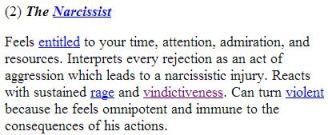
 Something I neglected to explicitly observe in the recent post referenced in the introduction that may merit observation is that all narcissists are stalkers (whether latent or active) insofar as the objects of narcissists’ romance fantasies are always merely objects to them (psycho-emotional gas pumps); they’re never subjects. What distinguishes the narcissistic stalker is that s/he’s seldom recognized for what s/he is, so s/he’s seldom rejected for what s/he is. Realize that the difference between normal pursuit behavior and aberrant pursuit behavior may be nothing more than how the pursued feels about it. Narcissists choose targets they perceive as vulnerable (empathic, tolerant, and pliable).
Because narcissists are extroverted, confident, aggressive, and socially commanding, “stalking” is seldom applied to their conduct. Narcissistic pursuit is by allure, false promise, and emotional coercion. The narcissist preys on the expectations of the cognitively normal, which s/he understands intuitively and manipulates with horrible proficiency. S/he often isn’t recognized as a user with no sincere investment in the other’s feelings until it’s too late.
To compound the difficulty either of making categorical pronouncements about narcissistic motives or exposing them, they’re not always known to narcissists themselves. To read most diagnostic explications of their mentality, the uninitiated would come away with the impression that narcissists are sharks, cunning, predatory automatons with false smiles and devious intentions. Anyone who’s had intimate and sustained relations with a narcissist, though, will perceive that s/he’s following what to him or her seem normal, romantic impulses in the moment. The difference is the narcissist is able to disown the moment with reptilian facility when his or her fantasy conflicts with interests of more pressing concern to the narcissist’s ego-preservation—or the interests of the other conflict with the narcissist’s fantasy.
It’s often argued that narcissists aren’t crazy, that they know what they’re doing. But this isn’t strictly so. In the throes of fantasy, narcissistic consciousness may be schizoid. Narcissists may lead parallel lives, even multiple parallel lives, like polygamists with spouses in different cities. And they may indulge an impulse with abandonment…then coldly—oh, so coldly—return to business as usual and plot the necessary steps to erase traces of the lapse. The narcissist runs either hot or cold. There is no warm.
 Once the other fails to satisfy the psycho-emotional needs of the narcissist, corrupts his or her fantasy, or by intimacy threatens the autonomy of the narcissist or the reality s/he’s primarily invested in, the narcissist’s pathology is such that s/he can instantly blame the other (whom the narcissist targeted in the first place) for his or her perceived “betrayal.”
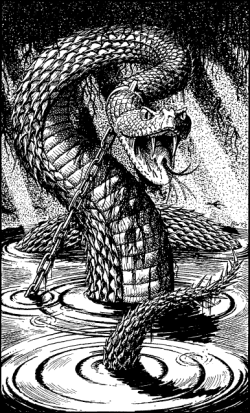
It’s at this stage that the anger and jealousy, identified as the germinal motives of the stalker, rear their scaly heads. For the narcissist, a restraining order may not only satisfy his or her lust to scourge and cripple his or her target; it may also be a way to satisfy jealousy: “Now no one else will have you.”
Revenge for the narcissist, too, is an impassioned fantasy. The preternatural vehemence of the narcissist is dismaying to its target. In a sense, though, it’s just a redirection of ardor that provides a different source of narcissistic supply. The restraining order process accommodates the narcissist exquisitely, allowing him or her to summon police like a dignitary and ham it up for a judge or several of them. S/he owns the spotlight. And once in possession of a restraining order, the spotlight will follow him or her wherever s/he wants.
The monstrous caricature of the other s/he’s authorized to present to friends, family, and acquaintances current and future serves as the perfect surrogate for the other. It delivers all of the attention while being free of any of the expectations.
Copyright © 2014 RestrainingOrderAbuse.com

 In “
In “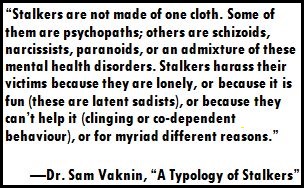
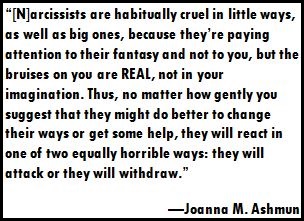
 Rape and domestic violence happen. There’s no question about it. There’s likewise no question that their effects may be damaging beyond either qualification or quantification.
 A significant number, if not the majority, of respondents to this blog who report being the victims of false allegations on restraining orders—particularly the ones who detail their stories at length—are women. This doesn’t mean that women, who represent less than 20% of restraining order defendants, are more commonly the victims of false allegations. It’s indicative, rather, of women’s disposition to socially connect and express their pain, indignity, and outrage. (Women, furthermore, aren’t perceived as dangerous and deviant, so they feel less insecure about publicly declaiming their innocence; they have the greater expectation of being believed and receiving sympathy.)
 If you imagine there are hard-and-fast rules that apply to what a judge can issue a restraining order for, think again. Grounds for establishing “harassment” or vague emotional allegations like fear need only be their plaintiffs’ assertion. Plaintiffs don’t even

 Ignore that and consider what judge, in the “bad old days” before restraining orders existed, would have allowed a woman to be publicly labeled a rapist, merely by implication.
 In fact, what it and any number of others’ ordeals show is that when you offer people an easy means to excite drama and conflict, they’ll exploit it.
 Her coterie of girlfriends is transposed straight from the halls of high school. They’re less physically favored than the leader of their pack and content to warm themselves in her aura. The adolescent intrigue injects some color into their treadmill lives, and they savor the vicarious thrill of the hunt. The man is a topic of their daily conversation. The women feel young again for a few months, like conspirators in an unconsummated teen crush.
 The life of the man who’d hospitably welcomed the strangers, shaking hands in good faith and doling out mugs of cheer, is trashed: multiple trips to the police precinct to answer false charges and appeals to the court that only invite censure and further abuse. His record, formerly that of an invisible man, becomes hopelessly corrupted. His artistic endeavor, a labor of love that he’d plied himself at for years and on which he’d banked his future joy and financial comfort, is predictably derailed.
 A man eyes a younger, attractive woman at work every day. She’s impressed by him, also, and reciprocates his interest. They have a brief sexual relationship that, unknown to her, is actually an extramarital affair, because the man is married. The younger woman, having naïvely trusted him, is crushed when the man abruptly drops her, possibly cruelly, and she then discovers he has a wife. Maybe she openly confronts him at work. Maybe she calls or texts him. Maybe repeatedly. The man, concerned to preserve appearances and his marriage, applies for a restraining order alleging the woman is harassing him, has become fixated on him, is unhinged. As evidence, he provides phone records, possibly dating from the beginning of the affair—or pre-dating it—besides intimate texts and emails. He may also provide tokens of affection she’d given him, like a birthday card the woman signed and other romantic trifles, and represent them as unwanted or even (implicitly) disturbing. “I’m a married man, Your Honor,” he testifies, admitting nothing, “and this woman’s conduct is threatening my marriage, besides my status at work.”


 I hear weekly if not daily from victims of second-wave feminist rhetoric and the influence it’s exercised over the past 30 years on social perceptions that translate to public policy. Today most Americans assume that the instrument born of 60s and 70s consciousness-raising efforts by equity feminists, the civil restraining order, is rarely abused. This falsehood is promulgated through the unconsciousness-raising efforts of radical feminist usurpers who’ve left proto-feminists like philosopher Christina Hoff Sommers asking,
  The Wikipedia entry I’ve cited explains rape culture includes behaviors like “victim-blaming” and “trivializing rape.” Considering that a significant proportion of restraining order abuses may be instances of victim-blaming, that is, of abusers’ (including violent abusers’) inducing the state to harass, humiliate, and drop the hammer on their victims; and considering that this abuse (characterized by some as “rape”) is arguably trivialized by its being categorically ignored or denied, a case arises for the reverse application of the phrase rape culture.
 The idea that even one perpetrator of violence should escape justice is horrible, but the idea that anyone who’s alleged to have committed a violent offense or act of deviancy should be assumed guilty is far worse.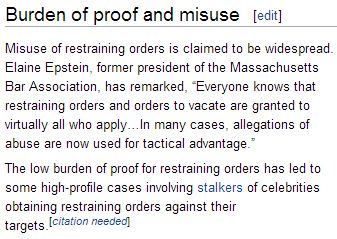
 No topic defies neutral qualification, and since Wikipedia’s own “Restraining order” page recognizes that restraining orders are widely claimed to be misused, and since restraining orders are furthermore issued against millions of people every year across the globe, restraining order abuse can hardly be dismissed as a trivial topic or one unworthy of attention and elucidation. That’s its being disregarded owes to avoidance of a sensitive subject is a more credible explanation.
 Victims of false allegations made on restraining orders may be labeled “stalker,” “batterer,” “sicko,” “sexual harasser,” “child-abuser,” “whore,” or even “rapist”—publicly and permanently—by accusers whose sole motive is to brutalize. And agents of these victims’ own government(s) arbitrarily authorize this bullying and may baselessly and basely participate in it, compounding the injury exponentially.

 Many restraining order recipients are brought to this site wondering how to recover damages for false allegations and the torments and losses that result from them. Not only is perjury (lying to the court) never prosecuted; it’s never explicitly acknowledged. The question arises whether false accusers
 Civil injunctions aren’t warnings; they’re orders of the court. If violated, even by the express invitation of their plaintiffs—and if the search terms that bring people to this blog are any indication (and they are), this happens more than anyone cares to acknowledge—the consequences to their defendants may be extreme, including months of incarceration, loss of employment, and all of the possible ramifications (physical, psychological, and material) that attend both. Police won’t inquire whether renewed relations between a plaintiff and a defendant were consensual, nor will they care. They’ll just slap the cuffs on, and the situation isn’t one that an ill-informed plaintiff can simply “clear up.” It’s out of his or her hands. It’s sufficient, furthermore, for an officer to reasonably believe a violation has occurred. No report by the plaintiff is required to authorize an arrest.
 I’m 100 blog posts old…and feel it.
 I was contacted by a woman a few months ago who was issued a false restraining order sought by a vindictive and parasitic man who meant to use the system to hurt her. She happened to be out of town and timed her return to coincide with the order’s expiration for non-service. (Restraining orders must be served within a specified period, for example, 45 days. If this term elapses, the restraining order is voided, and its applicant must return to the courthouse and start the process over.) This cagey woman actually called the police, explained the situation, and inquired how long they had to serve her. She didn’t hide from them; she simply remained unavailable for that period. Upon her return, she applied for a restraining order against her false accuser…and got it.

 Those who profit politically and monetarily by the misery inflicted through court processes that are easily abused by the “morally unencumbered” love all this conflict and misdirected rage, which only ensure that these corrupt processes continue to thrive.
 TALKING BACK to restraining orders