Scapegoating: All Violence against Women, Including Rape, IS Punished—It’s Just Not the Guilty Who Necessarily Bear the Blame

Many of the posts published here in 2014 concern how we talk about violence against women.

Criticism of anti-violence rhetoric and policies is sternly denounced or dismissed, including by mainstream, populist writers. Toeing the line of political correctness, they call such criticism “denialist.” To criticize anti-rape zealotry, for instance, is said to mean a critic is a “rape denier.”

This is what the late William F. Buckley called rebuttal by epithet.

Name-calling isn’t an argument. But it’s easier than thinking—and when it identifies you with the in-crowd, it’s congenial, besides. Using epithets like “rape denier” is PC; it makes you one of the team.

The fact is the people who are said to “deny” rape are often the people who bear the blame for all of the rapists and domestic tyrants who never receive the punishment they’re due, and never will.

I had a brief but enlightening conversation years ago with a detective in my local county attorney’s office. I called to report perjury (lying to the court) by a restraining order petitioner. He sympathized but said his office was too preoccupied with prosecuting more pressing felonies, like murder, to investigate allegations of perjury.

His evasion wasn’t the enlightening part.

The enlightening part was this: He opined that the reason why judges so eagerly gibbet restraining order defendants is that they’re straw targets. They’re available scapegoats.

Realize that judges have been told for decades that physical and sexual violence against women is “epidemic,” and the alert status has never been downgraded from red. Judges, furthermore, are hardly insensitive to the expectation placed upon the justice system to arrest violence against women—or to statistics that say a majority of rapes are never reported, let alone punished.

Judges can’t act independently of allegations; they can only exercise wrath upon those who are implicated as abusers…and they do. Physical and sexual violence that’s said to go unpunished is punished—by proxy.

Proving rape in a criminal proceeding is exceedingly hard. There are seldom witnesses, and evidence can be highly uncertain, besides being ephemeral. Because rape is a serious crime punishable by a lengthy prison sentence, the evidentiary bar is high, so rulings can predictably disappoint. Rapists, even when they are reported, may escape justice.

Those accused in civil court, though, are fish in a barrel. Judges are authorized to decide restraining order cases according to personal whim. There’s no “proof beyond a reasonable doubt” criterion to satisfy, and they know they have the green light to rule however they want.

How they’re predisposed to rule shouldn’t be a mystery.

Restraining order defendants aren’t exclusively male, but most of them are of the demonized sex. Courts, what’s more, proceed by precedent, and judges act habitually. So female restraining order defendants face judicial vigilantism by association. Restraining order recipients are trussed targets, and they bear the brunt of society’s lust for vengeance, because they can be made to.

Criticism here and elsewhere of how we talk about rape and domestic violence doesn’t deny that they occur. It urges, rather, that the influence of rhetoric be recognized and that its fervor be tempered. Violent rhetoric, no less than physical violence, destroys lives.

The person who believes otherwise is the one in denial.

Copyright © 2014 RestrainingOrderAbuse.com

You Can’t Sue for Perjury: Why Targets of Restraining Order Fraud and Other Procedural Abuses Based on Lies Get Screwed and Stay Screwed

The postscript (P.S.) to a series of comments left on the blog this week by the stepmother of a man who was falsely accused of violence asks whether he could sue his ex-girlfriend for lying.

The details, as the stepmother reports them, are these:

  1. Man and woman, who aren’t married, were together for four years and have a one-year-old daughter.
  2. During the term of their relationship, no reports of any kind of domestic conflict were made to authorities.
  3. The woman has heart disease (diagnosed as “congestive heart failure”) and can only perform minimally stressful activities, so this had typified the couple’s daily life: The man “gets up [at] 5 a.m., feeds [the] daughter, changes [her] diaper, makes his lunch, and heads to work. [He] gets home around 4­–4:30, and she is still in bed [and the] baby is still in [the] same diaper from that morning. […] He cleans, cooks, [does the] dishes [and] laundry, bathes [the] child, and heads to bed—and [the woman] bitches ‘cause he rolls over and goes to sleep.”
  4. On or about December 13, 2014, the couple “got in an argument, and she moved out, taking [their] child with her. She then texted [the child’s father] saying she was taking [the] child and moving to Oregon and he [would] never see [his] daughter again.”
  5. The woman then returned home to retrieve her belongings, “and when she went downstairs, he went out [the] door with [the] child. She freaked out. [Two] days later she filed a protection order saying all these lies about him…and he had to give [the] daughter back.”
  6. The woman, with her dad’s help, then relocated to Oregon with the child.

Among the woman’s allegedly false statements, apparently made to the police before she prepared to abscond with the child, was that the man pushed her into a fish tank, which it’s reported she actually slammed with her fist in a fit of rage while the man’s back was turned. Since the woman’s knuckles were plainly lacerated from punching glass, no arrest ensued. According to the man’s stepmother, the woman lied similarly to procure a protection order a couple of days later.

The stepmom wants to know if her stepson can sue his girlfriend for lying under oath. The answer, which is no, exposes why lying to the court is so effective, besides being easy.

Quoting “The Rule against Civil Actions for Perjury in Administrative Agency Proceedings: A Hobgoblin of Little Minds” (University of Pennsylvania Law Review, 1983):

“No action lies to recover damages caused by perjury.” If A is injured by the false or misleading testimony of B in a judicial proceeding, A cannot maintain an action for damages against B; A can obtain relief only by a direct attack on the judgment. So it was at common law, and although some observers have called for its abandonment, courts today are unanimous in following that ancient rule.

Tennessean and fraud victim Betty Krachey has launched a petition to urge her state to punish lying.

Appreciate that a corollary of that “ancient rule” is that if someone who’s lied about in a judicial proceeding lapses into suicidal despondency and kills him- or herself, his or her loved ones have no legal recourse. If you publicly mislabel someone a stalker, child molester, or batterer, for instance, outside of court, and that person kills him- or herself, you can be sued. But if the same end results from false allegations you make in court, you get away scot free.

Perjury—that is, knowingly lying to the court about influential facts—is a “serious criminal offense,” as a law student from South Africa recently remarked in a comment about a case of restraining order fraud that emerged in her country’s popular press. In many if not most jurisdictions in the U.S., perjury is a felony.

Punishment for it, however, can only follow its prosecution by the district attorney’s office, which rarely initiates perjury proceedings and only does so in slam-dunk cases of prominent interest like misconduct by public officials. Private litigants can sue for damages caused by the commission of other crimes—murder, for example—and they can sue for slanders and libels made outside of court. They can’t, though, sue for damages caused by lies told in judicial proceedings, no matter how injurious those lies might be.

The reason why, basically, is that the system likes closure. Once it rules on something, it doesn’t want to think about it again.

Consider what would happen if Person A lied about Person B, and Person B were authorized to sue Person A for lying. This would open the door for Person A to turn around and claim Person B lied in the second proceeding and sue Person B back. Person B could then pursue another action that alleged Person A lied about Person B in the third proceeding, and on and on ad infinitum.

While this would force the court to pay more than a lick of attention to the facts and also motivate it to drop the hammer on liars, it’s messy and time-consuming. So it’s rejected in the name of economy—and damn the consequences to people who are lied about.

This policy is among the reasons why restraining orders should be repealed.

Temporary orders are issued upon a few minutes’ prejudicial deliberation (really none at all). A petitioner goes to the courthouse, fills out some paperwork, and has a chitty-chat. If the accused doesn’t appeal, the court’s entire application to the case will have been those few minutes (sandwiched between stifled yawns). Even when a defendant does appear in court to contest allegations against him or her, judicial “review” of the matter may be less than 30 minutes.

On the basis of this brief “review” (which is often merely theater), a person like the man in the story above can be branded a “domestic abuser,” have his or her name entered into state and national police databases (permanently), and be denied contact with his or her child (besides potentially being denied credit, leases, and jobs, and having to indefinitely endure the agony and humiliation of being re-judged for something s/he didn’t do). S/he can also be made to pay court costs for having his or her life torn apart by lies.

A person like him, who can be male or female, can attack the false judgment in a further appeal—provided s/he has the emotional and financial resource—but s/he can’t seek redress for fraudulent testimony given in evidence against him or her.

That would inconvenience the court.

Copyright © 2014 RestrainingOrderAbuse.com

Smile, You’re on Candid Camera: Bringing a Measure of Accountability to Restraining Order Trials

Many if not most of the posts on this blog concern the absence of accountability in the restraining order process. Accusers lie, and so may judges.

State law often designates lying in court a felony offense punishable by a term in prison, and there are ethical canons that prescribe how judges should behave.

With regard to the honest representation of facts in court, however, both accusers and judges fudge (and that’s putting it mildly). Each may frame facts to produce a favored impression.

Lying in court, even if it’s discerned, is never called “lying”—which isn’t to say judges never tacitly express disdain or disgust. Frowns, scoffs, and scowls, though, aren’t picked up by microphones or preserved in trial transcripts.

Judges know the system would fall apart if they began acknowledging in the record that accusers lie, so lies are generally talked around if they’re remarked at all. No one, furthermore, reviews testimony afterwards to detect lies or material contradictions (which constitute “perjury by inconsistent statements”).

Consider how different things might be if courtroom procedures were recorded on video. Just consciousness of scrutiny puts people on notice. It triggers a primal alarm.

The knowledge or fear that we’re being watched exerts a disciplining influence on how we behave. Park an empty cop car on a street corner, and suddenly people are mindful of traffic signs. Rules are obeyed without anyone’s having to tell us to obey them.

Park a camera in a courtroom, and count on it that judges would be a lot more conscious of their performance and how their acumen stood to be perceived by others. Liars, too, would likely be a good deal warier of being caught out.

Making frauds visible, what’s more, and available for airplay would pressure district attorneys to treat lying like the serious crime it is. The concern wouldn’t be that some shaming video soundbite would appear; the concern would be what if.

Exceptions to video-recording testimony could be made in criminal trials when a witness might be inhibited or endangered by it. Since civil restraining order trials are regarded as no big deal, anyway, however, there’s much to recommend this simple, inexpensive measure to enhance accountability without having to do anything at all.

True, a possible negative consequence of cameras in court might be that the bench would only attract hams and blowhards.

Would anyone, though, notice a difference?

Copyright © 2014 RestrainingOrderAbuse.com

Restraining Orders and the First Amendment: A Female Blogger’s Successful Appeal of a Restraining Order That Labeled Her a “Cyber-Stalker”

“The First Amendment is FIRST for a reason.”

Larry Smith, former attorney and indomitable muckraker

A recent post on this blog revisited the case of Matthew Chan, author of ExtortionLetterInfo.com (ELI), whose appeal of a lifetime restraining order is presently under consideration by the Georgia Supreme Court. A verdict is anticipated within the coming month or months.

Criticisms are handily represented as acts of terrorism to the courts, whose officers have been conditioned to pander to accusers. Anyone is a potential target of facile accusations, which are made in mere moments. Retirees and vegetarian soccer moms, for whom the cost of attorney representation is often prohibitive, report being implicated as violent menaces and tyrants.

This post reports a successful appeal waged by North Carolinian Cindie Harman, who was issued a no-contact order for allegedly “cyber-stalking” a mother and her minor daughter by publicly criticizing them in a blog. Mrs. Harman named the adult plaintiff’s daughter a “bully” of other children and opined that her behavior was influenced by her mother’s conduct.

According to the Associated Press, the mother, who owns or owned an Asheville-area water services company, was “sentenced to nearly three years in prison for faking thousands of tests designed to ensure that drinking water is safe” in 2012 (and also faced “conspiracy charges”), had “plead guilty in 2010 to mail fraud,” and “paid a fine and did community service after pleading guilty to misconduct by a public official after she was charged with embezzling more than $10,000 from Marshal when she served as town clerk there.” Mrs. Harman’s accuser, whose husband is a former magistrate, controverts the popular notion that restraining order applicants are innocent lambs seeking protection from marauding predators.

Mrs. Harman prevailed in her restraining order appeal, but the vindication of her character and her judgment of her accuser’s character didn’t come without a steep price—and that’s excluding attorney fees.

According to the blogger quoted in the epigraph, Larry Smith, a friend of Mrs. Harman’s and fellow comrade-in-arms:

During the long time this case was pending, I had been talking to Cindie on the telephone, trying to reassure her that she would win her case in the NC Court of Appeals. She was very nervous, inconsolable, dyspeptic, upset about it.

Being accused of stalking, let alone being accused of stalking a child, isn’t funny. It’s the kind of thing that breaks a person.

To be charged with stalking in North Carolina signifies you’ve caused someone “to suffer substantial emotional distress by placing that person in fear of death, bodily injury, or continued harassment.” (Note that the latter element of the statutory definition of stalking, “continued harassment,” is glaringly incongruous to the elements that precede it. The contrast between fear of “death [or] bodily injury” and fear of “continued harassment” underscores the slapdash, catch-all nature of stalking and related statutes that makes them not only objectionable but outrageous, and urges their legislative revision or repeal.)

The trial court that heard the restraining order case against Mrs. Harman, and whose backroom judgment was overturned by the North Carolina Court of Appeals, had ruled, “Defendant [Harman] has harassed plaintiffs within the meaning of [N.C. Gen. Stat. §] 50C-1(6) and (7) by knowingly publishing electronic or computerized transmissions directed at plaintiffs that torments, terrorizes, or terrifies plaintiffs and serves no legitimate purpose” (italics added).

Observe that even the court’s grammar was bad. The ruling should have read “transmissions…that torment, terrorize, or terrify.” Gaffes like this are hardly surprising considering how hastily and carelessly restraining order judgments are formed.

Mrs. Harman was said to have tormented, terrorized, or terrified the child plaintiff by referring to her as a “bully” (a “reason kids hate to go to school”) and tormented, terrorized, or terrified her mother by calling her a “crow,” an “idiot,” and a “wack” on a blog.

Terrifying indeed.

At the beginning of this year, Law Professor Jonathan Turley eagerly reported that the U.S. Court of Appeals for the Ninth Circuit ruled “Bloggers Have Same First Amendment Rights As Journalists” (cf. Robinson Meyer’s “U.S. Court: Bloggers Are Journalists,” published in The Atlantic, and “Reporters’ Privilege,” prepared by the Electronic Frontier Foundation). Judges in North Carolina seem not to have heard the news.

The decision came in a defamation lawsuit where the panel ordered a new trial in the case of Crystal L. Cox, a blogger from Eureka, Montana. Cox was sued for defamation by attorney Kevin Padrick and his company, Obsidian Finance Group LLC, after she wrote about what she viewed as fraud, corruption, money-laundering and other illegal activities.

The details may sound familiar.

In legal commentary presented in Chan v. Ellis, the appeal mentioned in the introduction to this post, Law Profs. Eugene Volokh and Aaron Caplan asserted to the Georgia Supreme Court:

The First Amendment protects the right to speak about people, so long as the speech does not fall into an established First Amendment exception (such as those for defamation or for true threats). This includes the right to speak about private figures, especially when they do something that others see—rightly or wrongly—as unethical.

Restraining orders and criminal stalking law may properly restrict unwanted speech to a person. But they may not restrict unwanted speech about a person, again unless the speech falls within a First Amendment exception. The trial court’s order thus violates the First Amendment.

This may also sound familiar.

Cindie Harman ultimately won the case against her, a case that should never have been entertained by the court in the first place, but a victory that should have reassured her that freedom of speech in our country is a revered and inviolate privilege has had the opposite effect.

Reportedly consequent to receiving threats against her person and having several of her pets poisoned, Mrs. Harman has removed her blogs. Even her Twitter feed is now “protected” and no longer accessible to a general audience. Mrs. Harman lives in the sticks and says if she weren’t armed, she’d be afraid to be alone.

She has been terrorized into silence.

Copyright © 2014 RestrainingOrderAbuse.com

*The author of this blog, too, has had a lifetime injunction imposed upon him by the court for communication “about a person” (communication that alleged misconduct, including criminal, by a public official). His 2013 trial, which was conducted in the Superior Court of Arizona and in which he represented himself, concluded less than four months before the Ninth Circuit Court of Appeals’ ruling in Cox v. Obsidian Finance Group. He hasn’t subsequently received any threats but has been monitored. His accuser, a married woman he encountered standing outside of his house one day in 2005 (and many nights thereafter), is believed to be among the first to read anything posted here.

Yes, Virgil, There Is a Santa Claus: In a Month, Not Only Has Feminism Received Stern Scrutiny from Distinguished Members of the Press…So Has the Press

This is what an anti-feminist looks like.

Feminism may not know it yet, but 2014 will mark the year when patrons whose sympathies it has enjoyed for decades stopped taking a knee.

There were intimations of a climate change last summer. An intrepid band of men’s rights activists staged an International Conference on Men’s Issues in June. Turnout was slim, MSNBC mocked its presenters, and its reverberations were seemingly minor. It nevertheless inaugurated a shift. People were talking back—and not just anonymously from behind cartoon avatars on blogs and in forums.

Women Against Feminism’s Tumblr page drew hundreds of submissions like the one above.

Results of a Time Magazine poll urged a ban on the the word feminist (until Time was bullied into begging feminists’ pardon and pulling the word from its list).

This week, things came to a head.

One of those lightning rod stories feminist advocates rally around, a November Rolling Stone article about a purported frat house gang rape, turned out to be sketchy at best, and besides being roundly criticized has started journalists questioning what they’ve been taking for granted.

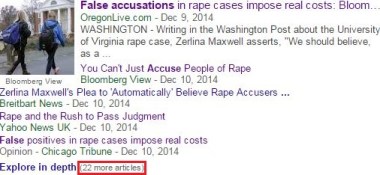
Feminist attorney and writer Zerlina Maxwell opined in a Washington Post piece days ago that the Rolling Stone story’s failings shouldn’t deter “us” from continuing to accept allegations of sexual violence at face value. She, too, has been taken to task by her peers, many of whom are asking, “What do you mean ‘us’?”

Quite suddenly, denunciations of feminist excesses are emerging from other than fringe sources, which means they won’t be so easily discounted. Yesterday, Philip Terzian of The Weekly Standard panned the press for feeding into PC prejudices, and Bloomberg columnist Megan McArdle, bless her heart, produced an op-ed that ran Tuesday under the title, “You Can’t Just Accuse People of Rape.”

Next thing you know, writers will be saying you can’t just accuse people…period.

Copyright © 2014 RestrainingOrderAbuse.com


Judicial Impression Management: What Makes False Allegations “True” and True Allegations “False” (and Drives Victims of Procedural Abuses to Despair)

“Politics, corporate bullshit—it’s all the same game of impression management.”

House of Lies

What do political spin-doctoring, corporate PR, government-sponsored science, and judicial rulings have in common?

Each is about impression management, the selective representation of facts to create a composite “truth” that suits a particular set of social, political, and/or economic imperatives.

Pols and corporations engage in flimflam to win votes and increase profit shares. Science, too, seeks acclaim and profit, and judicial motives aren’t so different. Judges know what’s expected of them, and they know how to interpret information to satisfy expectations.

The general context of discussions on this blog is the issuance of restraining orders, an arena of law that receives little scrutiny either from within the system or from the public; there is no oversight. Judges are moreover licensed to rule according to their discretion, so their latitude for impression management is broad. Any set of facts or plausible fictions can be rendered damning with a little rhetorical footwork, which needn’t be subtle—skewed rulings more often suggest clog dancing than ballet.

Nobody’s paying attention anyhow, except to make sure judges are fulfilling their mandate to make government look good and keep special interest groups mollified.

Since judges can rule however they want, and since they know that very well, they don’t even have to lie, per se, just massage the facts a little. It’s all about which facts are emphasized and which facts are suppressed, how select facts are interpreted, and whether “fear” can be reasonably inferred from those interpretations. A restraining order ruling can only be construed as “wrong” if it can be demonstrated that it violated statutory law (or the source that that law must answer to: the Constitution). There are no “mistakes,” only the very exceptional “over-reach.”

The restraining order process is the product of lobbying by special interest groups (collectively called “feminism”), which have secured government favor in recent decades, and this favor has conditioned how judges manage impressions. Favoring special interest groups has translated into the investment of billions, which has directed trends in social science research (including monetarily), swayed public opinion, and besides conditioned police and judicial impulses and priorities, thereby determining how allegations ranging from harassment to violent and/or sexual assault are credited and acted upon by officers of the justice system.

A crude evolutionary précis (not necessarily chronological) might look something like this:

  • Feminism gets the nod;
  • legislation is passed enacting restraining orders;
  • further legislation is passed making them more stringent and punitive;
  • additional legislation is passed: domestic violence acts and statutes, stalking statutes, etc.;
  • the definition of “domestic violence” is broadened to be inclusive of almost anything that can be construed as “abusive” according to judicial discretion;
  • the Violence Against Women Act (VAWA) is passed;
  • a special office of the Justice Department is established;
  • billions of dollars of federal monies are doled out in the form of grants to police departments and the courts to beef up arrest policies and “train” judges and police officers how to interpret allegations of violence or merely “fear”;
  • and the popular press is enlisted, knowingly or not, to flak the whole business.

Impression management marks the standard operating procedure from top to bottom.

Feminism’s foot soldiers in the blogosphere and on social media, finally, spread the “good word,” and John and Jane Doe believe what they’re told—unless or until they’re torturously disabused of their illusions. Stories like those you’ll find here are often the stories of average people who’ve been publicly maligned and have maddeningly discovered that “the truth” is whatever the system chooses to enter into the record.

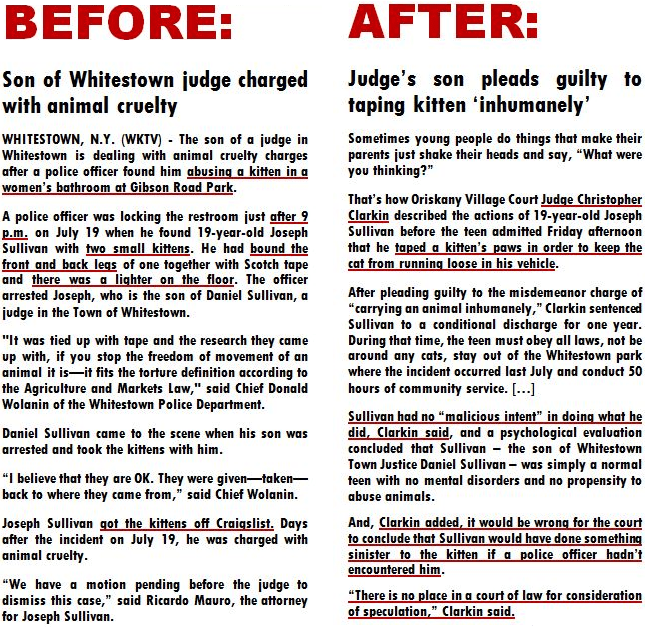
To conclude this abstract litany with a concrete illustration, consider these stories, published six months apart (“Son of Whitestown judge charged with animal cruelty” and “Judge’s son pleads guilty to taping kitten ‘inhumanely’”):

The difference you’ll detect between the two versions of the facts and how they’re interpreted exemplifies impression management.

Copyright © 2014 RestrainingOrderAbuse.com

The Politics of Feminism and Women’s Law: A Response to Zerlina Maxwell’s Editorial “No Matter What Jackie Said, We Should Generally Believe Rape Claims”

Implicit in the headline of this op-ed is that even “wrongly accused” men are “perps.”

The only complimentary thing this writer can find to say about attorney Zerlina Maxwell’s December 6 column in The Washington Post is—yeah, scratch that; it has no redeeming qualities.

The editorial is not only intellectually callow but morally vacuous. Even its research and computations are careless.

Ms. Maxwell’s piece concerns a story published last month in Rolling Stone Magazine about a purported gang rape at the University of Virginia. The story was swiftly lofted upon a current of hot air then failed to maintain elevation because of a number of holes.

By Ms. Maxwell’s pained logic, the story’s having nosedived is all the more reason why allegations of rape should be accepted wholesale.

Many people (not least U-Va. administrators) will be tempted to see this as a reminder that officials, reporters and the general public should hear both sides of the story and collect all the evidence before coming to a conclusion in rape cases. This is what we mean in America when we say someone is “innocent until proven guilty.” After all, look what happened to the Duke lacrosse players.

In important ways, this is wrong. We should believe, as a matter of default, what an accuser says.

Default means negligence, which Ms. Maxwell equates with propriety. According to feminist algebra, negligence = propriety is a balanced equation.

Note that Ms. Maxwell isn’t actually making an argument for policy reform. We already do, by default, believe what an accuser says, hence outraged and anguished accounts like the ones you’ll find here: “Stop False Allegations of Domestic Violence.”

Ms. Maxwell fails to appreciate that our crediting what a rape accuser says “as a matter of default” means the slope is greased all the way to the bottom. Accepting allegations of rape on faith means accepting on faith all allegations that relate to or imply violence.

And the grease flows sideways, also, not just top-down.

According to the same policy, women  too, are victimized by false allegations, false allegations made in criminal, civil, and family court (as well as to government agencies like Child Protective Services)—and the standard applied in non-criminal procedures is already much reduced from “innocent until proven guilty.” Women unjustly lose their good names, their livelihoods, their children, and their homes (and that’s just the abbreviated list). These are among the consequences of equating allegations with facts “as a matter of default.”

false-rape-letterMs. Maxwell concludes: “Ultimately, the costs of wrongly disbelieving a survivor far outweigh the costs of calling someone a rapist.”

She asserts that rape leaves a “lasting psychological wound” but that the fallout from being falsely accused of rape is minor and ephemeral. “The accused would have a rough period,” she allows. “He might be suspended from his job; friends might defriend him on Facebook.”

Haunting is not only that people like Ms. Maxwell can appeal to pathos to make their case or that they can make such an appeal despite demonstrating no faculty for empathy; haunting is that their appeals nevertheless succeed.

Ms. Maxwell says the “cost of disbelieving women…signals that women don’t matter and that they are disposable.” No, it signals that no one is any more disposable than anyone else.

Copyright © 2014 RestrainingOrderAbuse.com

Why It’s Valuable to Report Your Story of Restraining Order Abuse or Other Procedural Abuse on an E-Petition or Similar Medium

Government statistics used to train police officers and judges are derived significantly from surveys, as discussed in the previous post.

These surveys are represented as “science” but are in fact simply acts of collecting responses, responses that may be completely anecdotal (that is, unverified and most likely unverifiable). Interviewers ask questions, and volunteers answer. Some studies according to which policy is determined (for example, on college campuses) may not even be conducted person-to-person; they may be electronic.

Policy that indelibly impacts lives on a grand scale may be based, yes, on glorified questionnaires.

“Science” that influences research trends and legislation, and that consequently conditions police and judicial impulses, is derived by “randomly” eliciting responses from a sample population—and not a particularly large one at that.

When you hear a controversial statistic, the kind that appears in international headlines and in feminist blogs from one end of the Internet to the other, like one in five college women has been a victim of sexual assault (a statistic drawn from a Web survey administered at two American universities), that figure was based on survey data.

What is a petition?

It’s a survey (of personal experience and public sentiment).

Copyright © 2014 RestrainingOrderAbuse.com

Blinded by Science: Examining the Australian Government’s Sexual Assault Statistics to Expose How Such Science Is Derived, How It’s Applied, and Why It’s Not Really as Scientific as It’s Represented to Be

Here is the Australian government’s Institute of Family Studies’ sexual assault “Facts & Figures” page.

And here is the first thing it says: “Statistics carry significant power and persuasion.”

That’s putting it mildly. That power and that persuasion influence lives on a magnitude that no numbers could quantify. Appreciate that figures concerning sexual assault and how these figures are popularly exploited influence court rulings in all cases that touch on violence or the purported fear of it, including in civil and family court, cases based on allegations of harassment, stalking, child abuse, and/or domestic violence, among others.

You’ll encounter these statistics bruited ubiquitously on the Internet.

“Sexual assault statistics are based on two main types of data,” according to the Australian government website:

  • victimisation survey data—data collated from surveys conducted with individuals, asking them about their experiences of sexual assault victimisation, regardless of whether they have reported to police; and
  • administrative data—data extracted through the various systems that respond to sexual assault (e.g., police, courts, corrections or support services).

Important to note at the outset of this discussion is that statistics often quoted by advocates and commentators of one stripe or another (including journalists) may originate from survey responses, that is, from “intelligence” that may be unqualified by any corroborating investigation. Though this post looks at Australian statistics, figures cited as originating from the United States, for example, are derived the same way. When a statistic is phrased “[x number] of [men or women] report being the victim of [x],” that figure was derived from survey responses.

The Australian Institute of Family Studies draws its statistics from six national surveys. This number suggests scrupulous science, but no ascertainable accuracy can be ascribed to the raw data, which is anecdotal.

The 2012-13 Crime Victimisation Survey (CVS), for example, which is one of the six surveys from which the Australian government draws its statistics, is based on interview responses from one member (“selected at random”) of 30,749 “fully responding households,” that is, on the personal interpretations and alleged experiences of fewer than 31,000 people, a study sample that represents about a tenth of 1% of the Australian population. What percentage of this sample is male and what percentage female isn’t reported on the CVS webpage (though other surveys, like the Personal Safety Survey, do report gender-specific conclusions).

Survey-based statistics are among the sorts you’ll encounter broadly promulgated in feminist “fact sheets” and brochures—and consequently everywhere else.

Important to consider, furthermore, is that “administrative data” (police and court statistics), the second data set from which government figures are derived, may itself be influenced by the former sort of data. Survey responses, much touted, may exert either a direct influence on how officers of the law and courts are trained to respond to or interpret allegations, or they may exert a proximal influence by having inspired the direction of social science research that’s used for training. The former data, survey responses, may in other words determine the conclusions and actions of agents of the justice system to some degree, and possibly to a very considerable one.

“Statistics carry significant power and persuasion,” and neither police officers nor judges are any less susceptible to that power and persuasion than anyone else. In fact, they more than almost anyone else are required to absorb these statistics.

Granted, survey statistics are probably as comprehensive as it’s practical for them to be, and contrary statistics that these figures are rejoined with by advocates for disenfranchised groups like battered men may themselves be based on surveys of even smaller groups of people. All such studies are subject to sampling error, because there’s no practicable means to interview an entire population, and sampling error is hardly the only error inherent to such studies, which are based on reported facts that may be impossible to substantiate.

What must be appreciated in all of this is that what’s called “science” is far from certain and is no more verifiable or creditworthy than are responses to online petitions like this one: “Stop False Allegations of Domestic Violence.” Both types of data, that is, are anecdotal.

The significant difference is that respondents to petitions aren’t “randomly selected” or interviewed by trained questioners. There are no “controls.”

So-called controls, however, may themselves influence findings.

Government surveys are inherently biased insofar as their aim is to collect information according to specific questions. The questions determine the nature and bounds of the responses to them and are determined by designated topics of interest.

Petitions in contrast place no constraints on respondents’ comments—and indirectly garner uninhibited answers to questions like, “Have you or someone you know been the victim of fraudulent abuse of court or state process?”

They garner answers to questions, that is, that the government doesn’t care to ask.

Copyright © 2014 RestrainingOrderAbuse.com

Stepford Syndrome: Why Feminist Rape Rhetoric Is Both Tiresome and Disturbing (and How It Hurts Not Only Men, but Women, Too)

“A U.S. law professor, who will be speaking at the Commons, said the UK’s stance on false allegations [of rape] is more aggressive than in countries such as the United States, Canada, and Australia. Prof. Lisa Avalos, of the University of Arkansas, said false allegations in the U.S. were dealt with as a misdemeanour offence, not a felony—and most women were not jailed if found guilty.

“‘In the course of my research, I have not found any country that pursues these cases against women rape complainants in the way the UK does. The UK has an unusual approach, and I think their approach violates human rights,’ she said.”

The Guardian (December 1, 2014)

This quotation about rape “complainants” is drawn from a story that appeared in The Guardian this week (“109 women prosecuted for false rape claims in five years, say campaigners”), a story that’s mirrored on a number of other sites, including Jezebel.com and Salon.com.

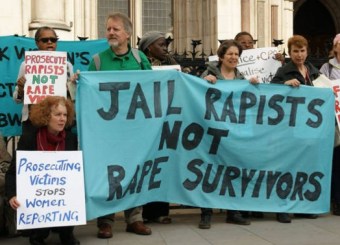
Picketers object to the prosecution of 109 British women in recent years for perverting the course of justice by falsely alleging rape. According to the protesters’ signs, all female accusers are “victims” and “rape survivors,” and the men they accuse are all “rapists” (ipso facto).

The story concerns outrage expressed by activist representatives of the charity Women Against Rape, or WAR, whose assertions require no elucidation; they’re clockwork.

Whether WAR’s outrage has merit is difficult to discern.

Obviously lost in the uproar, however, is what the (female) American law professor who’s quoted in the epigraph actually says, which is this: Falsely accusing someone of rape in the United States is merely a misdemeanor offense and one for which an accuser is rarely punished and may never be prosecuted at all.

This fact isn’t perceived as unfair by feminist activists—far from it. It’s touted, rather, as a reason why it’s a “human rights violation” for the United Kingdom to mete out sterner justice.

This writer, for one, would be more sympathetic to the denouncements of WAR if there were any headline-grabbing activist groups tabulating how many men are arrested and/or prosecuted each year for being falsely accused of rape.

In the fictional community of Stepford, all the women have been replaced by robots whose responses are programmed.

Even allowing that the 2 to 8% false allegation rate commonly cited by feminists were true (and it isn’t), the number of men falsely accused of rape is many times greater than the number of women prosecuted for false allegations, in the UK and everywhere else (for analysis of the rate of false allegations of rape, see Cathy Young’s 2014 Slate.com article, “Crying Rape: False rape accusations exist, and they are a serious problem,” and Emily Bazelon and Rachel Larimore’s 2009 piece, “How Often Do Women Falsely Cry Rape?” published in the same outlet).

Feminist outcry is reflexive, even arguably robotic, and invariably insensitive to male victimization. The argument that a majority of rapes goes unpunished in no way (logically, morally, or otherwise) excuses the unjust implication or punishment of even a single person, ever.

Besides being insensitive to male victimization, moreover, feminists evince no awareness that women, too, are victimized by their furor’s trickle-down effect. Feminists’ making an international case of the prosecution of 109 women works a very real influence on how rulings on charges “lesser” than rape are formed by the courts—charges made in restraining order, stalking, domestic violence, and related cases—and the defendants in these cases are far from exclusively men.

False allegations made against women in prosecutions involving or implying violence may only be a fraction of those made against men, but with those prosecutions’ numbering in the millions each year, that fraction is hardly inconsiderable and easily dwarfs a figure like 109. To posit, as activist groups like WAR tacitly do, that accusers’ allegations should be credited on faith means a lot of women (globally) will continue to be falsely implicated or punished based on judicial impulses that have been conditioned by feminist rhetoric. Much of the “social science” that’s used to “train” judges how to rule in prosecutions predicated on allegations of violence or the fear of violence is inspired by groups like WAR.

To illustrate how feminists’ gears turn (and why those gears need retooling), contemplate this letter printed in The Guardian recently that was composed by a 21-year-old man who was accused of rape as a boy: “A letter to…the girl who accused me of rape when I was 15.”

Now consider this steely response to it by Lucia Osborne-Crowley published almost simultaneously (buzz…whir…click) on WomensAgenda.com: “Why did the Guardian publish this letter about false rape accusations?

Need any more really be said?

Copyright © 2014 RestrainingOrderAbuse.com

Retracting False Allegations to the Court

Apologies are offered upfront to the reader expecting a tutorial on how to recant false testimony (though here is an explication about how a restraining order may be dismissed by a petitioner who has reconsidered).

The reason this post must disappoint is that to withdraw false allegations would be to confess to lying to the court and would, as well, be to require that the court acknowledge it was snookered. Hence is copping to lies a doubly taboo subject.

A thorough scouring of the Internet for a simple how-to on retracting false allegations to the court will reward an earnest inquirer with virtually nothing.

The fact is that in America, Land of the Brave Knave, the most fundamental legal precept is admit nothing. Application of that precept apparently extends to the court itself, whose officers may practice moral contortionism sooner than own on record that lies are ever detected.

Their reflex, when no amount of revision can redeem a false allegation, is to talk around it or reach for a nonjudgmental word like unfounded or baseless. Complainants never lie; at worst, they err.

The question remains, however, of how “errant” testimony may be retracted.

This writer proposes that since judges provide false accusations with the agency to work their pernicious effects on untold people’s lives, a judge should be the one to fill the informational void presently under consideration.

The judicial impulse to frame rulings according to personal conceptions of “right behavior” must surely reject the qualification of lying as conscionable conduct. Arrogating to themselves the right to prescribe rules for how others should behave, besides, presumes judges have faith in their intelligence. They must therefore know false accusations are made even if it’s against policy to say so. It’s not for nothing, after all, that statutes nominating perjury a crime exist.

Since only ignorant people could innocently deny lying occurs, and since we’ve established judges don’t regard themselves as ignorant, to them is this question humbly put: “How may false allegations to the court be simply taken back?”

Copyright © 2014 RestrainingOrderAbuse.com

Restraining Orders as “Revenge Porn”

In the second season of HBO’s The Newsroom, a lead character is exposed on a website called Revenge Porn by a man with whom she’d had a brief fling.

After sitting huddled in a corner and pronouncing, “I want to die,” she rallies and confronts her former lover while he’s conducting a business meeting. Without much prelude, she kicks him in the testicles and bloodies his nose.

It makes for engaging TV.

If only an ex-intimate’s exploitation of the legal equivalent of Revenge Porn could be so briskly requited and resolved.

What I’m referring to, of course, is treacherously defamatory representations to the court on a civil restraining order, representations intended to publicly humiliate and satisfy a scorned lover’s urge to wound. The restraining order is an invitation for the system to poke its nose into the crevices, one it’s glad to accept.

The TV show character wasn’t able to sue the man who betrayed her, because she posed for the pictures. She even bought the camera for him.

Had the man surreptitiously shot the photos and aired them without her consent, she could have taken him to the cleaners. The courts do more than frown upon that kind of thing, especially when the photos are nudies.

Non-photographic representations that use the justice system as their porn site, though, are embraced as compelling causes of action.

Stalking, indecent exposure, assault, child molestation, bestiality, rape—no pubic allegation, however scandalous, is off the table, and there are no consequences for falsely portraying someone as a lewd and lascivious beast. It’s not defamation; it’s testimony. This distinction sublimates obscene slanders and libels into protected speech, and denies defendants any recourse for realizing compensation for the damage they inflict, psychological, physical, financial, and material.

The court hosts the site, and judges, the site’s administrators, are only answerable to the law, which licenses the site.

This revenge porn is legal—and has the feminist stamp of approval.

Copyright © 2014 RestrainingOrderAbuse.com

A Source of False Reporting and Procedural Abuse Even Feminists Can’t Get Behind: Women Lying about Women

The Orlando Sentinel reported this month that a former Seminole County deputy sheriff faces criminal charges for falsely accusing her boyfriend’s ex-wife of being a child molester.

The backstory runs something like this:

  • Boy and girl deputy sheriffs, despite being married to other people, begin sleeping with each other in the early weeks of 2014, including while on duty.
  • An internal affairs investigation concludes they abandoned their posts at least three times to have sex.
  • The girl deputy consequently resigns; the boy deputy is fired soon after.
  • A month later, on May 15, an anonymous call is placed to the Florida Abuse Hotline reporting the boy deputy’s (now ex-)wife abused a six-year-old girl (who is unidentified in the Sentinel article).
  • Authorities trace the anonymous call to the girl deputy’s phone and arrest her.

A recent post on this blog commented on the award of $500,000 from the federal government to a female law professor who proposes to disprove the claim that women make false allegations in family court to alienate fathers from their children.

Stories like the one highlighted in this post, to the contrary, suggest that love (scorned love, failed love, feared failed love, etc.) motivates some women to lie indiscriminately and heinously.

Procedural biases that broadly obtain today exist because, we’re told, men are motivated by their sexual urges to do horrible things (cf. “rape culture”). How ironic would it be if those procedural biases were being exploited by women motivated by their sexual urges to do horrible things?

That would discredit the whole shebang.

Copyright © 2014 RestrainingOrderAbuse.com

Chicken Sh*t from Rotten Eggs: Rosemary’s Story of Restraining Order Abuse

The account below, by Rosemary Anderson of Australia, was submitted to the e-petition End Restraining Order Abuses (since terminated by its host) and is highlighted here to show (1) that restraining orders are abused not only by intimates but by neighbors and strangers, (2) that the ease with which they’re applied for entices vexatious litigants (especially once their appetite has been whetted), and (3) that restraining orders are abused in countries other than the United States.

Assuredly due to language barriers, most visitors to this blog are from predominately English-speaking countries (England, Canada, and Australia, in particular, among nations abroad), and for whatever reason, over 90% of visitors are American.

Foreign complainants of restraining order abuse, however, shouldn’t hesitate to report their stories and share their criticisms on blogs like this one or on petitions like the one Rosemary used, because the value of those stories and criticisms, ultimately, is to expose injustice. The civil restraining order is common to countries across the globe, as are its abuses.

Rosemary’s story (with minor editorial tweaks):

We have had several restraining order summons served upon us by our neighbours, and on one occasion a worker whom I had reported to police for exposing himself to me (evidenced in photos) tried to take a VRO out against my husband (VRO = violence restraining order). To date they haven’t gone the distance thanks to our lawyer, but we know they will never stop trying.

The allegations are false, though we admit to giving them the finger from time to time in retaliation for being abused or watched.

The matter began when we opposed the expansion of their egg farm. We did so through the appropriate channels and in the appropriate manner. They have a CCW on their property and for reasons unknown were allowed to build the egg farm far too close to our boundary and house.

Their settlement to buy their property went through in January (2011). Ours was delayed and went through in February. They keep telling people they were there and had already built and were running their egg farm before we bought our property. The egg farm did not end up how it was supposed to and has been poorly managed, creating unpleasant issues for us. To expand any farther, they need our property and have indicated they would like to purchase but are not willing to pay what it is worth.

Every time they are overstocked or doing something wrong, they will make some sort of false allegation against us, cost us thousands of dollars, and generally make our lives unpleasant. On one occasion, we had the police come out and accuse us of stealing their dog after we had to catch it to stop it from chasing our horses. On another occasion, they rang the ranger and accused us of shooting their dog after it had gone missing. It turned up two days later alive and well in the dog pound.

The woman is about the same age as me, in her 50s and supposedly religious. She married a disabled man, and she uses these things to gain sympathy. She will lie and first turn on the tears, and if that doesn’t work she will become aggressive and threaten, and get others to threaten.

She once threatened my employer to get me sacked. I had luckily recorded several previous incidents that proved to my boss the lies they tell. They once took us to court over the boundary fence even though we had evidence in the form of letters and photos. Miraculously they won as they brought the non-professional fencing person with them as a witness. We weren’t given the appropriate notice by the court of their witness and could have selected several witnesses of our own to prove the fencing contractor assisted our neighbours to make a false insurance claim. The summons for this also came 18 months after we had given them what we had considered an appropriate payment. They had cashed the cheque and never contacted us in between to dispute it.

I found the behaviour of the local magistrate and the local court registrar very suspicious, and seriously wonder if they are members of their church. I wish I had more time to explain. I have had people ring us on our silent phone number and abuse us as well as had threatening letters sent to our PO box and which also contained our pet names.

Rosemary’s accuser fits the profile of many others characterized by visitors who’ve left comments on this blog and is prototypical of the serial-accuser-cum-neighbor. Almost without exception, people like this are triggered by some petty grievance.

Restraining orders, because they’re issued on one party’s word alone, are addictive gateway drugs for vexatious litigants, who are induced to abuse process continuously once they see how conveniently it’s accomplished. There are no consequences for filing false or frivolous complaints. Not only do the courts never motivate serial accusers to stop; they often reward sniping and treachery.

It’s good for business.

Copyright © 2014 RestrainingOrderAbuse.com

J’s Story: Restraining Order Abuse and the “Dreaded Crazy”

J, a single dad who lives in Texas with his two kids, submitted his story as a comment to the blog in September, prefacing it: “I am writing this to share [it] with the rest of my fellow male victims [who] fall in with the dreaded Crazy.”

The “dreaded Crazy” in J’s case manifested as an Arkansas woman J began a romance with online, a high-conflict person whom a clinician might diagnose with borderline personality disorder (BPD).

(For an elucidation of BPD, see psychologist Tara Palmatier’s “In His Own Words: Dangerous Crazy Bitch Ahead,” which chronicles a case similar to J’s. See also any of Dr. Palmatier’s detailed explications of personality disorders.)

Here’s J’s story in his own words (lightly edited):

I met a beautiful, sexy, well-educated woman online. We met in person, and I was smitten. We shared our life stories with each other and began to see each other more. Although she lived over 500 miles away with her two children, I visited her every chance I could.

Her past was fraught will evil men who had taken advantage of her. She told me she was a young widow and that her first husband died suddenly of heart failure at a very early age, leaving her and her first child all alone. She said she remarried shortly after and had her second child. Unfortunately the second husband turned out to be a quite the carouser and left suddenly for Europe to be with another woman.

I felt so bad for her. I had two children of my own as a single father, so I was able to connect with how hard it was. She told me how she loved children and had always wanted a big family. She lamented feeling that her own family had deserted her, shunning her because she wasn’t a devout Christian.

There were so many twists and turns to her story. How could all this happen to such a wonderful and beautiful woman? She was such a nice and giving person….

Because it was all complete bullsh*t.

I won’t go into the details of my awakening. Let’s just say dates didn’t match up. Her kids’ (Fruit Loops’) stories didn’t match up. As a matter of fact, just about everything she told me didn’t match up. But I was smitten. So this went on for a long time until one day I just flatly called her on it. Suddenly my little scoop of heaven turned into a raging, clawing, screaming harpy. She accused me of being like every other son of a bitch in her life. Then she was swinging at me and screaming at me to get out.

I was already sprinting backwards, car keys in hand, toward my car. I got inside and sped off as she was chasing me. I was outta there, heading back to Texas never to return.

I did not see, speak, or talk to that woman again for over six months. Then one day a constable walks into my office and says, “Are you so-and-so?” I said yes. “Well, I have a restraining order for you from Arkansas.” Confused, I took it and read it. The constable then said as he was leaving, “I normally don’t read those. But looks like one crazy bitch to me. Better stay away. Ha-ha. Have a nice day.”

I was blown away.

The order claimed that I had snuck inside her house the weekend prior and forced her to call some other guy to tell this other guy (whom I don’t know, never met or heard of) that she was madly in love with me. Then her statement said I “roughed [her] up” then vanished into the night. Damn I was stunned. I did not know what to do. The order stated that I had 14 days to show up in Arkansas! I wasn’t even there. I lived in another state! I had not seen or heard from this woman in six months!

So I called an attorney friend of mine. He jokingly asked, “Did you do it”? I replied, “Hell no!” He then asked me to fax over the order. After he reviewed it, he called back and said, “Yep, it’s a restraining order, and you have 14 days. In the meantime, you have to stay away from her and her children.”

I replied, “This is bullsh*t! What if I just ignore it?” He said, “Well, if you ignore it and don’t show up in court on that day, you will automatically be found guilty. The charge will stay on your record, and you may not be able to buy a firearm.” “What the f—!” I yelled. “Can’t you just send a letter to the court explaining I wasn’t there and live 500 miles away?” He said no. “If you want to fight the charge, you have to show up.” He said he would have gone for me but wasn’t licensed in Arkansas.

He gave me the number of an attorney friend who worked in Little Rock. Next thing I knew, I’m having to fax or email every record I kept that shows my whereabouts on that day: gas receipts, store receipts, etc. I had to get a list of movies that I watched from the video download company we use. Cell phone calls. Text messages. (By the way, they really do monitor those. They can pinpoint your exact location, but you have to send a written request.) All of this to prove I was not there. Once I gave that attorney everything, he told me he would go to court that day and ask for an extension of 60 days. And I would still have to show up in Arkansas. Sh*t!

I cannot express the worry I endured during this time. Here I was falsely accused of something I did not do and was guilty until I proved otherwise in another state!

Prior to my court date, the attorney hired a private detective to run police reports on this woman’s current and former addresses. All you really have to do is call the local police department, and for a small copy fee it will give you all of the police reports related to a specific address for a specified time period. It’s really quite easy to do.

I was shocked when I saw them.

This woman, over a period of five years, had called the police over 20 times between two different addresses claiming either an assault or attempted break-in. All the police reports were noted as unfounded. One was a claim of rape. On that claim, she took some poor guy all the way to a grand jury, which promptly dismissed it. (Grand jury decisions are sealed, but the defendant’s name and attorney were listed. My attorney called that guy’s attorney and got a few details.)

The file on her sordid past was pretty thick. I thought that this was going to be over. Nope! I couldn’t use this information in court. It didn’t pertain to this incident. It was still her word against mine.

The day of the court hearing came. I drove out of state to be there. She actually showed in up in court that day. I suspect she didn’t expect I would show. The judge called out our docket. She sat on one side of the courtroom. My attorney and I sat on the other.

Seconds before the hearing, my attorney asked to briefly speak just to the prosecutor. They met in front of the bench, and my attorney handed him the file with prior police reports and my receipts and information as to my whereabouts on the day in question. The prosecutor then asked the judge if he could take a few minutes with the plaintiff. The prosecutor walked over to her with the file and whispered in her ear as he let her review the contents of the file. You could see the blood drain from her face. She whispered something to him. The prosecutor then stood up and said, “Your Honor, the plaintiff requests to withdraw her charge.” The judge just laughed and said, “Case dismissed.” That was it. It was over, no questions asked: $3,800 bucks and a long drive back home.

I did return to the local sheriff’s office and file an amended police report to state I was falsely accused and the case was dismissed on this date. You can have the dismissal form put in the police record.

I also had a cease-and-desist letter drafted by my attorney stating basically, “Don’t ever do this again, or I will sue you for liability.” You can put that in the police record, as well.

I had a copy of that letter sent to her by certified mail. I also had a copy personally delivered to her place of work by the same investigator who ran the background check. He went to her office and told the receptionist that he had a “special delivery” letter for her and that he needed to deliver it in person.

The receptionist called her to the front office. When she did, the investigator introduced himself and informed her that he had a letter to present. He pulled the letter out and proceeded to read the cease-and-desist letter out loud to her in the crowded waiting room. Then he handed it to her and left. He reported back that she appeared to have been in shock.

That’s it. Haven’t heard from her to date.

Copyright © 2014 RestrainingOrderAbuse.com

Interminable Indeterminacy: How False Allegations on Restraining Orders May Be Worse than False Allegations of Rape


Journalists who recognize the harm of facile or false allegations invariably focus on rape. This ignores the harm done to women by false allegations, of course, and shows ignorance, besides, of a significantly more fertile yet equally damaging source of wrongful prosecutions: the civil restraining order.

Unarguably there are few miscarriages of justice worse than when rape is falsely alleged and the victim of the false accusation is nevertheless found guilty. That’s a life brutally scarred or ruined for absolutely nothing—and ruined not by a lone malefactor but by the state itself.

Most negative commentary on rape allegations, though, focuses on cases where the evidence is less than conclusive or is found to be utterly false.

Just as there’s no quantifying the effects of being raped, there’s no quantifying the effects of being falsely accused of rape. The stigma is devastating, and public sympathy is nevertheless scant. Even online support groups for victims of false allegations of rape may be accessible to screened subscribers only, so distrustful and averse to scrutiny are the men who are maligned this way.

If, however, an allegation of rape is officially determined baseless, its victim has at least the solace of being able to say so. This hardly dispels the psychic effects, but it does mitigate external ramifications, like access to jobs.

False restraining orders, in contrast, often aren’t discerned as false (and restraining orders may be awarded in spite of false allegations’ being detected), and the consequences their recipients must live with are more than psychological. The damning records are preserved indefinitely. In some regions (like Massachusetts), to merely be accused of domestic violence in an ex parte civil court procedure is to be recorded in a state registry as a violent offender. Even if claims are later dismissed when the accused is given an opportunity to defend him- or herself, that is, even if a judge later recognizes on record that s/he’s “innocent,” s/he’s still “guilty” according to the system, and “guilty” is all a background check will reflect.

The implications of restraining orders, what’s more, are generic. There’s no specific charge associated with them. They’re catchalls that categorically imply everything sordid, violent, and creepy. They most urgently suggest stalking, violence, and sexual deviance.

Rape, it should be noted, may be among the actual allegations made by a restraining order applicant—and unlike in a criminal trial, a judgment grounded on such an allegation, amid others, may be affirmed in spite of the allegation’s merits’ never having been assessed.

Restraining orders don’t determine anything. The procedures from which they issue are too accelerated and loosey-goosey to be conclusive.

That no punishment attends the issuance of a restraining order is a tacit acknowledgment by the state that it may be based on nothing more substantive than hearsay and innuendo, and that its implications should be discounted.

They aren’t discounted, though. They’re regarded just as gravely in some respects as felony sentences. Restraining order recipients are denied jobs, leases, and loans. Some are prohibited from working with or around children—and even from attending their own children’s school events (sometimes based on accusations they’re never granted the practicable opportunity to contest in court—and always based on accusations they’re at most given a few minutes to controvert, typically without benefit of legal counsel).

Restraining order rulings are inevitably sketchy at best. They’re indeterminate but nevertheless treated as decisive—and they never go away.

“On the force of the plaintiff’s testimony, the court concludes it’s a crocodile.”

Victims of false rape allegations are socially disgraced and alienated, and psychologically tormented. Victims of false restraining orders may be, too, and besides may lose everything of value to them or have it taken from them by the state. People report spending as much as $100,000 or more to defend themselves in protracted litigations whose seed was an accuser’s filling out some paperwork and having a few-minute chinwag with a judge. They report losing their homes, becoming estranged from their children, and being permanently barred from employment in their fields of qualification and expertise.

Negative associations that attend a charge of rape are unquestionably more sensational and severe than those that accompany the issuance of a restraining order, but on balance the lived consequences of a restraining order may be comparable if not worse.

False allegations of rape should emphatically be called out by reporters to check the impulse that prevails today to credit finger-pointing as fact (particularly finger-pointing by women). Because the implications of rape are so loud and urgent, revelations of false allegations are loud and urgent, too. They arouse consciousness and conscience.

The question that they should stimulate and have yet to, however, is that if people will lie about rape, what won’t they lie about and what quieter and subtler lies and their consequences are being overlooked?

Exposure in the press would indicate that newsworthy instances of dubious or false allegations of rape are few. The problem with giving exclusive attention to them is that it hides more than it reveals.

The cancer of false allegations is far more advanced and widespread.

Copyright © 2014 RestrainingOrderAbuse.com

Living in the Crosshairs: Crackpot Neighbors, False Reports, and Restraining Order Abuse

I bonded with a client recently while wrestling a tough job to conclusion. I’ll call him “Joe.” Joe and I were talking in his backyard, and he confided to me that his next-door neighbor was “crazy.” She’d reported him to the police “about a 100 times,” he said, including for listening to music after dark on his porch.

His neighbor had never been punished for her mischief, only indulged and rewarded. This is behavior the police and court have been conditioned to treat as urgent. The woman’s husband refused to participate in her sniping—but didn’t interfere with it, either. He had to live with her. Others in the vicinity just tried to stay off her radar.

The neighboring house was dim and still as Joe related the woman’s pranks, which spanned a period of years. “She’s probably listening to us now,” he remarked.

I commiserated but didn’t share with Joe that I wrote about such things and heard about them monthly from people whose lives were sometimes crippled by hyped allegations of fear and danger.

Joe told me, unsurprisingly, that his neighbor had twice sworn out restraining orders against him. The first was laughed out of court on appeal; the second he didn’t bother to contest. He gestured as if to say, “What would’ve been the point?” Maybe Joe intuited that high-conflict people like his neighbor live for strife and attention, and decided to deny her the satisfaction of a fight.

(Many respondents to this blog report they’ve had multiple false restraining orders petitioned against them. One e-petition respondent recently reported being the recipient of seven fraudulent restraining orders obtained by a “diagnosed narcissist.”)

Joe informed me, with a hint of sarcasm, that his neighbor was a professional psychic. Surveillance cameras nevertheless hung from the corners of her home’s roofline. I guess she couldn’t see everything coming.

(Among people who report being stalked or serially accused by neighbors through the courts, the presence of security cameras is commonly mentioned. The neighbors also tend to be of middle or advanced age and female—as are their victims, sometimes. One 60-year-old woman, chronically accused by a female neighbor, has reported having to abandon her house and flee to forestall further allegations. Men who are spies, peepers, and cranks are more likely to be the recipients of restraining orders than the petitioners of them: women accuse sooner than men do—and they do it more effectively.)

Joe didn’t get too explicit, but he told me he’d been photographed fooling around with his wife in the hot tub, which he’d since removed. In Arizona, at least, it’s apparently legal to monitor your neighbor over a bordering fence.

Joe said after he and his wife divorced, his neighbor told his ex-wife he was having an affair. He took in a male roommate. His neighbor photographed him, too—through the window adjacent to her backyard.

Joe shifted an arbor from one side of his patio to the other after getting approval (but no compensation) from the homeowners’ association. Two massive Tombstone rosebushes interwove to form a decent privacy screen.

I asked Joe whether he’d ever tried to get the woman off his back. He told me, unrepentant, that he’d once shot her with the garden hose while she was peeping. To this day, he says, she circulates it that he “assaulted her with a high-pressure hose.” He may have said this was the grounds for one of the restraining orders.

His neighbor has reported her other neighbors, too. The neighbor across the street knew of her particular “sensitivities” and informed her in advance that she was having a birthday party for her little girl at 2 in the afternoon on a weekend. The neighbor from hell reported it, anyway—on principle, I guess. The kids’ party was disrupted by cops.

Joe says his neighbor’s record is seven calls to the sheriff’s department in a single day (just on him). Deputies finally told her that if she called again, they’d cite her.

Joe works as a chef and didn’t appear to have any kids. With a few beers in him, he seemed to take the whole thing in stride.

I wonder if a feminist would be as tolerant.

Copyright © 2014 RestrainingOrderAbuse.com

How Dogma Is Preserved: A Feminist Law Professor Is Awarded a $500,000 Grant from Uncle Sam to Prove Claims of False Allegations in Family Court Are “Junk Science”

“Ten years ago, about one in 10 domestic violence arrests involved women as defendants. Now, it’s one in five in Michigan and Connecticut, one in four in Vermont and Colorado, and more than one in three in New Hampshire. Public officials are trying to figure out what’s going on. They are especially mystified because, according to [The New York Times], the trend ‘so diverges from the widely accepted estimate that 95 percent of batterers are men.’

“Interesting logic: first, a dogma contradicted by virtually all social science research [namely, 95% of batterers are men] becomes ‘widely accepted.’ Then, when it’s disproved by the facts, the response is to ask what’s wrong with the facts.”

—Cathy Young, “Female Aggression—Domestic Violence’s ‘Dirty Little Secret’” (1999)

What the quoted writer means is that when dogma becomes “widely accepted,” it stays “widely accepted.” Time has proven her right. Fifteen years later, that dogma—men are abusers; women are victims—still predominates.

It gets by with a little help from its friends.

Some months ago, a post on this blog responded to research conclusions published this year by Prof. Kelly Behre, director of the UC Davis Law School’s Family Protection and Legal Assistance Clinic.

Among those conclusions was that anecdotal reports of procedural abuses, false allegations, and judicial bias by what she calls FRGs (fathers’ rights groups) have no “legitimate” research studies to back them up and should therefore exert no influence on public policy. They should, according to the professor’s own research, be disregarded.

Last month, it was reported that a George Washington University law professor was awarded a $500,000 grant from the National Institute of Justice (i.e., taxpayers) to “conduct a study in which she hopes to show that family courts across the country have fallen into a pattern of awarding custody” of children to fathers who are “known abusers.”

The professor, Joan Meier, directs the university’s Domestic Violence Project. She’s also the “founder and legal director of the Domestic Violence Legal Empowerment and Appeals Project, a nonprofit that [helps] domestic violence survivors receive pro-bono [legal aid].” Her credentials, you’ll notice, are conspicuously similar to those of Prof. Behre, referenced above.

Consider why Prof. Meier was awarded the grant:

She said researchers can say anecdotally that courts have awarded custody to known abusers or fathers whose [partners or ex-partners] have warned could be abusive to children, but researchers and advocates’ sharing their experiences alone hasn’t yet led to change.

Now consider that fathers’ rights researchers and advocates’ sharing their experiences has also yet to lead to change, and appreciate that those researchers and advocates aren’t being cut half-million-dollar checks to compile research data. What they have to say doesn’t accord with the “widely accepted” dogma; it isn’t popular.

Because their anecdotal reports of false allegations, procedural abuses, and judicial bias don’t have any official research to validate them, they’re to be ignored.

Ignoring those reports, in fact, is essential for a hypothesis like Prof. Meier’s to be tenable. It depends on absolutely denying that those whom the professor calls “known abusers” could be men who’ve been falsely implicated.
Prof. Meier says she expects to use the $500,000 federal grant to conclusively expose gender bias in family court against women—and to do it using a study sample of “over 1,000 court cases from the past 15 years” (a study sample, in other words, of fewer than 2,000 cases).

For the professor’s hypothesis to be proven “true,” it just has to be shown that in a significant number of the “over 1,000 cases” reviewed, a father awarded custody of children had previously been accused of abuse.

The researchers hope to debunk “junk science” that mothers make false accusations of abuse to alienate fathers from their sons or daughters, a misconception that Meier said has put many children in danger.

Prof. Meier seems to fail to grasp that the complaint is that mothers successfully “make false accusations of abuse to alienate fathers from their sons and daughters.” Even if her study were to show that child custody is awarded to fathers who’ve been successfully accused of abuse, it wouldn’t necessarily prove that the complaint that false accusations are routine  is based on “junk science” (unless by that phrase she means science that hasn’t been government-funded and -audited).

Prof. Meier’s assertion that claims of false allegations are a “misconception,” what’s more, ignores that any number of attorneys who practice family law publicly corroborate that so-called misconception. Some indeed say false allegations to gain the advantage in custody battles are commonplace. These are the attorneys who actually practice in the trenches. Their reports, however, are once again only anecdotal.

Fathers and their advocates who claim false accusations are made don’t, of course, misconceive anything. They know what they know; they’ve lived it. The professor’s use of the word misconception is directed at the “people who count,” that is, the policy-makers. What she means is any credibility they might be disposed to show complainants of procedural abuse is based on a misconception. That misconception, apparently, is that men without law degrees could possibly be telling the truth.

The professor’s assertion that reports of false accusations are “junk science,” furthermore, would seem to advocate for good science, and there’s certainly nothing scientific about prejudicially dismissing those reports offhand. Studies like those proposed by Prof. Meier need to be counterbalanced by studies with opposing hypotheses—and they aren’t.

Meier and her team of legal and statistical experts will create a database of court opinions that she hopes will show a pattern that supports her hypothesis, and will then present it to activists, local courts, and organizations that train judges.

Preservation of dogma is a game of ring-around-a-rosy. Advocacy for what’s widely accepted to be true is lavishly funded, and the resultant “science” may then be used to “train” judges how to rule, further reinforcing the dogma.

(If the context of this policy were Russia instead of the United States, would training still be the word we used to mean influencing judges?)

This is how underhand gets the upper hand, and it’s remarkable how openly this kind of business is transacted. No one bats an eye, because it’s “official.”

Prof. Meier may have the best of intentions. The author of this post has never known anyone whom he would characterize as a domestic violence “survivor.” He has no doubt, however, that there are people who are daily subject to violent cruelty, and if he did know someone like that, he’d be grateful that there were people like Prof. Meier looking out for their interests.

Victims need advocates and defenders.

The reality is, though, that victims of domestic violence have quite an abundance of public and private sympathizers, while victims of abuse of civil and criminal processes legislated to protect battered women and children (including restraining orders) receive little public recognition at all. An agency that calls itself the “National Institute of Justice” shouldn’t play (or pay) favorites. Justice would, in fact, advocate that an equal payout be provided to researchers to study the frequency of fraudulent accusations, which can’t be determined from court rulings, because those rulings are influenced if not dictated by the prevailing dogma.

Hypotheses, it’s been amply observed, tend to incline researchers to find evidence of whatever it was they were looking for in the first place (this is called “confirmation bias” or “myside bias”).

Leora Rosen, a former senior social science analyst at the National Institute of Justice, said [Prof. Meier’s] study is unique because it is transparent about its lack of objectivity and looks at family court rather than criminal court cases. She has partnered with Meier for the study.

Copyright © 2014 RestrainingOrderAbuse.com

Criminalizing Criticism: Restraining Orders, the First Amendment, and Chan v. Ellis

This search term brought a visitor here a day or two ago: “restraining order in ohio because a couple texts.”

It struck a chord with this author, because he himself was issued a restraining order on a similar basis (three emails over a weekend). There were accompanying allegations, but the court’s final ruling was based exclusively on the emails (i.e., speech). They weren’t even judged threatening, just unwanted (the contents, in fact, weren’t read by the court).

Some people are issued restraining orders on even more tenuous bases, like criticizing their plaintiffs on Facebook or in a blog or other online medium. If you’re such a person, you should be aware of a case before the Georgia Supreme Court that’s been the subject of a prior post on this blog: Chan v. Ellis.

The court was scheduled to hear opening arguments on October 7.

A summary of the case by UCLA Law Professor Eugene Volokh, along with his legal commentary in support of the appellant, Matthew Chan, is here.

The First Amendment protects the right to speak about people, so long as the speech does not fall into an established First Amendment exception (such as those for defamation or for true threats). This includes the right to speak about private figures, especially when they do something that others see—rightly or wrongly—as unethical.

Restraining orders and criminal stalking law may properly restrict unwanted speech to a person. But they may not restrict unwanted speech about a person, again unless the speech falls within a First Amendment exception. The trial court’s order thus violates the First Amendment.

If you’ve been issued an injunction from the court based exclusively on your speaking publicly about its plaintiff (and you didn’t threaten or lie about him or her), a verdict in favor of Mr. Chan could conceivably provide you with grounds for an appeal. FYI.

See Mr. Chan’s website, ExtortionLetterInfo.com, for trial updates. A ruling, he reports, should be returned between mid-January and mid-March.

The case stands to highlight judicial abuse of discretion and power and is one anybody who’s been put through the restraining order wringer will want to track.

Copyright © 2014 RestrainingOrderAbuse.com

*Update: The Georgia Supreme Court returned a verdict in favor of Matthew Chan on March 27, 2015.

Hocus-Pocus: More on False Restraining Orders and the Five Magic Words

Some recent posts on this blog have touched on what might be called the five magic words, because their utterance may be all that’s required of a petitioner to obtain a restraining order. The five magic words are these: “I’m afraid for my life.”

Cops, it’s even reported, tell women whom they goad to get restraining orders that they should recite this magical phrase to the judge (wink, wink)—and some of these women complain later that they felt forced onto a course that they regretted pursuing but weren’t permitted to correct.

(Notably, billions in federal tax dollars have been invested under the Violence Against Women Act in so-called STOP grants—“Services and Training for Officers and Prosecutors”—as well as in grants to encourage arrests, according to which VAWA grants police officers have essentially been instructed to promote restraining orders.)

The I’m-afraid-for-my-life enchantment has variant forms. This writer’s accuser, who had for months nightly hung around outside of his residence alone in the dark, used this one: “Will I be attacked?”

The abbreviated version, “I’m afraid,” can even suffice. What’s more, judges in some jurisdictions may cue a restraining order applicant to say it, because they’re not authorized to issue the requested injunction unless s/he does (e.g., “I can only issue a restraining order if you tell me you’re afraid of [him or her]. I’m going to ask you one more time: Are you afraid?”).

Gamesmanship in this arena is both bottom-up and top-down. Liars hustle judges…and judges hustle liars along.

Claims of fear are seldom unaccompanied by specific for-instances (sometimes real, sometimes not), but typically if it weren’t for the magic words’ coloring the for-instances, they would signify little by themselves.

(A California man employed as a little league umpire, for example, had a restraining order petitioned against him this year by his sister-in-law. She alleged that looks the man had cast in his nephew’s direction—while the boy was playing baseball, and the man was in the park to perform his job—caused his nephew grave emotional upset. She also cited an incident when she said her brother-in-law had aggressively honked and waved at her and her son from his car. The so-called relevant facts were only made sinister by their reporter’s alleged apprehension.)

Words aren’t magical, and allegations of fear aren’t facts. In procedures as brief and superficial as those mandated by restraining order laws, even facts aren’t facts. They’re often just innuendo upon which foundation a judge is urged and authorized to erect an outhouse.

Copyright © 2014 RestrainingOrderAbuse.com

The Five Magic Words: What Do Restraining Order Defendants Mean when They Say They’ve Been Falsely Accused?

A presumption of people—including even law professors—is that when restraining order defendants say the accusations against them are false, they mean that specific allegations of fact made by their accusers are untrue.

This is a misunderstanding, and it’s a totally understandable one that accounts for the incredulity expressed by proponents of the battered women’s movement when they hear statistics propounded like 50 to 90% of restraining orders are based on “false accusations.” (A family court judge might say 30%. The jaded former director of a woman’s shelter might say 40 or 50%. A men’s rights activist might say 60 to 80%, and a family attorney might well agree.) There are no “official” statistics—and there can’t be, because no records of false accusations are kept, and false accusations, besides, are seldom called “false accusations” in court rulings. Figures put forward are always speculative.)

It must be appreciated that restraining order prosecutions aren’t criminal prosecutions. They don’t evolve from detailed allegations made to the police and vetted by public attorneys; they’re based on forms filled out in 10 or 15 minutes by private litigants who deliver their claims straight to a judge (who meets with them for about the time it takes to make a sandwich).

To falsely accuse someone of “domestic violence,” for example, may just mean putting a check mark in a box on such a form.

That’s the false accusation—and if a defendant doesn’t show up to court to challenge that check-marked accusation, s/he becomes, by default, a “domestic abuser” according to the various law enforcement and registry databases his or her name is entered into.

hey-prestoPeople on the outside of the restraining order process imagine that the phrase false accusations refers to elaborately contrived frame-ups. Frame-ups certainly occur, but they’re mostly improvised. We’re talking about processes that are mere minutes in duration (that includes the follow-up hearings that purport to give defendants the chance to refute the allegations against them).

The fact is when defendants say accusers lie, they may just mean those accusers uttered the five magic words: “I’m afraid for my life.”

The magic words, which may of course be untrue, aren’t even susceptible to contradiction. They can’t be refuted; what they represent is an alleged feeling, not a fact that can be disproved. You can’t even really call them an accusation.

Contrary to all things reasonable and sound, a restraining order may be issued on the basis of the five magic words alone.

Copyright © 2014 RestrainingOrderAbuse.com

A Story of Female Sterilization That Should Stress to Those Who’ve Been Violated by Fraudulent Abuse of Legal Process Why Reporting Judicial Tyranny and False Accusers Is by Itself Pointless (You Must Demand Change)

The point of sharing the explication below is to emphasize how forlorn prospective recourses for redressing rights violations stemming from false restraining order and similar prosecutions are. Accountability is zero, across the board.

If you’ve ever wondered why a judge may be censured for rude conduct but not for ignoring lies or misrepresenting evidence, here’s why.

Quoted from “The Plumb Line: So What Else is New?” (Murray N. Rothbard, Libertarian Review, 1978), reprinted on LewRockwell.com as “The Tyranny of the Bench”:

The United States Supreme Court ruled, in 1872, that judges were immune from any damage suits for any “judicial acts” that they had performed—regardless of how wrong, evil, or unconstitutional those acts may have been. When clothed in judicial authority, judges can do no wrong. Period. Recently a case of an errant judge has come up again—because his action as a judge was considered generally to be monstrous and illegal. In 1971, Mrs. Ora Spitler McFarlin petitioned Judge Harold D. Stump of the DeKalb County, Indiana, Circuit Court to engage in a covert, compulsory sterilization of her 15-year-old daughter, Linda Kay Spitler. Although Linda was promoted each year with her class, Mrs. McFarlin opined that she was “somewhat retarded” and had begun to stay out overnight with older youths. And we all know what that can lead to.

Judge Stump quickly signed the order, and the judge and mamma hustled Linda into a hospital, telling her it was for an appendicitis operation. Linda was then sterilized without her knowledge. Two years later, Linda married a Leo Sparkman and discovered that she had been sterilized without her knowledge. The Sparkmans proceeded to sue mamma, mamma’s attorney, the doctors, the hospital, and Judge Stump, alleging a half-dozen constitutional violations.


All of these people, in truth, had grossly violated Linda’s rights and aggressed against her. All should have been made to pay, and pay dearly, for their monstrous offense. But the federal district court ruled otherwise. First, it ruled that mamma, her lawyer, and the various members of the “healing professions” were all immune because everything they did had received the sanction of a certified judge. And second, Judge Stump was also absolutely immune, because he had acted in his capacity as a judge, even though, the district court acknowledged, he had had “an erroneous view of the law.” So, not only is a judge immune, but he can confer his immunity in a king-like fashion even onto lowly civilians who surround him.

The U.S. Court of Appeals, Seventh Circuit, unaccountably didn’t understand the program, and so it reversed the district court, claiming that Judge Stump had forfeited his immunity “because of his failure to comply with elementary principles of due process,” and had therefore in a sense “not acted within his jurisdiction.” To allow Stump’s action to stand, said the appeals court, would be to sanction “tyranny from the bench.”

Now this was pretty flimsy stuff, and besides it opened an entertaining wedge toward holding judges accountable to the law and to the protection of rights like everyone else. But this would have shaken the foundations of our monopoly archist legal system. And so the U.S. Supreme Court, on March 28, set the matter straight. In a 5–3 decision in this illuminating case of Stump v. Sparkman, Justice Byron R. (“Whizzer”) White, speaking for the majority, sternly reminded the appellate court of the meaning of the 1872 ruling:

A judge will not be deprived of immunity because the action he took was in error, was done maliciously, or was in excess of his authority. Rather, he will be subject to liability only when he has acted in the “clear absence of all jurisdiction.”

Justice White conceded that no state law or court ruling anywhere could be said to have authorized Judge Stump’s action; but the important point, he went on, is that there was no statute or ruling which prohibited such an action by the judge.

Those interested in reading more are urged to click the link to Mr. Rothbard’s article at the top of the post.

What all of this should make clear is that for redress of rights violations stemming from false allegations made in restraining order and related prosecutions to be possible, the laws themselves must be rectified—and legislative reform will only be urged when more people loudly demand it.

For rights abuses to be capable of remedy by process of law, they must be illegal, which means the processes that authorize those abuses must be revamped or repealed by lawmakers (your state representatives). So long as the standard applied to restraining orders is merely a discretionary one, judges can rule however they want (that’s the statutory latitude they’ve been given), and they’re accountable for those rulings to no one.

Copyright © 2014 RestrainingOrderAbuse.com

“Predator” v. “Porn Star”: Restraining Order Fraud, False Allegations, and Suing for Defamation

destroyPeople falsely alleged to be abusers on restraining order petitions, particularly men, are treated like brutes, sex offenders, and scum by officers of the court and its staff, besides by authorities and any number of others. Some report their own relatives remain suspicious—often based merely on finger-pointing that’s validated by some judge in a few-minute procedure (and that’s when relatives aren’t the ones making the false allegations).

The social alienation and emotional distress felt by the falsely accused may be both extreme and persistent.

The urge to credit accusations of abuse has been sharpened to a reflex in recent decades by feminist propaganda and its ill begot progeny, the Violence Against Women Act. No one thinks twice about it.

Using four-letter words in court is strictly policed. Even judges can’t do it without risking censure. Falsely implicating someone, however, as a stalker, for example, or a child molester—that isn’t policed at all. Commerce in lies, whether by accusers, their representatives, or even judges themselves is unregulated. No one is answerable for sh* s/he makes up.

Accordingly, false allegations and fraud are rewarding and therefore commonplace.

It should be noted that false allegations and fraud can be distinctly different. For example, David Letterman famously had a restraining order petitioned against him by a woman who was seemingly convinced he was communicating to her through her TV, and her interpretations of his “coded messages” probably were genuinely oppressive to her. David Letterman lived in another state, had never met her, and assuredly had no idea who she was. Her allegations of misconduct weren’t true, but they weren’t intended to mislead (and the fact that they did mislead a judge into signing off on her petition only underscores the complete absence of judicial responsibility in this legal arena).

Fraud, in contrast, is manipulative and deceptive by design. It occurs when an accuser intentionally lies (or spins the facts) to give a false impression and steer a judge toward a wrong conclusion that serves the interests of the fraudster.

Regardless, though, of whether false allegations are made knowingly or unknowingly, they’re rarely discerned as false by the court, are seldom acknowledged as false even if recognized as such, and are always destructive when treated as real, urgent, and true, which they commonly are.

The falsely accused (often private citizens who’ve never had a prior brush with the law) are publicly humiliated and shamed, which by itself is predictably traumatizing. They are besides invariably (and indefinitely) entered into police databases, both local and national, and may be entered into one or more domestic violence registries, too (also indefinitely). These facts pop up on background checks, and defendants in some states may even appear in registries accessible by anyone (including friends, neighbors, family members, boy- and girlfriends, employers, colleagues, students, patients, and/or clients).

This costs the falsely accused leases, loans, and jobs (being turned down for which, of course, aggravates the gnawing indignity and outrage they already feel). Those falsely accused of domestic violence may further be prohibited from attending school functions or working with or around children (permanently). Defendants of false restraining orders may besides be barred from their homes, children, assets, and possessions. Some (including salaried, professional men and women) are left ostracized and destitute. Retirees report having to live out of their cars.

This, remember, is the result of someone’s lodging a superficial complaint against them in a procedure that only requires that the accuser fill out some paperwork and briefly talk to a judge. A successful fraud may be based on nothing more substantive, in fact, than five “magic” words: “I’m afraid for my life” (which can be directed against anyone: a friend, a neighbor, an intimate, a spouse, a relative, a coworker—even a TV celebrity their speaker has never met).

This incantation takes a little over a second to utter (and its speaker, who can be a criminal or a mental case, need not even live in the same state as the accused).

Accordingly, people’s names and lives are trashed—and no surprise if they become unhinged. (Those five “magic” words, what’s more, may be uttered by the actual abusers in relationships to conceal their own misconduct and redirect blame. That includes, for example, stalkers. Those “magic” words may also be used to cover up any nature of other misbehavior, including criminal. They instantly discredit anything the accused might say about their speakers.)

The prescribed course of action to redress slanders and libels is a defamation suit, but allegations of defamation brought by those falsely accused on restraining orders or in related prosecutions are typically discounted by the court. Perjury (lying to the court) can’t be prosecuted by a private litigant (only by the district attorney’s office, which never does), and those who allege defamation are typically told the court has already ruled on the factualness of the restraining order petitioner’s testimony and that it can’t be reviewed (the facts may not even be reviewed by appellate judges, who may only consider whether the conduct of the previous judge demonstrated “clear abuse of discretion”). The plaintiff’s testimony, they’re told, is a res judicata—an already “decided thing.” (Never mind that docket time dedicated to the formation of that “decision” may literally have been a couple of minutes.)

So…slanders and libels made by abuse of court process aren’t actionable, slanders and libels that completely sunder the lives of the wrongly accused, who can’t even get them expunged from their records to simply reset their fractured lives to zero.

Such slanders and libels may include false allegations of stalking, physical or sexual aggression, assault, child abuse, or even rape. In the eyes of the court, someone’s being falsely implicated as a monster, publicly and for life, is no biggie.

In contrast, it was reported last month that the court awarded a Kansas woman $1,000,000 in a defamation suit brought against a radio station that falsely called her a “porn star.”

When violated people speak of legal inequities, this exemplifies what they’re talking about: Falsely and publicly implicating someone as a sex offender is fine and no grounds for complaint in the eyes of the justice system, but for the act of falsely and publicly calling someone a mere sex performer, someone may be fined a million bucks.

Copyright © 2014 RestrainingOrderAbuse.com

How It Serves Political Interests to Issue Restraining Orders Falsely

Under the Violence Against Women Act (VAWA), some $10 billion has been invested over the past 20 years in procedures meant to redress violence against women, and restraining orders are the centerpiece of a host of related legislative measures.

The truth is restraining orders can’t prevent violence; they’re just pieces of paper. Their only value is rhetorical (they influence). They put defendants on notice, and they make it look like the government is protecting people.

When defendants are falsely blamed, their (isolated) protests are seldom registered or credited by others. Because their complaints are discounted or disregarded, they don’t tarnish the court’s image or inspire the press to investigate.

At the same time, it serves the court’s interests when defendants are falsely blamed. The greatest likelihood that an order of the court will appear to have averted violence is realized when that order is issued to someone who was never a threat at all.

Put another way, if the court only issued restraining orders to volatile people, it’s a fair bet that a discomforting percentage of orders would be violated, and the negative statistics would urgently disclose their ineffectiveness as deterrents.

Issuing a majority of restraining orders to people who pose little or no violent threat, contrariwise, ensures violations will be fewer and less consequential by and large. Negative figures, like murders, are thereby minimized, and the process appears to live up to its promise of insulation.

All of this is to say that if you issue 60 restraining orders against nonviolent people to every one issued against a violent aggressor, violations of restraining orders resulting in injuries or death will be comparatively few respective to the total number of people “restrained.” It skews the odds in favor of positive perception.

It’s good PR.

More restraining orders, besides, guarantees greater job security for those who administer them. It means there’s more “work” to get (handsomely) paid for doing.

More restraining orders also means greater substantiation of claims of “epidemic” this and that, which keeps dominant political interests happy and thriving (cha-ching!)…and justifies ramping up the process even further.

Copyright © 2014 RestrainingOrderAbuse.com

Beating up Disabled Girls: False Allegations and Judicial Dishonor

“There is no normal. The rational has been torn away from your ability to grasp it.”

Cartoonist Scott Stantis (on growing up in an abusive household)

This is the sentiment shared by everyone who’s been wrongly blamed—and abused and condemned for it.

Consider that current restraining order and domestic violence legislation and policy are defended as protecting battered women and children. Consider further that honor is not only represented as the guiding principle of judicial conduct but that it’s the title that judges are expected to ceremoniously be addressed by.

Now consider this appeal posted three weeks ago (September 30, 2014) to the e-petition “Stop False Allegations of Domestic Violence” by Phoenicia W. of Springfield, Missouri:

Hi im disabled 28 year old women. And just. Because. I was sick of being. Beat by my exboyfrend I kicked him out and he put fales charges on my cost me 10.000 dollars and I lost. Alot. How can his lies be taken. Off my record. Please. IV never. Even. Could. Hurt a fly please. I cry every. Nite. Help me.im incident I swere.

I’ve edited copy since I was teenager. Here’s what Phoenicia means:

Hi, I’m a disabled 28-year-old woman, and just because I was sick of being beaten by my ex-boyfriend [and] kicked him out…he put false charges on me that cost me $10,000—and I lost. A lot. How can his lies be taken off my record? Please. I’ve never even (and couldn’t) hurt a fly. Please. I cry every night. Help me. I’m innocent, I swear.

The gist of Mr. Stantis’s cartoon essay is that when you’re punished for something you didn’t do, and there’s no way to make sense of your situation or escape it, it “mangles the soul.”

My tidied version makes Phoenicia sound very able and together. Look again at the unedited script, though, which is a poem of pain.

Does it look and sound like it was authored by someone who could capably represent herself in court? For that matter, does it look and sound like it was authored by someone dangerous? Finally, how honorable is beating up (or beating down, if you prefer) a disabled girl and leaving her crying herself to sleep each night—a disabled girl, what’s more, who says she was beaten by the man who accused her of violence?

Feminists are urged to ask themselves which they think will have a more lasting consequence on this woman’s psyche: having been hit by an ex-boyfriend or living day and night with the court’s judgment? Which obviously haunts her? Which has healed, and which can’t heal? (When the court acts on lies by abusers, it compounds the abuse many times and makes it gnawing and constant: “There is no normal.” Ever. Again.)

You can’t relate pain like Phoenicia’s with a lurid picture of a black eye. Her pain and its source are invisible—and count on it that all traces of either have been carefully concealed beneath layers of judicial impression management.

If you’re not familiar with the phrase impression management, here’s an example: “She’ll be okay. She just ran into a door.”

Copyright © 2014 RestrainingOrderAbuse.com