
“On the European continent, for the court to hold against the defendant, the judge must be convinced that the facts brought forward by the plaintiff in support of the claim are indeed true. In principle, continental law does not make a difference between civil law and criminal law […]. By contrast, U.S. law has three different standards of proof […]. In criminal law, the charge must be established ‘beyond a reasonable doubt.’ In civil law, normally the plaintiff wins if only ‘the preponderance of the evidence’ is in [his or] her favour. Only in a limited number of civil law matters, of particular gravity for the defendant, the intermediate standard of ‘clear and convincing evidence’ must be met.”
—Dr. Cristoph Engel
The monograph from which this quotation is excerpted, which is by a professor of experimental law and economics, begins by candidly remarking that “American law is irresponsible.”
 No argument here.
At the root of restraining order injustice is the lax evidentiary standard applied to plaintiffs’ allegations. Not only may allegations on restraining orders be false; a judge doesn’t have to be convinced that they’re not false to find in favor of their plaintiff.
Excepting in Maryland, which adjudicates the merits of civil restraining order allegations based on the intermediate standard of “clear and convincing evidence,” the standard applied to restraining orders is “preponderance of the evidence.”
If claims seem more likely true than false, “preponderance of the evidence” is satisfied.
In other words, the law is contented if a single judge (not a jury of independent thinkers) reckons the allegations against a defendant are “probably true” (or “maybe true” or “true enough”). To be effective, all allegations have to be is compelling.
Making allegations compelling isn’t a tall task for people in the throes of bitter animosity, as restraining order plaintiffs typically are, and it’s a cakewalk for unscrupulous liars, who are hardly rare among restraining order plaintiffs.
Officers of our courts have furthermore had it impressed upon them that they shouldn’t question allegations made pursuant  to the procurement of restraining orders, which are presumed to be sought by those in need of protection.
The legal standard familiar from TV and the movies, “proof beyond a reasonable doubt,” is reserved for criminal prosecutions. For a judge to find in favor of a civil restraining order plaintiff, no proof of his or her allegations is necessary.
Why this is a big deal is that being publically accused is agonizing. Cops and constables serve restraining orders on people at their homes, and just the documents themselves terrorize and shame (as they’re meant to). Allegations on restraining orders, what’s more, are never harmless. Even alleged minor offenses like harassment are inevitably tinged with overtones of danger and/or sexual deviancy. Plaintiffs are inclined to make their allegations as sensational as possible to justify their applications to the courts, and the courts are inclined to find threat or perversion even where none may exist to justify their intrusions into defendants’ lives.
Defendants are met with damning fingers from all directions—and enduringly, because restraining orders (and the allegations on them) are public records, accessible by anyone, that never disappear.
What makes this an even bigger deal, especially when evidence is fraudulently represented or allegations are false, is that restraining order defendants further face loss of employment and employability, as well as loss of access to kids, home, and property in a majority of cases.
Revisiting a phrase used by the author of the epigraph, such losses easily qualify as “particularly grave” and should therefore require the application of a more conclusive standard of evidence by our courts than “close enough.”
Exacerbating the injustice of this tenuous standard is that restraining orders are issued based solely on the word of their plaintiffs (ex parte). Decisions that may result in the losses enumerated above proceed from testimony given in interviews rarely lasting longer than 10 minutes.
 Such hearings are far more perfunctory than probative. Basically a judge is just looking for a few cue words to run with and may literally be satisfied by a plaintiff’s saying, “I’m afraid.” (Talk show host David Letterman was notoriously issued a restraining order based on the petition of a woman who accused him of mentally oppressing her through her TV.)
What you have, then, on top of the presupposition of guilt, is a wishy-washy protocol yoked to a wishy-washy evidentiary standard.
It’s true that defendants are afforded the opportunity to challenge allegations leveled against them and actually address the court, but these follow-up hearings, also mere minutes long, are necessarily biased by the court’s prior findings.
The issuance of a restraining order (based on a few-minute chitchat) already represents a ruling, and the court’s disposition isn’t to contradict itself. This bias, authorized by a low evidentiary bar, too often translates to follow-up hearings’ being little more than theater—and an opportunity to subject defendants to additional humiliation and scorn.
Judges coyly criticize their partiality as “paternal.” Considering, however, the steep toll that that partiality may exact from innocent defendants, this self-excuse is nothing shy of obscene (and underscores the cognitive disconnect to which judges are prone between their performances in the courtroom and the effects of those performances on people’s lives).
Clearly the motive for applying a diminished standard of evidence to any courtroom procedure is not to decrease the likelihood of error. The lower the standard of evidence is, that much greater is the probability that miscarriages of justice will occur. When such miscarriages equate to innocent defendants’ being subjected to public humiliation and defamation, loss of employment, and effacement from their former lives, besides their having to tolerate the ever-looming possibility of incarceration following further false allegations’ being made against them, nothing less than the highest standard of evidence is conscionable.
The criticism of the writer of this post’s epigraph that “American law is irresponsible” doesn’t even begin to say it.
Copyright © 2014 RestrainingOrderAbuse.com

 A scratch, a push, a pinch—which may not even have been real but whose allegation had real enough consequences.
 I’ve written recently about the abuse of restraining orders by fraudulent litigants to punish. What needs observation is that the laws themselves, that is, restraining order and domestic violence statutes, are corrupted by the same motive: to punish. Their motive is not simply to protect (a fact that’s borne out by the prosecution of alleged pinchers).
 Restraining orders are maliciously abused—not sometimes, but often. Typically this is done in heat to hurt or hurt back, to shift blame for abusive misconduct, or to gain the upper hand in a conflict that may have far-reaching consequences.
 A recent male respondent to this blog, for example, reports encountering an ex while out with his kids and being lured over, complimented, etc. (“Here, boy! Come!”), following which the woman reported to the police that she was terribly alarmed by the encounter and, while brandishing a restraining order application she’d filled out, had the man charged with stalking. Though the meeting was recorded on store surveillance video and was unremarkable, the woman had no difficulty persuading a male officer that she responded to the man in a friendly manner because she was afraid of him (a single father out with his two little kids). The man also reports (desperately and apologetic for being a “bother”) that he and his children have been baited and threatened on Facebook, including by a female friend of his ex’s and by strangers.
 What a broader yet nuanced definition of stalking like Dr. Palmatier’s reveals is that what makes someone a stalker isn’t how his or her target perceives him or her; it’s how s/he perceives his or her target: as an object (what stalking literally means is the stealthy pursuit of prey—that is, food).
 Placed in proper perspective, then, not all acts of stalkers are rejected or alarming, because their targets don’t perceive their motives as deviant or predatory. The overtures of stalkers, interpreted as normal courtship behaviors, may be invited or even welcomed by the unsuspecting.
 courts by disordered personalities as stalkers ignite in them the need to clear their names, on which their livelihoods may depend (never mind their sanity); and their determination, which for obvious reasons may be obsessive, seemingly corroborates stalkers’ false allegations of stalking.
 Contemplating these statements should also make clear the all-but-impossible task that counteracting the fraudulent allegations of high-conflict people can pose, both because disordered personalities lie without compunction and because they’re intensely invested in domination, blaming, and punishment.
 I’ve read Freud, Lacan, and some other abstruse psychology texts, because I was trained as a literary analyst, and psychological theories are sometimes used by textual critics as interpretive prisms. None of these equipped me, though, to understand the kind of person who would wantonly lie to police officers and judges, enlist others in smear campaigns, and/or otherwise engage in dedicatedly vicious misconduct.

 If you’ve been attacked serially by someone you trusted who’s abused legal process to hurt you, spread false rumors about you, made false allegations against you, and otherwise manipulated others to join in bullying you (possibly over a period spanning years and despite your reasonable attempts to settle the situation), your persecutor is an example of the high-conflict person to whom the epigraph refers, and understanding his or her motives may be of value to your self-protection.
 Under the Violence Against Women Act (VAWA), our courts and police districts are awarded hefty
  Judicial process proceeds from rules first and facts second. Our entire system of law is based upon the principle of stare decisis, which says that what has previously been decided must be adhered to.
 So enculturated has the belief that women are helpless victims become that no one recognizes that feminist political might is unrivaled—unrivaled—and it’s in the interest of preserving that political might and enhancing it that the belief that women are helpless victims is vigorously promulgated by the feminist establishment that should be promoting the idea that women aren’t helpless.

 Learning the ins and outs of restraining order litigation has for this writer been an ongoing educational process bordering on a descent into hell that he’s only submitted to with a great deal of teeth-gnashing. In my state (Arizona), it’s possible for a plaintiff who’s petitioned for a restraining order in civil court to return to the same court and file a
  Noteworthy finally is Ms. Malloy’s acknowledgment that false allegations of violence, which are devastating in the emotional oppression, humiliation, and social and professional havoc they wreak on the falsely accused, are used strategically to gain leverage in divorce proceedings.
 Disturbing, also, are that the phrase miscarriages of justice is typically only applied to wrongful criminal convictions and that false allegations are discounted as contributing significantly to the number of miscarriages of justice, when in fact they’re responsible for the majority of them. Fraudulent claims are certainly unexceptional in civil proceedings, and the successes of fraudulent claims in civil court are just as much miscarriages of justice as failures of the system that result in false criminal convictions are.
 Scholars, members of the clergy, and practitioners of disciplines like medicine, science, and the law, among others from whom we expect scrupulous truthfulness and a contempt for deception, are furthermore no more above lying (or actively or passively abetting fraud) than anyone else.
 M.D., Ph.D., Th.D., LL.D.—no one is above lying, and the fact is the better a liar’s credentials are, the more ably s/he expects to and can pull the wool over the eyes of judges, because in the political arena judges occupy, titles carry weight: might makes right.
 The FBI Law Enforcement Bulletin I’ve quoted goes on at some length to detail the difficulties and complexities that unraveling false claims entails for agents of the FBI. Appreciate then how absurd is the state’s faith that a single judge—or a couple of them—can ascertain the truth of civil restraining order allegations by auditing claims in a hearing or hearings arrived at with no prior information, that last mere minutes, and that are furthermore biased by the preconception that the accused is guilty.
 The first of these important facts is that the nanny state issues restraining orders carelessly, tactlessly, and callously. Their recipients are completely bewildered, and no one actually explains to them what a restraining order signifies, what its specific prohibitions are, or anything else. If a cop is involved, s/he may impress upon a restraining order recipient that the court’s order should be “taken very seriously.” (“What should be taken very seriously?” “The court’s order!”) That’s it. Not one person involved even inquires, for example, whether the restraining order recipient is sighted (as opposed to stone blind), mentally competent, or knows how to read. Restraining orders are casually dispensed (millions of them, each year) and then, unless they’re violated intentionally or accidentally (and motive doesn’t matter; the cops swoop in, regardless), they’re dispensed with: “NEXT!” “NEXT!” “NEXT!” It’s a revolving-door process that’s administered by conveyor belt but enforced with rigorous menace. That’s the first important fact.

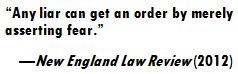


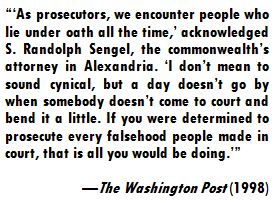
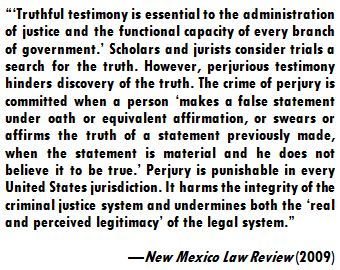

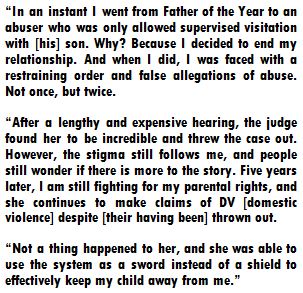
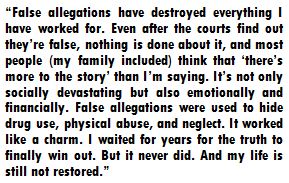
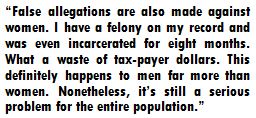
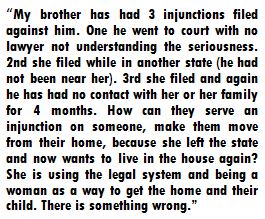
 The very real if inconvenient truth remains that victims of false allegations made to authorities and the courts present with the same symptoms highlighted in the epigraph: “fear, anxiety, nervousness, self-blame, anger, shame, and difficulty sleeping”—among a host of others. And that’s just the ones who aren’t robbed of everything that made their lives meaningful, including home, property, and family. In the latter case, post-traumatic stress disorder may be the least of their torments. They may be left homeless, penniless, childless, and emotionally scarred.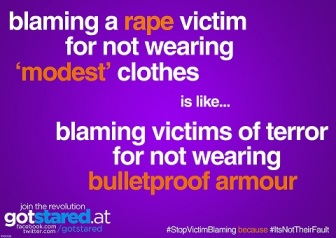
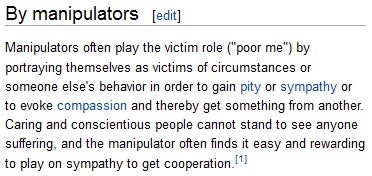
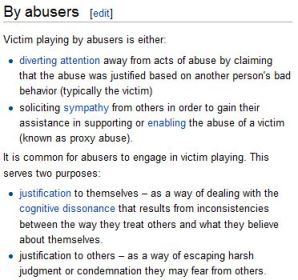
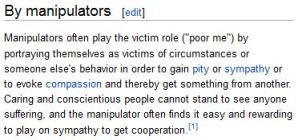
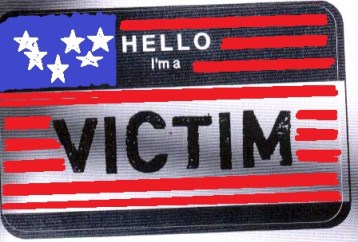 Right, the faker (opportunist, easy-outer, buck-passer, hysteric, bully, vengeance- or attention-seeker, crank, sociopath, neurotic, disordered personality, etc.).
 What I discovered was that group-bullying certainly is a recognized social phenomenon among kids, and it’s one that’s given rise to the coinage cyberbullying and been credited with inspiring teen suicide. The clinical term for this conduct is
 There was a
  TALKING BACK to restraining orders