“Three Times She Said I Ran Her Over”: On the Nature of False Allegations and False Accusers

There was a story out of England last summer about a Zimbabwean refugee, a mom, who clashed with a neighbor over a parking place—a parking place—shortly after moving into her cul-de-sac. The dispute was brief but inspired the neighbor to begin accusing her of crimes. She called the police and claimed the Zimbabwean woman had “stabbed her with a screwdriver and a set of keys” and that she had “smashed into her car and used her keys to scratch her vehicle.” Then, after police determined the allegations were baseless and issued the woman a harassment notice, she began keeping her neighbor under video surveillance.

The neighbor’s account:

“It has been a very unhappy nightmare.

“I’ve had so many different people knock on my door questioning me—that is really scary, even if you know you’ve done nothing wrong.

“It’s really difficult to cope.

“I am a quiet person; I don’t like conflict. I don’t understand why she’s doing it.

“Three times she said I ran her over. It frightened me, because I’d look out the window and see police looking underneath my car, and your heart starts pounding.

“Once she phoned the police in front of me and said, ‘Help me, my neighbour’s stabbing me’ and they were out straight away.”

In this story, the fraud was hoist on her own petard and eventually issued a restraining order for her misconduct. The horror is that had this woman sought a restraining order instead and then made her false allegations, the neighbor’s torment could have been magnified manifold. This is particularly easy to accomplish in the United States.

All of her allegations—stabbing, vandalism, vehicular assault—would have remained on her target’s public record had these allegations been made on a restraining order. And the suspicion of the authorities and courts would have been reversed.

This blog was contacted over the summer by a solitary woman in her 60s, living alone, who similarly aroused the wrath of her neighbor, who proceeded to accuse her of threatening behavior, sought a restraining order against her, and eventually accused her of killing her horse. To avoid further false allegations, the formerly independent senior was forced to abandon her home and rely on the kindness of strangers for a roof and a warm bed.

It’s difficult enough impressing upon someone that restraining orders are issued casually through a process that entails no more than a few-minute theatrical audition. Impressing upon him or her that people willfully and persuasively lie without any motive but malice is next to impossible. “Why would people do that?” they ask, incredulous. One answer might be for attention or for kicks. The simple answer, though, is this: “Because they can.” It isn’t just the case that allegations to authorities and judges may be exaggerated or invested with a little hammed hysteria; they may be calculatedly, sadistically, and hugely false.

And when sadistic impulses aren’t discerned and shut down—and, when they’re ventilated on a restraining order, they often aren’t—they may be indulged by the system repeatedly, even over many years, and to the ruination of their victims.

False accusers are never prosecuted in civil cases, and if they’re sanctioned at all, it’s only in highly publicized cases.

The question people should ask is, “Why wouldn’t people lie?” And the answer should be, “Because they’d go to jail.”

Copyright © 2014 RestrainingOrderAbuse.com

“Something Is Very Wrong Here!”: On the “Amazing Ease of Obtaining a Restraining Order against Someone”

“I just wanted to alert you regarding the amazing ease of obtaining a restraining order against someone.

“I am a landlord, and on Jan. 22, I had the sheriff issue a tenant/roommate a ‘notice to quit’ by the end of the month. The tenant, in retaliation the very next day, requested from the courts that I be slapped with a restraining order and be ordered to stay 100 yards away from her. I guess, lucky for me, the judge did not grant her the 100 yards, which would have gotten me out of my own house.

“This is absolutely outrageous, because the document says the court finds that I ‘constitute a credible threat, that an imminent danger exists to the life and health of the protected persons named in this action.’

“So…if the judge believed the stuff my tenant wrote in her request, why in the world would I be allowed to stay at the house? Now I have to wait two weeks for my hearing to present my side of the story and bring my witnesses.

“I’ve even been advised by my lawyer to leave the house, even though I don’t have to, because who knows what the tenant might claim next?

“How does any landlord in Durango evict a tenant when all the tenant has to do is claim harassment, and the judge will slap a restraining order on the landlord? Something is very wrong here!”

—Letter to the Editor (Durango Herald)

Take a guess when this letter to the editor was published.

It could be 20 years ago. It could be yesterday. The outrage, in either case, would be the same, and its source would be the same. Probably even the phrasing on the injunction would be the same. And possibly the same judge could have issued it.

“I just wanted to alert you regarding the amazing ease of obtaining a restraining order against someone”: The writer’s earnestness is almost heartbreaking. Think any journalists will follow up? That he’ll inspire a series of editorials or investigative exposés?  What’s impressive is that he believes he’s saying something new or that what he’s saying only applies to Durango, Colorado. Why it’s impressive is that what he’s saying isn’t common knowledge and of course should be, because it’s been said over and over and over for decades.

The proofreader will have corrected the writer’s grammar without really having appreciated what it is he’s said or its implications. The desk editor will have run his letter, because it’s marginally interesting and maybe not the kind of complaint s/he gets every day. Some readers will have assimilated the letter and registered an instance of crookedness. Some will nod the nod of those who’ve heard it all before.

The letter was published two weeks ago, and whatever limited impression it made will have already faded.

Copyright © 2014 RestrainingOrderAbuse.com

Fantasists Fatales: More on Narcissistic Sociopaths and Restraining Order Abuse to Gratify Stalkers’ Anger and Jealousy

“Narcissistic people do fall in love, but they usually fall in love with being in love—and not with you. They crave the excitement of love, but are quickly disappointed when it becomes a relationship—and not just a trip into fantasy.”

Mark Banschick, M.D.

In a recent post, I surveyed some scientific literature about stalking and narcissism, probably to excess, because qualification by experts makes arguments more palatable to a certain audience. That post’s epigraph, by two distinguished researchers, concluded that the motives of stalkers could be reduced in sum to anger and jealousy, both of which emotions are ones to which the narcissistic personality is pathologically prone.

Narcissistic stalkers are anomalous in their abuse of restraining orders (as they are in most respects). Some stalkers use restraining orders serially or as part of a campaign of harassment and attention-seeking, and not always against a current or former romantic partner or love interest. The same qualifications of anger and jealousy apply to the woman who torments a former boyfriend’s or husband’s new girlfriend, fiancée, or wife with restraining orders. Only last week, one such victim wrote to report that as soon as she got one restraining order quashed, another was petitioned.

The narcissistic stalker, by contrast, may pour all of his or her venom into one consummate fraud. The point is to get revenge and discard the offending threat to his or her ego-stability once that person’s use value has been exhausted. A false restraining order may simply represent the final blow that shifts the narcissist’s pathological courtship behavior onto its target. The narcissist walks and leaves his or her victim splayed in the dust.

Essential to bear in mind is that a relationship with a narcissist is always a one-way relationship and always confusing. The only person actually trying to relate is the person the narcissist targeted or baited; the narcissist can’t relate. The narcissist’s intentions—not necessarily understood as such by the narcissist him- or herself—were never real in the first place but based on fantasy fueled by the solicited attention and interest of the other person. Once that other person ceases to mirror back to the narcissist what s/he wants to see, that person is expendable. Some psychologists suggest, moreover, that in his or her paranoia about being rejected/abandoned, s/he may be motivated to act preemptively, that is, to reject first and thereby preserve his or her ego from an imagined injury.

Something I neglected to explicitly observe in the recent post referenced in the introduction that may merit observation is that all narcissists are stalkers (whether latent or active) insofar as the objects of narcissists’ romance fantasies are always merely objects to them (psycho-emotional gas pumps); they’re never subjects. What distinguishes the narcissistic stalker is that s/he’s seldom recognized for what s/he is, so s/he’s seldom rejected for what s/he is. Realize that the difference between normal pursuit behavior and aberrant pursuit behavior may be nothing more than how the pursued feels about it. Narcissists choose targets they perceive as vulnerable (empathic, tolerant, and pliable).

Because narcissists are extroverted, confident, aggressive, and socially commanding, “stalking” is seldom applied to their conduct. Narcissistic pursuit is by allure, false promise, and emotional coercion. The narcissist preys on the expectations of the cognitively normal, which s/he understands intuitively and manipulates with horrible proficiency. S/he often isn’t recognized as a user with no sincere investment in the other’s feelings until it’s too late.

To compound the difficulty either of making categorical pronouncements about narcissistic motives or exposing them, they’re not always known to narcissists themselves. To read most diagnostic explications of their mentality, the uninitiated would come away with the impression that narcissists are sharks, cunning, predatory automatons with false smiles and devious intentions. Anyone who’s had intimate and sustained relations with a narcissist, though, will perceive that s/he’s following what to him or her seem normal, romantic impulses in the moment. The difference is the narcissist is able to disown the moment with reptilian facility when his or her fantasy conflicts with interests of more pressing concern to the narcissist’s ego-preservation—or the interests of the other conflict with the narcissist’s fantasy.

It’s often argued that narcissists aren’t crazy, that they know what they’re doing. But this isn’t strictly so. In the throes of fantasy, narcissistic consciousness may be schizoid. Narcissists may lead parallel lives, even multiple parallel lives, like polygamists with spouses in different cities. And they may indulge an impulse with abandonment…then coldly—oh, so coldly—return to business as usual and plot the necessary steps to erase traces of the lapse. The narcissist runs either hot or cold. There is no warm.

Once the other fails to satisfy the psycho-emotional needs of the narcissist, corrupts his or her fantasy, or by intimacy threatens the autonomy of the narcissist or the reality s/he’s primarily invested in, the narcissist’s pathology is such that s/he can instantly blame the other (whom the narcissist targeted in the first place) for his or her perceived “betrayal.”

It’s at this stage that the anger and jealousy, identified as the germinal motives of the stalker, rear their scaly heads. For the narcissist, a restraining order may not only satisfy his or her lust to scourge and cripple his or her target; it may also be a way to satisfy jealousy: “Now no one else will have you.”

Revenge for the narcissist, too, is an impassioned fantasy. The preternatural vehemence of the narcissist is dismaying to its target. In a sense, though, it’s just a redirection of ardor that provides a different source of narcissistic supply. The restraining order process accommodates the narcissist exquisitely, allowing him or her to summon police like a dignitary and ham it up for a judge or several of them. S/he owns the spotlight. And once in possession of a restraining order, the spotlight will follow him or her wherever s/he wants.

The monstrous caricature of the other s/he’s authorized to present to friends, family, and acquaintances current and future serves as the perfect surrogate for the other. It delivers all of the attention while being free of any of the expectations.

Copyright © 2014 RestrainingOrderAbuse.com

Who or What Can’t Be Published on CafeMom?: On Ad Hominem Attacks, Feminist Hatemongering, and the Victimization of Moms by Both

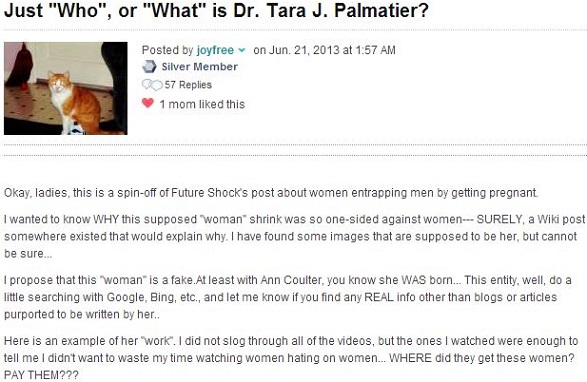
I was concerned to see that someone was brought to this site recently by the search term “Tara Palmatier [X].” I’ve omitted the final word of the phrase not because it’s vulgar but because I don’t want an anomalous Google query to put an idea into the head of some crank with too much time on her hands.

Dr. Tara J. Palmatier is a psychotherapist whose writing I’ve come to admire and respect, and which I’ve consequently quoted many times. She has what distinguishes the brilliant from the intelligent: bold candor. I did a hasty Google search of my own to see what would have prompted someone to use the keywords cryptically quoted above and nothing correspondent appeared except a page that appeared to be a spoof.

I did, however, notice this post, published eight months ago, on CafeMom: “Just ‘Who’ or ‘What’ is Dr. Tara J. Palmatier?” (which was deleted subsequent to the publication of this post).

In several pieces I’ve published over the last couple of months, I’ve given critical scrutiny to feminist rhetoric, because I believe the gross civil injustices this blog concerns owe their ontological debt and perpetuation to such rhetoric.

Consider the rhetorical strategies of this writer, who identifies herself with a picture of a kitty cat and the alias “joyfree” (prompting this writer to wonder whether she’d be less catty if she were more joy-ful).

Note first that the question that titles the post disdains to recognize Dr. Palmatier as human. Why? Apparently because she wrote about women’s entrapping men by getting pregnant. Assuming she did, how this observation could be “one-sided against women” is baffling, not for the least of reasons because it’s impossible for men to entrap women by getting pregnant. The actual source of the beef, of course, isn’t its writer’s perception of Dr. Palmatier as unfair; it’s kneejerk resentment of a woman’s criticizing women. That’s why instead of offering a reasoned critical response, the writer simply denounces a (“supposed”) woman with a doctorate in clinical psychology as a “fake.” (William Buckley called this “rebuttal by epithet.”)

There’s little point in my spending an hour parsing (and thereby dignifying) the facile hatemongering of an anonymous writer who probably invested half that time cobbling her post together. What I would bring to the attention of this blog’s audience (particularly its female readers) is that this vitriol was published on a site called CafeMom. This isn’t a forum of radical feminist academicians; these are your everyday householders. And the question I would hope scrutiny of public statements like this arouses is when did it become okay to attack someone’s sexuality and qualification as a human being, because she voiced an eminently informed, professional opinion that wasn’t favorable to female exaltation?

If Dr. Palmatier were black, would it still be okay to suggest she wasn’t human? Not so much, right? Observe, though, that this writer’s rhetorical strategies (like those of any number of like-minded writers) pretty much mirror those of racial bigots of centuries past.

And it slides under the radar.

What shouldn’t slide under the radar of this blog’s readers is that the acceptability of these kinds of views is an indicator of the breadth of feminist influence, and it’s this coercive influence by women that allows this to continue (quoted from the e-petition “Stop False Allegations of Domestic Violence”):

“My ex has used the law and the justice system, and destroyed my life and those of my minor children! He lied and said he had a witness to testify to his false accusations and bullied me into a deal with the devil eight months ago, and has filed five emergency ex parte motions to remove my kids…. He has put me in debt. I lost my job. I have no money, no friends. Therapists will not help my children as they are afraid he will ruin their lives, too…. Lawyers drop the case because of the constant verbal abuse he does to me and eventually to them, too. I have no friends left. Everyone has left me, and my family is far away, and their hands are tied. He has told teachers and principals and camp counselors these horrible accusations and caused me to have to move to a different town. My five-year-old told me his mind is telling him to die because his mommy is never happy. So what about the [woman] who [doesn’t] cry wolf and [leaves] an unhealthy marriage to save [her] kids and [has] a scorned, mentally ill, narcissistic ex-husband who is torturing every single day and using the law to harass [her]? He is a doctor and has deep pockets, and I am now in debt with no income. Had they been ethical the day of the hearing and admitted that they had no witness anymore, this would never have happened. So what about the tortured women?”

Over to you, CafeMom.

Copyright © 2014 RestrainingOrderAbuse.com

Targeted by a Narcissistic Sociopath: When a Stalker Obtains a Restraining Order to Dominate and Destroy

“Accumulated forensic, clinical, and social research strongly suggests that the two most prominent emotions of most stalkers are anger and jealousy…. Such feelings are often consciously felt and acknowledged by the stalker. Nevertheless, these feelings often serve to defend the stalker against more vulnerable feelings that are outside of the stalker’s awareness. Anger can mask feelings of shame and humiliation, the result of rejection by the once idealized object, and/or feelings of loneliness, isolation, and social incompetency.

“Anger may also fuel the pursuit, motivated by envy to damage or destroy that which cannot be possessed…or triggered by a desire to inflict pain on the one who has inflicted pain, the primitive impulse of lex talionis, an eye for an eye.

“Angry pursuit can also repair narcissistic wounds through a fantasized sense of omnipotence and control of the victim. Victim surveys, in fact, have noted that the most common victim perception of the stalker’s motivations is to achieve control….”

—J. Reid Meloy, Ph.D., and Helen Fisher, Ph.D.

This discussion’s epigraph is drawn from “Some Thoughts on the Neurobiology of Stalking” and touches on a number of the motives of restraining order abuse both by stalkers generally and, in particular, by those stalkers who are most vulnerable to narcissistic wounds, namely, pathological narcissists.

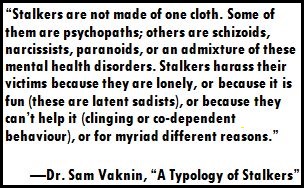
The narcissist is a living emotional pendulum. If [s/he] gets too close to someone emotionally, if [s/he] becomes intimate with someone, [s/he] fears ultimate and inevitable abandonment. [S/he], thus, immediately distances [him- or herself], acts cruelly, and brings about the very abandonment that [s/he] feared in the first place. This is called the ‘approach-avoidance repetition complex’ [Sam Vaknin, Ph.D., “Coping with Various Types of Stalkers: The Narcissist”].

While procurement of a restraining order is commonly perceived as the definitive act of rejection, possibly rejection of a stalker’s advances, it may in fact be an act of possession and control by a stalker (a perverse form of wish fulfillment). A restraining order indelibly stamps the presence of a stalker onto the public face of his or her target (“I own you”). It further disarms the target and mars his or her life, possibly to an extremity. Per Meloy and Fisher, a stalker achieves control and damages or destroys that which cannot be possessed. The “connection,” furthermore, can be repeatedly revisited and harm perpetually refreshed through exploitation of legal process.

The authors of the epigraph use the phrase attachment pathology. For a stalker who’s formed an unreciprocated attachment or an unauthorized one (as in the case of someone who’s married), a restraining order presents the treble satisfactions of counter-rejection (“I reject you back” or “I reject you back first”), revenge for not meeting the authoritarian expectations of the stalker, and possession/control. Procurement of a restraining order literally enables a false petitioner to revise the truth into one more favorable to his or her interests or wishes (cf. DARVO: Deny, Attack, and Reverse Victim and Offender). A judge is a rapt audience who only has the petitioner’s account on which to base his or her determination. The only “facts” that s/he’s privy to are the ones provided by the restraining order applicant.

In “Female Stalkers, Part 2: Checklist of Stalking and Harassment Behaviors,” psychologist Tara Palmatier identifies use of “the court and law enforcement to harass” as a female stalking tactic (“e.g., making false allegations, filing restraining orders, petitioning the court for frivolous changes in custody, etc.”), and this form of abuse likely is more typically employed by women against men (women tending “to be more ‘creatively aggressive’ in their stalking acts”). Anecdotal reports to this blog’s author, however, indicate that male stalkers (jilted or high-conflict exes and attention-seeking “admirers”) also engage in this form of punitive subversion against women. (Dr. Palmatier acknowledges as much but explains, “I tailor myself writing for a male audience.”)

Clinical terms for this kind of stalking—less stringent in their scope than legal definitions of stalking, which usually concern threat to personal safety—are “obsessive relational intrusion, intrusive contact, aberrant courtship behavior, obsessional pursuit, and unwanted pursuit behavior,” among others (Katherine S-L. Lau and Delroy L. Paulhus, “Profiling the Romantic Stalker”).
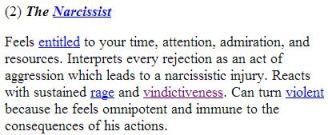
For someone with narcissistic personality disorder, someone, that is, who lives for attention (and is only capable of “aberrant courtship behavior”), a restraining order is a cornucopia, a source of infinitely renewing psychic nourishment, because it can’t fail to titillate an audience and excite drama.

(As noted in The Psychology of Stalking: Clinical and Forensic Perspectives, “Axis II personality disorders are…evident in a majority of stalkers, particularly Cluster B [which includes the narcissistic and borderline personality-disordered]”).

Per the DSM-IV, a narcissist evinces:

A. A pervasive pattern of grandiosity (in fantasy or behavior), need for admiration, and lack of empathy, beginning by early adulthood and present in a variety of contexts, as indicated by five (or more) of the following:

1. Has a grandiose sense of self-importance (e.g., exaggerates achievements and talents, expects to be recognized as superior without commensurate achievements).

2. Is preoccupied with fantasies of unlimited success, power, brilliance, beauty, or ideal love.

3. Believes that he or she is “special” and unique and can only be understood by, or should associate with, other special or high-status people (or institutions).

4. Requires excessive admiration.

5. Has a sense of entitlement, i.e., unreasonable expectations of especially favorable treatment or automatic compliance with his or her expectations.

6. Is interpersonally exploitative, i.e., takes advantage of others to achieve his or her own ends.

7. Lacks empathy: is unwilling to recognize or identify with the feelings and needs of others.

8. Is often envious of others or believes that others are envious of him or her.

9. Shows arrogant, haughty behaviors or attitudes.

Correspondences between this clinical definition and what might popularly be regarded as the traits of a stalker are uncanny (e.g., preoccupation with fantasies of “ideal love,” dependence on admiration not necessarily due, interpersonal exploitation, and an inability to identify with or a disregard for others’ feelings). It further suggests why a narcissist wouldn’t scruple about abusing legal process to realize malicious ends.

In “Threatened Egotism, Narcissism, Self-Esteem, and Direct and Displaced Aggression: Does Self-Love or Self-Hate Lead to Violence?”, psychologists Brad Bushman and Roy Baumeister observe that aggressively hurtful behavior is more likely to originate from narcissistic arrogance than from insecurity:

[I]t has been widely asserted that low self-esteem is a cause of violence (e.g., Kirschner, 1992; Long, 1990; Oates & Forrest, 1985; Schoenfeld, 1988; Wiehe, 1991). According to this theory, certain people are prompted by their inner self-doubts and self-dislike to lash out against other people, possibly as a way of gaining esteem or simply because they have nothing to lose.

A contrary view was proposed by Baumeister, Smart, and Boden (1996). On the basis of an interdisciplinary review of research findings regarding violent, aggressive behavior, they proposed that violence tends to result from very positive views of self that are impugned or threatened by others. In this analysis, hostile aggression was an expression of the self’s rejection of esteem-threatening evaluations received from other people.

The DSM-5 notes that for the narcissist, “positive views of self” are everything (and others’ feelings nothing). Diagnostic criteria are:

A. Significant impairments in personality functioning manifest by:

1. Impairments in self functioning (a or b):

a. Identity: Excessive reference to others for self-definition and self-esteem regulation; exaggerated self-appraisal may be inflated or deflated, or vacillate between extremes; emotional regulation mirrors fluctuations in self-esteem.

b. Self-direction: Goal-setting is based on gaining approval from others; personal standards are unreasonably high in order to see oneself as exceptional, or too low based on a sense of entitlement; often unaware of own motivations.

AND

2. Impairments in interpersonal functions (a or b):

a. Empathy: Impaired ability to recognize or identify with the feelings and needs of others; excessively attuned to reactions of others, but only if perceived as relevant to self; over- or underestimate of own effect on others.

b. Intimacy: Relationships largely superficial and exist to serve self-esteem regulation; mutuality constrained by little genuine interest in others’ experiences and predominance of a need for personal gain.

B. Pathological personality traits in the following domain:

1. Antagonism, characterized by:

a. Grandiosity: Feelings of entitlement, either overt or covert; self-centeredness; firmly holding to the belief that one is better than others; condescending toward others.

b. Attention seeking: Excessive attempts to attract and be the focus of the attention of others; admiration seeking.
The picture that emerges from clinical observations of the narcissistic personality is one of a person who has no capacity to identify with others’ feelings, a fantastical conception of love, and unreasonable expectations of others and an irrational antagonism toward those who disappoint his or her wishes.

It’s further commonly observed that narcissists’ antagonism toward anyone whom they perceive as critical of them—that is, as a threat to their “positive views of self”—is boundless. The object, then, of a narcissist’s attachment pathology who rejects him or her (disappointing his or her “magical fantasies”), who challenges his or her entitlement, or who manifests disdain or condescension toward the narcissist (even in the form of sympathy) becomes instead the object of the narcissist’s wrath. As psychologist Linda Martinez-Lewi notes, “For the narcissist, revenge is sweet. It’s where they live in their delusional, treacherous minds.”

Narcissists adopt a predictable cycle of Use, Abuse, Dispose. This pathological repetition can last a few weeks or decades…. With a narcissist, there is never an authentic relationship. He/she is a grandiose false self without conscience, empathy, or compassion. Narcissists are ruthless and exploitive to the core [Linda Martinez-Lewi, Ph.D., “Narcissistic Relationship Cycle: Use, Abuse, Dispose”].

The restraining order process, because it enables a petitioner to present a false self and caters to fraudulent representation, is a medium of vengeance ideally suited to a narcissistic stalker. Its exploitation plays to a narcissist’s strengths: social savvy, cunning, and persuasiveness. Its value as an instrument of abuse, furthermore, is unmatched, offering for a minimal investment of time and energy the rewards of public disparagement and alienation of his or her victim, as well as impairment of that victim’s future prospects.

There are sociopathic narcissists who will not be satisfied until their ‘enemy’ is completely vanquished—emotionally, psychologically, financially. They seek revenge, not for what has been done to them but [for] what they perceive in a highly deluded way…has been done to them [Linda Martinez-Lewi, Ph.D., “Sociopathic Narcissists—Relentlessly Cruel”].
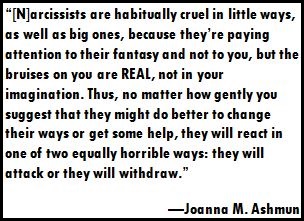
Fraudulent abuse of legal process elevates the narcissistic stalker to prime mover and puppet-master over his or her prey and compensates his or her disappointment of “ideal love” with the commensurate satisfactions of “unlimited power” over his or her victim and an infinitely renewable source of ego-fueling attention. By his or her false representations to the court, the narcissist’s fantasies become “the truth.” S/he’s literally able to refashion reality to conform to the false conception s/he favors.

In conclusion, an observation by psychologist Stanton Samenow:

The narcissist may not commit an act that is illegal, but the damage [s/he] does may be devastating. In fact, because the narcissist appears to be law-abiding, others may not be suspicious of him [or her] leaving him [or her] freer to pursue his [or her] objectives, no matter at whose expense. I have found that the main difference between the narcissist and antisocial individual, in most instances, is that the former has been shrewd or slick enough not to get caught…breaking the law.

Copyright © 2014 RestrainingOrderAbuse.com

Why Women Are Abused by the Restraining Order Process So Easily

People—brothers, sisters, mothers, fathers, friends, lovers, spouses, exes, and strangers—abuse women with false restraining orders for the same reason rapists abuse women: because they can. And the reason why women are so easily abused by malicious prosecutors is that the restraining order process is the bowling alley of jurisprudence.

Set ‘em up, knock ‘em down.

Women are abused by restraining orders, because restraining order policy is lax and prejudiced in favor of applicants. Why? Because women are abused.

Sound circular? It is. The social push to address violations against women, agitated by galvanic denunciations of “rape culture” and domestic violence, has unwittingly contributed to violations against women.

Rape and domestic violence happen. There’s no question about it. There’s likewise no question that their effects may be damaging beyond either qualification or quantification.

The overwhelming majority of rapes represent sexual violence against women by men. Social perception to the contrary notwithstanding, however, victims of domestic violence may be of either gender, and the ratio is nearly 50-50.

Perception is the operative word here, and perception is the preeminent concern of this blog, because it’s what informs the bias for plaintiffs and against defendants (of both genders) that’s customary to the restraining order process.

The precedent for this bias reaches back three decades to the institution of the process as a deterrent to domestic violence against women, and the influence exerted by second-wave feminists since has only reinforced the bias to the extent that anyone who’s accused on a restraining order, male or female, is considered guilty, ipso facto.

To assert guilt, in a majority of cases, is to “prove” guilt.

Beyond satisfying social expectations, the court must satisfy its ethical obligation, so guilt is presumed not just of male defendants on restraining orders but of all defendants on restraining orders (to make the process “fair”).

A significant number, if not the majority, of respondents to this blog who report being the victims of false allegations on restraining orders—particularly the ones who detail their stories at length—are women. This doesn’t mean that women, who represent less than 20% of restraining order defendants, are more commonly the victims of false allegations. It’s indicative, rather, of women’s disposition to socially connect and express their pain, indignity, and outrage. (Women, furthermore, aren’t perceived as dangerous and deviant, so they feel less insecure about publicly declaiming their innocence; they have the greater expectation of being believed and receiving sympathy.)

The irony is that it’s this same disposition, the disposition to engage with others and ventilate suffering, that has given feminist propaganda such emotive force, force that has spawned the prejudices endemic to the restraining order process that have trashed these women’s lives.

The metaphor that inevitably presents itself to the writer who contemplates restraining order injustice is the knot, and I’ve used it more than once.

Abuse of restraining orders, which originate with gender loyalty, is sustained by gender loyalty. Who do women who’ve been abused by male restraining order plaintiffs resent? Men. Who do the feminist advocates for restraining orders resent? Men. Who makes it so easy for restraining order plaintiffs to total the lives of female victims of false allegations (including mothers and grandmothers), possibly leaving them destitute besides psychologically shattered? Women.

This is the vicious circle of misattributed blame that has preserved an unjust process from scrutiny and reform.

And this discussion circles back on itself by reintroducing perception as the ultimate culprit.

Victims of restraining order abuse only recognize the immediate causes of their torment: the scabby liars who falsely accused them and the cruel, careless, or clueless judges who validated their false accusers’ lies.

The invisible, germinal cause of that torment is the demonization of men as rapists and batterers. The restraining order process is both fueled and funded by this perception, and until this perception is more actively challenged by women, particularly by women who’ve been victimized by its effects on public policy, the self-perpetuating cycle of grief will grind on.

Copyright © 2014 RestrainingOrderAbuse.com

“Can Someone Get a Restraining Order Against Me if [Fill in the Blank]?” YES.

If you imagine there are hard-and-fast rules that apply to what a judge can issue a restraining order for, think again. Grounds for establishing “harassment” or vague emotional allegations like fear need only be their plaintiffs’ assertion. Plaintiffs don’t even need to assert apprehension. A judge may ask, “Are you afraid of him/her?” To be granted a restraining order, a plaintiff may only have to chirp, “Yes.”

That’s it? That’s it. Allegations including stalking, battery, and sexual harassment or violence can be made and publicly recorded on a restraining order (indefinitely) based on no concrete proof, and they can be made against men or women.

The conceit is that judges are held to standards of fairness, diligence, etc., but the truth is that the issuance of restraining orders is discretionary, that is, a judge can do what s/he wants. The predominant inclination, what’s more, is to assume where there’s smoke there’s fire. And, yes, a restraining order can also be upheld on appeal on no basis, and judges can reduce innocent defendants to cinders and face no repercussions for it.

Search-term queries that lead visitors here often begin with “Can.” The questions invariably translate to “What’s necessary for authorization?” The answer is nothing. To act is to act with authorization. Restraining orders can be issued on no basis at all other than that they were petitioned, and the process was famously criticized for its availability to all comers fully 20 years ago by Elaine Epstein, former president of the Massachusetts Bar Association—to little effect.

The abuse industry that has cropped up around the restraining order is an extremely lucrative one for the people who service it, including officers and staff of courts and police districts; attorneys and mediators; therapists and anger management counselors; shelters and social workers, etc. Google restraining order + false allegations + attorney + your state, and you’ll discover from the returns that any number of law firms recognize restraining orders are falsely issued and are there to help you beat a bad rap…for a price.

The number of restraining orders issued each year is already two to three million (in the U.S. alone). Were it not for the uncertainty reflected in questions that begin, “Can,” it’s a good bet that that number would be significantly larger.

Copyright © 2014 RestrainingOrderAbuse.com

False Allegations of Rape: A Digression into Taboo Territory from Talking back to the Usual Sorts of False Allegations Made on Restraining Orders

=The prevalence of false allegations of rape is contested. What isn’t contested by anyone is that false allegations of rape are made, and what shouldn’t be contested by anyone is that false allegations of rape (and any number of other offenses) are heinous lies that may end life as they knew it for the falsely accused.

The specter invoked by “rape culture” is what informs public perceptions of allegations of fear and violence made on restraining orders, and has prompted the operant conditioning to which authorities and judges have been subjected for decades and which translates to an accused’s being presumed guilty on little or no more basis than that an accusation was made. So influential has rhetoric like this been that most or all allegations made on restraining orders are perceived as valid, urgent, and sinister, whether they’re made against men or women. Police officers and judges have been conditioned to react reflexively instead of critically in these cases, and they’ve been authorized, moreover, to view and treat the accused with contempt.

Acknowledging that false allegations are made doesn’t discount the reality and trauma of rape, nor does it excuse the act; it isn’t a concession to the “enemy.” Not acknowledging that false allegations are made, however, does make light of human torment and is inexcusable. Also, it’s false accusers, more than anyone, who discredit and mock the trauma of real victims; and for this reason, they should be the targets of feminist ire, instead of those who advocate for the victims of false accusers.

Statistics reported by Cathy Young, whose journalistic integrity is unimpeachable, conservatively put false allegations of rape at 9% (as computed by the FBI). It’s often posited that many more rapes occur than are reported, which is no doubt true. So the percentage of false allegations relative to the number of actual rapes may be less than 9%. This, though, is a misleading observation that mixes apples and oranges. Unreported rapes have nothing to do with the fact that a conservatively estimated 9% of alleged rapes are falsely alleged rapes.

A consideration that isn’t statistically irrelevant, furthermore, is that some false allegations of rape aren’t recognized as false.

To a feminist, even a 9% false-allegation rate is deemed negligible. Maybe it’s statistically negligible—and that’s a BIG maybe—but people aren’t statistics. That nine in a hundred represents nine people. In 1,000 cases, that’s 90 people. In 10,000 cases, that’s 900 people.

According to Wikipedia, “Nearly 90,000 people reported being raped in the United States in 2008.”

What’s evident in the slant of writing that discounts false allegations of rape is that the lives of the falsely accused are somehow less important than the lives of rape victims. Categorically, they are not, and concluding otherwise betrays what psychologists call “emotional reasoning.” The falsely accused have no relationship either to the victims or perpetrators of rape whatsoever.

Falsely accused = innocent.

What’s implicit in the slant of writing that discounts false allegations of rape is that the victims of those allegations are men, and men having it coming to them anyway.

This manner of thinking is wrong. Like a rape victim, someone falsely accused of rape (or anything else) is someone who is guiltless. Period. (S)he is not accountable, by any sane standard, for the actions of rapists (or other offenders). Period.

Thinking to the contrary has infected the perceptions of our administrators, legislators, judges, and police officers to the lasting detriment of every man who’s falsely accused of anything. And not just every man who’s falsely accused. The propagandist rhetoric generated by this thinking is lethal, and it has corrupted our system and our social conscience to their marrows.

Victims of false allegations are casualties—casualties—not trivia.

Copyright © 2014 RestrainingOrderAbuse.com

The Modern-Day Witch Trial: On Using a Restraining Order to Accuse a Mother of Rape

The last post addressed the case of a mom who’s been accused of serial rape by the father of one of her children.

Ignore whether it’s okay to allow a man’s record to be contaminated with an uncorroborated allegation of rape scrawled on a restraining order application—an allegation, incidentally, that will ruin his life (there’s not an employer on the face of the planet who’s going to respond to “She accused me of rape” with “Oh, fiddlesticks. When can you start?”).

Ignore that and consider what judge, in the “bad old days” before restraining orders existed, would have allowed a woman to be publicly labeled a rapist, merely by implication.

Now consider how far back in history we’d have to reach to find a time when such an unfounded allegation would previously have been taken seriously. I’m not a historian, but my guess would be during the period when we last had witch trials.

It was probably possible, say, as recently as the 1600s to have a woman tried as a succubus (a demon in female form who forcibly copulated with men while they slept) just based on “persuasive” testimony like “She consorts with the devil!”

Our modern-day witch trials, restraining order adjudications, which proceed from the same non-evidentiary basis, don’t threaten penalties like drowning or incineration. I wonder, though, whether their draconian punishments were the only aspects of the original witch trials that were unjust.

Copyright © 2014 RestrainingOrderAbuse.com

Restraining Orders Are Heroin: On Feminists, “Rape Culture,” and Affliction Addiction

“I have known my ex since 2007, and our relationship was never easy. I stood with him during the affairs, the lies, whatever…. We had a child in 2009, and then the violence started…. After the last failed mediation in Nov[ember] 2012, he again wanted to get back together, [and] I was hit with a new motion to change the parenting time for our child, and he stated that I was harming or endangering our child.

“In Jan[uary] 2013, he again wanted us to work [things] out, and I again agreed…. I began to assist with bills, his house, [and] accommodating his requests with our child. Fast forward to Oct[ober] 2013…after learning once again there were other women involved and accepting his apology at dinner one night, the next day I was served with a temp[orary] restraining order. It was filled with a whole lot of false allegations and a report that he filed with the police. The report with the police came back unfounded, and shortly after that report was put into evidence, he filed an addendum to his original…restraining order in Nov[ember] 2013, adding on 38 more individual allegations dating back to 2007 from when we first met.

“In mid-Nov[ember] 2013, he then filed an additional complaint against [me] through military channels…. He has also filled more in [on] our parenting-time case against me.

“He is now stating that since 2007, he feels I have been forcing him into sex, and he may now need to seek therapy after learning how often he has been raped.

“Since the restraining order has been in effect, my ex has contacted my family, has [had] his new [girlfriend] file complaints with me at my job, has filed additional allegations with my job, and is now saying I am an unfit parent.

“I just am unsure where to turn…or what to do. If this restraining order is found to go permanently against me, I have more to lose with my career and way of providing for my children, and though he is aware of this, he is also not backing down. And now with his new allegations in court about the forced sexual encounters for years, his feelings of being afraid, and his claim that he will need to seek therapy, I am not sure how all of this will play out against me.”

 Blog respondent

I recently acquainted myself with rape culture,” a term used ubiquitously in feminist screeds, and observed that there’s a contrary case to be made for its being applied to the defenders of court-mediated villainies that emotionally scourge innocents and cripple their lives.

The woman whose story serves as epigraph to this discussion is one such victim. Here’s a woman, a mother, moreover, who has endured beastly treatment with the patience of Job only to be labeled a rapist, terrorist, unfit mother, etc., etc. and who now faces the prospect of having her entire existence tweezed apart.

With regard to so-called rape culture, consider that this woman’s story shows that not only may false allegations of rape be readily put over on the courts through restraining order abuse; it isn’t just men who can be falsely accused.

Maybe feminist readers of this woman’s saga of pain would only conclude that it wasn’t impressed upon her early enough that women need men like fish need bicycles. Or maybe they’d conclude that it just goes to show how awful men can be, disregarding that the woman has also been persecuted by her ex’s new girlfriend.

In fact, what it and any number of others’ ordeals show is that when you offer people an easy means to excite drama and conflict, they’ll exploit it.

There’s a reason why opiates are carefully controlled substances that aren’t freely handed out to everyone who claims to need them for pain relief. If they were, a lot of people would welcome a cheap high.

Process abusers need to be recognized for what they are: substance abusers. Restraining orders, whose injustices persist because they’re vehemently championed by ideologues, are dispensed gratuitously and used gratuitously. For too many users, what’s more, they’re gateway drugs that whet an insatiable, predatory appetite.

Drama and attention junkies are no different from any other kind. Offer them a free narcotic, and they’ll take it and jones for more.

Defenders of restraining orders, who think of them as fixes, don’t realize how right they are.

Copyright © 2014 RestrainingOrderAbuse.com

DARVO and the Diva: A Hypothetical Case in Point of Restraining Order Abuse to Reverse the Roles of Victim and Offender

“False allegations and bogus calls to the police are an extremely sick form of abuse.”

Tara J. Palmatier, Psy.D.

I introduced a useful term in my previous post coined by psychologist Jennifer Freyd and adapted by psychologist Tara Palmatier to her own practice and professional writing: DARVO, an acronym of Deny, Attack, and Reverse Victim and Offender.

In sum, the abuser in a relationship denies a behavior s/he’s called on, attacks his or her confronter (the victim of the behavior), and by social manipulation (including false allegations, hysterical protestations, smear tactics, etc.) reverses roles with him or her: the batterer becomes the beaten, the stalker becomes the stalked, the sexual harasser becomes the sexually harassed, etc.

The restraining order process and DARVO are a jigsaw-puzzle fit, because the first party up the courthouse steps is recognized as the victim, that party’s representations are accepted as “the truth,” a restraining order is easily got with a little dramatic legerdemain, and procurement of a restraining order instantly qualifies its plaintiff as the victim and its defendant as the villain in the eyes of nearly everybody. In one fell swoop, the exploiter dodges accountability for his or her misconduct and punishes his or her victim for being intolerant of that misconduct.

To illustrate, a conjectural case in point:

Imagine that a solitary, bookish man, a starving but striving artist working on a project for children, haplessly attracts a group of overeducated and neglected women keen for recognition and attention. Their leader, a brassy, charismatic, married woman, works her wiles on the man to indulge an infatuation, contriving reasons to hang around his house up to and past midnight. He lives remotely, and the secluding darkness and intimacy are delicious and allow the woman to step out of the strictures of her daytime life as easily as she slips off her wedding ring and mutes her cellphone.

Her coterie of girlfriends is transposed straight from the halls of high school. They’re less physically favored than the leader of their pack and content to warm themselves in her aura. The adolescent intrigue injects some color into their treadmill lives, and they savor the vicarious thrill of the hunt. The man is a topic of their daily conversation. The women feel young again for a few months, like conspirators in an unconsummated teen crush.

Eventually, however, the creeping finger of consequence insinuates itself between the pages of the women’s Harlequin-novel holiday, and the game is a lark no more. Realizing the ruse can’t be maintained indefinitely, the married woman abruptly vanishes, and her cronies return where they came from like shadows retreating from the noonday sun.

What no one knows can’t hurt them.

The man, though, nevertheless learns of the deception and confronts the woman in a letter, asking her to meet with him so he can understand her motives and gain some closure. The woman denies understanding the source of his perplexity and represents him (to himself) as a stalker. She then proceeds to represent him as such to her peers at his former place of work and then to her husband, the police, and the court over a period of days and weeks. She publicly alleges the man sexually harassed her, is dangerous, and poses a threat to her and her spouse, and to her friends and family.

Her co-conspirators passively play along. It’s easy: out of sight, out of mind.

The life of the man who’d hospitably welcomed the strangers, shaking hands in good faith and doling out mugs of cheer, is trashed: multiple trips to the police precinct to answer false charges and appeals to the court that only invite censure and further abuse. His record, formerly that of an invisible man, becomes hopelessly corrupted. His artistic endeavor, a labor of love that he’d plied himself at for years and on which he’d banked his future joy and financial comfort, is predictably derailed.
The women blithely return to realizing their ambitions while the man’s life frays and tatters.

Sleepless years go by, the economy tanks, and the man flails to simply keep afloat. The paint flakes on his house and his hopes. His health deteriorates to the extent that he’s daily in physical pain. He finally employs an attorney to craft a letter, pointlessly, undertakes a lawsuit on his own, too late, and maunders on like this, alternately despairing and taking one stab or another at recovering his life and resuscitating his dreams.

The married woman monitors him meanwhile, continuing to represent him as a stalker, both strategically and randomly to titillate and arouse attention, while accruing evidence for a further prosecution, and bides her time until the statute of limitation for her frauds on the court lapses to ensure that she’s immune from the risk of punishment. A little over seven years to the day of her making her original allegations, she takes the man to court all over again, enlisting the ready cooperation of one of her former confederates, to nail the coffin shut.

This is DARVO at its most dedicated and devotional, and it’s pure deviltry and exemplifies the dire effects and havoc potentially wrought by a court process that’s easily and freely exploited and indifferently administered.

In her explication of DARVO, Dr. Palmatier introduces this quotation from attorney and mediator William (Bill) Eddy: “It’s only the Persuasive Blamers of Cluster B [see footnote] who keep high-conflict disputes going. They are persuasive, and to keep the focus off their own behavior (the major source of the problem), they get others to join in the blaming.”  As a scenario like the one I’ve posited above illustrates, persuasive blame-shifters may keep high-conflict clashes going for years, clashes that in their enlistment of others verge on lynch-mobbing that includes viral and virulent name-calling and public denigration.

Consider the origins of consequences that cripple lives and can potentially lead to physical violence, including suicide or even homicide, and then consider whether our courts should be the convenient tools of such ends. Absent our courts’ availability as media of malice, the appetite of the practitioner of DARVO would starvo.

Copyright © 2014 RestrainingOrderAbuse.com

Dr. Tara Palmatier: “Cluster B disorders include histrionic personality disorder, borderline personality disorder, narcissistic personality disorder, and antisocial personality disorder. At their core, I believe all Cluster B disorders stem from sociopathy (i.e., lack of empathy for others, refusal to hold themselves accountable for their behaviors, and exploitation of others). Bleiberg (2001) refers to these characterological disorders as ‘severe,’ because they chronically engage in extreme conflict [and] drama, and cause the most problems in society.”

Shifting Blame: DARVO, Personality Disorders, and Restraining Order Abuse

“DARVO refers to a reaction that perpetrators of wrongdoing…display in response to being held accountable for their behavior. The perpetrator or offender may Deny the behavior, Attack the individual doing the confronting, and Reverse the roles of Victim and Offender such that the perpetrator assumes the victim role and turns the true victim into an alleged offender. This occurs, for instance, when an actually guilty perpetrator assumes the role of ‘falsely accused’ and attacks the accuser’s credibility or even blames the accuser of being the perpetrator of a false accusation.”

—Jennifer J. Freyd, Ph.D.

I discovered this quotation and the acronym it unpacks in Dr. Tara Palmatier’s “Presto, Change-o, DARVO: Deny, Attack, and Reverse Victim and Offender,” one of the most validating explications of the motives of false accusers I’ve read. There’s nothing in it that I can’t identify with personally, and I’ve heard from many others who I know would respond similarly.

DARVO seems to be a combination of projection, denial, lying, blame-shifting, and gaslighting…. It also seems to be common behavior in most predators, bullies, high-conflict individuals, and/or abusive personality-disordered individuals.

Goaded by some instances of blame-shifting that screamed at me from the e-petition “Stop False Allegations of Domestic Violence,” I recently wrote about “Role Reversal: Using Restraining Orders to Conceal Misconduct and Displace Blame.” I even referred to Dr. Palmatier’s work in the post, not yet having come across the above-mentioned entry in her own blog, which incisively exposes the origins of false motives.

Dr. Palmatier is a psychologist who specializes in treating male victims of domestic violence and abuse, but the behaviors she elucidates aren’t gender-specific, and both male and female victims of blame-shifting will be edified by her revelations, among them “why many Narcissists, Borderlines, Histrionics, and Antisocials effectively employ smear-campaign and mobbing tactics when they target someone” (“By blaming others for everything that’s wrong in their lives, they keep the focus off the real problem: themselves”).

At least a few visitors are brought here daily by an evident interest in understanding the motives of personality-disordered individuals—usually their spouses, lovers, or exes—who’ve obtained restraining orders against them by fraud or otherwise abused them through the courts. If you’re such a reader, consider whether this sounds familiar:

The offender takes advantage of the confusion we have in our culture over the relationship between public provability and reality (and a legal system that has a certain history in this regard) in redefining reality. Future research may test the hypothesis that the offender may well come to believe in [his or her] innocence via this logic: if no one can be sure [s/he] is guilty then logically [s/he] is not guilty no matter what really occurred. The reality is thus defined by public proof, not by personal lived experience [quoting Dr. Freyd].

So thorough and laser-sighted is Dr. Palmatier’s topical treatment of “[a]busive, persuasive blamers [who] rely on the force of their emotions to sell their lies, half-truths, and distortions” that there’s little point in my repeatedly quoting it and adding my two cents, but I eagerly bring it to the attention of those who’ve been attacked through the courts by abusers who used them as scapegoats to mask their own misconduct.

Dr. Palmatier remarks, “This behavior is crazy-making if you are the target of it.” If you respond, Amen—and especially if you respond, F*ckin’ A!men—read this.

Copyright © 2014 RestrainingOrderAbuse.com